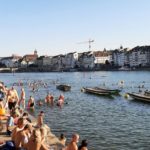
Thun, Brahms, Thun-Panorama and the Middle Bridge in Basel

Almost every village and town in Switzerland harbours cultural and historical surprises. Thun (canton of Bern) is no exception. The city not only gives its name to Lake Thun (Thunersee) but is also the subject of one of the best-preserved panoramic paintings in the world. In Switzerland, three other panoramas can be seen in Einsiedeln, Murten, and Lucerne.

Marquard Wocher (1769-1830), the creator of the Thun panorama, lived along the River Aare, which flows through Lake Thun, Interlaken, and Lake Brienz.

The Dukes of Zähringen also left their mark on Thun. They built the castle, the town church and the old town centre. This dynasty died out in 1218, whereupon their successors, the Counts of Kyburg, granted Thun its town charter in 1264. After a brief Habsburg interlude, Bern acquired the town in 1384.

The Holy Roman Empire is also still present in Thun

Another local dynasty, the Barons of Thun, played a prominent role in other towns in the 13th century. Henry II of Thun was the Prince-Bishop of Basel from 1216 until his death in 1238, succeeding Walter von Rötteln. Henry II built the Middle Bridge in Basel in 1225 (only replaced by the current bridge in 1905!).

Basel, Rheinsprung 1, Relief from 1914. Bishop Heinrich von Thun (with staff) and the construction of the bridge.

Thun developed into a tourist magnet in the 19th century. The Eiger, Mönch, and Jungfrau, along with the lake’s location, beautiful nature, hiking opportunities, and the construction of the railway network, attract many visitors at all times of the year. Marquard Wocher knew Thun as a small town with a few thousand inhabitants. Two hundred years later, the city has almost 44,000 inhabitants!

Johann Brahms’ monument and tree, where he spent several summer months in Thun

(Source and further information: City of Thun)


Schadau Castle

Complex of the former Carthusian monastery

Le bateau à vapeur


Romanesque Churches, Castles and Suspension Bridges along Lake Thun

Not only do the Eiger, Mönch and Jungfrau look out over Lake Thun (Thunersee), but also twelve Romanesque churches and five castles. In addition, the Sirius observatory looks upwards into the infinite universe and its countless stars. The St. Beatus Caves will never have this view! Lake Thun owes its name to the town of Thun.

Thun

On the other side of the lake, Interlaken (named after the former monastery Inter lacus) separates it from Lake Brienz. However, the River Aare connects the two lakes. Lake Thun was formed when the Aare glacier melted around 12,000 years ago.

This glacier was hundreds of metres thick. The melting was also accompanied by the displacement of earth and stone, which ultimately separated Lake Brienz and Lake Thun near Interlaken. Anyone who sees the vineyards on the sunny slopes today cannot imagine that time.

Lake Thun was first mentioned around 660 under the name lacus Dunensis. The area was already inhabited before the Celts colonised it. After the Celts, Romans, Alemanni, Burgundians, and Franks, the dukes of Zähringen, the counts of Kyburg, Habsburg, Bern ruled from 1384 onwards.

Twelve Romanesque churches

The River Aare and Lake Thun have long been the cultural border between the French-speaking diocese of Lausanne, the Kingdom of Burgundy (888-1032), and the mighty Abbey of Cluny, on one side, and the German-speaking bishopric of Constance and the Abbey of St. Gall, on the other.

Sigriswil

The commissioner of these 12 churches is unknown. However, there are indications that King Rudolf II of Burgundy commissioned them in the Romanesque-Lombard style. Twelve is, of course, no coincidence; it refers to the twelve apostles.

Thun

They surrounded the mother church in Einigen. Most churches still retain their authentic architectural style. The church in Uttigen was destroyed by fire in 1536. For this reason, there are twelve, not thirteen, churches. The year 1536 is also no coincidence, as it is the time of the Reformation in the canton of Bern!

Hilterfingen

The twelve Romanesque churches are located in Thun, Hilterfingen, Sigriswil, Leissigen, Frutigen, Aeschi, Wimmis, Spiez, Einigen, Amsoldingen, Thierachem and Scherzligen.

Spiez

The five castles

Thun Castle, Oberhofen Castle, Spiez Castle, Hünegg Castle and Schadau Castle stand along the lake. The history of these monuments dates back to the Middle Ages and the 19th century.

Oberhofen Castle

They represent different eras and give a good impression of life in those times. Thun Castle, Oberhofen Castle, Spiez Castle and Hünegg Castle house a museum, while Schadau Castle is home to a hotel and restaurant

Schadau Castle

Hünegg Castle

The surrounding area

Those who climb the mountains will be rewarded with breathtaking views, flower-filled meadows, dense forests, and one of the longest suspension bridges in Switzerland.

The 340-metre-long and 182-metre-high suspension bridge near Sigriswil spans the Gummischlucht gorge. Two other suspension bridges, Leissigen (144 metres long) and Beatenberg (80 metres long), rightly give this route its name Brückenweg.

A considerably smaller bridge on the Brückenweg

The Swiss Alpine Club

The Swiss Alpine Club (Schweizer Alpen Club, SAC / Club Alpin Suisse, CAS) regularly organises hiking tours in this area and elsewhere in the country.

Although the name suggests otherwise, the SAC not only organises ski tours, mountain climbing, and other sports in the high mountains and the Alps but also (walking) activities in other regions.

Impressions of Lake Thun and surroundings

The Gummischlucht

Sigriswil

Gunten

European Youth Choir Festival Basel

The festival is a platform for concerts and encounters for the highest-qualified children’s and youth choirs. The festival also unites children and choirs across borders; this applies to the singers, the audience, and choral professionals from all sectors and scenes.

The festival offers concerts of high musical quality, shows a variety of choir music from Europe and Switzerland, and addresses contemporary tendencies in choral singing.

It also promotes cultural exchange throughout multilingual and multicultural Switzerland and between Switzerland and other European countries. The program includes education for conductors and children’s and youth choirs.

(Bron en verdere informatie: Europäisches Jugendchor Festival)

The Swiss franc, The Latin Monetary Union and the Euro

The Swiss franc (CHF) is 175 years old. It was officially introduced on 7 May 1850. Before the introduction of the franc, there was a huge confusion about currencies. Since the Middle Ages, every canton, city, and diocese minted its own money. People paid with batzen, rappen, taler, oertli, assis, gulden or dicken. There were more than 8,000 different coins!

Travelling from one canton to another was like travelling abroad; money had to be exchanged and customs duties had to be paid at every cantonal border. This monetary reform was not self-evident, but a Swiss ‘euro’ avant la lettre.

The cantons defended their right to mint coins and levy customs duties, but since the new constitution (1848), the confederation has formed a solid basis for the economy and the Swiss franc. Today, the Swiss franc embodies monetary independence, economic reliability and a long-term vision.

The franc has overcome numerous challenges throughout its history, from crises and wars to periods of high inflation, the transition from the gold standard and the dynamics of the international monetary system.

The treaty of 23 December 1865. image: Wikipedia

The Latin Monetary Union

Switzerland also had its European ‘euro’ in 1865, a monetary catastrophe. In 1865, France, Belgium, Italy, and Switzerland established the Latin Monetary Union, a precursor to the euro. Greece joined a year later. This coinage union was established by Napoleon III (1808-1873).

French poster from 1865, source: Wikipedia

The ‘Latin Monetary Union’ (L’Union monétaire latine) contained detailed regulations on the weight, fineness, shape, and exchange rate of gold and silver coins, as well as quotas for the minting of coins for the individual countries in proportion to their populations. In return, the coins in question were accepted throughout the entire territory of the monetary union.

The five contracting countries of the Latin Coinage Union. Picture: Wikipedia

The pro-European Swiss government saw this as a first step towards realising the idea of a European monetary system. Accordingly, the composition of the gold and silver coins circulating in Switzerland was international.

The Latin Monetary Union in 1914. image: Wikipedia

Between 1885 and 1920, the proportion of Swiss 5-franc coins in the Latin Monetary Union fluctuated between 2% and 7%. Devaluation and depreciation quickly led to increasing inequality between the coins, and the agreements proved to be worthless. In addition, this monetary union was extended to many less solvent countries and even colonies through bilateral and unilateral agreements until 1914.

Silver coins in the states of the Latin Monetary Union, issued for Switzerland by Kaiser & Co, Bern. Plate from the time of the First World War (Swissmint). Source: Historisches Lexikon der Schweiz

The Alphirte (Alpine shepherd)

The village of Richterswil (Canton Zurich) is the home town of Paul Burkhard (1888-1964), the creator of the famous 5-franc coins. In 1920, he was commissioned to design a new 5-franc coin. He created the Alphirte (shepherd). On 1 April 1927, the Latin Monetary Union was dissolved.

The Alpine shepherd and not William Tell!

The SNB (founded in 1907) had now freed itself. The key to monetary policy was no longer to follow the standards of neighbouring countries. Financial stability was a value in itself.

Until 1914, the franc was a standard currency that fluctuated in value against its competitors, sometimes appreciating and sometimes depreciating. After 1914, the currency emerged (including ups and downs) as a monetary island of stability.

The Swiss franc today

This quality is based on numerous pillars, including political and social stability, direct democracy, federalism, subsidiarity, liberalism, industrial innovation, exports, the excellent research and education system, high labour morale, a market-oriented and at the same time social economic system, low national debt, high gold reserves, surpluses in the current account balance and net foreign assets.

However, its monetary neighbours, including today’s euro, have made and continue to make life difficult for the Swiss franc. In 2002, the SNB harboured the vain hope that the euro and the ECB would be a kind of successor to the Deutsche Mark (DM) and the Bundesbank.

Development of the euro-CHF exchange rate 2002-2025 Source: www.schweizer-franken.eu

 Conclusion

However, the euro has lost almost 40% of its value against the franc since 2002, and the outlook is not good. More and more (economically, financially and politically) ailing countries are participating, and the ECB strongly resembles a politically orientated Franco-Italian bank and a new Latin Monetary Union.

The former Latin Monetary Union is a ‘warning from history’, also regarding the new negotiations and agreements between Switzerland and the EU, its centralism, its top-down democracy, bureaucracy, and judiciary.

(Source: S. Heeb, Historisches Lexikon der Schweiz, l’Union monétaire latine, 25.03.2014)

Ins, Albert Anker, Monuments and Climate Change

Ins (Anet in French, canton of Bern, Three-Lakes-Region/Seeland) is the village of the (birth) house, studio, and museum of the painter Albert-Anker (1831-1910). The medieval village was an important regional centre with more inhabitants than the town of Erlach (Cerlier in French).

Erlach was the seat of the governors (Landvogt) of Bern after the conquest by Bern in 1474.  Ins became the seat of the Court of Justice (Landgericht).


The castle (Schlössli) Ins, the Rosenhof-Park, and the size of the square also refer to the importance of the village. The medieval church has been evangelical since 1525. The baptismal font is seven centuries old. The church was first mentioned in a document in 1228.

Impressions of the village


The Allalin-Stone from the Allalinhorn, left behind in Seeland by the melting Wallis-Glacier around 17.500 years ago 

The Schlüchter-Stone, left behind in Seeland by the melting Wallis-Glacier around 20.000 years ago 

The princely City and the canton of Neuchâtel

Not much is known about the habitation of the area of the city of Neuchâtel until the year thousand. The first counts of Neuchâtel date back to the ‘second’ Kingdom of Burgundy (888-1032). The last King, Rudolf III (970-1032), built a castle on the rock—the beginning of today’s Neuchâtel. In the years 1185-1190, the abbey, la Collégiale, followed.

Neuchâtel railway station, the first inhabitants in the Stone Age

Galerie de l’histoire de Neuchâtel. The city around 1400

The dynasty of the Counts of Neuchâtel came to an end in 1395. Until 1504, the German families Freiburg and Hochberg successively ruled the county. The French (royal and Catholic) d’Orléans-Longueville family acquired the county in 1504 after the extinction of these German dynasties. The county became a principality.

However, its citizens sought rapprochement with the 13 cantons of the Confederation, as evident on the castle wall. This rapprochement progressed to the point where cantons ruled the principality for several years (1512-1529), an occupation with the consent of the citizens.

In 1530, Neuchâtel became Protestant. It had consequences for the principality’s future. The dynasty d’Orléans-Longueville died out in 1706. The States-General (les Trois états) of Neuchâtel wanted a Protestant prince who resided far away.

There were several pretenders, including the French king. Both religious and geopolitical considerations influenced the choice. Berlin was much further away than Paris. Moreover, the (Protestant) cantons kept an eye on it. Neuchâtel had been closely allied with the Confederation since the ‘years of occupation,’ 1512-1529.

The (Protestant) Prussian King of the Hohenzollern dynasty, Frederick William 1 (1688-1740), acquired the principality of Neuchâtel in 1707. He remained (formally) Prince of Neuchâtel until 1857.

City Hall

A brief French interlude followed the French era (1798-1813) in 1806. French Marshal Alexandre Berthier (1753-1815) was the Prince of Neuchâtel from 1806 to 1813. After Napoleon’s defeat and the French departure, the Prussian king regained power (formally) in 1814.

In 1815, Neuchâtel became a canton of the Swiss Confederation but remained a principality under Prussian rule. This situation ended in 1857, when King Frederick William IV (1795-1861) formally relinquished his rights after the Confoederatio Helvetica of 22 cantons, including Neuchâtel, was established in 1848. The industrial towns of Le Locle and La Chaux-de-Fonds led a successful revolt against the city of Neuchâtel’s royalist aristocracy.

Monument 1814-1848

Unlike the changes in other cantons, the first revolt in the European revolution of 1830 failed (e.g., the split of Basel-Stadt and Basel-Landschaft, and the Regeneration with a modern Constitution in 11 cantons).

The last monarch to rule Switzerland disappeared in 1857; however, many city palaces still recall the centuries-old French, German and Prussian periods.

The city subsequently developed into an industrial and commercial centre, with a focus on watchmaking, microtechnology, electronics, tourism, trade, and, for example, cocoa processing. Suchard was the first chocolate multinational.

Its rapid population growth and urban development are well-documented and mapped in Les Galeries du Histoire.

Le pavillion Hirsch

Swiss Centre for Electronics and Microtechnology

Today, the city, with its university and medieval centre, is, after its recent merger with some municipalities, the third-largest city in Romandie, or French-speaking Switzerland. It is beautifully situated at the foot of the Jura on Lake Neuchâtel.

However, this did not eliminate the rivalry between the industrial La Chaux-de-Fonds and the aristocratic Neuchâtel, “le Bas du canton et le Haut du Canton,” the low-lying and high-lying areas of the canton (La Chaux-de-Fonds is Switzerland’s highest-lying town, at almost 1,000 m.).

Rowing on Lake Neuchâtel  Photos: Gaetano Mileti

L’Hôtel DuPeyrou

Le Jardin anglais and the Casino of Neuchâtel

Neuchâtel, Bulgari

Habsburg heritage, humanism and UNESCO World Heritage in Alsace

The Habsburgs were the longest-serving imperial dynasty in Europe until 1918. Members of the family were uninterrupted emperors of the Holy Roman Empire from 1438 (apart from Wittelsbacher Charles VII Albert (1697-1745, the emperor from 1742-1745), the Empire of Austria from 1806 and the dual monarchy of Austria-Hungary from 1867 to 1918.

Archduke Maximilian (1832-1867) was even the emperor of Mexico for a short time (1864-1867).

Édouard Manet (1832-1883), L’exécution de Maximilien, 1867. Photo: Wikipedia. Städtische Kunsthalle, Mannheim

In 1555, the family had already split into the Austrian and Spanish branches to keep the vast territory (including the New World) governable. More than 50 years earlier, in 1499, another division had already occurred.

From the Treaty of Basel onwards, the Swiss Confederation or Eidgenossenschaft was effectively an independent ‘nation’ of sovereign cantons. The Peace of Westphalia confirmed this status in 1648. Habsburg’s tribal land was thus lost forever, although the castle and village of Habsburg upheld the honour.

Castle and village of Habsburg (canton Aargau)

 Alsace

Today, when you think of the towns of Ensisheim, Ferrette (Pfirt) or Sélestat (Schlettstadt) in Alsace, who still thinks of Habsburg’s imperial presence? Yet Ensisheim was Habsburg’s Vorderösterreich capital for centuries. Ferrette and Sélestat were important defensive and administrative towns.

The beautiful rolling landscape with its many vineyards and villages is also home to the mighty Haute-Koenigsbourg (Hohkönigsburg) castle, a Habsburg possession for centuries.

Ferrette Castle

Ferrette

The village of Vieux-Ferrette lies on the ancient Roman road from Basel to Porrentruy (canton of Jura). The nearby town of Ferrette is named after the castle, first mentioned in documents in 1105. The counts of Pfirt (then German-speaking) inhabited the castle and had vast territories in Alsace. In 1324, the Habsburgs took over the castle through marriage politics.

In the Thirty Years’ War (1618-1648), Swedish troops destroyed the Oberburg atop the mountain (612 metres). Only the Unterburg was rebuilt. In 1648, however, France acquired the Sundgau and, a few decades later, the whole of Alsace (including Colmar and Strasbourg).

Ensisheim

Ensisheim is close to other areas of the Habsburg Patrimoine, including Murbach and Ottmarsheim. To govern the large area of Vorderösterreich, Emperor Ferdinand I (1503-1564) made Ensisheim in 1526 the administrative capital of this area. The Palais de la Régence (1545), monasteries, churches and city palaces recall this era. The city was also the legal centre of Vorderösterreich until 1648. However, the grandeur of Ensisheim is still shining.

Palais de la Régence

Sélestat

The growth and prosperity of this little town began even before the Habsburg era. In 1217, the Hohenstaufen Emperor Frederick II (1194-1250) granted Sélestat the status of a free imperial town (Reichsunmittelbarkeit). During this period, the construction of the Gothic church of Saint. Georges, situated adjacent to the beautiful Romanesque church of Sainte-Foy, commenced.

Saint-Georges

Sainte-Foy 

Sélestat was one of the ten cities in Alsace of the Decapolis (which also includes Colmar, Mulhouse (Mülhausen), Hagenau, Wissembourg (Weissenburg), Obernai (Oberehnheim), Rosheim, Kaysersberg (Kaisersberg), Turckheim (Türkheim) and Munster (Münster).

It was an alliance of the ten free imperial cities in the Alsace region. Strasbourg was also a free imperial city, but had an even higher status and was not part of this alliance (1354-1697).

It was a (defensive) alliance and collaboration agreement à la the Eidgenossenschaft, which did, however, continue to exist. Mulhouse withdrew from the Decapolis as early as 1515 and became an associate member (Zugewandter Ort) of the Swiss Confederation until 1798, when Napoleon annexed it.

Under the Habsburgs, not only did the economic and religious boom begin in the 15th century, but the cultural and scientific heyday also took off.

The Latin school and humanism (l’humanisme rhénan) are famous. Even Erasmus dedicated a poem to it, ” The Eulogy on Sélestat” (1515). Beatus Rhenanus’s humanist library (1485-1547) has been a UNESCO World Heritage Site since 2011! However, France also acquired Sélestat in 1648.

Haut-Koenigsbourg

The Haute-Koenigsbourg castle, situated near Sélestat, stands at a lofty elevation of over 700 metres and dominates the surrounding area. What the Roche towers are to Basel, Haut-Koenigsburg is to this region; its history is somewhat older.

The Hofenstaufer Emperor Frederick I, or Emperor Barbarossa (1119-1190), built the castle in 1147. Thereafter, the Habsburgs and their allies owned the castle until it was destroyed in the Thirty Years’ War and taken over by France in 1648.

Conclusion

Alsace’s many German-speaking place names still refer to the region’s German-speaking and Habsburg past. Despite France’s annexation, the local spoken language remained based on the German-speaking Alemannic language for centuries.

Residents of Markgräflerland and other areas in Baden, as well as the cantons of Solothurn, Basel-Stadt, Basel-Landschaft, and Jura, have spoken this language for centuries.

The end of the Habsburg era did not change the use of the language. However, the aftermath of the wars in 1870/1871, 1914-1918 and 1939-1945 put a definitive end to this linguistic tradition. However, the monumental heritage of the Habsburg era remains present and is being cherished anew today.

In any case, it is worth visiting not only Colmar and Strasbourg but also the wine villages and the places mentioned above.

Ferrette

Ensisheim

The former palace of the Duke

The monastery complex and the city walls

Sélestat

Haute-Koenigsbourg

La route des Vins d’Alsace 

Switzerland is the Herb Garden of Europe

The medicinal, psychological, and sometimes miraculous (and poisonous!) effects of herbs and plants are as old as humankind on all continents. Native Americans in the Amazon, Indians in America, Chinese, Japanese, Aborigines, Persians, Greeks, Celts, or Romans, every community knew its herbalists and plant experts.
The monks on the European continent preserved this knowledge of their predecessors from the sixth century onwards, developed it further, and often recorded it in writing. Every monastery had its herb garden.

Dornach Monastery today

Le Jardin botanique de Genève

However, one of the most famous writers was not a monk, but a nun of the Benedictine order. Hildegard von Bingen (1098-1179) was not only a nun and later (1152) the abbess of the Rupertsberg monastery she founded near Bingen on the Rhine.

She became known above all as a theologian, author, composer, natural scientist, and ‘pharmacist’ avant la lettre, with her research into medicinal herbs, plants, and juices.

She was also an advisor to Emperor Frederick I, also known as Barbarossa (born around 1122-1190). She corresponded with popes, bishops, and other abbots and monks, such as Bernard of Clairvaux (1090-1153). In short, an extraordinary medieval personality.

Her biography is described in various (digital) publications and will not be discussed further here (see, among others: G. H. Heepen, Das Heilwissen der Hildegard von Bingen. Munich 2015; G. Muhr, Hildegard von Bingen. Man in harmony with nature, Daun, 2024).


The first printed book, “Physica” (1533). Picture: Wikipedia

In addition to various theological works, she also wrote two medical works between 1150 and 1158 that are still relevant today. The first work bears the full title “Liber simplicis medicinae” or “Physica”; the second is called “Liber compositae medicinae” or “Causae et Curae”.

L’Ermitage de Neuchâtel

Both books explore mental illnesses and the therapeutic effects of herbs, plants, and juices. She drew not only on the experience of the monastery (and classical antiquity), but also on the folk knowledge of local communities and their herbal and plant experts. She described hundreds of mental and physical ailments and set up a kind of pharmacy in her books and her herb garden.

Samedan

After her death, Hildegard and her pharmacy were forgotten for centuries. However, several personalities devoted themselves to the healing power of herbs, including the Swiss physician Theophrastus Bombast von Hohenheim, also known as Paracelsus (1493-1541), and the Bavarian Sebastian Anton Kneipp (1821-1897) centuries later.
Hildegard’s ‘herbal pharmacy’ only became accessible again in the twentieth century. The books mentioned above were translated (from Latin) into German at the beginning of the 20th century.

Johann Künzle, Das Grosse Kräuterbuch. Ratgeber für gesunde und kranke Tage

The Swiss Father Johann Künzle (1867-1945), Father Flurin Maissen (1906-1999), Rudolf Steiner (1861-1925), and Ita Wegman (1876-1943) also recognised the beneficial effects of herbs and plants at the beginning of the 20th century.

Another Swiss, Alfred Vogel (1902-1996), went his own way and founded the company Bioforce AG (now A. Vogel AG) in 1963, after a half-century of practical experience, publications, and research (worldwide) in the field of the healing effects of herbs.

However, the Swiss chemist Kurt Altermatt and some pharmacists from Austria were the first producers of prescriptions based on Hildegard’s works.

After that, the dissemination increased rapidly, and it is no coincidence that the International Hildegard von Bingen Society was founded in Switzerland in 1980.

The worldwide centre of pharmacy, the care of nature, and the recognition of Hildegard’s merits also go hand in hand in Basel. It symbolises the city’s respect for this pioneer of modern medicine and pharmacy.

Switzerland is not only Europe’s moated castle, but also its herb garden. In every hamlet, village, town, and on numerous public and private properties, (centuries-old) herb plants often grow and bloom. Nature is literally and figuratively never far away in this country.

The Gornergrat, 3,089 m

https://www.swiss-spectator.ch/nl/die-abtei-und-das-dorf-engelberg/

Splügen

Degersheim

Arlesheim

Hotel Weisshorn, canton of Valais, Europe’s first alpine garden

Alpage de Cottier

Zermatt

Bern

Sion, voormalig Kapucijnerklooster

Freilichtmuseum Ballenberg

Basel, Merian Gärten

Mariastein

Vals

Leukerbad

Oberwil, FGV Lettenmatt 

Goetheanum

Blatten (canton of Valais), the Ricolagarten

Ernen

SAC-Hütte Illhorn

Kindled out of cosmic spirit” Rudolf Steiner – Life and Work 1861-1925

To mark the centenary of Rudolf Steiner’s death, a major exhibition (Aus des Kosmos Geist entzünden. Rudolf Steiner – Leben und Werk 1861-1925) of his life and work, including artworks, photographs, documents, and works of art, will be on display at the Goetheanum from 28 March 2025 to 1 January 2026. The exhibition is in German and English.

In addition to the exhibition located in the main building of the Goetheanum, the surrounding buildings designed by Rudolf Steiner, as well as other exhibition spaces on the site, can be visited.

The exhibition reveals how Steiner’s biography is interwoven with his spiritual scientific, artistic, social, and other works. The motif that runs through the presentation is how Rudolf Steiner experienced and shaped the relationship between the sensory-material and spiritual worlds throughout his life.

Important stages in this trajectory include the editing of Goethe’s scientific writings and his own epistemological, theosophical, and anthroposophical works. His artistic impulse is significant, as are the new approaches he developed in education, architecture, medicine, agriculture, banking, and social life.

The interaction between Steiner’s intentions, the external influences of his time, and his destiny, as well as the lively mesh of his social relationships, friendships, and the questions posed to him, reveals a life that began at a small railway station in what is now Croatia and that has unfolded with a worldwide impact to this day.

(Source and further information: Goetheanum)

Impressions of the exhibition