Zwingli and the Reformation in Switzerland

Ulrich Zwingli (1484-1531) preached his religious ideas from the pulpit of the Grossmünster in Zurich 500 years ago. The Reformation profoundly influenced the city, the canton of Zurich, the (ancient) Confederation and Europe. The break with Catholic tradition occurred in 1522 when a sausage meal was consumed in violation of the fasting commandment. Zwingli’s remarks … Read more » “Zwingli and the Reformation in Switzerland”

The Thurgauer Swabians become Swiss

Thurgau was first mentioned as a region in the Duchy of Swabia in the 9th century. After the extinction of the Counts of Kyburg in 1264, the Habsburgs inherited the rights. Medieval Thurgau was not yet a clearly defined region, encompassing large parts of the present-day cantons of St. Gallen and Zurich, as well as … Read more » “The Thurgauer Swabians become Swiss”

Amerbacher Music Library

Basel was a centre of humanism in the late 15th and 16th centuries. The printing and paper industry flourished thanks to the university’s foundation in 1460. The printer Johannes von Amerbach (1440-1513) settled in Basel in 1484. Erasmus of Rotterdam (1467-1536) was a friend of the family. His youngest son, Bonifacius Amerbach (1495-1562), gained access … Read more » “Amerbacher Music Library”

Habsburg, the Confederation and the Eternal Peace

In the Late Middle Ages, large parts of Central Switzerland, including the present-day canton of Lucerne, still formally belonged to the Habsburg dominion. Under Duke Leopold III (1351-1386), the Habsburgs tried to get a better grip on their territories after the foundation of the Confederation and the lost battle in 1315 (Morgarten). At the same … Read more » “Habsburg, the Confederation and the Eternal Peace”

Rottweil and the Swiss Cantons

The ancient Roman town of Arae Flaviae, present-day Rottweil in Germany (Baden-Wurttemberg), had an alliance with the Eidgenossenschaft of thirteen Orte (or cantons) since 1519 and, from 1463 onwards, gained the status of zugewandter Ort. Besides Mulhouse, Rottweil is the only city with this status that is not part of modern Switzerland. In 1519, twelve of … Read more » “Rottweil and the Swiss Cantons”

Alpine route of Romanesque culture

The Alpine route of Romanesque culture features buildings and paintings from the period. It stretches between the Swiss Engadine and the Italian South Tyrol and Trentino. It features dozens of Romanesque cultural sights. The Vinschgau and the Val Müstair are home to some of Europe’s oldest Carolingian/Romanesque churches and frescoes. The route travels through Müstair, … Read more » “Alpine route of Romanesque culture”

The Acropolis of Neuchâtel

Available in French and Dutch.

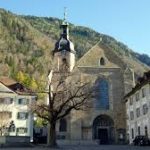
Christianity in Graubünden and the last Prince-Bishop of the Holy Roman Empire

Christianity took root in Switzerland at the beginning of the 5th century and continued to spread throughout the 6th century. The oldest church foundations in St. Maurice, Chur, and Geneva date from the 4th century. The abbey of St. Maurice was founded in 516. Christian congregations existed in the fifth century in Romainmôtier, Nyon, Yverdon, … Read more » “Christianity in Graubünden and the last Prince-Bishop of the Holy Roman Empire”

Pilgrimage in European Perspective

Three major pilgrimage routes existed in the Middle Ages. The Way of St. James extends from various parts of Europe to the Cathedral of Santiago de Compostela, the Via Francigena travels from Canterbury to Rome, and the pilgrimage route spans the continent, leading to Jerusalem. The latter ultimately led to violent crusades. Many routes in … Read more » “Pilgrimage in European Perspective”

Jörg Jenatsch in the Treasury Museum of the Cathedral of Chur

Available in German and Dutch