

The Swiss franc, The Latin Monetary Union and the Euro
14 May 2025
The Swiss franc (CHF) is 175 years old. It was officially introduced on 7 May 1850. Before the introduction of the franc, there was a huge confusion about currencies. Since the Middle Ages, every canton, city, and diocese minted its own money. People paid with batzen, rappen, taler, oertli, assis, gulden or dicken. There were more than 8,000 different coins!
Travelling from one canton to another was like travelling abroad; money had to be exchanged and customs duties had to be paid at every cantonal border. This monetary reform was not self-evident, but a Swiss ‘euro’ avant la lettre.
The cantons defended their right to mint coins and levy customs duties, but since the new constitution (1848), the confederation has formed a solid basis for the economy and the Swiss franc. Today, the Swiss franc embodies monetary independence, economic reliability and a long-term vision.
The franc has overcome numerous challenges throughout its history, from crises and wars to periods of high inflation, the transition from the gold standard and the dynamics of the international monetary system.

The treaty of 23 December 1865. image: Wikipedia
The Latin Monetary Union
Switzerland also had its European ‘euro’ in 1865, a monetary catastrophe. In 1865, France, Belgium, Italy, and Switzerland established the Latin Monetary Union, a precursor to the euro. Greece joined a year later. This coinage union was established by Napoleon III (1808-1873).

French poster from 1865, source: Wikipedia
The ‘Latin Monetary Union’ (L’Union monétaire latine) contained detailed regulations on the weight, fineness, shape, and exchange rate of gold and silver coins, as well as quotas for the minting of coins for the individual countries in proportion to their populations. In return, the coins in question were accepted throughout the entire territory of the monetary union.
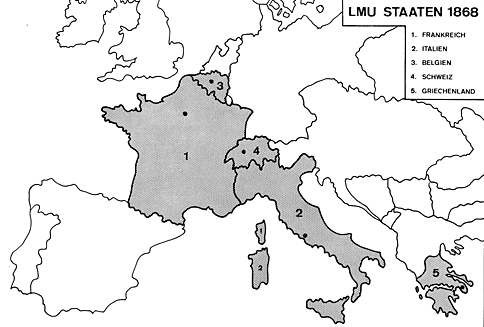
The five contracting countries of the Latin Coinage Union. Picture: Wikipedia
The pro-European Swiss government saw this as a first step towards realising the idea of a European monetary system. Accordingly, the composition of the gold and silver coins circulating in Switzerland was international.

The Latin Monetary Union in 1914. image: Wikipedia
Between 1885 and 1920, the proportion of Swiss 5-franc coins in the Latin Monetary Union fluctuated between 2% and 7%. Devaluation and depreciation quickly led to increasing inequality between the coins, and the agreements proved to be worthless. In addition, this monetary union was extended to many less solvent countries and even colonies through bilateral and unilateral agreements until 1914.

Silver coins in the states of the Latin Monetary Union, issued for Switzerland by Kaiser & Co, Bern. Plate from the time of the First World War (Swissmint). Source: Historisches Lexikon der Schweiz
The Alphirte (Alpine shepherd)
The village of Richterswil (Canton Zurich) is the home town of Paul Burkhard (1888-1964), the creator of the famous 5-franc coins. In 1920, he was commissioned to design a new 5-franc coin. He created the Alphirte (shepherd). On 1 April 1927, the Latin Monetary Union was dissolved.
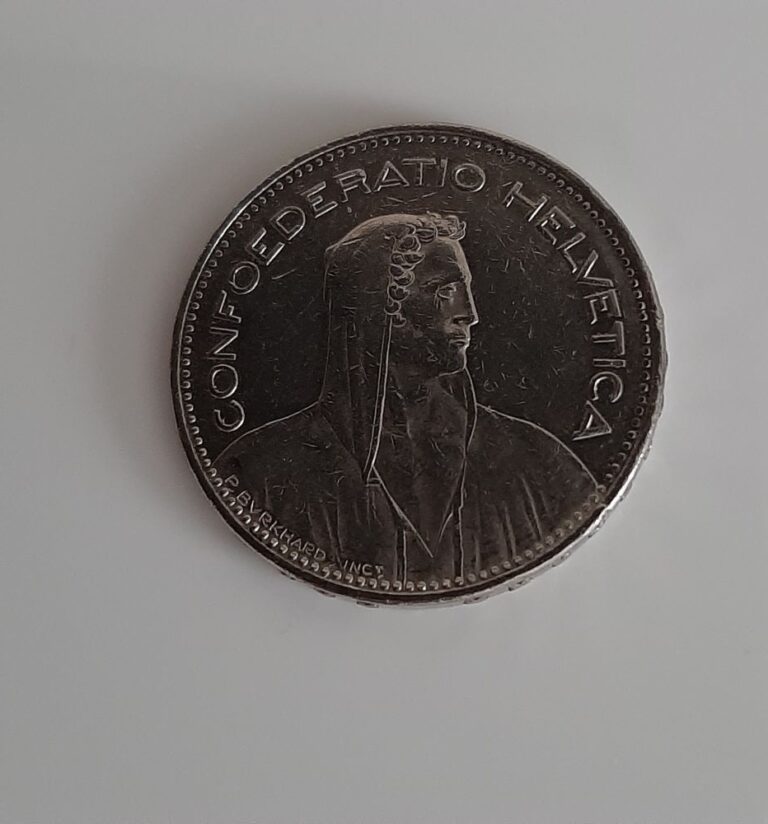
The Alpine shepherd and not William Tell!
The SNB (founded in 1907) had now freed itself. The key to monetary policy was no longer to follow the standards of neighbouring countries. Financial stability was a value in itself.
Until 1914, the franc was a standard currency that fluctuated in value against its competitors, sometimes appreciating and sometimes depreciating. After 1914, the currency emerged (including ups and downs) as a monetary island of stability.
The Swiss franc today
This quality is based on numerous pillars, including political and social stability, direct democracy, federalism, subsidiarity, liberalism, industrial innovation, exports, the excellent research and education system, high labour morale, a market-oriented and at the same time social economic system, low national debt, high gold reserves, surpluses in the current account balance and net foreign assets.
However, its monetary neighbours, including today’s euro, have made and continue to make life difficult for the Swiss franc. In 2002, the SNB harboured the vain hope that the euro and the ECB would be a kind of successor to the Deutsche Mark (DM) and the Bundesbank.

Development of the euro-CHF exchange rate 2002-2025 Source: www.schweizer-franken.eu
Conclusion
However, the euro has lost almost 40% of its value against the franc since 2002, and the outlook is not good. More and more (economically, financially and politically) ailing countries are participating, and the ECB strongly resembles a politically orientated Franco-Italian bank and a new Latin Monetary Union.
The former Latin Monetary Union is a ‘warning from history’, also regarding the new negotiations and agreements between Switzerland and the EU, its centralism, its top-down democracy, bureaucracy, and judiciary.
(Source: S. Heeb, Historisches Lexikon der Schweiz, l’Union monétaire latine, 25.03.2014)