

Habsburg Castle and the new Worldpower
1 September 2023
One of the most informative sources on the early Habsburgs is the Acta Murensia on the foundation of the monastery of Muri in 1027. The Habsburgs descended from a family from Alsace. (See also the last Habsburger in Basel)
The Habsburg castle was built around 1030. The Acta Murensia mention the Habsburg Radbot and the Bishop Werner of Strasbourg as builders. Around 1100, Otto II was the first Habsburg to refer to himself as Count of Habsburg. This title referred to the count’s status in Alsace.

The vordere Burg with the Steinhaus and the Ostturm, The Burghof with the Sodbrunnen and the hintere Burg. After P. Frey, M. Hartmann, E. Mauer, die Habsburg.
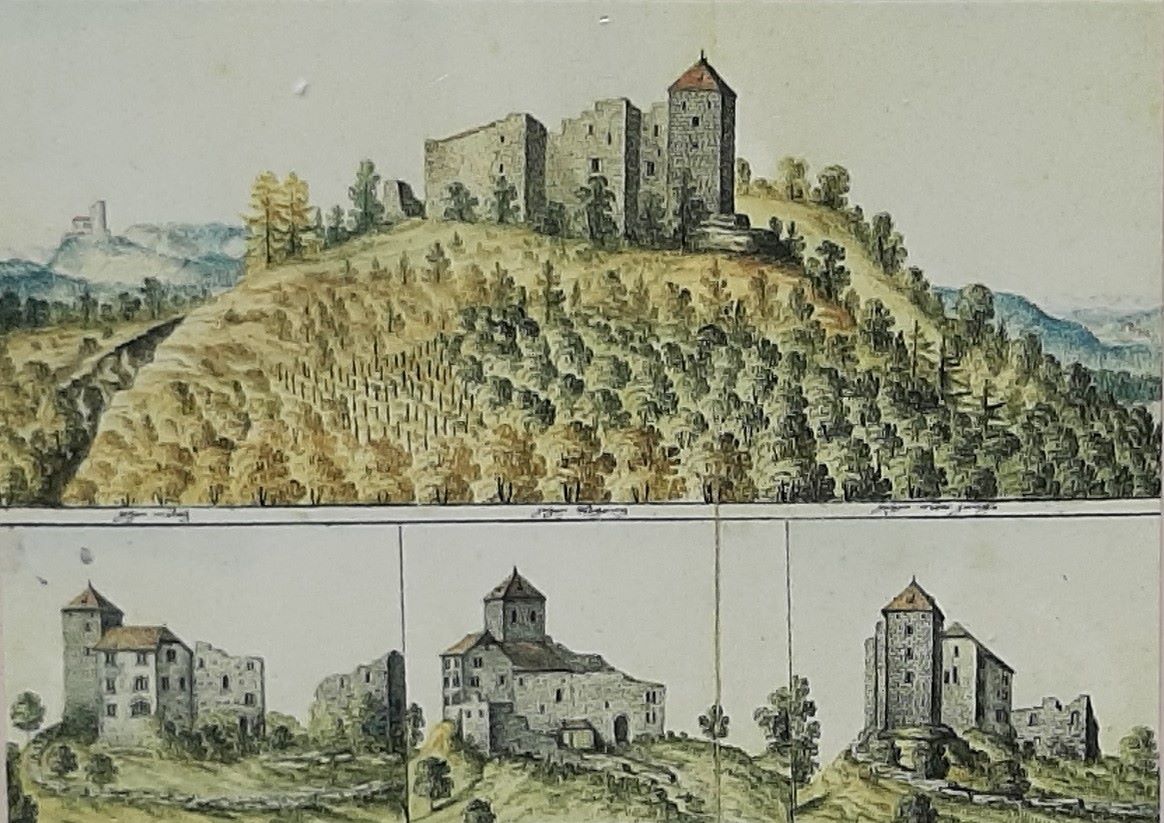
Albrecht Kauw (1616-1681), rond 1670. The Habsburg Castle from four perspectives. Collection: Bernisches Historisches Museum
The Habsburgs benefited from the extinction of other dynasties in the region (including the counts of Lenzburg and later Kyburg). They acquired earldoms in the southern Zurichgau, in the Frickgau, and around 1200 also in Aargau.
In 1273, the electors of the Holy Roman Empire elected Count Rudolf IV (1218-1291) as German king Rudolf I. Habsburg Castle was then no longer suitable as a residence, and the Habsburgs moved to Brugg, Bremgarten or Laufenburg.

The seal of King Rudolf I. Staatsarchiv des Kantons Bern

Habsburg territories around 1265. After P. Frey, M. Hartmann, E. Mauer, die Habsburg.
Nobles in the service of Habsburg then occupied the castle until the conquest of Aargau by the Swiss Confederation in 1415. In 1469, the castle came into the hands of the Königsfelden monastery in Brugg.

The Eidgenossen knock on the door, 1415. Diebold Schilling, Spiezer Chronik. Burgerbibliothek Bern, Mss.h.h.I.16, p. 629.
When the monastery was dissolved in 1528, the castle fell to Bern. In 1804, the new canton of Aargau became the owner. Today the castle a national monument. A small exhibition showcases the castle’s building history and the rise of the Habsburgs to a global power.
(Source and further information: Via Habsburg; P. Frey, M. Hartmann, E. Mauer, die Habsburg, Bern 1999; Museum Aargau)

The vordere Burg


The hintere Burg


The Burghof


The landscape


The namegiver
