Sierre, Muzot and Rainer Maria Rilke

In the predominantly French-speaking city of Sierre (Siders in German, canton of Valais/Wallis), traces of various civilisations dating back to prehistoric times are still visible: hunters, the first farmers, the Ligurians, the Celts, the Romans, the Alemanni, the Franks, Christianity, the Holy Roman Empire, and then the Republic of the Seven Zehnden, and in 1815, the canton of Valais (Wallis in German).

As the little sister of the episcopal city of Sion (Sitten) and as a trade route to and from Italy, it has experienced major conflicts, the (failed) Protestant Reformation in the 16th century, and commercial activity over the centuries. The rise of tourism has attracted not only sports and nature enthusiasts but also leading artists.

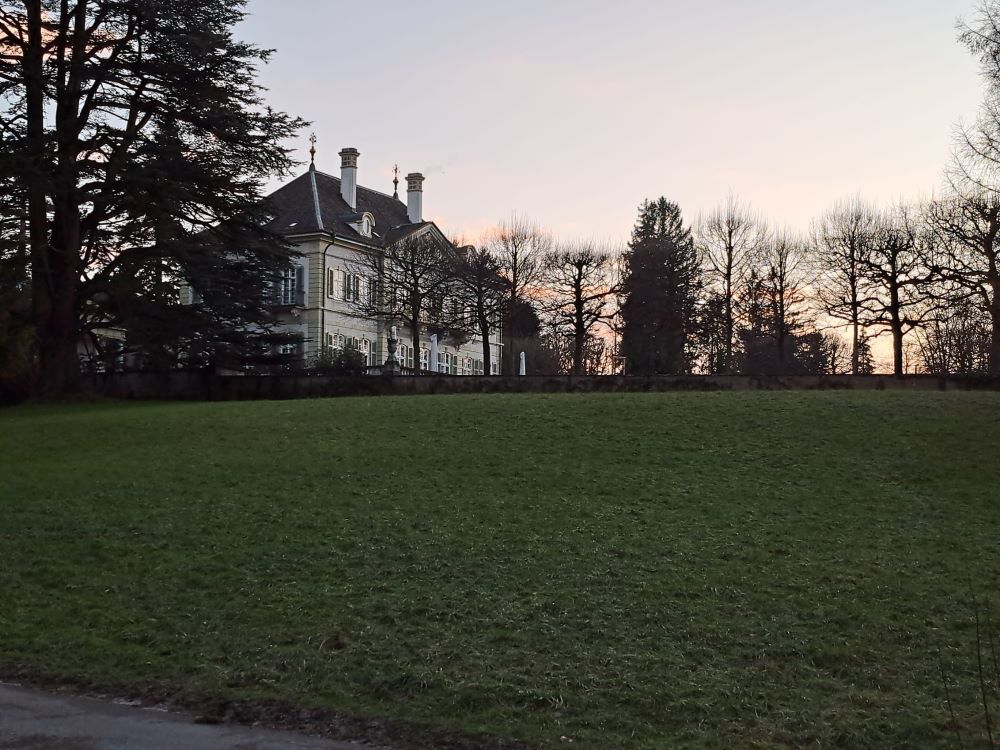
Muzot Castle

Le château de Muzot

Rainer Maria Rilke (1875-1926) was one of the most prominent residents from 1921.
The museum documents his life and stay in Muzot through documentation, photos, and other illustrations and stories. His residence, a small manor or Muzot Castle, still stands, although it is not accessible to the public.

Although much new construction has been added to the area in the last hundred years, it is not surprising that this great poet chose this place as his domicile. His final resting place is in nearby Raron (Rarogne in French).

(Source and further information: Sandra Richter, Rainer Maria Rilke oder das offene Leben. Eine Biographie (Berlin, 2025); Ville de Sierre)

Impressions from Sierre

Lac de Géronde

Le Petit Lac


Church and Venthône Castle

The Remarkable Capuchin Monastery in Sion

According to a recent United Nations report, Switzerland remains one of the most innovative economies globally. However, this also applies to (religious) architecture and design. Several museums, including the Vitra Design Museum in Weil am Rhein, the Museum für Gestaltung in Zurich, and Platforme 10 in Lausanne, are just a few examples.

In the church field, architecture and design are also sometimes innovative. The St. Nicolas Church in Hérémence, St. Antonius Church in Basel or the Capuchin Monastery (Le Couvent des Capucins) in Sion (Sitten, Canton of Valais/Wallis) speak for themselves. However, they reveal little about spiritual innovation.

The courtyard, in pink, is the ancient home for sick people.


Contemporary painting by Hans Ludolff, around 1653, the monastery on the left.

This Capuchin monastery was founded in 1643, partly in response to the reform movement that also held Valais in its grip until 1603. In 1603, however, the seven Zehnden in the Tagsatzung of Valais chose the old faith.

The monastery soon gained a good reputation in education and health care. Philosophy and theology, in particular, were well-known in the wider area and remained so well into the 20th century.

The garden of the monastery

The flourishing monastic community decided to modernise and enlarge the complex in the 1920s and 1930s. The first renovations, undertaken by architect Alphonse de Kalbermatten (1870-1960), date from this period. However, the 1946 earthquake forced further repairs by Fernand Dumas (1892-1956) and others.

However, the most remarkable intervention took place in the years 1962-1968, several decades before the monastery was taken over by Sion. Today, the municipality manages and rents the complex.

The ancient wall and modern decoration

However, it does not diminish the Capuchins’ creativity, innovations, and apparent financial strength. Venetian architect Mirco Ravanne (1928-1991) gave an original interpretation of the conversion of the convent. He largely preserved the old structures and walls, but with the addition of modern materials and, above all, beautiful contemporary artworks by Kengiro Azuma (1926-2016), Alberto Buri (1915-1995), Ángel Duarte (1930-2007), Marcel Feuillat (1896-1962), among others, Jacques le Chevalier (1986-1987) Manfredo Massironi (1937-2011), Paul Monnier (1907-1982), Bernhard Mühlematter (1931-2001), François Ribas (1903-1979), Remo Rossi (1909-1982), Gino Severini (1883-1966) and Antoni Tapiès (1923-2012).

Gino Severini, windows by Jacques le Chevalier

These artists continue to add a unique collection of artwork to the former monastery. Ravanne’s architecture, influenced by Le Corbusier (1887-1965), gives space, respect, and reflection not only to this art but also, at the time, to the religious, social, and educational significance of the monastery.

As of 2014, the Episcopal city of Sion has one more monument of national importance.

(Source: P. Cagna, P. Varone, R, Salvi, C. Schmid, F. Vannotti (Red.), Le Couvent des Capucins, Sion, 2017)

Kengiro Azuma

Antoni Tapiès and the traumata of the Spanish Civil War (1936-1939), symbolized by a warplane

Belle van Zuylen or Isabelle de Charrière in the Netherlands and Switzerland

Belle van Zuylen (1740-1805) is known abroad, especially in Switzerland, by the name Isabelle de Charrière. Her birthplace, or castle of birth, was Slot Zuylen in the village of Zuilen, today Oud-Zuilen in the municipality of Stichtse Vecht (province of Utrecht).

As the name suggests, the castle is located on the Vecht. At the time of Belle, this river was a trade route between Utrecht, Amsterdam, and the Zuiderzee. The castle’s origins date back to the 12th century.

The Vecht

Initially, it was a motte, a fortified tower. The strategic location on the Vecht, in the powerful bishopric of Utrecht at the time, was a source of income through tolls.

Over the centuries, the complex was continuously expanded and adapted to new residential uses and new styles of the day. The last major renovation took place in the 19th century.

Belle was the daughter of Diederik Jacob Tuyll van Serooskerken (1707-1776) and Jacoba Helena de Vicq (1724-1768).

She married Charles-Emmanuel de Charrère de Penthaz (1735-1808) in 1771, residing at the manoir Le Pontet in Colombier, in the French-speaking Prussian principality of Neuchâtel. He was the French-speaking house teacher of her eldest brother Willem (1743-1839). Belle moved to Colombier and thereafter called herself Isabelle de Charrière.

The desk of Belle in Zuylen Castle

As was common at the time (and until the 20th century), the aristocracy was bilingual (or trilingual): the mother tongue, French, and sometimes Latin. Belle is best known for her literary legacy, which includes correspondence, literature, plays, and various other writings in French.

She lived and wrote in Colombier from 1771 onwards. In both countries, the Netherlands and Switzerland (particularly the canton of Neuchâtel), her legacy is part of the cultural heritage or patrimoine.

The Netherlands knows the museum in Zuylen Castle and the Belle van Zuylen / Isabelle de Charrière Society, while the University of Neuchâtel (and the University of Lausanne) and the Public and University Library of Neuchâtel pay attention to her life and works, among others with 1 530 letters out of a collection of around 2 600 letters and her writings.

In September 2025, a detailed article about Isabelle’s life in Switzerland and particularly in Colombier will appear in the Nouvelle Revue neuchâteloise. The Swiss Spectator will contribute to her life at Zuylen Castle and in the Netherlands. In this way, the Dutch and Swiss life paths of this woman of the Enlightenment will be highlighted. Belle, alias Isabelle, perfectly symbolises this era.

Switzerland, with its many immigrants and visitors from England, Russia, Germany, and France, its societies, export networks, and emerging industries at the time, is often overlooked as a hub of the Enlightenment.

Lord Byron, Edward Gibbon, Madame de Staël, Rousseau, and Voltaire are just a few names from the 18th and 19th centuries, just as Basel was the intellectual, humanist, and printing and publishing centre in the 15th and 16th centuries.

Literature: K. Verboeket, Slot Zuylen, Oud-Zuilen, Amsterdam, 2003; K. van Strien, Belle van Zuylen. Een leven in Holland, Soesterberg, 2019; J. Bujard et autres, ‘Le Manoir du Pontet à Colombier’, dans la Nouvelle Revue neuchâteloise, Hiver 2002, n° 76.

Impressions of Slot Zuylen

Museum Slot Zuylen

The world of Swiss White Gold and the three Swiss Salines

Switzerland does not have many resources. Coal, oil or rare metals are lacking in its soil. Instead, it has an abundance of building materials, including various types of stone, wood, ‘white energy,’ and cement and concrete ingredients. These are well-known examples.

Less well known is salt, which has been known for centuries as the ‘white gold’. Salt is indispensable not only for preserving and preparing food but also for cheese production and animal feed.

Image: Saline Schweizerhalle

Until the 15th century, the Old Eidgenossenschaft had to import salt from France and Austria (Salzburg). Schaffhausen was a significant transhipment point for Austrian salt for centuries.

Saline de Bex

Anyone who sees sheep does not immediately think of salt. However, in the 15th century, sheep were the first to discover salt in what is now known as the Saline de Bex (canton of Vaud). The shepherd noted that they always drank from the same spring because of its high salt content. This salt came from oceans that also covered Switzerland 200 million years ago.

Picture: Saline de Bex

Then, from 1554, salt mining began at the Saline de Bex. This history is showcased in the open-air and underground museum and can also be experienced. Today, the mine continues to produce approximately 30 tonnes of salt per year, utilising a combination of artisanal and modern techniques.

Over the centuries, 52 kilometres of mine galleries were constructed. The train is not missing in this mine either, as is customary in Switzerland, (almost) always punctual with a route of several kilometres through the corridors, galleries and various exhibition areas.

Salt is indispensable not only for sheep but also for people. Not surprisingly, in the land of mineral springs and spas, Bex soon became Bex les Bains.

Bex

Today, Bex’s salt mines are a vast underground labyrinth, several kilometres of which are open to visitors. The labyrinth has 15 halls or galleries on two floors, where the world of salt is explained in words and pictures.

Due to its constant temperature of 18 degrees Celsius, it is also ideal for maturing cheese and storing wine. What could be a better place to keep sausages than a salt mine?


Saline Schweizerhalle and  Saline Riburg

Until 1837, Bex had a monopoly on salt mining in Switzerland. However, production was not enough for the country. Extraction of salt also began in 1837 at the Saline Schweizerhalle near Pratteln (Canton of Basel-Landschaft) and in 1848 at the Saline Riburg (Canton of Aargau).

Saline Schweizerhalle

The Riburg plant has one of the largest evaporators in Europe. The Salt Storage Hall, Saldome 2, is the largest domed wooden structure in Switzerland.

Saline Riburg

The operation of these salt mines is technically more straightforward and cheaper than in Bex. Today, Saline Schweizerhalle and Saline Riburg produce approximately 600,000 tonnes of salt annually.

Approximately half of this production is dedicated to ice and snow removal on roads. The domestic use (food) industry, medicine, and cleaning products are among the other applications.

Applications of salt and the Swiss road network. Image: Saline Schweizerhalle

Schweizer Salinen/ Salines Suisses

Since 2014, these three salt mines have been united into Swiss Salt Mines. Shareholders are the 26 cantons and the Principality of Liechtenstein. The primary goal is to ensure salt supply for Switzerland, which is no luxury in uncertain times. At least these three mines cover the country’s salt supply.

Saline de Bex and the flags of the three cantons of the Schweizer Salinen/ Salines Suisses

Conclusion

In this context, the question is whether the European Union will accept this monopolist in a potential new treaty, which may also affect SBB’s position.

The salt couldn’t care less. Nature has no concept of time. The three Swiss salt mines are open to the public and impressively display the world of ‘white gold’.

Salt as a molecule and in stone. Image: Saline Schweizerhalle

Impressions from the Saline de Bex


Impressions from the Saline Schweizerhalle

Impressions from the Saline Riburg

The underground lake of St-Léonard

Humans are not the only ones who build tunnels. Nature, too, has a reputation in this field, for example, in Saint-Léonard (Canton of Valais), Vallorbe (Canton of Vaud), and Baar (Canton of Zug).

St Léonard is even home to the largest navigable underground lake in Europe, the Lac Souterrain de St Léonard.

This 300-metre-long, 20 to 30-metre-wide, and several-metre-deep lake lies around 60 metres below the mountains and has been formed over thousands of years. Water from springs, meltwater from snow and ice, and rainwater have displaced the soft rock gypsum. The other types of rock (marble, slate, and anhydrite) now form the backdrop.

Initially, there were many separate spaces, but gradually, the underground lake we know today was formed. Residents and experts had been aware of this lake for a long time, but as the water reached right up to the roof of the cave, it was not possible to conduct any investigations for a considerable period.

Their research boat is now a museum object.

Two speleologists first investigated and documented the lake in 1943. However, the breakthrough only came with the 1946 earthquake, which caused cracks in the walls, allowing the water to drain to its current level.

The stage for the artists

With a glass of wine from Lac Souterrain St. Léonard

The lake is navigable by boat, and there are even musical performances; the wine also thrives thanks to the constant temperature of 15 degrees Celsius.

Even the first stalactites began to form after 1946. Until then, there was no air and no oxygen, only water. It also shows how much time stalactites need to equal Vallorbe or Baar.

What applies to the salt in Bex also applies in St Léonard: nature knows no time or takes its time.

St. Léonard

Bellwald, Ernen, the bishop, the Binn Valley and the Suspension Bridge

The village and municipality of Bellwald (including the hamlets of Ried, Eggen, Bodmen, and Fürgangen) is the highest in the region of Goms (Conches in French, canton of Valais) at an altitude of 1,560 m.

The Alemanni immigrated to this region in the 8th and 9th centuries and cultivated the land. They settled on farms, from which the hamlets and villages gradually emerged.

The name Bellwalderberg appears in medieval documents in the 14th century. In 1394 the farmers of Bellwalderberg founded a farmers’ guild. This grew into the municipality of Bellwald in the Zehnden or Zenden of Goms in the sixteenth century.

Agriculture was the only economic activity. However, it was not able to feed the inhabitants. Many emigrated to other cantons or other countries.

The big change started at the end of the 1950s. In 1962, the first hotel opened its doors. The road to the valley, completed in 1971, accelerated the development of tourism, and the village changed from a farming village into a tourist resort.

Fürgangen is best known for the 280-metre-long and 92-metre-high suspension bridge over the Lamma Gorge. This suspension bridge connects the villages and hiking areas of Ernen and Bellwald. The suspension bridge spans the Rhone and the Glacier-Express railway line.

Ernen is situated on the other side of the Lamma Gorge. Unlike Bellwald, this village has been a trading post and residence of the bishop of Sion.

The town’s palaces, the Zenden town hall (Zenden-Rathaus), the typical Valais wooden houses, barns, and other buildings, along with its location in the Binntal, the first regional nature park in Valais, make it one of the most beautiful villages in Switzerland (Die schönsten Schweizer Dörfer).

Also worth seeing is the nearby hamlet of Mühlebach, featuring the oldest wooden houses, which date back to the 14th and 15th centuries, including the residence of Cardinal Schiner (1465-1522).

The annual classical music festival in Ernen is known far beyond the borders of the canton and the country.

(Source and further information: www.bellwald.ch)

Impressions of Bellwald, Ernen, Mühlebach and the Binntal

Bellwald

Das Binntal


Ernen

Mühlebach


Translation Program for the Romansh Language

Lia Rumantscha has entered into a long-term collaboration with the computational linguistics department of the University of Zurich. The first project from this cooperation is developing a translation program that supports all five idioms, Rumantsch Grischun and German.

In March of this year, Lia Rumantscha published its strategy for digital transformation. The strategy’s goal is to make Romansh more visible in the digital space and thus facilitate its use in everyday life.

The translation program should be operational one year after the project starts. The  program is freely accessible to the entire Romansh community and others interested and also available for professional use via interfaces (APIs). Radiotelevisiun Svizra Rumantscha (RTR) supports the project with know-how, texts, and contributions.

The projects of the digital transformation strategy are coordinated according to the governance between the institutions Radiotelevisiun Svizra Rumantscha, Fundaziun Medias Rumantschas, Dicziunari Rumantsch Grischun, and Lia Rumantscha. 

Graubünden Car Free 1900-1925

Switzerland boasts numerous historical, political, and cultural peculiarities, in addition to its stunning natural landscapes. One very special one, though, is the former car ban in Graubünden from 1900 to 1925.

In 1925, there were 136 passenger cars; by 1967, this number had increased to 24,000. In 2020, there were approximately 150,000 cars for the 200,000 inhabitants of Graubünden.

The small number of cars in 1925 was due to the ban on vehicles that had been in effect from 1900 to 1925. Motorised traffic, ‘monster luxurius‘ or the ‘dubius vehicels‘ was strictly forbidden. The tourists either came by train or had to leave their cars at the cantonal borders and continue by horse-drawn carriage. It even happened that horses pulled the vehicle.

It was not conducive to tourism and economic development. Emotions ran high in the ten referendums between 1900 and 1925. The opponents saw the motor car as a threat to road safety, the traditional horse-drawn carriage, the horse trade, freight transport by pack animals, and a competitor to the railways. Proponents mainly saw economic benefits.

The opponents prevailed in five referendums up to 1918. Between 1918 and 1925, five additional referenda were held. On 13 March 1921, the use of cars was allowed for medical reasons, fire brigades or certain other professions.

Finally, on 21 June 1925, most voters allowed motorised traffic, cars, motorbikes, and lorries. Environmental considerations, road safety or limiting transit traffic played no role whatsoever. A hundred years later, the reduction of transit traffic and the use of cars are again in the spotlight.

(Source: Felici Maissen, Der Kampf ums Automobil in Graubünden, Automobilclub der Schweiz, Sektion Graubünden, 1968).

The old bishopstown Leuk, the Pfynwald and the Pfyn-Finges Nature Park

Leuk (Loèche in French), Susten, Erschmatt, and a few small villages comprise the municipality of Leuk, with a population of around 4,000.

The municipality of Leuk was one of seven Zehnden/Dizains or municipalities that administered the Haut-Valais for centuries, with the Bas-Valais as their subject area. The city lies between Haut-Valais and Bas-Valais, which are the French-speaking and German-speaking parts of Valais.

It was not until 1798 that the French invasion ended this division of the Valais. The town of Leuk lies over 700 metres above sea level amidst vineyards, rock formations, and a dry landscape with no less than 3,500 hours of sunshine annually.

This historic medieval town is home to various monuments, mazots, the town hall, the bishop’s castle, the late Gothic St. Stephen’s Church (1497), and its Romanesque tower from the 11th and 12th centuries with its Beinhaus (bone house), the late Baroque Ringaker’s Chapel and other medieval and Renaissance architecture.


The town offers a magnificent view of the Rhone Valley, the Pfynwald Nature Reserve, and the Pfyn-Finges Nature Park.

The lower town of Susten (650 metres) lies on the edge of the Pfynwald Nature Reserve and the Pfyn-Finges Nature Park.

The upper St. Theresa’s Church dominates the townscape. The village is mentioned in a document in 1302 under the name “Sust”.

(Source and further information: www.leuk.ch)

Douze Points for Basel and a Confederation United by Music

One musical event is not yet over when another is already on the horizon. The Eurovision Song Contest (ESC) in Basel (May 10-17) gives way to the European Festival of Youth Choirs in Basel from May 28 to June 1.

The ESC slogan was “United by Music.” The media widely covered this contest. However, the slogan took on its true meaning outside the spotlight and on the street.

Firstly, the police forces of the cantons, Liechtenstein, Baden (Germany), and Alsace were ‘United by Music’. Police, Gendarmerie, Polizei and Polizia in the streets of Basel – who would have thought this in a country with the ‘Kantonli’ spirit?

It is also part of the militia system, which manifests itself, for example, during the ‘Federal Camp (Bundeslager) for Scouts’, Fête des Vignerons, Fasnacht, Schwingen, or the Basler Tattoo.

Hundreds of artists, children, adults, individuals, and groups were also ‘United by Music’ in the city on specially arranged stages or other locations.

Hundreds of volunteers were ‘United by Music’ and made this event accessible, friendly, and organised in an original musical way. They may be candidates for the Schappo 2026!

The ESC mainly showed the discreet way in which not only Basel but the whole country handles such events—no hysteria, media hype, or exaggerations. Not only do the police and security measures deserve positive attention, but also the attitude and conduct of the many visitors.

A performance of Les Festins du Vendredi on May 16 this year

Since 2020, for example. Every third Friday of the month at the Bachletten/Holbein community centre in Basel, events organised by Alain Moirandat have been taking place. He combines a short concert with a dinner based on the music performed: ‘Les Festins du Vendredi’.

The musicians are usually from the Schola Cantorum Basilienis, and the concerts and dinners focus on music and menus from before 1800, with a few forays into the 20th century.

Johann Sebastian Bach thus already met Susanne Eger’s 1745 ‘Leipzig Cookery Book’, Italian music from the early Baroque by Mealli was combined with dishes from a banquet for Queen Christine of Sweden, and Robert May’s 1685 ‘Accomplished Cook’ provided the recipes for music by Dowland, Gibbons and Simpson.

These events also confirm the centuries-old musical tradition at the local and cantonal levels. Besides various world-class concert buildings (for example, in Lucerne, La Chaux-de-Fonds, or Geneva) and many top musical events (for instance, in Gstaad, Montreux, Basel, or St. Moritz), it is mainly the musical base that stimulates the imagination.

Numerous small and large concerts and festivals occur daily throughout the country. The country is ‘United by Music’, which makes the ESC unforgettable.

Impressions of the ESC 2025 in Basel


Fanacht 2025, Lanterne about the ESC