
The Furka Pass, Rhone Glacier and Grand Hotels

The film The Grand Budapest Hotel (2014), directed by Wes Anderson, depicts the decline of a hotel from the Belle Époque era, spanning from 1900 to the outbreak of World War I (1914-1918).

The Hotel Belvédère

The story of Hotel Belvédère on the Furka Pass serves as a model for this film, in a sense. The hotel, in any case, is one of the most famous from this period.

Sean Connery (1930-2020 )also drove the famous hairpin bend in Goldfinger (1964) in his silver Aston Martin DB5 at an appropriate speed for 007. Countless postcards, and these days, Instagram posts showcase the hotel and the glacier.

The Furkap Pass, Hotel Belvédère and the famous bend. Photo: TES

Furka Pass, Hotel Belvédère. Photo: TES

Since 2015, however, the hotel has been empty. The nearby Rhone glacier is also shrinking, a development that began as early as the 19th century. Until 1870, the glacier extended into the valley to the village of Gletsch (Canton Valais). In 1980, the glacier was still opposite the Hotel Belvédère. In 2022, there is a lake instead, and the glacier is hundreds of metres away.
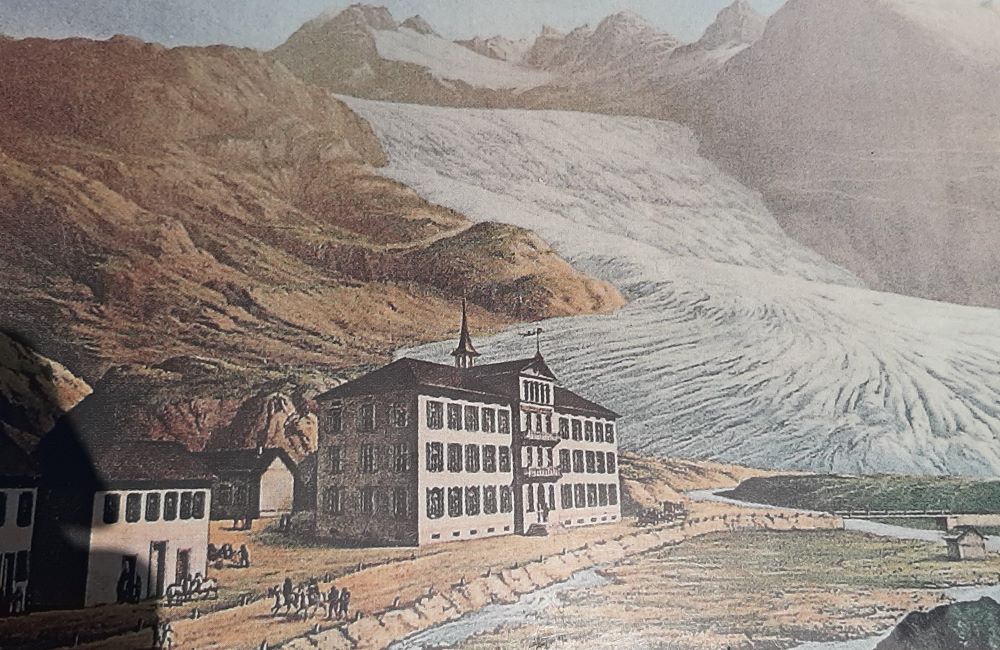
Gletsch, Grand Hotel Glacier du Rhône, around 1870. Source: Gletscherlehrpfad Furka Pass. Photo: TES.

The history of the Belvédère dates back almost two hundred years. The first inn in the region was built in Gletsch in 1830. Alexander Seiler (1819-1891) expanded it into the Grand Hotel Glacier du Rhône in 1857.

The glacier still reached the valley and the village. The hotel was intended for travellers who used the Furka Pass or the Grimsel Pass to exchange horses and increasingly for (English) mountaineers and their large (aristocratic) entourage. The Queen (Queen Victoria 1819-1901) drank her tea here on 23 August 1868, “a delicious cup of tea”.

The Furka Hotel and the Queen

In 1850, a simple hotel was built on the Furka Pass, near the Furka Pass Hotel. The owner was Franz Karl Müller. The most famous guest was Queen Victoria. During her four-day stay at the hotel in August 1868, she admired the glacier and the view of the Alps, but was less enthusiastic about the hotel itself. However, her visit ensured that the Furka Pass and Gletsch were on the front pages and in the news for many days.

The Ice Cave

It also aroused the interest of other entrepreneurs. In 1870, the organ builder Philipp Carlen from Goms (Upper Valais) had a plan: he dug a 100-metre tunnel into the glacier, known as the Eisgrotte. For a fee, visitors can see the inside of the glacier. It is a great success. People queue up.

The ‘Eisgrotte‘ still exists. The entrance, however, is almost a kilometre further away. Philipp Carlen’s great-great-grandson and namesake runs the “Eisgrotte‘” today.

 Hotel Furkablick and Hotel Belvédère

Hotel Furkablick. Photo:TES

The number of grand hotels in Switzerland increased rapidly between 1880 and 1914. Between 1888 and 1914, the number of hotels (including Grand Hotels) doubled from 1,700 to over 3,500. Alexander Seiler builds his second hotel, the Belvédère, on the Furka Pass. Franz Karl Müller also establishes his second hotel, the Furkablick.

Grand hotels are always places of progress, featuring amenities such as electricity, hot water, private sanitary facilities, and facilities for winter and summer sports, including skiing, figure skating, horse racing, golf, tennis, and, since the 1920s, bridge. The hotels on the Furka Pass are modest but equipped with the most modern inventions and achievements.

The Gotthard-Matterhorn line. Photo: TES.

The hoteliers also take initiatives to build the Brig-Furka-Disentis railway, today’s Gotthard-Matterhorn line, and to widen and improve the roads over the Furka Pass and the Grimsel Pass. The three hotels on the Furka Pass (Furkahotel, Furkablick and Belvédère) and the Glacier du Rhône in Gletsch flourish.

The Great Grand Hotel Depression

But then, on 1 August 1914, the First World War (1914-1918) began, followed two decades later by the Second World War (1939-1945). The great grand hotel depression begins. On the one hand, the splendour of the Belle Époque now seems old-fashioned and outdated. Moreover, medicine offers alternative treatments so that spa cures and mountain air attract fewer and fewer visitors.

After 1960, other holiday destinations and the number of holidaymakers increased rapidly. However, the new target groups have limited budgets and holiday days. Until 1914, wealthy guests typically stayed in hotels for extended periods.

Many hotels were demolished, burned down (whether due to insurance money or other reasons remains to be seen), or stood empty. Only the old names in mondaine villages and towns remained open. The “Eisgrotte”, however, continues to attract many visitors.

Even Hotel Furka, the hotel of the visit of the Queen, has been blown up to make room for a car park. The construction of the Furka Base Tunnel (1982) also marked the end of the Furka Pass as a vital traffic connection.
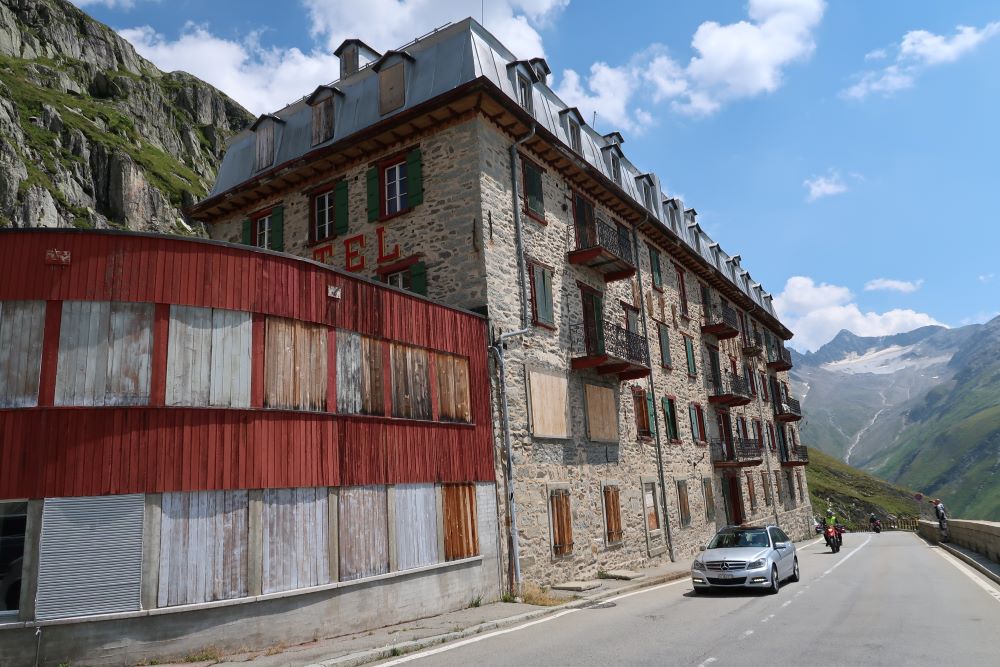
Hotel Belvédère in 2022. Photo: TES

The Belvédère Hotel and the Ice Cave

In 1985, Valais’s Canton took over the remaining hotels (Furkablick and Belvédère). The glacier has shrunk by hundreds of metres, and the canton wants to build a hydroelectric power station in the new lake and demolish the hotels. However, due to the population’s resistance, it does not happen.

Right on top the Furka pass, Hotel Belvédère and the disappeared glacier. Photo: TES

In 1988, the canton sold the Hotel Belvédère to Philipp Carlen, the current operator of the “Eisgrotte”. The hotel reopened in 1990. In 2015, however, it closed its doors (for good?).

However, Philipp Carlen also has other initiatives, including a glacier nature trail, an alpine garden, and soon a children’s slide. He also wants to rent out boats on the lake.

Only the Hotel Furkablick is still operational, serving as a gallery. There is new hope for the Hotel Glacier du Rhône in Gletsch. Plans are in place to reopen this grand hotel in 2025 following renovation. It is part of the revival and upgrading of Grand Hotels that have been taking place since the end of the 20th century.

The Revival of Grand Hotels

Swiss Historic Hotels, founded in 1995, plays a role in this revival. Other Grand Hotels such as the Badrutt’s Palace, the Kulm Hotel and the Suvretta House in St. Moritz, Les Trois Rois in Basel, the Kurhaus in Bergün, the Bellevue in Scuol, the Montreux Palace, but also hotels in smaller towns such as Maloja and Celerina are just a few examples of an almost unbroken continuity from the Belle Époque era, even if only a few hotels have remained independent.

Other Grand Hotels, such as the Val Sinestra in the Lower Engadine, have used the splendour of the past for different purposes. However, many Grand Hotels are waiting for investors and renovation.

Grand Hotel Celerina, Upper Engadine. Photo: TES

Grand Hotel Maloja, Upper Engadine. Photo: TES

Suvretta House, Upper Engadine. Photo: TES

Hotel Les Trois Rois, Basel. Photo: TES

Continental Parkhotel (the former Grand Hotel Beauregard), Lugano. Photo: TES

The future of some Grand Hotels is uncertain. However, the “Eisgrotte” will be gone within two generations. That is a certainty.

The glacier in 1980, on the left of Hotel Belvédère. Source: Gletscherlehrpfad. Photo: TES

The lake in front of Hotel Belvédère in 2022. Photo: TES

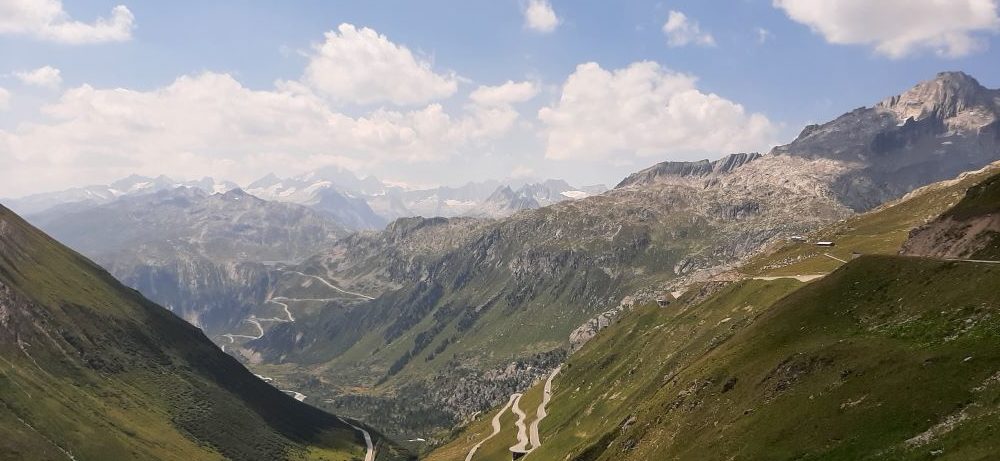
The Rhone Valley, view from the Furka Pass. Photo: TES

Buochs, democracy and the Netherlands

What do the small villages of Buochs (Canton Nidwalden), democracy, and the Netherlands have in common? Not much at first glance. But appearances can be deceptive.

Not only were Louis Wyrsch or Borneo Louis (1793-1858) and his son Alois (Louis) Wyrsch (1825-1888) employed in the Netherlands and the Dutch East Indies for many years, but the other son of Borneo Louis, Jakob Konstantin Wyrsch (1842-1933), also had an international career.

Buochs, Protestant church, tombstone of Louis Wyrsch (Borneo Louis)

Buochs, a Protestant church, the gravestone of Alois (Louis) Wyrsch

Buochs and the so-called “Urschweiz” (the cantons of Uri, Schwyz, Obwalden and Nidwalden) are democratic mirrors for the Netherlands today.

Buochs was the birthplace and place of execution of the painter Johann Melchior Wyrsch (1732-1798) by French soldiers in 1798 when France invaded the Swiss Confederation after annexing part of the former diocese of Basel in 1792.

Pfarrkirche St. Martin and Pfarrhof

The French troops conquered Beckenried Stans and Stanstad without much resistance, but there was fierce fighting in Buochs, and many inhabitants were killed in revenge.

Johann Melchior Wyrsch, a painter recognised at home and abroad at the time, tried to mediate but was mercilessly shot. The village honours him with a statue. The Nidwalder Museum is dedicating an exhibition to the artist until 29 September 2024.

Buochs, sculptor Hans von Matt (1899-1985), statue of Johann Melchior Wyrsch

The villages and cantons on Lake Lucerne are not only of great importance for the development of modern-day Switzerland and its unique direct democracy.

The splendour of the villages and the international networking of many of their inhabitants also bear witness to their economic, cultural and cosmopolitan past and present. A major international conference was recently held in Bürgenstock.

This region is often wrongly labelled as “nationalistic”, “backwards”, or “primitive” by certain circles in Switzerland. 

Buochs

Politically, they tend to be conservative, an excellent counterbalance to the often opportunistic and (morally) superior thinking of circles in the more urbanised cantons.

The Urschweiz, as it has proven since 1291 against Habsburg, Burgundy, France, the Italian dukes and the German emperors and other leaders, has no fear. Its inhabitants also traded, studied, or waged war on all continents.

Its political compass deserves more respect even if the results of direct democracy and most cantons do not please everyone. After all, the Supreme Federal Court still can correct apparent cases of “conservatism” (e.g.Appenzell Innerrhoden 1990).

Beckenried

Suppose the possible new treaty with the European Union is not subject to a mandatory referendum. In that case, Switzerland would be at the same (low) political level as the Netherlands, with all the consequences.

In a 2005 referendum on the European Union in the Netherlands, an overwhelming majority (62% against 37%) voted against further European integration.

Not because this majority is against a European Union, but against this European Union and the lack of a relevant say in the most critical issues with far-reaching consequences.

Geneva, referendum September 2022

It was the first-ever national referendum. Until then, citizens had never had the opportunity to have a say in developing this European Union. The European Union was and is never an issue in national and European elections, only to make the most far-reaching decisions and the associated consequences.

Voter turnout was almost 70 per cent, compared to 30-40 per cent in European elections. Politicians, the media, academics, and the bureaucracy reacted by abolishing the referendum and ignoring the result.

“Highly educated” says nothing about mentality, wisdom and integrity, and even supposedly “less educated” people are highly educated in their field, especially in Switzerland.

Direct democracy in Switzerland is not old-fashioned but modern and tailored to the age of international, technological and social developments. It is a good indicator and barometer of the problems and bottlenecks in society that politicians cannot ignore.

It does not mean that direct democracy is ideal. The “inflation” of popular initiatives and some results may be wrong or sometimes problematic. But that is precisely the strength of the federal model, which is based on subsidiarity and compromise: In the end, there is always further discussion, and the result is usually well-founded, even if the political process sometimes takes (too) long.

Conclusion

In 1309, Emperor Henry VIII (1278-1313) of the Holy Roman Empire granted the cantons of Uri, Schwyz and Unterwalden independent jurisdiction. Uri and Schwyz had already received the status of imperial immediacy in the 13th century, Unterwalden in 1309.

The granting of independent jurisdiction (i.e. without interference from “foreign judges“) and imperial immediacy or free status to mountain villages (!) was unique in the Holy Roman Empire and a sign of their prestige.

The urban appearance of these villages corresponded to this status. In Switzerland, there could also be more appreciation for these communities, even if their political clock ticks differently.

(Source and further information: Gemeinde Buochs, Gemeinde Beckenried, Gemeinde Stansstad)

Impressions of Buochs

Hotel Rigiblick am See (1912)

Impressions of Stansstad

The artists Escher and Haas-Triverio in Italy (1922-1935)

The Dutch artist Maurits Cornelis Escher (1898-1972) is world-famous. But who knows Giuseppe Haas-Triverio (1889-1963)? The two artists were close friends between 1922 and 1935 and shared a passion for Italy.

Giuseppe Haas-Triverio and M. C. Escher on a hike from Scanno to Villetta Barrea, Abruzzen, 21. 5. 1929. Photo: M. C. Escher

Josef Haas was born in Sachseln (Canton Obwalden) in 1889. As an autodidact, he travelled to Rome at a young age, where he developed his talents, initially with oil paintings and later increasingly with woodcuts.

In 1919, he married the Italian Secondina Triverio, and from then on, Josef called himself Giuseppe Haas-Triverio. He became increasingly recognised and opened a studio in Rome, where he taught (aspiring) artists from Switzerland and Italy.

Born in Arnhem, Escher studied graphic techniques under Samuel Jessurun de Mesquita (1866-1944) in Haarlem. He then lived in France and Spain before settling in Rome in 1922. There he married the Swiss Giulia (“Jetta”) Umiker (1897-1969) in 1924.

Escher and Haas lived and worked within walking distance of each other in Rome, and their friendship developed. They travelled through Italy together on several working trips until 1935.

Haas kept a diary, and Escher took photographs and recorded the journeys in his agendas. Sometimes, they travelled alone or were accompanied by other artists. In any case, both were inspired by Italy, its people, art, and nature.

Both diaries and Escher’s pictures have been preserved. Together with the artworks by the two artists, they form the starting point for the exhibition “Gemeinsam Unterwegs. Giuseppe Haas-Triverio & M.C. Escher” (Travelling together: Giuseppe Haas-Triverio & M.C. Escher) at the Museum Bruder Klaus in Sachseln.

Giuseppe Haas-Triverio, Stilo, 1931, woodcut, 60 x 70 cm / 36 x 47 cm, Stiftung Giuseppe Haas-Triverio, Inv. HS 29.

Maurits C. Escher, Cattolica von Stilo, Kalabrien, November 1930, Lithography, 22,6 x 29,7 cm (Escher 1986, Kat. 139), © The M. C. Escher Company, Baarn, The Netherlands

The exhibition mainly shows woodcuts by the two artists and their differences and similarities. The latter is apparent, as the artists often pictured the same objects.

Haas wrote in his diary: “Mit dem holländischen Künstlerkollegen Maurits Cornelius Escher, der zehn Jahre jünger was als ich und auch auf dem Monte Verde wohnte, unternahm ich bis 1935 jedes Frühjahr Reisen nach Korsika, Malta, Sizilien, Kalabrien und in die Abruzzen” (With the Dutch artist colleague Maurits Cornelius Escher, who was ten years younger than me and also lived on Monte Verde, I travelled to Corsica, Malta, Sicily, Calabria and Abruzzo every spring until 1935).

Due to the health of one of his sons, Escher moved with his family to Steckborn (canton of Thurgau) in 1935 and later to Château-d’Oex (canton of Vaud).

Impression of the exhibition. Photo: Christian Hartmann

After a stay in Belgium and after the German occupation, he returned to the Netherlands in 1941 and lived in Baarn.

The beginning of the Second World War also meant a return to Sachseln for Haas. He devoted himself to local themes. Unlike Escher, he fell into oblivion. 

The catalogue by Beat Stutzer, Gemeinsam Unterwegs. Giuseppe Haas-Triverio & M.C. Escher (Sachseln, 2024) is a unique source of the two artists’ friendship and life in Italy between 1922 and 1935.

Impressions of the exhibition

Obwalden, Sarnen and Sachseln, (geographical) centre of Switzerland, in the middle of Europe

Sarnen is the main town and capital (Hauptort) of the canton of Obwalden. The village lies on the shores of Lake Sarnen (Sarnersee), which in turn is connected to Lake Lucerne (Vierwaldstättersee). Together with the cantons of Uri, Schwyz, Lucerne, Zug and Nidwalden, Obwalden is part of the so-called Innerschweiz.

Together with Nidwalden (under the name Unterwalden), Uri and Schwyz, Obwalden is a founding member of the Eidgenossenschaft, named after the oath on the Rütli (1291) on the shores of the Urnersee (a part of Lake Lucerne). This oath ratified the alliance between these three Orte. A new alliance was signed in 1315, just after the first victory over the Habsburgs in 1315 (Morgarten).

Centre of Sarnen

Sarnen is small in size but, like Stans, has the appearance of a town. A square with monumental buildings, several remarkable (public) buildings, a relatively large museum and (dissolved) monasteries testify to a rich (Roman Catholic) life and a fascinating history.

The Monastery  St. Andrea

The Benedictine monastery of St. Andrea for nuns was founded in 1120 in Engelberg, alongside the Benedictine monastery of Engelberg for monks. However, the monastery St. Andrea, also a place of pilgrimage (Wallfahrtsort Sarner Jesuskind), moved to Sarnen in 1615. Both monasteries will jointly celebrate their 900th anniversary in 2020.

The St. Martinskirche (1966) is an icon in church building history and architecture. It resembles Le Corbusier’s pilgrimage church of Notre-Dame-du-Haut in Ronchamp (Alsace) and the St. Nicholas in Hérémence from the same period.

The Älggialp in the canton is not only the geographical centre of Switzerland. The small town of Sarnen in the small canton of Obwalden demonstrates once again that Switzerland is at the heart of Europe and an integral part of European history.

Indeed, the St. Martinskirche belongs to the Benedictine monastery Muri-Gries in Bozen (Italy). It stands next to the so-called Professorenheim, the complex’s main building. The Kollegium Sarnen, a former Jesuit Latin school, also belongs to the organisation.

Muri (Canton Aargau) is derived from the Benedictine monastery of Muri, which was dissolved in 1841. The monks sought refuge in Sarnen and the Benedictine monastery Engelberg.

The abbot of the dissolved Muri monastery, founded by Habsburgs in the 11th century, contacted the Austrian Emperor Ferdinand I (1793-1875) and his chancellor Klemens von Metternich (1773-1859) to take up residence in the abandoned Benedictine monastery of Gries.

Indeed, the monks relocated to Gries in 1845, but the monastery remained formally affiliated with the Swiss Order of Benedictines. The former Latin Kollegium of Jesuits even became a Benedictine Kollegium.

Austrian Bozen became Bolzano after 1919, and ties with Switzerland remained complicated until 1945.

Landenberg Castle (11th century), completely renovated in the years 1711-1752, was the former site of the Landsgemeinde (abolished in 1998) and a Zeughaus (armoury)

Apart from a museum, an impressive village square and other (public) buildings, Sarnen is also the gateway to Sachseln, the last resting place and museum dedicated to Bruder Klaus.

Sachseln, in addition to its location on the Sarnersee lake and stunning mountain scenery, offers a range of cultural and historical attractions. Moreover, the birthplace and residence of the ‘Father of the Fatherland’, Bruder Klaus, are just a few kilometres away.

Obwalden Museum

(Source and further information: Gemeinde Sachseln; Gemeinde Sarnen)

Impressions of Sarnen

The Maria Lauretana Chapel  (1556, renovations in 1662 and 1856)

Benedictiner-Kollegium

The Capuciner Church(1642) 

The St. Peter and Paulkirche (1742)

The seat of the government of the canton

The Professorenheim

The Sarnersee

Impressions of Sachseln


The pilgrim’s Church (Wallfahrtskirche) and the last resting place of Bruder Klaus

Museum Bruder Klaus

The Village Square

Collection (Sammlung) Christian Sigrist

Bruder Klaus, the Confederation and a Father of the Fatherland

The existence of Wilhelm Tell can be questioned, although this story fits into the historical, political and religious context of resistance to a sovereign and the formation of local alliances.

However, the other Swiss hero, Niklaus von Flüe (1417-1487), is a historical figure whose person, way of life and (political) deeds were already recognised and recorded during his lifetime.

Fluëli-Ranft and the Fluëli-Chapel (1618), dedicated to St. Borromeus

Nothing in his younger years pointed to a life as Bruder Klaus. Niklaus was born in Flüe, a small village near Sachseln, an Ort in the present-day canton of Obwalden, then referred to as Unterwalden and Nidwalden.

The old Eidgenossenschaft (Confederation) consisted of eight Orte and towns (Uri, Schwyz, Unterwalden, Lucerne, Zurich, Zug, Glarus, and Bern). It was not yet a close-knit Confederation. On the contrary, diverging economic, political, and geographical interests regularly led to tensions and conflicts.

Discussions and disagreements were as numerous and great at the religious and international levels as the Council of Constance (1414-1418) and the religious reform movements show.

The house of Niklaus and Dorothea (around 1446)

Niklaus was a child of his time and place of birth. He was a peasant who took part in armed conflicts. He married Dorothea Wyss (1430-1495) when he was 29. He was a father, farmer and politically active.

Around age 50, however, the farmer, Niklaus, became known as Bruder Klaus. He withdrew from worldly life and began a new life as a hermit on the banks of the  Melchaa in the Ranft Gorge, just a few hundred metres from his home in Flüe.

The bridge over the Melchaa and the Ranft Gorge (Ranftschlucht)

He did not cut off contact with his family and extended family. On the contrary, Dorothea supported him and his new way of living. The inhabitants of Flüe gave him a small wooden house and, later, even a stone chapel. The bishop of Constance consecrated this chapel in 1469, indicating his great prestige in the early stages of his new life.

The wooden cell and the Upper Ranft Chapel (obere Ranftkapelle), on the left; the wooden house is a centre of information

Bruder Klaus was not the only hermit at this time. All over the (Christian) world, women and men dedicated themselves to a life of seclusion, poverty, contemplation and prayer.

This tradition dates back to the first centuries of Christianity in the Middle East. Pastors of Bruder Klaus in Switzerland include St Gallus in St Gallen, St. Wiborada in St. Georgen (St. Gallen), and St Meinrad in Einsiedeln; successors in Switzerland include the Einsiedelei St Margarethen in Räsch (canton Fribourg/Freiburg).

Bruder Klaus, however, distinguished himself by his political commitment. In this respect, he had both feet in the world despite his seclusion and intense devotion.

The Lower Ranft Chapel (untere Ranftkapelle), built in 1501

He was well-informed about local, confederal and international politics and discussions. As Bernardo Imperiali, a diplomat in the service of the Duke of Milan, put it when visiting the oft-frequented Bruder Klaus, “Io trovato informato di tutto” (I met him with knowledge of all issues).

This diplomat of a powerful duke did not consult him in vain. For years, Bruder Klaus had been a name associated with local, regional, and international conflicts. He was what we today call a ‘mediator’ or ‘arbitrator’. Poor and rich, farmers and politicians from Sacheln, Stans, or Flüe, representatives of Orte or cities of the Eidgenossenschaft, and international diplomats consulted him.

Bruder Klaus protects Switzerland, 1940

However, his diplomatic highlight is his (presumed) mediating role in the conflict between members of the Eidgenossenschaft. According to a 1507 chronicle (the Lucerne Chronicle by Diepold Schilling (1460-1515)), Bruder Klaus was one of the founders of the Stanser Verkommnis of 22 December 1481.

The eight members of the Eidgenossenschaft were on the brink of civil war after victories over Charles the Bold, Duke of Burgundy (1433-1477), in the years 1476-1477.

Bruder Klaus mediated, and at the Tagsatzung of Stans, the Stanser Verkommnis came about. Since then, he has been a kind of ‘Father of the Fatherland’.

Pope John Paul II visited the place in 1986

Although he could not be awarded the Nobel Peace Prize, Bruder Klaus was beatified in 1649. It was followed by canonisation by Pope Pius XII (1876-1958) on 15 May 1947. The citizens of Obwalden and four continents had recognised his merits much earlier.

Sachseln’s Book of Churches and many other contemporary documents and written sources discuss mysticism, devotion, fasting, and his role as a ‘mediator’ and peacemaker.

Today, hundreds of churches, chapels and schools are dedicated to Bruder Klaus on four continents. Swiss poet Heinrich Federer (1866-1928) put it as follows in 1921: “Bruder Klaus ist viel zu gross, um nur Schweizer zu sein. Er gehört der ganzen Welt“.

Bruder Klaus’s remains are interred in Sachseln’s pilgrimage church (Wallfahrtskirche, 1684) 

The Bruder Klaus museum in Sachseln and the village of Fluëli-Ranft are dedicated to this person, his wife Dorothea and their reception.

(Source and further information: Bruder Klaus Museum; W. Signer, G. Appius, Niklaus von Flüe, ein politischer Mystiker, Bazel 1989)

Commemoration of the citizens of Budapest and their bravery in 1956 in the Ranftschlucht

Industrialisation, Catholics, Protestants and Monasteries in St. Gallen

The city, canton, and abbey of St. Gallen have been a symbol of division and conflict of interests in the Swiss Confederation for centuries, both before and after the Reformation in 1526. The relationship between the governments of the cities of Chur, Constance, Basel and Geneva and their bishops is similar.

Until the Reformation, these divisions had nothing to do with religion, but rather with economic, dynastic, and political interests. These conflicts of interest and religious division were common in Europe; remarkably, the Confederation and the cantons survived it, with 1848 as the constitutional foundation of today’s Confoederatio Helvetica of sovereign republics (unless the constitution provides otherwise).

Canton, City and Abbey of St. Gall

The Reformation introduced the religious dimension. However, economic and political motives also played a (significant) role in the choice of the other faith.

Access to rich abbeys, monasteries, and episcopal property was attractive, and the political role of the bishop in the city was either finished (Basel, Constance, and Geneva) or less important (Chur). Sitten (Sion) was also the residency of a bishop with a tense relationship between the bishop and the seven Upper Valaisan Zenden, but there was no Reformation.

Therefore, the relationships between economy, politics, and religion played a crucial role in the city and canton of St. Gallen for centuries. The canton and town of St. Gallen are known for their textiles, the famous abbey, and its library.

Far less well known are the industrial histories of other products, including chocolate, among others, as well as the long-standing schism between the Catholic and Protestant communities in the city of St. Gallen and the canton.

 St. Gall Abbey

The city of St. Gallen

Industrialisation and religious division are closely linked in St. Gallen. In 1526, the city converted to the new (Protestant) faith, and the abbey and the town lived separately for centuries after that.

A wall separated the abbey from the city, and the monks and the abbot were only allowed to cross this wall under strict conditions, a Berlin Wall avant la lettre. Nevertheless, the abbey was the most important landowner in the region until 1798 (French invasion and the founding of the Helvetic Republic (1798-1803). Many villages and towns, though not all, therefore, remained Catholic.

St. Georgen

St. Georgen

This situation changed with the expropriation of the monastery in 1805 and the beginning of industrialisation outside the city. A good example is St. Georgen, part of the former municipality of Tablat.

This village is in the Mülenen Gorge, a few kilometres from St. Gallen’s centre and the Abbey. As so often in the Middle Ages, the town of St. Georgen developed around the church of St. Georgen (founded in the 9th century) and the monastery of St. Wiborada (dissolved in 1834).

The former church of the monastery

Until 1798, Tablat (and St. Georgen) was a subject territory of the prince-abbey of St. Gallen and thus Catholic. As early as the Middle Ages, many mills provided the mechanical drive and water supply for blacksmiths, bakers and other small artisans.

The textile industry did not develop in the village until after 1800. The Müleggweier, the moor on Dreilinden, the Steinach and other small springs provided a constant water supply, even in dry times.

The moor today and around 1900

In 1885, the chocolate manufacturer Maestrani opened a factory in St. Georgen, having already started producing chocolate in St. Gallen in 1849. Maestrani remained in St. Georgen until 2003, when the factory moved to Flawil (Canton St. Gallen).

Until industrialisation around 1820, St. Georgen’s population was predominantly Catholic. The immigration of Protestant workers increased the population from about 4,400 in 1850 to over 12,000 in 1900. This led to the establishment of separate Catholic and Protestant schools, as well as the settlement of Catholic and Protestant bakers, butchers, grocers, doctors, and other service providers.

St. Georgen also became the centre of the religious culture war (Kulturkampf) in Switzerland. Several buildings (including school buildings) in St. Georgen still recall this period of solid industrial growth and spiritual division.

The Evangelical Reformed school Bach around 1900

Although religious division in Switzerland did not lead to the violent excesses of other European countries (except for some conflicts in 1529, 1531, 1656, 1712 and 1847), it was a political reality until 1848 and a social reality until the 1960s.

Notkersegg Monastery

The nearby Notkersegg convent for women, founded in 1381, remained largely unaffected by these developments. Initially, it was not a formal monastery but a residential facility for Beguines.

By 1602, the number of Beguines was so large that the Beguines formally joined the Capuchin Order (a branch of the Franciscan Order) as Capuchin nuns. The complex consisted of several buildings, including the church of 1453, but the powerful Benedictine Abbey of St. Gall was never far away and even took over supervision in 1610.

1727 and 1757 were important years for the monastery. Due to the Vatican dogma of enclosure for nuns, the monastery built a wall to seal off the nuns from the (evil) outside world. The wall still stands today. In 1757, the convent received a gift from Italy: a statue of the “Madonna di buon consiglio“. Since then, the monastery has been known as “Maria vom guten Rat”.

The monastery still exists and functions despite the difficult years following the dissolution of the abbey in 1805, the Kulturkampf and today’s low enthusiasm for joining. The convent still has six nuns and mainly lives from agriculture.

(Source and further information: St. Georgen; Notkersegg monastery)

The multicultural Town of Vevey and its great Perfomances

The Celts and Romans inhabited the region of Vevey (canton of Vaud) more than 2,000 years ago. En Crédeyles, a Celtic burial site near the (medieval) church of St Martin, and the Roman names Vibiscum or Viviscum (in the Tabula Peutingeriana) show their presence. The place lies at the mouth of the rivers Veveyse and Ognonaz.

Roman inscription

The site was located on the Roman roads leading to and from the Great St. Bernard and Martigny (Octodurus), Lausanne (Lousonna), and Avenches (Aventicum). Lake Geneva (Lac Lemanus) was also a busy waterway in the Roman period.

St. Martin Church

After the Roman period, which ended in the first half of the 5th century, Vevey did not appear in documents again until the 12th century. For centuries, the bishops of Sitten and Lausanne, the Abbey of St. Maurice, the counts of Geneva, the counts of Gruyère, and the dukes of Savoy played a role. Savoy granted the city its rights in the 14th century. The duke also founded the Sainte-Claire convent in 1422.

The former Sainte-Claire convent 

Bern conquered Vevey in 1536 and ruled the town until 1798. Chillon Castle was the residence of Bern’s bailiff. The city had no political independence but prospered economically.

Many mills operated water-powered businesses on the banks of the Veveyse and Ognonaz. The location of Lake Geneva and its proximity to roads connecting all regions of the Confederation of 13 cantons and neighbouring countries were also advantageous for trade.

Moreover, like the rest of Switzerland, Vevey has always been an international and cosmopolitan (trading) town. French Huguenots, Russians, English and Germans are just some of the many nationalities.

Anonymous artist Vevey, 17th century. Collection: Musée historique de Vevey

Just before the French invasion of 1798 and the foundation of the Helvetic Republic (1798-1803), Vevey hosted the first edition of the Fête des Vignerons. This tradition, the Fête, also held in 2019, indicates the centuries-old prominence of viticulture in this region and Lavaux.

A performance of the Fête des Vignerons in the 19th century. Collection: Musée de la Confrérie des Vignerons

The Fête des Vignerons and the Confrérie des Vignerons may not be well-known outside Switzerland, but a well-known institution is headquartered in Vevey.

Nestlé’s headquarters

The ‘fork’ in the lake is a remarkable monument, just as the Alimentarium is a culinary and scientific museum that bears witness to Nestlé’s presence. Moreover, chocolate is also closely linked to Vevey.

(Source and further information: Ville de Vevey)

Impressions of Vevey and surroundings

Grand Hotel du Lac

Musée Jenisch

La Grenette (grain market)

Russian-Orthodox Church St. Barbara (1878)

All Saints Church (1882)

La tour-de-Peilz and the Musée Suisse du Jeu, the unique museum of games 

The Rütli, an oath and an impeachment

Der Weg der Schweiz is a historic road along Lake Urnersee, the southernmost arm of Lake Lucerne. It is approximately 35 kilometres long and divided into 26 stages, corresponding to the 26 cantons.

The order was determined by the time the cantons joined the Confederation.
The length of the sections is based on the number of inhabitants in a canton in 1991, with a length of 5 mm per inhabitant.

The Urnesee from Seelisberg

It is not surprising that the Rütli on the shores of the Urnersee is the first stop on this route. It is irrelevant whether, at this place, in 1291, the three first members, Uri, Schwyz and Unterwalden (Obwalden and Nidwalden) took an oath (Eid (Genossenschaft) to ratify their alliance. In any case, it is a story that fits the political and historical context. The same goes for the Wilhelm Tell history.

The ‘Schwurplatz’, the location of the oath 

Many alliances and partnerships existed in this part of Europe. However, only the Swiss Confederation (Eidgenossenschaft) survived into the 19th century. What if is not an interesting historical question.

An authentic document from 1315 confirms an alliance between the Orte. This alliance was followed by a long process of state formation, from a loose confederation of increasingly more Orte and towns (the word canton dates back to the 16th century) to the modern Confederation in 1848. In 1291 or 1309, however, the Eidgenossen were not yet considering founding their state.

However, defending oneself against the sovereign, Habsburg, and his bailiffs was a mortal sin in these religious times. There had to be a justification, which is the background to the story of Wilhelm Tell. After all, the landlord (the bailiff Gessler) was a tyrant.

First page of the ‘Acte van Verlatinghe’, 1581. Photo: Wikipedia

A similar case occurred in the Netherlands in 1579 with the founding of the Union of Utrecht (a confederation of seven sovereign provinces (cantons) with a Staten-Generaal (Tagsatzung).

The Spanish king was deposed as sovereign with the subsequent ‘Acte van Verlatinghe’ (1581). The thorough and religiously based motivation was the same as in the William Tell story: the ruler is a tyrant, and therefore, the removal from office is justified, and only for this reason.

It is, therefore, all the more astonishing that certain (academic) circles in Switzerland expend so much energy, books, articles, and (scientific) research to dismiss the “oath” of 1291 or the William Tell story as nonsense.

Despite powerful neighbours, the Reformation, and economic, linguistic, and cultural differences between the cantons, this Confederation has one of the least flawed democratic systems in Europe and perhaps even the world today.

Image: Rütli Museum

Moreover, its economy, monetary policy,  multicultural and international society and culture, science and research, and respect for nature are of a high standard.

The Rütli, located at the foot of the village of Seelisberg (canton of Uri), is a location to cherish for good reason. A hike from Seelisberg to the Rütli takes about an hour downhill.

The path from Seelisberg to the Rütli

It is, to paraphrase the words of Neil Armstrong (1930-1982) on 21 July 1969 (first moon landing), “One small step for one person, but one giant leap for mankind”.
In other words, a walk from Seelsberg to the Rütli is a small step, but what started in this region over 700 years ago was a giant leap in the formation of today’s Confederation.

(Source and further information: Weg der Schweiz)

The Kleine and the Grote Mythe (canton of Schwyz). In the foreground, Brunnen (kanton Uri), in the background Schwyz

Sisikon

The Rütli Museum

The Rütliwiese

Seelisberg, village of a World Government, International Conferences and the Diet

Seelisberg (canton of Uri) is an ancient Alemannic village situated on the border with the canton of Nidwalden. Despite its small size, the village enjoyed significant autonomy in the Middle Ages, holding market rights and exercising jurisdiction.

Seelisberg, perched at an altitude of over 800 m, 400 metres higher than the Urnersee, which is part of Lake Lucerne (Vierwaldstättersee). It was home to the pivotal Treibhafen, a crucial shipping hub on the lake.

Perhaps this port and shipping connection was also the reason for the meetings of representatives from the cantons of Uri, Schwyz, and Unterwalden in the Middle Ages, for example, on the Rütli.

Contrary to what is sometimes claimed, the Rütli is not so unlikely as a location of (secret) meetings, given its isolated but easily accessible location by water. Shipping was the fastest and safest mode of transport in Europe during the Middle Ages, including in the Inner Schwyz. In any case, several Tagsatzung meetings also took place in Seelisberg in the 17th and 18th centuries.

Seelisberg also had a pilgrimage chapel aptly named Maria Sonnenberg. This name comes from the village’s sunny location. The healthy mountain air, the location on the Urnersee and the many hours of sunshine also prompted the development of the spa resort Grand Hotel Sonnenberg in the 19th century.

Since 1972, Sonnenberg has been the centre of the self-proclaimed ‘World Government of the Age of Enlightenment’.

The Treibhafen was a steamship station in 1854. The Seelisbergbahn has been in operation since 1916. Above all, however, Seelisberg and the Rütli are prominent locations on the historic road ‘Wiege der Schweiz‘.

This route features 12 sites, various village attractions, and the Grand Hotel Sonnenberg, which offers stunning views over the Urnersee and the Gotthard Pass.

In 1947, Grand Hotel Sonnenberg was also the site of the still topical, interfaith and international conference on anti-Semitism.

(Source and further information: Commune of Seelisberg)

Grand Hotel Sonnenberg

The chapel Maria Sonnenberg


Impressions of the region

Maria-Rickenbach Monastery, pilgrims and America

Rickenbach (Commune of Niederrickenbach) in the canton of Nidwalden was first mentioned in 1314. The late Gothic statue of Mary with the infant Jesus dates from the period (around 1350).

According to legend, the statue was rescued in 1528 during the iconoclasm of the Reformation in the Bernese Oberland and brought to Rickenbach, where the altar of the pilgrimage church (Wahlfahrtskirche) stands today.

The place developed into a spot of pilgrimage. The first chapel was built in 1593. In 1798, many people from Nidwalden sought refuge in the chapel due to the violent French invasion.

 Copy of a Painting from 1799 in the chapel depicting the transport of Nidwalder men by the French military in 1799. They all survived, however, and visited the chapel after their release. The original is in the monastery of Einsiedeln.

The first sisters arrived in Rickenbach on 4 September 1857. They came from Engelberg, where they had prepared for monastic life in the Benedictine monastery of Engelberg.

The Stäfelihaus

They moved into an old farmhouse, known as the “Stäfelihaus”, located next to the monastery gate, which still stands today. The nuns knew how to act, as the first monastery buildings were completed as early as 1864. Further buildings followed in 1897 and 1973. Additionally, some nuns migrated to America in 1879 and established several convents there.

The pilgrimage chapel continues to attract many pilgrims today, and the Benedictine monastery remains well-positioned both spiritually and financially. The herb garden, the weaving mill, the hotel, and thousands of pilgrims form the monastery’s economic basis.

Daily spiritual life is in good hands with the sisters. Thousands of people visit the pilgrimage church and the pilgrims’ house (Pilgerhaus) every year, and the landscape itself is a spiritual experience.

(Source and further information: Maria-Rickenbach Monastery)

Impressions of the monastery, the pilgrimage church and the landscape


Dallenwil and the cable car to the monastery