

Bridge in Switzerland
13 August 2022
The Netherlands and Switzerland were republics of seven sovereign provinces of the Netherlands and thirteen sovereign cantons of the Confederation (Eidgenossenschaft) until 1795 and 1798, respectively.
Both were recognised as independent states by the Peace of Münster/Westphalia in 1648. Close diplomatic, military, and commercial contacts existed between countries and their cantons/provinces.
Swiss (Protestant) mercenaries in the service of the state army of the Republic came into contact with a Dutch game of cards known as Klaverjassen.

The Suisse Garde in the Dutch Republic, 1752. Source: Cent suisses retousched – Schweizer Truppen in niederländischen Diensten – Wikipedia

They introduced this game under Jass in Switzerland, including the Trump Nine and the Trump Jack. It is the most popular card game in Switzerland today. However, a new card game emerged between the World Wars and the Interbellum.
English or American tourists introduced a bridge to Switzerland between 1925 and 1930. Did the first bids occur in the Waldhaus in Flims, the Schweizerhof in Vulpera or perhaps in the Grand-Hotels Kulm or Badrutt’s Palace in St. Moritz, in Baur au Lac in Zurich, the Montreux Palace, the Kurhotel Val Sinestra near Sent or in the residences in Bern? In any case, the Belle Époque Hotel Museum Waldhaus exhibits architectural elements from this era.
Or was it in the Suvretta House in St. Moritz, which has a long bridge history, bridge rooms, and the first international bridge tournament in Switzerland in 1941?


The bridge rooms with a view, Suvretta House. Source: Suvretta House. Photo: TES
The American Harold Stirling Vanderbilt (1884-1970) developed the so-called contract bridge in 1925 during a cruise across the Atlantic.
In 1930, an English team led by Colonel Walter Buller (1886-1938) faced off against a team led by the American Ely Culbertson (1891-1955) at Almack’s Club in London. The game was covered on the front pages of European (including Swiss) and American newspapers.
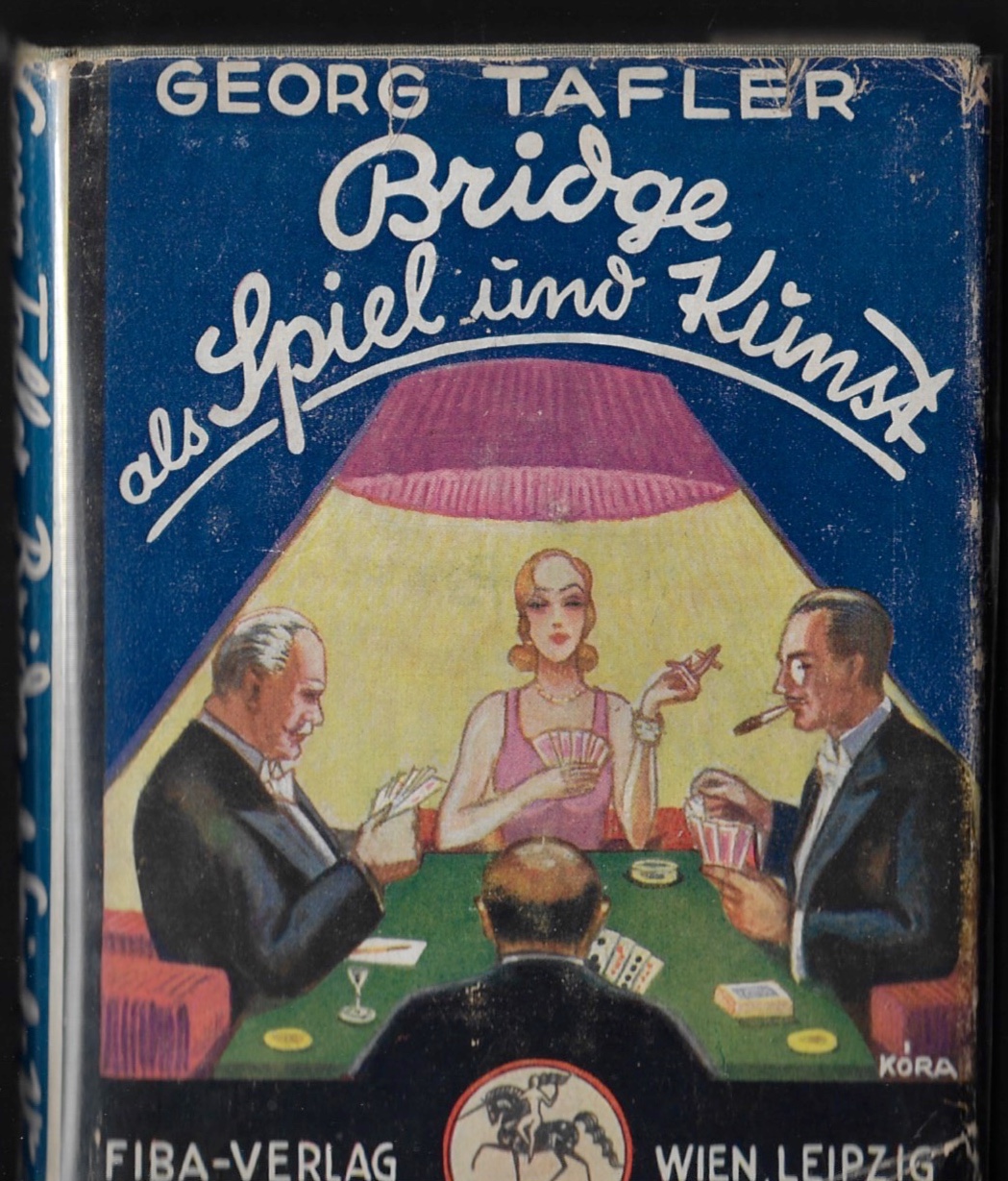
Georg Tafler, Bridge als Spiel und Kunst, Vienna, 1930.
Vanderbilt’s contract bridge was accepted as the international bridge system in 1932 by the world’s leading bridge organisations: the Portland Club of London, the Whist Club of New York and the French Bridge Commission. Culbertson introduced the first bridge conventions and shaped the game as we know it today. It soon became the card game for the well-to-do in America and England.
The famous (Belgian) detective Hercule Poirot also played bridge in 1936.

Agatha Christie, Cards on the Table, London, 1936.
On the one hand, this fascinating game with an almost infinite number of combinations is considerably more complicated than, for example, ‘klaverjassen’ or ‘Jass’. On the other hand, it is more social than, for example, chess.
The triumph of bridge in Europe and Switzerland began in 1947 after the founding of the European Bridge League, based in Lausanne. The FSB (Fédération Suisse de Bridge) was established on 18 March 1950, followed by the World Bridge Federation in 1958, also based in Lausanne and recognised by the International Olympic Committee (IOC).
IOC President Juan Antonio Samaranch (1920-2010) stated at the opening of the first Bridge Grand Prix in the Lausanne Olympic Museum in September 1998 that bridge was also a competitive sport. Bridge was a demonstration sport at the 2002 Winter Olympics in Utah (USA).


European Bridge League, Lausanne. Photo: Headquarters | European Bridge League (eurobridge.org) and the logo of the World Bridge Federation.
The FSB has around 3000 members and 52 clubs. The minor club has five members in Sainte-Croix (canton of Vaud), and the largest has 271 members in Zurich. In addition, many bridge players are not club members.
Swiss teams participate in the World and European championships, the Sports Games (a type of Olympic Games for bridge players), national, regional, and local championships, as well as tournaments in clubs, cities, and communes.
Gerry Link and Max Saesseli were champions for Switzerland in the 1993 European Senior Pairs Championship. The Swiss team became world champions in April 2022, followed by the U31 in August 2022.


The FSB competition at the national level consists of Leagues A and B, each with eight teams. They play in a two-weekend Round Robin in November (all teams play against each other). At the third weekend, the finals and barrage matches take place.
The lower leagues I-IV are divided geographically. These leagues are split into eight teams that play at two weekends in November.
The country’s multilingualism also plays a role. Bidding and communication are often conducted in three national languages: Italian, German, and French, sometimes in Romansh, and frequently in English. For example: spades: Pik, pique, picche, palas, hearts: Cœur, cœur, cuori, cours, diamonds: Karo, carreau, quadri, pizs and clubs: Treff, trèffle, fiori and cruschs.
The bridge association FSB’s name is only in French, but its seat is in the German-speaking city of Zurich. St. Moritz, Crans-Montana, Geneva, and Zurich host the most prestigious international tournaments. The larger towns and communes also organise annual bridge events.
Sources: Fédération Suisse de Bridge, Zurich; Suvretta House and Hotel Kulm Archives in St. Moritz; Belle-Époque Hotel Museum Waldhaus, Flims.
