The Panorama of Thun and other Swiss Panoramas

The Panorama of Thun (1809) by Marquard Wocher (1760-1830) is the oldest surviving panorama in the world, dating back 210 years.

No more than 21 other panoramas made before 1900 survived, four of which can be seen in Switzerland: Einsiedeln (the crucifixion of Christ), Murten (the battle of Murten 1476), Lucerne (the flight of the French general Bourbaki to Switzerland (1871)) and Thun (the town of Thun around 1809).

The panorama is a unique art and media form popular in the first half of the nineteenth century. It was the first optical mass medium, and people could see their cities, landscapes, historical events, and battles. This was a time of globalisation, the beginning of the Industrial and Scientific Revolution, and the rise of tourism to Switzerland and the Alps.

However, few could afford these trips, and panoramas offered a spectacular, accessible and not overly expensive opportunity (most panoramas charged a reduced entrance fee).

Robert Barker exhibited the first panorama in 1787, London’s first Cyclorama. Standing on a platform, one could see the whole city. Many scenes followed, but by the end of the nineteenth century and the appearance of photography, trains and cars, people got other resources, and the panorama disappeared. Most panoramas were sold in pieces or destroyed.

Today, however, the panorama is making a spectacular comeback, as Yadegar Asisi (1955) shows with his panoramas (Rome 312, Battle of Leipzig 1813, Pergamon museum pieces from the ancient world (Berlin) and Luther 1517 (Wittenberg).

The panorama of Thun was saved by luck, funding and the vision of a few. It depicts the town of Thun around 1809, initially located in Basel, from 1899 in Thun, and in 1961 in the rotunda of Thun’s Schadaupark.

Thun was the ideal Swiss town to show: city, lake and mountains in the background. It is still a unique document of life, buildings, and nature in Thun around 1900.

(Source: D. Imhof and others (ed.), Marquand Wocher, Das Panorama von Thun, Thun, 2009; Thun Panorama).

100 Years Lia Rumantscha

This year is a festive period for the Lia Rumantscha, the Romansh organisation. The organization is committed to the Romansh language and culture since 1919. The Lia Rumantscha organizes a language and culture festival in Zuoz in the Upper Engadine. It will take place in August.

The programme offers events on various themes of the Romansh language and culture. There is for example the Di da famiglia (4.8.2019), a day at Grischun triling (11.8.2019) and the Festa da 100 onns (17.8.2019). In the evening the theatre production will be shown.

(Source: www.liarumantscha.ch).

Morat, Burgundy, the Obelisk, the Panorama the Eidgenossen

Morat (Murten in German) is one of the cities that, by the fate of history, belongs to the canton of Fribourg (Freiburg).

The Dukes of Zähringen founded the city in the second half of the twelfth century, in the same period as the foundation of Bern and Fribourg.

The Burgundian wars (1474-1477) were crucial. The city chose Bern and Freiburg against Burgundy and Savoy in 1475. After the defeat of Burgundy in 1476, the city was ruled by Bern and Freiburg until 1798.

The Duke of Burgundy besieged Morat after the defeat in March 1476 at Grandson; Burgundy suffered another crushing defeat on 22 June. The Duchy lost for the third time in 1477 (at Nancy). Duke Charles the Bold (1433-1477) died in combat, and the Kingdom of Burgundy never materialised.

Morat was assigned to the canton of Fribourg by the Act of Mediation (1803).

Lord Byron (1788-1824) wrote in 1816:

While Waterloo with Cannae’s carnage vies, Morat and Marathon twin names shall stand;
They were true Glory’s stainless victories,
Won by the unambitious heart and hand
Of a proud, brotherly, and civic band, ….

The Obelisk of Meyriez (1821)

The famous Panorama (1893) by Louis Braun (1836-1916) is on view in Museum Murten.

Picture: Panorama de la Bataille de Morat 1476

The Prince-Bishopric of Basel till 1813

The history of the bishopric of Basel (Basilia in Roman times) goes back to the Roman Empire. In the fifth century, the bishop moved from Augusta Raurica (Augst) to Basel, prompted by the invasions of Germanic tribes (Alamanni). The hill in Basel offered an excellent refuge and had some defensive walls.

The ancient palace of the bishop in Augusta Raurica (Augst)

The bishopric led a politically and culturally inconspicuous existence until the time of the Empire of Charlemagne. The bishops Wado and Haito (762-836) were advisers of Charlemagne and initiators of crucial cultural changes.

The diocese acquired the rights of Moutier-Grandval Abbey in 999 as a gift from Rudolf III (971-1032), the last king of Burgundy. The bishop became the vassal and Prince of the Holy Roman Empire in 1033. It was the beginning of the Prince-Bishopric of Basel, which formally lasted until 1803.

Emperor Henry II (953-1024) financed the renovation of the Münster in Basel, the cathedral. The Prince-Bishopric became the most powerful state on the Upper Rhine by acquiring St. Ursanne Abbey in 1146 and conducting military expeditions in the thirteenth century.

Delémont, Musée d’art et d’histoire. 

The possessions encompassed the Jura, the Sundgau, southern Alsace, Birseck, Birstal, and territories south of Germany.

The Eidgenossen confiscated the southern part of the Jura and the cities of Biel and Moutier in 1476 and 1477 (after the Burgundian Wars). The northern part of the Jura and the cities Délemont, Porrentruy, and St. Ursanne remained the possession of the bishopric.

The town hall (Rathaus) of Basel

When Basel joined the Eidgenossenschaft in 1501, the relationship between the bishop and the city council became increasingly complex. The Reformation forced the bishop to move his seat to Porrentruy (Pruntrut in German) in 1527. The Chapter went to Freiburg im Breisgau and in 1678 to Arlesheim.

The architecture and grandeur of Porrentruy bear witness to the splendour of the prince-bishop and his court. The Treaty of Westphalia (1648) caused a further (political) separation between the northern and southern parts of the Jura.

Delémont (Delsberg), the castle of the chapter and the bishop’s summer residence 

The prince-bishopric’s area (including the northern part of the Jura) remained a Catholic principality of the Holy Roman Empire. Protestant Bern kept its possessions in the southern part of the Jura.

The world would no longer be the same after 1792. Five political constructions succeeded in 13 years.

Collection: Musée jurassien d’art et d’histoire, Delémont

1792-1815

In 1792, the northern Catholic part of the Jura became the French République rauracienne. In 1793, this region merged with the French department Mont-Terrible. In 1798, France annexed the southern part of the Jura to this department.

In 1800, the whole area of the prince-bishopric was added to the Haut-Rhin department. This situation remained until Napoleon’s defeat. In 1813, Allied troops occupied the area, and Arlesheim was the seat of the Allied administration.

The four great powers decided to divide the territory of the Prince-Bishopric between Bern and Basel at the Congress of Vienna (1814-1815). Bern got the entire area and the Laufental of the bishopric, minus Birseck, as compensation for losing other places (the new cantons of Vaud and Argovie). The Birseck was assigned to the canton of Basel.

Delémont, Musée d’art et d’histoire. 

The new canton of Jura was founded in 1979 to separate from the canton of Bern. In 1833, the Birseck joined the new canton of Basel-Landschaft. The Laufental left the canton of Bern in 1994 and joined the canton of Basel-Landschaft in 1994. Due to the referendums (2017 and 2021), Moutier will leave the canton of Bern in 2026 and become part of the canton of Jura.

(Source: A. Berchtold, Bâle et Europe. Une histoire culturelle, Lausanne 1990)

See also the Bishopric of Basel after 1815

Delémont, Musée d’art et d’histoire. 

Romont Castle

The castle of Romont was built in 1240 by Pierre II of Savoy (the Little Charlemagne, 1203-1268). The castle houses the glass museum (Vitromusée) nowadays. The museum has a unique stained glass collection from the Middle Ages, Renaissance, Art Nouveau to contemporary works.

(Quelle: F. Guex, Romont, Stiftskirche und ehemalige Kapuzinerkirche, Bern, 2014).

Urbanism and the watchmaking industry

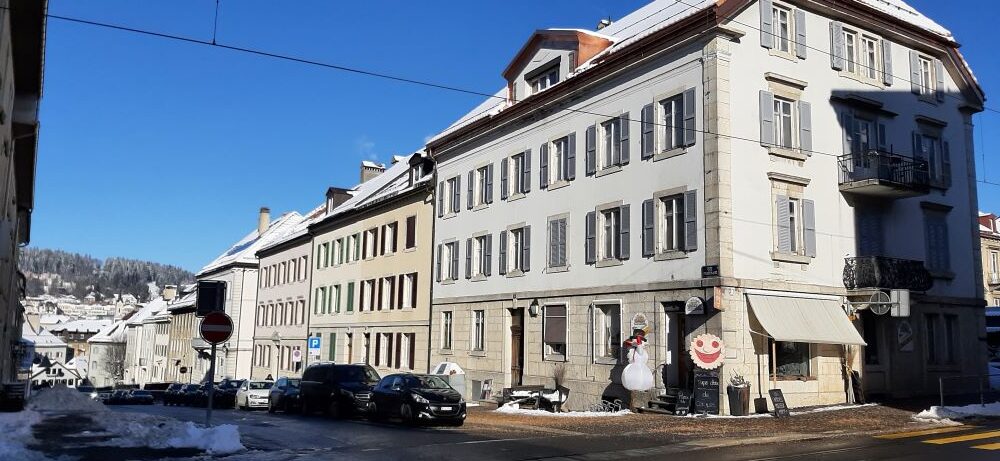
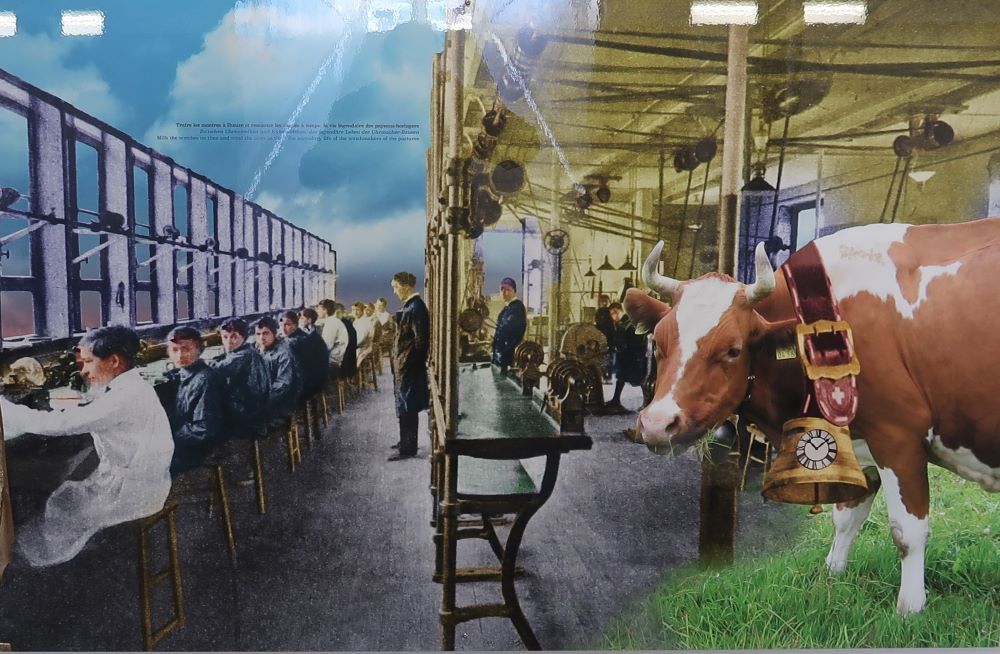
Since 1705, the Neuchâtel Region has been producing watches and clockworks. This watchmaking industry has shaped the way cities live and even influenced town planning.

The cities of La Chaux-de-Fonds and Le Locle embodied the urban and architectural unity dedicated entirely to clock and watch production, as they were built by and for this industry.

Before the Industrial Revolution took off in the nineteenth century, small villages dominated, and farming was the most important economic activity. The

Espace d’urbanisme horloger is a multimedia space devoted entirely to the watchmaking town planning of La Chaux-de-Fonds.

This event is the key to understanding the origins of the city’s status as a UNESCO World Heritage site and offers an exhibition and a film highlighting the city’s impressive industrial heritage and unique urban concept.

(Source and further information: www.timExplorer.ch).

The vineyards of Lavaux

The vineyards of Lavaux, also known as the Lavaux region, are often referred to as the “Land of the Three Suns”: the sun from the sky, the sun reflected from Lake Geneva (Lac Léman), and the sun absorbed by the walls, which acts as a heat source.

Lavaux’s landscape is one of the most extensive vineyard areas in Switzerland, encompassing 14 villages. It is located in the Canton of Vaud, on the shores of Lake Geneva, between Vevey and Lutry, and is a UNESCO World Heritage Site.

(Source and further information: www.lavaux-unesco.ch)

Dornach, 1499, Nepomuk and Schwarzbubenland

Schwarzbubenland consists of the Dorneck and Thierstein districts in the Solothurn canton. Dornach is derived from Tornacho, Tornegg, or Tornach, the Celtic-Latin name for a type of fundus turranicus. A Gallo-Roman settlement existed in the first centuries AD.

The medieval ruins of the castles Dorneck and Hilzenstein, the Goetheanum, the monastery, and the Nepomuk bridge have stories to tell. A flood destroyed the bridge in 1813, and only the statue of St. Nepomuk remained intact.

Das Goetheanum