Erasmus and Basel

Desiderius Erasmus (1466-1536) spent ten years in Basel in four periods (1514-1516, 1521-1529, 1535-1536), like many of his contemporaries, the humanist and scholar travelled throughout Europe. The elite of artists, scholars, students, traders, monks, and spiritual and secular (aristocratic) rulers was much more European in the Middle Ages than it is nowadays.

Holbein was responsible for the artistic design of the publications from Froben’s publishing house, founded by Johann Froben (1460-1527), and Erasmus’s works. His son Hieronymus Froben (1501-1563) took over the printing/publishing business in 1527.

House of the Froben family and Hans Holbein the Younger  (1497-1543), 1523, impresa of Johann Froben. Collection: Kustmuseum Basel, Amerbach-Kabinett

Latin was the lingua franca. They read the same books, listened to the same music, had the same cultural background, and shared the same (university) education. In short, they spoke the same language, which did not detract from the many (religious, economic, political or dynastic) differences, (belligerent) strifes and disagreements. The rise of the nation-state in the nineteenth century changed this attitude and mentality.

Collection: Historisches Museum Basel

Erasmus felt at home in an environment of learning, humanism and (relative) tolerance. Basel was the European centre of humanism and the capital of publishing and printing in the fifteenth and sixteenth centuries.

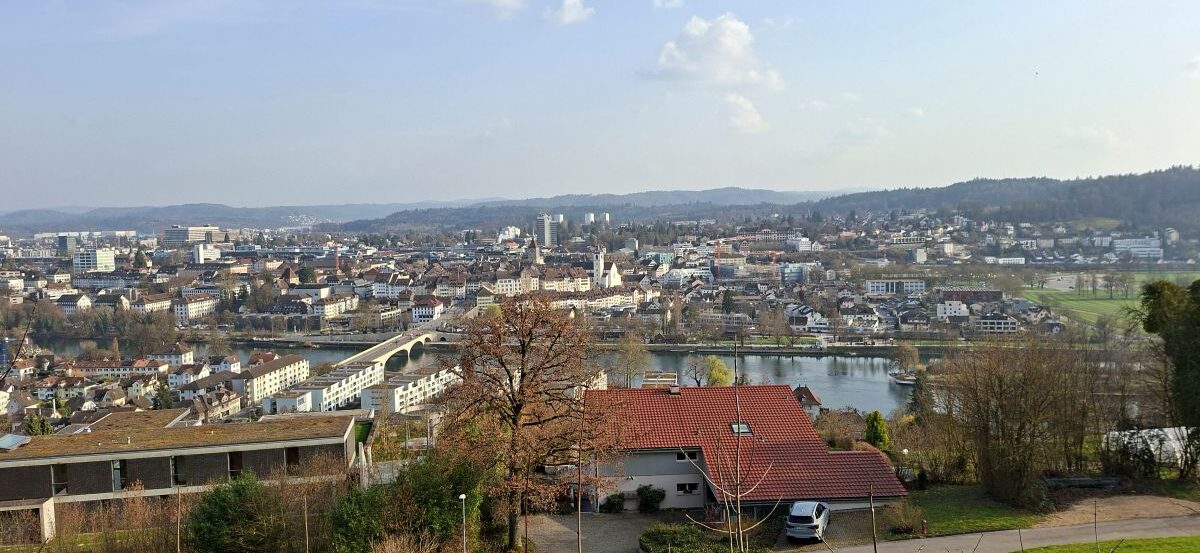
Basel 2022, Rhine, the cathedral (das Münster) and the ancient building and garden of the university (1460)

The Swiss Museum for Paper, Writing, and Printing (The Basler Papiermühle) in St. Alban, Basel, is a cultural monument to the industry’s heyday.

Many of Erasmus’s works were written, printed, and published in Basel. For example, his famous Greek translation of the New Testament was written and published in Basel by his friend Johann Froben.

From 1525 to 1529, Basel adopted the Protestant faith. Erasmus left for Freiburg (Baden) but returned in 1535. He died on 11 July 1536 and was buried in the Basler cathedral near his last residence, Haus zum Lufft, in the Bäumleingasse.

Basel, the cathedral

The Münsterplatz

The well-kept Christian Heritage of Switzerland

Even Switzerland, with its many (dissolved or still-functioning) monasteries and monumental (Reformed and Catholic) churches, will not formally be a Christian country in the foreseeable future. In the foreseeable future, most of its citizens will be ‘without religion’.

However, in terms of symbolism, a country cannot be more Christian than Switzerland. The Swiss cross in the national flag, the red cross of the International Red Cross, the arms of various cantons (among others, the bishop’s staff of the cantons of Basel-Landschaft, Basel-Stadt and Jura, the keys of St Peter of Obwalden and Nidwalden or Saint Fridolin of Glarus), the national anthem is a psalm and the Constitution begins with the words ‘In the name of the Almighty God’.

Interior of the St. Peter Church in Gelterkinden

Although the Christian religion is rapidly declining in importance, the social, humanitarian and humanistic function of churches at the local level will hopefully not be lost. At least the cultural heritage of Christianity is respected and maintained in Switzerland.

Not only does the country have the oldest dioceses north of the Alps (Chur, Kaiseraugst/Augst (Augusta Raurica)–Basel, Martigny-Sitten, Avenches-Lausanne and Geneva), it also maintains the Frankish, Carolingian, Romanesque, Gothic, Baroque, Rococo and Neoclassical heritage, not to mention some startling 20th-century churches.

The St. Gallus Church in Kaiseraugst

As is well known, Christianity developed within the administrative, logistical, cultural, and political structures of the Roman Empire. The bishopric in Augusta Raurica is one example. The bishop’s palace and church were among the first in Switzerland until the 6th century, when he moved to the Münster in Basel.

Kaiseraugst lies on the Rhine, and one of its smaller water suppliers is the stream Ergolz, which flows into the Rhine at Augst. Upstream to its source on the Geissflue in the Jura are various monumental (Catholic and Reformed) churches.

The region was inhabited in Roman times by the Celtic tribe of the Rauraci. The emigration of the German-speaking pagan Alemanni after the departure of the Romans in the fifth century did not mark the end of the Christian world of the Romanised Celts (Gallo-Romans). The Christian Franks defeated the Alemanni. They continued to spread Christianity in this region, and the construction of churches began.

Oltingen, St. Nikolaus Church

The towns and villages of Liestal, Sissach, Ormalingen, Otlingen and nearby Arisdorf and Gelterkinden host some sites of Switzerland’s remarkable Christian heritage upstream of the 30-kilometre Ergolz.

Impressions

Oltingen, Kirche St. Nikolaus

The old ‘Beinhaus’  on the left


Ormalingen, Kirche St. Nikolaus 

Sissach, Kirche St. Jakob

Liestal, Kirche St. Martin

Arisdorf

Gelterkinden

(Source and further information:  Gesellschaft für Schweizerische Kunstgeschichte/ Société d’histoire de l’art en Suisse)

The Morges Tulip Festival

The Morges Fleur du Léman association recently presented the 54th Morges Tulip Festival programme, which starts on Good Friday, 29 March, and ends during the Ascension weekend on 12 May. With 288,000 registered visitors in 2023, the Morges Tulip Festival is Switzerland’s largest flower festival.


The main innovation is a new catering concept that highlights regional products. Offering a maximum of regional and local products is the starting point.

This year’s theme is “Countries of the World,” with concerts, Thés dansants, and dance performances will be held in cooperation with the music pavilion in the Parc de l’Indépendance.

The “Wine Taster’s Day” offers wine tastings from the region. While traditional events such as the pottery market on 6 and 7 April or the barrel organ music on 14 April are back, a new arts and crafts market will be offered along the river Morges on Ascension Day, Thursday, 9 May.

(Source and further information: www.tulpenfest.ch)

The Disentis Monastery

The monastery of Disentis in the village of Disentis/Munster (Munster means “monastery” in Romansh) was founded around 700.

The Saracens destroyed the monastery in 940. Charlemagne (748-814) and German emperors of the Holy Roman Empire travelled to Italy via Disentis on their way to or from the Lukmanier Pass.

The monastery’s abbot was one of the initiators of the Graue or Obere Bund (the Grey League) in 1395. In 1497, the Grey League became an ally (Zugewandter Ort) of the Eidgenossenschaft.

The abbot played a decisive role in this process. The following two centuries were dominated by the Reformation in the Freistaat der Drei Bünde (from 1524 to 1803, the canton of Graubünden). Disentis, however, remained Catholic.

The complex was rebuilt in the Baroque style at the end of the 17th century.
The war between France, Russia, and Austria reached Disentis in 1799. The monastery was looted.

However, the new canton did not abolish it after 1815. For this reason, the monastery entered its fourteenth century with the renovation of the Lady Chapel (Maria Kapelle).

(Source and further information: Kloster Disentis)

Impressions

The church

The chapel

\

Further Impressions

Lenzburg Castle, its history and famous Residents

In Lenzburg (Canton Aargau), an impressive medieval castle towers high above the town. It is one of the best-preserved Höhenburgen in Switzerland.

The town of Lenzburg has an even older history. The remains of the Roman Amphitheatre, which could hold 4,000 spectators, indicate an important settlement in Roman times.

However, the Roman name has yet to be discovered. Still, the nearby Roman garrison of Vindonissa (today’s Windisch), the border river (Limes), the Rhine and Aare and Roman roads made the location of today’s Lenzburg relevant from a military, transport and commercial point of view.

The name is derived from the Alemannic word ‘Lencis’ and shows the presence of this German-speaking tribe after the Romans’ departure. The first known written mention dates back to 893 (see also the museum Burghalde in Lenzburg).

The castle (castellum) Lenciburg is mentioned in a document from 1077, at the time of Count Ulrich II of Lenzburg. This dynasty died out in 1173. The Emperor of the Holy Roman Empire, Frederick I (Emperor Barbarossa 1121-1191) ) inherited the castle. After his death, the Counts of Kyburg acquired the castle and, after the extinction of this family in 1263, the Habsburgs.

Lenzburg received city rights in 1306, and the town and castle took on their medieval contours. Numerous renovations and extensions continued until the 19th century.

Bern conquered Lenzburg (and Aargau, apart from the Fricktal) in 1415 and acquired the castle in 1444. From 1444 to 1798, Bern’s bailiffs lived in the castle. Bern introduced the Reformation in Lenzburg in 1528.

The coats of arms of Bern and Habsburg are at the main gate, demonstrating Habsburg’s great prestige.

After the creation of the canton of Aargau, Lenzburg became a district capital in 1803. The town became a major producer of cotton and a centre of the Lenzburg “cotton lords”. At the time, English textile manufacturers and politicians were also very impressed by the innovative textile industry in Lenzburg and the Confederation.

The Canton of Aargau administered the castle from 1803 to 1860. After 1860, famous Swiss, German, English, and American families, successively the Pestalozzi-Scotchburn, Wedekind, Jessup-Bowes Lyon, and Ellsworth families, owned the castle.

The Canton of Aargau and the city of Lenzburg finally bought the castle in 1956. The (Verein)  Freunde der Lenzburg Association manages the castle and its museum today.

(Source and further information: Stadt Lenzburg; Schloss Lenzburg)

Impressions from the castle and Lenzburg

Photo from Lenzburg Castle, on the opposite hill the Staufbergkirche

The town hall (Rathaus)


De Aabach

Aarau, or the emergence of a capital

The city of Aarau (Canton of Aargau) takes its name from the river Aare, the largest tributary of the Rhine. A few kilometres away, the Aare flows into the Rhine at the Swiss town of Koblenz, continuing its journey to Rotterdam.

The Aare and the hydropower plant near Aarau

Aarau is not just any town; it is the capital of the canton of Aargau. Neither the Celts nor the Romans, the Habsburgs nor the inhabitants of Aarau had this status in mind until 1798.

Due to its location on the Aare, this region was already inhabited in both Celtic and Roman times. The Counts of Kyburg founded the place around 1250. The castle, mill and old city walls and towers also date back to this time.

The medieval mill and castle

King Rudolf I of Habsburg (1218-1291) acquired the place in 1273 and granted it city rights in 1283.  In 1415, however, Bern and Solothurn conquered much of Aargau (only the Fricktal remained Habsburg property until 1803). Aarau was then governed by Bern as Untertanengebiet (with relatively large autonomy).

Aarau was Habsburg territory until 1415. The Habsburg double eagle and the coat of arms of Bern can be seen everywhere in the city

During the Reformation, the citizens chose the Protestant faith with a small majority, and from 1531, the meeting (Tagsatzung) of the representatives of the Reformed cantons regularly took place in Aarau. However, Baden remained the main venue for the Tagsatzung of all (Catholic and Protestant) cantons, although religious (and other) divisions hampered its effectiveness.

Haus zum Schlossgarten

The French invasion of 1798 ended nearly four centuries of Bern rule in March. French revolutionary ideals also found an enthusiastic audience in Aarau, and on 12 April, the Helvetic Republic (1798-1803) imposed by the French occupiers was proclaimed from the city hall. The parliament of this unitary state sat in the town hall, and the government (the directorate) was in the Haus zum Schlossgarten.

Aarau then effectively became Switzerland’s first capital. This status was short-lived. The infrastructure was lacking, and from September 1798, Lucerne became the new capital of the Helvetic Republic, serving as the seat of parliament and the directorate.

However, the revolutionary ideals of 1798 soon gave way in Aarau too to the reality of French occupation and an unwanted unitary state. (Armed) Rebellions erupted throughout this republic, and Napoleon personally intervened in 1803. He dissolved the Helvetic Republic and, through the Acte de Médiation (Act of Mediation), restored the old confederation of cantons by creating six new cantons, including canton Aargau (including the Fricktal).

Regierungsgebaude

Aarau becomes the capital of the new canton. Like other cantonal capitals, which are effectively villages, for example, in the cantons of Schwyz, Glarus, Appenzell, Obwalden, and Nidwalden, Aarau is a micro-level metropolis, just as Basel, the capital of the canton Basel-Stadt, is a cosmopolitan, multicultural metropolis with the rhythm of life of a village.

(Source and further information: A. Lüthi, Aarau, Historisches Lexikon der Schweiz, 25.11.2016; Gemeinde Aarau)

Impressions from Aarau


The Stadtmuseum

The Aargauer Kunsthaus

Heinrich Zschokke (1771-1848)

Flowers for Art in Aarau

From 5 to 10 March 2024, the Aargauer Kunsthaus celebrates the start of spring with the exhibition “Flowers for Art” (Blumen für die Kunst).

Hans Ernst Brühlmann, Mädchen auf dem Hügel, 1907. Florist Massimo Bundi

Arnold Böcklin, Bergschloss mit Kriegerzug, 1871. Florist: Rémy Jaggi

The Kunsthaus presents this exposition in cooperation with Flowers to Arts, ” which brings the spring to Aarau. The florists will be inspired by works of Art from the Aargauer Kunsthaus collection, giving them a floral response.

Flowers for Art bridges floristry and Art, offering surprising perspectives on the 14 works in the collection.

(Source and further information: Das Aargauer Kunsthaus)

Otto Morach, Fabrikumbau, 1916. Floristin: Angela Kaspar

The Cave Bear of Wenslingen, Grossholz near Ormalingen and the Ergolz in Oltingen

The stream Ergolz in the canton of Basel-Landschaft has a length of about 30 Kilometres. It originates at an altitude of 830 metres at the Geissflue on the cantonal border of Basel-Landschaft and Solothurn. It then flows through, among others, the villages of Anwil, Oltingen, Rothenfluh and Ormalingen on its way to the Rhine.

Anwil

The Ergolz is the vein of the Talweiher Nature reserve and its fens (Weiher). Numerous waterfalls and streams flow into the Ergolz, an essential habitat for the Black Woodpecker, the beaver, and numerous other animals, as well as a rich variety of flora.

The borders of cantons sometimes pass through villages and towns. Moreover, there are sometimes enclaves of cantons (e.g. in the region of the Murtensee/lac Morat and Schaffhausen/Zürich) and even of neighbouring countries within cantons (e.g. Campesino in canton Tessin and Büssingen in canton Schaffhausen). The village of Oltingen also had such a history with the Ergolz as its border stream.

The Ergolz in Oltingen

Oltingen, the Schaffmatt  (820 m) in the background

The St. Nikolaus church (1296) was renovated in the 15th century with beautiful wall paintings (15th century).

In the Middle Ages, the counts of Homberg, Froburg, Homburg, and Thierstein successively ruled the village. Basel acquired the town in 1461. However, the Ergolz separated the village into two parts. The right bank remained the property of Habsburg until the 17th century. Basel acquired this part only in the 17th century.

Ormalingen and the Ergolz

Ormalingen is another village on the banks of the Ergolz. Ormalingen is not only known for the Ergolz and its medieval church. Just beyond the village, one of Switzerland’s largest contiguous forest areas, the Grossholz, begins. The Grossholzweg, therefore, lives up to its name, nomen est omen, with beautiful views of valleys, villages, meadows and streams.

Grossholz

One of these villages is Wenslingen, with its monumental buildings, farmhouses, and views of the Wiesenberg in a landscape of ‘Kopfweiden’, arable land, and picturesque streams.

Wenslingen

Wenslingen, Ormalingen, and Oltingen are derived from Alemannic names. The Alemannic tribe, a German-speaking group, migrated to this region after the Romans’ departure in the 5th century. Upon their arrival, (vulgar) Latin was the spoken language of the Romanised Celts. However, German (specifically, the Alemannic dialect) became the spoken language within a few generations.

De Wisenberg (1002 m)


Ormalingen, Wenslingen, Oltingen and Anwil are only a few kilometres apart. However, even this short stretch boasts numerous cultural and natural attractions, and cave bears felt at home thousands of years ago, as evidenced by the cave (Bärenloch) near Wenslingen and the remains of a cave bear, including its bones and teeth.

The Ergolz eventually flows into the Rhine at the ancient Roman Colonia Augusta Raurica (present-day Augst, Canton of Basel-Landschaft and Kaiseraugst, Canton of Aargau), near the Wyhlen-Augst hydroelectric power station.

Thus, the circle is complete. After all, the Wenslingen, Ormalingen, and Oltingen areas were also inhabited in Roman (and prehistoric and Celtic) times, and the Ergolz, together with a Roman road, connected these villages.

The Swiss Alpine Club

The Swiss Alpine Club (Schweizer Alpen Club, SAC/Club Alpin Suisse, CAS) regularly organises hikes in this area and elsewhere in the country.

(Further information: www.sac-cas.ch)

The Talweiher Nature Reserve

The fens (Weiher)


La Chaux-de-Fonds, The Sapin-Style and Charles L’Eplattenier

Between 1905 and 1914, students at the École d’Art (Art School) de La Chaux-de-Fonds (canton of Neuchâtel), under the guidance of their teacher Charles L’Eplattenier (1874-1946), devised an original artistic language (le Style sapin) inspired by the Jura’s local nature. Sapin means pine, and there are plenty of them in this region.

In the early twentieth century, La Chaux-de-Fonds was a developing town. In barely sixty years, the population had tripled, and the isolated village in the middle of the forests at an altitude of 1,000 metres in the Jura Mountains had become an industrial town of 40,000 inhabitants, a factory town focused entirely on watchmaking.

La Chaux-de-Fonds established several specialised schools to train its pupils: L’École d’horlogerie (the watch school), of course, but also l’École de mécanique (the mechanic’s school), l’École de commerce (the trade school), l’École professionnelle de jeunes filles (the vocational school for young girls) and, finally, l’École d’arts appliqués à l’industrie (the school of applied arts for industry), or l’’École d’art (Art School).

The La Chaux-de-Fonds art school was founded in 1870 by the Société des Patrons Graveurs. The city took over the school in 1872 and moved to the new Collège Industriel (now the Collège Numa-Droz and the city library) a few years later.

Charles L’Eplattenier. Foto: Wikipedia

Charles L’Eplattenier

Charles L’Eplattenier was born on 9 October 1874 to a farming family near Neuchâtel. During his apprenticeship as a house painter, he also took drawing lessons. Talented and passionate, he was sent by his family to Budapest, where he enrolled at the School of Decorative Arts. Thanks to a cantonal scholarship, he attended the École Nationale Supérieure des Beaux-Arts in Paris for three years to study.

In 1897, back in his canton, Charles L’Eplattenier was hired by the École d’art de La Chaux-de-Fonds as a drawing teacher. He was 23, highly ambitious and charismatic.

Charles L’Eplattenier, Les Musiciennes, 1907, still Art Nouveau. Collection: Musée des beaux-arts de La Chaux-de-Fonds

In 1905, L’Eplattenier proposed establishing a higher art and decoration course for the school’s most talented students. A major innovation was that this course would no longer be limited to horology-related subjects.

L’Eplattenier changed the entire education system, revised the curriculum and resolutely applied modern and innovative teaching methods. His great ambition was to create a new formal artistic language, le Style sapin (Pine-Style), rooted in Jura.

He dreamed of inventing with his students a regionalist variant of Art Nouveau (Jugendstil in Germany, Modernismo in Spain) specifically for La Chaux-de-Fonds.

André Evard (1876-1972), Femme à la Fourrure, 1909. Collection: Musée des beaux-arts de La Chaux-de-Fonds

L’Eplattenier wanted to use the Jura’s nature, its flora and fauna, as his primary (if not only) source of inspiration. He defined a method in five successive stages, which his students had to master one by one: starting with the observation of the natural form in situ to extract the essential element, the idea, and gradually arriving at a geometric, stylised motif that could then be used in decorative compositions.

Inspired by L’Eplattenier, the École d’art de La Chaux-de-Fonds participated in competitions and international exhibitions, winning the honorary diploma at the Milan International Exhibition in 1906 for the pocket watch cases created by its students.

Les Ateliers réunis and the Villa Fallet

In 1910, L’Eplattenier launched the Ateliers d’arts réunis to ” encourage cooperation between artists, industrialists and merchants”. The Ateliers produced mainly decorative commissions that served as practical work for students.

They designed approximately a dozen interiors, including the homes of watchmakers, such as the Salon Bleu Spillmann, the post office hall in La Chaux-de-Fonds, the chapel in Cernier-Fontainemelon, and the observatory pavilion in Neuchâtel.

Observatory in Neuchâtel

The following year, L’Eplattenier broke away from the school by creating a New Section within the School of Art. The aim was to collaborate on joint projects and, ideally, to integrate artistic production into society and the local region.

L’Eplattenier was assisted by three assistants, including Charles Édouard Jeanneret (1887-1965), the future Le Corbusier. Together with Jeanneret, he convinced watchmaker Louis-Edouard Fallet (1845-1916) to entrust the entire design and construction of his villa to students at the school. The Villa Fallet would become the ultimate manifesto of the Sapin style—a collective and total work of art.

The end and rediscovery of the Sapin-Style

In just a few years, Charles L’Eplattenier had made the art school one of the three most prestigious in Switzerland, alongside those in Zurich and Geneva. However, despite, or thanks to, these successes, from 1913, L’Eplattenier came into open conflict with his management and with the ‘classical’ teachers at the Collège Industriel.

His assistants attempted to save the Nouvelle Section and received support from the prominent figures of Art Nouveau in Paris, Berlin, and Munich, who signed a manifesto. In vain, the city council closed the section on 1 August 1914. Les Ateliers réunis went bankrupt two years later due to a lack of sponsors.

The term “sapin style” is a recent invention: L’Eplattenier and his contemporaries never used it. The style was quickly forgotten, and many of his creations were destroyed: the post office hall lost its decorations in 1959, and the chapel in Cernier-Fontainemelon was converted into flats in 1975 (although the original stained-glass windows were recovered in a warehouse last year).

The rediscovery and ‘sapin-style’ adventure dates back some 15 years. Today, the Musée des Beaux-arts de La Chaux-de-Fonds dedicates a room to it, where the famous stained-glass windows and their characteristic motifs, including gentians, thistles, and pine trees, can be seen.

Lars Kophal (Neuchâtel), editor and journalist 

Some Impressions of the Style Sapin Collection of the Musée des Beaux-Arts de La Chaux-de-Fonds

Some more impressions of the Jura