

The Concert Hall and Culture of La Chaux-de-Fonds
30 March 2022
Zurich, Lucerne, Geneva and Basel are known for their beautiful or recently renovated concert halls. Much less known is the concert hall (la Salle de Musique) of La Chaux-de-Fonds (canton of Jura). The building opened in 1955, adjacent to the opera house, which was built in 1837.
The interior is solid and beautifully designed, primarily wooden, with a simplicity that is only surpassed by the quality of the much-praised acoustics. The almost 130-year-old Sociéte de la Musique took the initiative for this acoustic and architectural masterpiece.
It is part of the city’s tradition to invite the most significant artists in classical music and to offer space to the workers’ organisations. They have made this industrial town the capital of watchmaking and a UNESCO World Heritage site since 2009.

Image: Espace de l’urbanisme horloger
It is also part of this town’s rich cultural tradition of almost 40,000 inhabitants at an altitude of 1,000 metres. The impressive and interesting International Watch Museum (Musée International d’Horlogerie) is one such example.
The fascinating development of the watchmaking industry from the 18th century onwards in Switzerland (Geneva, Neuchâtel, Le Locle and many other places) is aptly portrayed in the freely accessible exhibition Espace de l’urbanisme horloger, which deals mainly with La Chaux-de-Fonds.


Le Corbusier, la maison blanche
The city is also the birthplace of and the primary source of inspiration for the architect Le Corbusier (1887-1965), the pseudonym of Charles-Édouard Jeanneret. He was a student of Charles l´Éplattenier (1874-1946). Le Corbusier’s buildings are listed as UNESCO World Heritage in several European countries, and this city. The town’s architecture is a jewel of Art Nouveau (and the local Art Sapin style), as well as Art Déco, and features a famous grid pattern.

After the devastating fire of 1794, the town was rebuilt to serve the watchmaking industry, with its workshops, logistics, and offices, while also providing quality housing for the workers. Cultural life has always been an essential aspect of social life for all classes. From the beginning of this industry’s heyday in the early nineteenth century, the wealthy local bourgeoisie generously supported cultural and social projects.
La Chaux-de-Fonds, therefore, has a rich cultural life for a relatively small town. Nevertheless, the city also experienced social unrest and a class struggle at the turn of the century (19th/20th century), but in the Swiss way: with a compromise.

The revolution against the Prince of Neuchâtel (the German king Friedrich Wilhelm IV, 1795-1861) and the elite of Neuchâtel also originated in La Chaux-de-Fonds (and Le Locle) and ultimately succeeded in 1848. The German king formally renounced his principality in 1857.
La Chaux-de-Fonds is not only historically, architecturally, culturally and socially attractive. The Jura region and its beautiful nature are added values as well.
(Source and further information: www.musiquecdf.ch; www.j3l.ch).
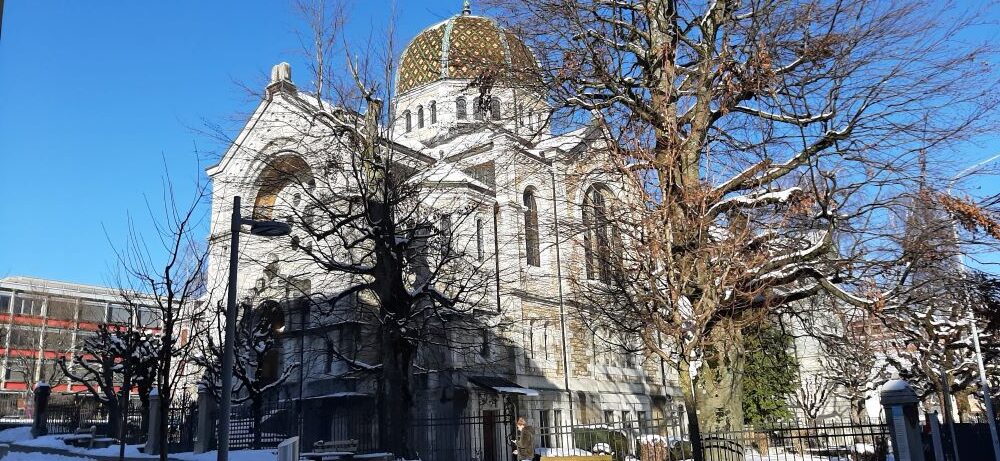
The synagogue, one of the most important in Switzerland