Gotthard Base Tunnel

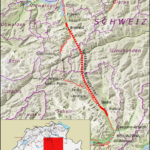
Since 1990, Switzerland has made efforts to ensure the development of the European transport system and the integration of the European high-speed rail network by building the Gotthard Base Tunnel (Gotthardbasistunnel).

The Gotthard tunnel is a crucial construction project on the European corridor connecting Rotterdam, Milan, and Genoa. The new freight line from Rotterdam to the Dutch-German border is another significant construction project. However, Germany and Italy failed to build the promised projects.

Verkehrshaus der Schweiz, Luzern. Photo: TES

The opening of the Gotthard Tunnel (1 June 2016) has a practical European meaning and symbolic value. The 15-kilometre Ceneri base tunnel in Italy and the connection between Karlsruhe and Basel are lacking. The extension of the so-called Betuwe line in the Netherlands to Germany shares a similar fate, as Germany is protecting the port of Hamburg.

The Gotthard Tunnel is also a significant milestone for the European Union. A small country in the middle of Europe has completed this project without corruption, without EU money, and a year ahead of schedule.

Jegenstorf, Haile Selassie and Bangerten

Former Emperor Haile Selassie (1892-1975) of Ethiopia stayed at Jegenstorf Castle (canton of Bern) for four days in November 1954 because of his state visit to Switzerland. The reception was a ‘Wiedergutmachung’ from the Swiss side.

The Swiss government did not grant asylum to the emperor in 1936 after Italy’s conquest of Abyssinia (the name of the empire), nor did it support the sanctions of the League of Nations ( the forerunner of the United Nations). Even then, the (dogmatic) Swiss policy of neutrality was already outdated.

Emperor Haile Selassie in  Jegenstorf Castle, 26 november 1954. photo: Björn Lindroos/zvgSalon,  Exhibition in Jegenstorf Castle, 2014

The emperor received a hero’s welcome in Bern in front of 100,000 spectators along the route and at the highest political levels. It is not known whether the emperor also explored the Jegenstorf area. In any case, he would then certainly have enjoyed the beautiful rose garden and coffee at the Hotel Kreuz in Grafenried.

Grafenried

The Rosegarten of restaurant Kreuz in Grafenried

He may even have taken a walk to villages in the area, with views of the Jura and Hotel Weissenstein and Mount Hasenmatt to the north (Solothurn canton) and the Alpine massif to the south.

Hotel Weissenstein (canton of Solothurn)

The rolling agricultural area between these two mountain ranges, the Mittelland, is the location of several characteristic villages. Fraubrunnen and Bangerten are a few examples of monumental village centres and farms. The varied forest, meadow and agricultural areas characterise this region.

Fraubrunnen Monastery

Bangerten (canton of Bern)

Not much is known about the emperor’s impressions or experiences. He ruled his empire for two more decades until he was deposed in 1975 and died under dubious circumstances.

It does not detract from the fact that Jegenstorf was a temporary residence of an emperor, thus giving an imperial touch to the area as well. Another fact is that the emperor has never been a member of the Schweizer Alpen Club.

The Swiss Alpine Club

The Swiss Alpine Club (Schweizer Alpen Club, SAC/Club Alpin Suisse, CAS) regularly organises hikes in this area (and elsewhere) in the country.

The SAC organises ski tours, mountain climbing and other sports in the high mountains and the Alps but also (hiking) activities in other regions.

(More information: www.sac-cas.ch).

The Swiss Political System

Switzerland’s political system is still regarded as a unique case among modern democracies. Its origins lie in multiple languages, sovereign cantons, social structures and historical development.

Switzerland held national parliamentary elections on 22 October. This contribution does not discuss the outcome of these elections. It focuses on the system’s functioning, addressing specific topics.

The political system

These circumstances have led to a political system characterised by far-reaching federalism, direct democracy, a striving for compromise, citizen participation (militia system), and horizontal and vertical power-sharing at the federal, cantonal, and municipal levels.

In no other country in the world do citizens and cantons have such significant and direct influence on the federal political decision-making level as in Switzerland. The state does not have a presidential or straightforward parliamentary system with proportional representation.

Parliament

The federal political system is structured as follows: the National Council (Nationalrat/Conseil national, 200 seats) is based on the votes of Swiss citizens aged 18 or older, and it employs the Proporzsystem (proportional representation).

The Council of States (Ständerat/Conseil d’Etats, 46 seats) represents the 26 cantons and is elected by citizens per canton, with a majority system (Majorzsystem). Both institutions (the National Council and the Council of States) are the Parliament (Bundesversammlung). It chooses the members of the federal government (Bundesrat/Conseil fédéral)

Government

The seven government members are elected for a four-year term with the broadest possible approval by the Parliament.

The consensus begins at the top: the government always acts as a unified political entity, with collegiality (even if members disagree), and represents the largest parties in Parliament (Konkordanzsystem). The Zauberformel has been used since 1959 to form a government of the four biggest parties: 2+2+2+1 for its seven members.

Discussion and consultation within the government continue as long as it takes to reach an agreement on a position (even if there is an agreement to disagree). The outcome is presented to the Parliament, which has the final say.

Each member of the government heads a federal department (of which there are seven), and one member acts as head of state (Bundespräsident(in) for a one-year term. The Parliament also elects the Federal Chancellor.

The People

As one of the first Republican (male) democracies in Europe and the first modern federal state, Switzerland had already played a pioneering role in the nineteenth century (although women’s participation was introduced only in 1971).

Direct control by citizens, known as direct democracy, plays a crucial role in the Swiss system. In times of globalisation and Europeanisation, the importance of the nation-state has diminished because of the transfer of powers.

This also leads to fewer opportunities for citizens and local authorities to exert their influence: legitimacy decreases, and the proportion of dissatisfied, politically disillusioned and protesting voters increases.

Conclusion

Direct democracy does not guarantee the right or desired results (for the establishment), but the system never fails. The establishment respects direct democracy, contrary to other systems on the Continent, because the People are the politicians. There is relatively little corruption. The economy is innovative, competitive and international.

The Swiss may not be “le peuple le plus heureux du monde” (Jean-Jacques Rousseau, 1762 or the United Nations, 2015), but the system and institutions function relatively well.

(Source: A. Vatter, Das politische System der Schweiz, Baden-Baden, 2016).

1848 in Baden, the German Confederation, Switzerland and France

Near the town of Eigenbrakel in the province of Walloon Brabant (Belgium) stands the Lion of Waterloo. The monument was commissioned by King William I (1772-1843) of the United Kingdom of the Netherlands. Belgium was part of this Kingdom until 1831. The monument commemorates the Allies’ last battle (18 June 1815) against Napoleon.

After the Congress of Vienna (1814-1815), peace and the Ancien Régime seemed to be restored. The Holy Alliance of Austria, Russia, and Prussia (concluded on 26 September 1815) maintained order and suppressed revolutionary and democratic movements.

Austrian Foreign Minister Klemens von Metternich (1779-1859) was the driving force behind this alliance until 1848. Metternich also played a prominent role in the German League, as well as in censorship and political repression within the German states.

He was also an advocate of military intervention in the relatively democratic and liberal Swiss Confederation. Not only did thousands of political opponents from European monarchies flee to Switzerland, but he also distrusted liberal movements and democracy in several cantons.

A veto by England and revolutions at home prevented intervention in the Sonderbundskrieg of 1847 and during the Neuchâtel crisis in 1848.

However, peace did not return, not in Switzerland (and its Confederation of sovereign cantons), not in the German Confederation (a loose confederation of 34 sovereign kingdoms, principalities and duchies and four free cities, established on 8 June 1815 by the Congress of Vienna) and not in France (and numerous other countries).

The revolutionary year 1848

The Dreiländermuseum (Three Nations Museum) in Lörrach (Baden-Württemberg) is devoting an exhibition „Der Ruf nach Freiheit – Revolution 1848/49 und heute“ (The Call for Freedom – Revolution 1848/49 and today) to this period. The show concentrates on developments in Switzerland, France and Germany, with the revolutionary year 1848 as a guideline and the Grand Duchy (Grossherzogtum) of Baden, the Kingdom of Prussia and the German Confederation (Deutscher Bund) as the main protagonists.

Collection Dreiländermuseum in Lörrach

The museum is an appropriate place to highlight these events from a comparative perspective. This region served as a laboratory for political experiments. Industrialisation, with Mulhouse and Basel as major industrial cities, had already given rise to a class of bourgeois citizens and workers’ movements. They were at the root of calls for political and social reforms.

The perspective focuses on constitutional and democratic changes with industrialisation, hunger and poverty in the (emerging) industrial cities and the working class in the background. Each country had its perspective, interest groups and leaders.

The German Confederation (Deutscher Bund), 1815-1866

1830

The emerging bourgeoisie in the states of the German Confederation claimed its place in the political system after 1830. These adjustments came at the expense of the power of (local) kings, princes and dukes in the 34 German states. In 1830, national unity and social issues still played a secondary role; by 1848, they had become central themes for the reformers as well.

In centralist France, the demands were the same, but Paris was the main centre, and unity was already a reality. The revolt of the bourgeoisie led to the deposition of King Charles X (1757-1836) in July 1830. Louis Philippe (1773-1850) became the new king, only to be deposed in 1848.

In Switzerland, the ‘Regeneration‘, the constitutional changes in eleven liberal cantons and the split of Canton Basel in 1830-1833 are important points of attention. The situation in Switzerland varied from canton to canton. The main topics of discussion were the power of the (restored) ancien régime in the (old) cantons, modernisation and the powers of the central government. The Confederation had existed for centuries as a loose alliance of sovereign cantons. The Confederation was not under discussion, but the federal government’s powers were the main issue.

On the left: the situation in France explained, with the Palais Bourbon (seat of the parliament in 1848). In the middle: the situation in the German Confederation explained, featuring the Pauluskirche in Frankfurt. On the right: the situation in the Swiss Confederation and the Bundeshaus in Bern.

The revolutions of 1848

The exhibition begins with an overview of the political situation in these countries before, during and after 1848. What these countries had in common were armed uprisings and civil wars. In Switzerland, it was the Sonderbundskrieg of 1847 (partly motivated by religion).

Germany had rebellions in cities and several states. In particular, three campaigns by insurgents in the Grand Duchy of Baden in 1848 and 1849 and the prominent (repressive) role of the King of Prussia are discussed.

In France, the February uprising of 1848 in Paris and the establishment of the Second Republic with Louis Napoleon Bonaparte (1808-1873) as president are the main points of attention. The French Republic descended into chaos and violence, culminating in a coup by Louis Napoleon Bonaparte in 1851 and the establishment of an autocratic empire (1851-1871) under Louis as Emperor Napoleon III.

The Parliament in Frankfurt

The parliament of the German Confederation met for the first time in Frankfurt’s Pauluskirche on 18 May 1848. The princes of the 34 German states initially recognised this parliament for fear of revolution. The parliament was composed of moderate liberals and conservatives from among the members of the German Confederation. They sought dialogue and compromise with the princes. Their goal was the unification of the German states and the establishment of a constitutional monarchy with the Prussian king as emperor.

Republican flag from 1848

The Parliament guaranteed the fundamental rights of citizens in December 1848, and in May 1849, the first Constitution of the United Germany, with fundamental rights for citizens and universal male suffrage, was a reality. The Frankfurt experiment ended the same month, however, by a military intervention, much violence, death sentences and restoration of the ancien régime. Troops of various states of the German Confederation, led by the King of Prussia, intervened and dissolved parliament.

Cover and Constitution of Baden from 1818

Baden and the German Confederation

The Grand Duchy of Baden was already a liberal forerunner in the German Confederation by 1818. Baden, therefore, had the name of ‘Liberales Musterland‘ and also played a pioneering role in 1848.

Its proximity to France and thus the French Revolution of 1789, and contacts with the Swiss Confederation played a role. Even in relatively liberal Baden, citizens organised rallies for more freedom and democracy on 27 May 1832 (Hambacher Fest) and 11 June 1832 (Badenweiler Fest). German unity still played a secondary role at the time. The liberal Karl von Rotteck (1775-1840) formulated it on 11 June 1832: “Lieber Freiheit ohne Einheit, als Einheit ohne Freiheit“.

Bernhard von Neher (1806-1886), Friedrich Hecker and Gustav Struve (probably). Museum der Stadt Schopfheim

On 26 April 1848, after previous military defeats, insurgents led by Friedrich Hecker (1811-1881) proclaimed the German Republic on Schuster Island (Schusterinsel). This island was located on the Rhine, between Baden, Switzerland, and France. However, the military defeat on 27 April against troops from other German states, led by the King of Prussia, ended this Republic.

Hieronymus Hess (1799-1850), declaring the German Republic on the Schusterinsel (disappeared today) near Weil am Rhein on 26 April 1848.

The parliament of the German Union had been meeting since May 1848, but did not want a republic. However, the revolutionaries in Baden wanted a united German Republic, and Gustav Struve (1805-1870) proclaimed it in Lörrach on 21 September 1848 with the motto “Wohlstand, Bildung, Freiheit für Alle“.

Altes Rathaus Lörrach

Original plate from September 1848. Dreiländermuseum Lörrach

This time, the uprising was better prepared militarily and politically. Moreover, many citizens and workers in Baden supported this movement. However, this revolt, too, was doomed and led to defeat on 24 September 1848. Due to the use of trains for transport, troops from the Confederation could be quickly moved to Baden to suppress the uprising.

Ludwig von Elliot in the Illustrierte Leipziger Zeitung, arrival of Gustav Struve in Lörrach on 21 september 1848

The last armed revolt took place in 1849. The immediate cause was the German resistance to the parliament in Frankfurt. The citizens and military of Baden did not accept the military interference led by the King of Prussia. This revolt, too, was put down in July. The Grand Duke of Baden then made his comeback after a short exile. Switzerland became the place of exile for many liberal politicians and revolutionaries from Baden and other German states.

The aftermath 

The aftermath of these (civil) wars and armed uprisings distinguishes Switzerland from France and Germany. In Switzerland, there were no death sentences or persecution of members of the Sonderbund, but dialogue, reconciliation, compromise and pragmatism. It was not wholehearted, especially in the cantons of the Sonderbund, but the 1848 Constitution laid the foundation for further democratisation in 1874 and 1891, continuing to the present day.

There was no room for this approach in France and Germany, but political opponents were persecuted, (re)introduction of authoritarian systems, reparations and censorship.

Liestal, the monument to the poet, politician and revolutionary Georg Herwegh (1817-1875)

Liestal, the capital of Canton Basel-Landschaft, created in 1833 as a separation from Canton Basel-Stadt, is the final resting place of Georg Herwegh (1817-1875) according to his last will (“in freier Schweizer Erde”). He was one of the leaders of the armed rebellion in Baden. Liestal was the cradle of the armed revolt against the ancien régime in Basel-Stadt in 1831.

The exhibition not only looks back but also looks to the present and the future. It focuses on current themes and self-reflection, with particular attention to young people and their perception of democracy and freedom.


Impressions of the exhibition

Conclusion

The period from 1847 to 1849 remains of great importance for the current constitutions in these neighbouring countries. In Switzerland, there is continuity from 1848 to the present. In France and Germany, there is none. However, the foundations of today’s constitutions were already in place in 1848.

The Grand Duchy of Baden even had a relatively liberal constitution as early as 1818, followed by the liberal Constitution of the German Confederation in 1849. Civic and labour movements were already pushing for democratisation, freedoms and fundamental rights.

Baden, while more radical than other German states in 1848 and 1849, symbolised the commitment of most German states at the time. The German Constitution has a solid foundation today, after several lows in the 20th century and the German unification in 1990.

France has had five republics and numerous constitutions since 1815, and it is questionable whether the constitutional process has yet reached its final stage. However, here too, democracy, fundamental rights, and freedom are guaranteed by the Constitution.

The diversity of political cultures and constitutional history between these three countries stands out the most, although the calls for more freedom, democratisation and fundamental rights were the same.

Therefore, how can an effective constitution be shaped at the European level if only three neighbouring countries with German and French as their primary languages already have such different political cultures and references?

(Source and further information: Dreiländermuseum in Lörrach)

Wildenstein Castle and its oaks

The former prince-bishopric of Basel ceased to exist more than two centuries ago. But the oak trees, over 500 years old, and Wildenstein Castle still experienced its heyday. Most of the land in what is today the canton of Basel-Landschaft was owned by the prince-bishopric. The village of Bubendorf and its surroundings also belonged to the prince-bishopric.

Basel, Rittergasse, the Eptingerhof

In the second half of the 13th century, the bishop granted a piece of land to the Lords of Eptingen as a fief. They cultivated the area for farming and cattle breeding and built Wildenstein Castle. Since then, they have referred to themselves as Eptinger von Wildenstein. Until 1792, several new owners followed, including the Planta family and, from 1792 to 1994, the Vischer-Merian family. Since 1995, the canton has been the new owner.

The complex and its medieval fortified tower, 17th-century paintings and interior decoration, 18th-century (English and French) gardens and castle residence, and 19th-century (chivalric) romanticism remain intact. The castle’s wells, (herb) gardens and courtyards also still exude the atmosphere of past centuries.

The landscape is also still medieval and preserved. The oak forest, whose trees are sometimes more than five centuries old, is known as Eichenwitwald. Witwald is the old German term for pasture forest. For centuries, the pigs fed on the acorns and nuts of the beeches and the cattle on the tender grass of the meadows.

The owners of Wildenstein valued the tender meat of the wild boar and cattle. The oaks and beeches owe their survival to this meat. Oak and beech wood were also valuable materials for making furniture, building houses and other objects. Agriculture provided yields of vegetables, fruits, and grains.

Since 1995, the canton has maintained the nature reserve. New oaks stand next to the (decaying) splendour of the centuries-old (dead) oaks, a medieval cultural landscape with a castle at its heart, less than 20 kilometres from the former bishop’s residence.

(Source and further information: Wildenstein Castle)

Wildegg, Habsburg and Effinger

Wildegg Castle was also founded by the House of Habsburg. They laid the foundations of Wildegg in the first half of the 13th century on the foothills of the Chestenberg near the villages of Holderbank and Möriken (today, the canton of Aargau).

The castle was long inhabited by stewards of Habsburg, most recently by the lords of Hallwyl. In 1415, Bern and other members of the Confederation conquered Aargau. Although the defenders (the Hallwylers) successfully resisted at Castle Wildegg, the castle still came into Bern’s possession through an agreement.

The nobleman Kaspar Effinger (1442-1513) from Brugg bought the castle in 1483. He had already fought under the Bern flag against the Burgundians (1474-1477) and maintained good relations with Bern. The Effinger families lived at Wildegg for almost 450 years until 1912.

The lord of the castle operated several businesses: wine growing, farms, a brickyard and mill and dairy workshops. Bernhard Effinger (1658-1725) converted the medieval castle into a Baroque palace around 1700 and added French gardens.

After 1798, life also changed for the Effingers. There was no place for noble privileges in the new canton of Aargau (1803). Although the family was allowed to retain most of their property, they lost many of their privileges.

Adelheid Pauline Juliette von Effinger (1837-1912) bequeathed the castle and estate to the Swiss Confederation after she died in 1912. The National Museum of Zurich opened the museum (Schlossmuseum) in 1917. The canton is the owner today. The castle is part of the Museum Aargau.

The reformed church and its cemetery in Holderbank are the family’s final resting place. Holderbank also has a Habsburg history. King Rudolf I of Habsburg (1228-1291) obtained the village through sale just before he died in 1291.

The church converted to another faith in 1528. Bernhard Effinger rebuilt the church in the late Baroque style in 1701.

(Source and further information: Museum Aargau; U. Frick, Die reformierte Kirche Holderbank. Hofkirche der Effinger, Holderbank-Möriken-Wildegg, 2018)

Aarburg Castle

Aare and Burg (castle) make Aarburg (canton of Aargau). The river Aare has been a defensive barrier since the Roman Era. Aarburg was not founded by the Romans but one thousand years later by the Counts of Froburg, a local dynasty.

The Habsburgers took control of the town in the thirteenth century. Bern occupied the town (and Aargau) in 1415.

The invasion of French troops put (1798) an end to the rule of Bern and other cantons.  Aargau became an independent canton in 1803. Aarburg lost its strategic relevance, and the canton became the castle’s new owner.

(Source: www.aarburg.ch).

Triennial International of Paper

The first paper art festival opened on 25 September 1993. Thirty years later, the Musée de Charmey (canton Fribourg) presents the 11th edition of this exhibition.

Over the last three decades, the Museum has hosted around 520 artists from 40 countries. To mark this anniversary, the theme of this year’s Triennial is ‘Roots’. Roots is an expansive subject, which the 59 exhibiting artists explore with verve and audacity, both in interpreting the theme and its execution.

The paper is sliced, glued, recycled, folded, crumpled, assembled, crafted, pulped and woven. The resulting works show different worlds – from botany to Braille, via genealogy, major and minor stories, and even the square root.

(Source and further information: le musée de Charmey)

The Huguenots, Agriculture and Viticulture

The board of the French Church in Bern (l’église française de Berne) and the VIA foundation (Stiftung VIA – Auf den Spuren der Hugenotten und Waldenser) hosted a ‘Banquet Huguenot’ at Bern’s town hall (Rathaus) on 3 September.

Impression of the ‘Banquet Huguenot’ with an introduction by Olivier Schopfer, protestant pastor of the French Church

From the Reformation at the beginning of the 16th century, France was the scene of religious and civil wars. The Bartholomeus Night in 1572 is perhaps the most (in) famous outburst of violence, but there were many. Thousands of Huguenots fled to other countries.

The 1598 Edict of Nantes gave them religious freedom. However, in 1685 (Edict of Fontainebleau), persecution resumed, and hundreds of thousands fled to northern and Protestant countries, primarily to German principalities and kingdoms, Switzerland, England, the Republic of the Seven United Provinces, the United States, and Ireland.

Many went first to Geneva, close to France and the French language, the Calvinist capital and the first Protestant republic on their way to the north. Many Huguenots were skilled artisans, merchants and scientists from the Mediterranean and Southwest France.

The origin of the word “Huguenot” is unclear. In the first half of the 16th century, it became a designation for Protestant French citizens. It may have originated in Calvinist Geneva, to which many Huguenots fled. Geneva designated this group as ‘Eidgnots, referring to the Eidgenossen of the Confederacy, comrades by oath, in this case, comrades by faith.

The Wall of Reformers in Geneva

Geneva

Geneva became the cultural synthesis of Protestant Northern Europe and Huguenot Mediterranean Europe. Lake Geneva’s milder climate and location also facilitated the assimilation of the Huguenots.

Immigration was a revival or a start of the watch and textile industry, as well as financial services and the silk trade in Switzerland. This economic enrichment is well known.

Horticulture, agriculture and wine-growing

The Huguenots’ share in horticulture, agriculture, and wine growing is much less well known. The Huguenots made significant contributions to the development of this sector in Switzerland. Consequently, at lunch on 3 September, Huguenot imported vegetables were on the menu: Kardy (a type of artichoke, Longeole (a sausage), potatoes, beans and wine.

The kardy in the Stiftsgarten in Bern. Photo: Stiftsgarten.ch

Basel, Merian Gärten, ProSpeciesRara garden, the artichoke from Geneva

Basel, Merian Gärten, ProSpeciesRara garden, the artichoke from Laon

Basel, Merian Gärten, ProSpeciesRara garden, the artichoke from de Provence

The Huguenots from Mediterranean France were often born into families of gardeners and winegrowers. The city and the Republic of Geneva provided them with land near Plainpalais. Since then, Plainpalais is considered the cradle of vegetable cultivation in Switzerland (Le berceau de la culture maraîchère en Suisse/Wiege des Gemüseanbaus in der Schweiz).

The Stiftsgarten in Bern

They transformed the marshy area between the Arve and the Rhône rivers into a flourishing garden of vegetables and wine. The Mediterranean architecture of the farms and the bocage landscape (small fields separated by hedges) are a reminder of this history.

Picture from the land register of Geneva in 1717. Source: Archives d’Etat de Genève, Cadastre B16 (Photo: DZ)

From Geneva, the new agriculture spread to Waadt (then governed and occupied as a territoire sujet/Untertanengebiet by canton Bern), Bern, Zurich and other areas, depending on (religious, geographical and climatic) opportunities.

Geneva, however, remained at the forefront for centuries. The first school of horticulture (L’École d’horticulture) opened in 1887 in Châtelaine (canton of Geneva). The first school of horticulture (Gartenbauschule) in German-speaking Switzerland followed in 1920 at Oeschberg in the canton of Bern. The Berner Seeland became Switzerland’s vegetable and fruit garden after the first Juragewässerkorrektion (1862-1891).

Botanical scientists

The Huguenots were also (botanical) scientists. The physician, Jean Bauhin fled to Basel in 1542. His sons Johann Bauhin (1541-1612) and Caspar Bauhin (1560-1624) were prominent doctors and (botanical) scientists. Johann is one of the founders of botany with his unfinished) work Historia plantarum universalis and several botanical gardens he created. His brother Caspar published a survey of thousands of plants in his Pinax theatri botanici (1623). The renowned Swedish botanist Linnaeus (1707-1778) drew much of his work from this research.

Caspar Bauhin, Pinax theatri botanici

Olivier de Serres (1539-1619) is considered the founder of agronomy, thanks to his 1,000-page publication, Le théâtre d’agriculture des champs (1600). The work had five reprints and discussed viticulture in Geneva (his hometown), the artichoke, kardy, beans and the silkworm.

Viticulture

Finally, the viticulture of the Huguenots deserves further attention. Despite its small size, Geneva is now Switzerland’s third-largest wine-growing area. The Huguenots made a significant contribution to this development.

The most common viticulture is low-growing grapevines on stakes or high-growing grapevines on pergolas. The Huguenots introduced the hutins. Hutins are grapevines which grow on fruit trees. Cereals were sown between the rows of trees.

Picture of hutins. J.C.L. Simonde de Sismondi (1773-1842), in ‘Le Tableau de l’agriculture toscane’, Geneva, 1801

This method had several advantages: they were less vulnerable to (night) frost, the soil was used for fruit, wine and grain and generated more yields. The disadvantage was the lesser susceptibility to the sun. Be that as it may, by the end of the 18th century, 7% of the Republic of Geneva area was used for hutins.

Conclusion

The contribution of these Protestant refugees to science and economics in northern countries has long been known and acknowledged. However, this brain drain was also significant for agriculture, viticulture and horticulture.

The touring exhibition ‘Wurzeln schlagen – Menschen und Pflanzem im Exil/prendre racine – hommes et plantes en exil‘ (freely translated ‘Integrating, people and plants in exile’) in the (former) Stiftsgarten (monastery garden) in Bern (until 1 October) is a joint project of the Stiftung Via and its partners in France, Italy and Germany.

(Source and further information: Musée protestant; Stiftung Via;  Stiftsgarten Bern)

The Stiftsgarten in Bern