
The Swiss Political System
16 October 2023
Switzerland’s political system is still regarded as a unique case among modern democracies. Its origins lie in multiple languages, sovereign cantons, social structures and historical development.
Switzerland held national parliamentary elections on 22 October. This contribution does not discuss the outcome of these elections. It focuses on the system’s functioning, addressing specific topics.
The political system
These circumstances have led to a political system characterised by far-reaching federalism, direct democracy, a striving for compromise, citizen participation (militia system), and horizontal and vertical power-sharing at the federal, cantonal, and municipal levels.
In no other country in the world do citizens and cantons have such significant and direct influence on the federal political decision-making level as in Switzerland. The state does not have a presidential or straightforward parliamentary system with proportional representation.
Parliament
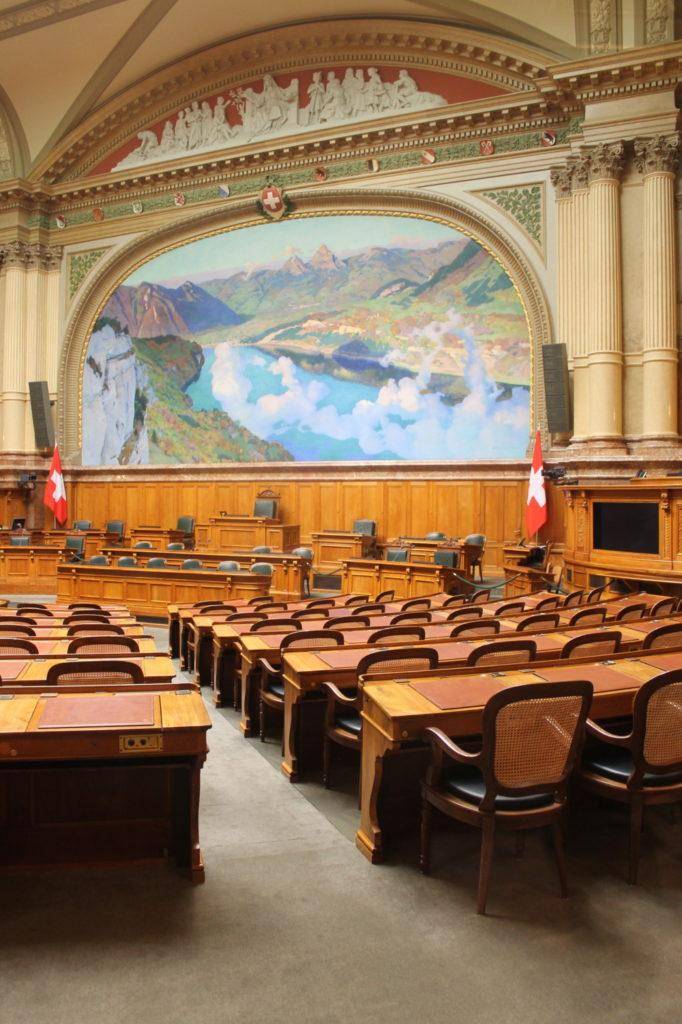
The federal political system is structured as follows: the National Council (Nationalrat/Conseil national, 200 seats) is based on the votes of Swiss citizens aged 18 or older, and it employs the Proporzsystem (proportional representation).
The Council of States (Ständerat/Conseil d’Etats, 46 seats) represents the 26 cantons and is elected by citizens per canton, with a majority system (Majorzsystem). Both institutions (the National Council and the Council of States) are the Parliament (Bundesversammlung). It chooses the members of the federal government (Bundesrat/Conseil fédéral)
Government
The seven government members are elected for a four-year term with the broadest possible approval by the Parliament.
The consensus begins at the top: the government always acts as a unified political entity, with collegiality (even if members disagree), and represents the largest parties in Parliament (Konkordanzsystem). The Zauberformel has been used since 1959 to form a government of the four biggest parties: 2+2+2+1 for its seven members.
Discussion and consultation within the government continue as long as it takes to reach an agreement on a position (even if there is an agreement to disagree). The outcome is presented to the Parliament, which has the final say.
Each member of the government heads a federal department (of which there are seven), and one member acts as head of state (Bundespräsident(in) for a one-year term. The Parliament also elects the Federal Chancellor.
The People
As one of the first Republican (male) democracies in Europe and the first modern federal state, Switzerland had already played a pioneering role in the nineteenth century (although women’s participation was introduced only in 1971).
Direct control by citizens, known as direct democracy, plays a crucial role in the Swiss system. In times of globalisation and Europeanisation, the importance of the nation-state has diminished because of the transfer of powers.
This also leads to fewer opportunities for citizens and local authorities to exert their influence: legitimacy decreases, and the proportion of dissatisfied, politically disillusioned and protesting voters increases.
Conclusion
Direct democracy does not guarantee the right or desired results (for the establishment), but the system never fails. The establishment respects direct democracy, contrary to other systems on the Continent, because the People are the politicians. There is relatively little corruption. The economy is innovative, competitive and international.
The Swiss may not be “le peuple le plus heureux du monde” (Jean-Jacques Rousseau, 1762 or the United Nations, 2015), but the system and institutions function relatively well.
(Source: A. Vatter, Das politische System der Schweiz, Baden-Baden, 2016).