
The Electoral System
29 December 2022
Introduction
Direct democracy, federalism, and a unique political system featuring directly elected members of the executive (government) at the canton and municipal levels are the foundations of the country’s political stability.
Collegiality applies at three levels: the municipality, the canton, and the federal government (Bund/Fédération). The government speaks with one voice. Parliament can never dismiss the government. The government can not call early elections or dissolve Parliament.
The Konkordanzsystem, in short, means that the seven members are appointed based on a fixed distribution of seats per party.
It reflects the political balance of power over a more extended period. A major electoral victory of a new party never immediately leads to a seat in the government. First, this party has to prove its stability and sustainability.
The seven seats are distributed among the four largest parties: 2-2-2-1, with one party occasionally losing to the others. However, the Parliament ultimately chooses the individual members.
The electoral system
The electoral system is equally crucial for political stability. Switzerland has two parallel systems: the Majorzsystem, which is based on the absolute majority of votes per candidate, and the Proporzsystem, which is proportional representation based on the number of votes a party obtains.
The people’s representation in the parliaments of the municipality, canton, or the National Council is, in most cases (not all; see below), elected based on the proportional representation of the number of votes obtained by each party.
However, the Ständerat/ Conseil des États) is elected per canton based on the Majorzsystem. There are two seats per canton. Only Basel-Stadt, Basel-Landschaft, Obwalden, Nidwalden, Appenzell Innerrhoden, and Appenzell Ausserrhoden have one seat (out of 46 seats).
The municipalities and cantonal governments (usually comprising 5-7 members) are directly elected based on the Majorzsystem, which is perhaps unique in Europe and the world.
Advantage
Proportional representation focuses on parties with a more substantial political profile. Smaller parties have a better chance of winning seats.
Political profiling is less intense in a majority choice between candidates (not parties). These individuals (members of a party) present themselves directly to the voters. They cannot hide behind the party. The bond between voter and candidate is much stronger.
In the Majorz system, majorities are not easily achieved with pure ideology. One has to be moderate to attract voters from the centre. After all, it is about the absolute majority, which implies a willingness to compromise. The main advantage of this system is guaranteeing the political centre. It also prevents fragmentation into numerous small parties, giving governments stability.
The electoral system ensures proportional representation of votes that elect the parliament. An absolute majority chooses the government’s candidates. The governments of the communes and cantons have close links with the voters.
Constituencies
The cantons organise the Senate elections and cantonal elections for the government. They must comply with Art. 51-1 BV: direct democratic elections. The canton is divided into constituencies or districts.
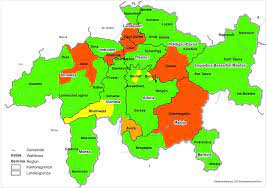
The proportional system applies when choosing the parliament. However, several cantons, including Schwyz, Graubünden, Appenzell Ausserrhoden, and Appenzell Innerrhoden, have constituencies with a Majorzsystem.
The Supreme Court
The Supreme Court (Bundesgericht/Tribunal fédéral) has ruled that it can be detrimental to democracy(as was recently the case in Graubünden). Article 51-1 of the Federal Constitution states that the condition of democratic elections has to be fulfilled.
Therefore, every vote has equal value and must be counted in Parliament. For this reason, the Supreme Court decided on 26 September 2014 (Appenzell Ausserrhoden) and 26 September 2019 (Graubünden) that the Majorzsystem in some constituencies does not sufficiently represent the voters.
A Majorzsystem in a constituency is possible, but only under certain conditions (e.g., few inhabitants and less importance of political parties). For this reason, Graubünden is adopting a new system for the 2022 parliamentary elections. The adjusted system has been approved in a referendum.
Conclusion
The proportional representation system gives every citizen a vote that counts, ensuring representation of the people by the people.
It is different for the government; the voter for a seat in the Senate first looks to the person. The Majorzsystem is based on ‘that the best may win’. Thus, there is a strong link between the voter and the politician.
The electoral system is a relatively well-functioning construct that allows individuals to make direct choices for the government and through parties for the Parliament.
Source: U. Häfelin, W. Haller, D. Thurnherr, Schweizerisches Bundesstaatsrecht, Basel 2020); A. Auer, Staatsrecht der schweizerischen Kantone, Bern, 2016.