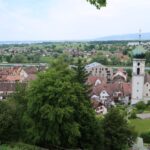
European Heritage Days

(Re)Discovering cultural heritage is the theme of the 30th European Heritage Days. A new online platform presents all events taking place in Switzerland on 9 and 10 September 2023. At the same time, the current theme shows how it is possible to preserve cultural heritage while making careful use of resources.

Die Nationale Informationsstelle zum Kulturerbe (The National Information Centre on Cultural Heritage), NIKE, presents the events of the European Heritage Days in all the cantons on the website www.kulturerbe-entdecken.ch: Guided tours, lectures, workshops, or exhibitions.

This digital agenda replaces the previous national program brochure. However, regional program brochures are still available from the cantonal offices for monument conservation and archaeology.

(Source and further information: Die Nationale Informationsstelle zum Kulturerbe )

Wonnenstein and St. Gall

Wonnenstein Monastery holds particular cultural and historical significance for the two Appenzell cantonsSt. Gall Abbey, and the former Diocese of Constance.

Located near the village of Niederteufen (Appenzell Ausserrhoden), the monastery has linked the two Appenzell cantons since 1597. The monastery buildings belong to Appenzell Innerrhoden, the farmland to Appenzell Ausserrhoden.

Wonnenstein was initially a Beguine community at the beginning of the 13th century. Around 1379, on the eve of the Appenzeller Wars, abbot Kuno von Stoffeln of St Gallen Abbey founded the monastery.

In 1524, however, the city of St Gallen introduced the Reformation. The Reformation was closely intertwined with the history of the canton of Appenzell in the second half of the 16th century (member of the Eidgenossenschaft since 1513).

On 8 September 1597, the split into the Protestant canton of Appenzell Ausserrhoden and the Catholic canton of Appenzell Innerrhoden followed after a vote. The monastery was at its peak (economically, culturally and financially) in the 17th century.

In 1938, the convent still had 47 nuns. After 1964, however, no new sisters registered. In 2010, five sisters were still living in the convent, and today, only one sister remains. The farmland has been leased since 1980.

Since 2014, the association Kloster Maria Rosengarten Wonnenstein has been the successor to the convent.

(Source and further Information: Verein Kloster Maria Rosengarten Wonnenstein)

Teufen and the Textile Industrie

Teufen was first mentioned in 1272 as “Tiuffen”. The hamlet was a district of the abbey of St Gallen. In 1377, several villages of Appenzell (Urnäsch, Teufen and Gais) joined the Schwäbischen Städtebund (‘Swabian League of Cities’)  or the Bund der Bodenseestädte with the permission of the abbot of the abbey. From 1429, Teufen was a Rhode in the independent land of Appenzell, an ally or Zugewandter Ort of the Swiss Confederation.

During the Reformation, Teufen adopted the new religion along with the other äusseren Rhoden. Following the Landsgemeinde decree in 1525, each municipality could decide whether to adhere to the old faith or adopt the new one. The religious differences eventually led to the country’s division in 1597. Since then, Teufen has belonged to the canton of Appenzell Ausserhoden.

Teufen’s economic boom was due to linen weaving and, later, cotton textiles. The municipality, still a poor Rhode in 1597, was one of the wealthiest municipalities in the canton in the 19th century.

The basis for its growth and prosperity was the textile industry (weaving and embroidery) that emerged from the 17th century onwards. Teufen developed into a textile manufacturing village with many villas and merchant houses.

In the 1890s, however, the textile industry experienced a severe crisis, from which it briefly recovered before ultimately collapsing for good after the First World War. However, the stately merchant houses and numerous embroidery houses along the streets serve as reminders of this era.

(Source and further information: Gemeinde Teufen; Kulturpfad Teufen)


The Arcadian Appenzeller Landscape

The Doctor and scholar Lauzenz Zellweger (1692-1764) discovered the healing effects of hiking on the Gäbris mountain near Trogen (Appenzeller Ausserrhoden) at a time when hiking was not appropriate for gentlemen (and ladies).

He founded a society in Trogen after he studied medicine in Leiden. He combined the healthy effects of hiking and medicine and “climbed to the Gaberius Höhe every morning to drink milk for their health”.

In the 19th century, other writers also referred to these motifs. They are an established canon nowadays and define the image of the landscape, the villages and the people of Appenzell.

Hiking became a national Swiss sport, surpassing skiing in popularity. Even in the 21st century, a walk in the Arcadian landscape of Appenzell promises a healing effect.

(Source: www.jahrhundertderzellweger.ch)

The Region Appenzell-St. Gallen

Roman Festival Augusta Raurica

On the weekend of 26 and 27 August 2023, Augusta Raurica (Augst, Canton Basel-Landschaft) will host Switzerland’s most significant Roman festival for the 26th time.

Visitors can buy Roman products at the Roman Market and learn more about Roman crafts. At that time, the market was an important location to see and to be seen, and visitors established social contacts there.

Visitors can also become active, for example, modelling clay, weaving, felting or working bones. Archaeologists also present their work and methods, and the construction crane shows how (very) heavy objects, e.g. in buildings, were lifted into place in Roman times.

The show Panem et Circensus (Bread and Games) in the Roman theatre, with a replica of a lodge for the emperor and his family, shows Roman performances with dance, music and gladiator fights. On Sunday, alongside a tour of the festival grounds, this show will be simultaneously translated into sign language for people with hearing impairments.

Empress Sabina and her entourage will also report on the life of women in the imperial court; about a hundred legionnaires build a legionary camp; senators meet in the Curia, and legionnaires and gladiators practise in the legionnaires’ or gladiators’ school.

Another highlight is the culinary variety of Roman cuisine. There are 15 stands on the premises. Visitors can also mingle with the Romans by dressing in the appropriate Roman way by wearing available clothes.

(Source and further information: www.roemerfest.ch)

The Zellweger in Trogen

The textile trade changed life in Trogen (canton Appenzell Ausserrhoden) in the 18th century. The Zellwegers were cosmopolitan citizens and merchants in Trogen. The name Trogen is first mentioned in 1175 as ‘the Trugin’, a place with a well (Trögen). After 1429, the independent country of Appenzell emerged with its present borders and with new administrative districts, the Rhoden.

The Rhode Trogen was the largest. In 1597, Trogen was the capital of the new canton of Appenzell Ausserrhoden. Only at the end of the 19th century did Herisau become the capital of the canton. After the division of Appenzell in 1597, Trogen was also the place of the Landsgemeinde until its dissolution in 1997.

Switzerland has always been a region and country with a European and international orientation, from Samnaun (canton of Graubünden) in the far east of the country to (canton of) Geneva, from Basel (canton of Basel-Stadt) to Chiasso (canton of Tessin).

Conrad Zellweger (1630-1705), founder of the firm Brüder Zellweger 

Jakob Zellweger (1770-1821), the last director of the firm, which was liquidated in 1817. Politician, present at the imperial coronation ceremony of Napoleon (1769-1821) on 2 December 1804, friend of Hortense de Beauharnais (1783-1837)

The Zellweger family shaped the town and international trading imperium in Trogen, a small village. The great wealth they acquired through international trade was partly invested in their hometown.

They founded social, cultural and educational institutions and built magnificent palaces and a (protestant) church. The palaces on the Landsgemeindeplatz speak for themselves.

Johann Ulrich Fitzi (1798-1855), 1829. The village after the construction of the palaces and the church.

The church was built in 1779, financed by the Zellwegers. The rich stuccowork, paintings, and other decorations are untypical for a Protestant church. The church and its furnishings correspond to the (religious) self-understanding of the upper class of the village. Those who recognise God have their role in society and act accordingly.

Despite their wealth, the Zellwegers remained true to their strict Protestant ethos. In ethical and religious matters, they were conservative, very innovative in trade and socially committed.

The success story began with the textile trading company “Gebrüder Zellweger”. The trading network expanded to Malta, Cadiz, Lisbon, London, Genoa, Lyon, Glasgow, Hamburg, Königsberg, St. Petersburg, Moscow, Kaluga, Istanbul, and Rijeka, as well as to and from North and South America and the French West Indies. Trading banks in London, Amsterdam and Augsburg (the Fugger) were the financial intermediaries.

(Source and further information: www.jahrhundertderzellweger.ch;www.trogen.ch)

The Rhine Valley of St. Gall

One of Switzerland’s beautiful but somewhat forgotten hiking and cycling regions is the Rhine Valley of St. Gallen (St. Galler Rheintal). Situated at an altitude of approximately 700 metres, this region in eastern Switzerland boasts a fairytale setting, nestled between Lake Constance (Bodensee), the Sarganserland, and the Old Rhine (Altrhein).

Numerous historical sites, museums and other cultural institutions accompany the region’s hikers, cyclists and other visitors.

With its unique geography, towns and villages, monasteries, castles, and manor houses, rich history, beautiful nature, a wide range of cultural activities, and vineyards, the Rhine Valley of St. Gallen is a destination for nature, art, and culture lovers. The Rhine Valley is also ideal for cycling and hiking tours.

(Source: www.st.gallen-bodensee.ch)

Chillon and the Prisoner

Lord Byron (1788-1824) wrote in 1816 in his poem “The Prisoner of Chillon” :

Lake Leman lies by Chillon´s walls:

A thousand feet in depth below

Its massy waters meet and flow;

Thus much the fathom-line was sent

From Chillon´s snow-white battlement,

Which round about the wave enthrals:

A double dungeon wall and wave

Below the surface of the lake

The dark vault lies wherein we lay.

The medieval fortress in Veytaux/Montreux (canton Vaud) is situated on a small rocky islet separated from the shore by a narrow natural waterway.

The period of the Counts and the Dukes of Savoy lasted until 1536. Bern conquered the castle (and Vaud). The Bernese troops liberated the subject of the poem.

François Bonivard (1493-1571) supported Geneva in the struggle between the town and the Dukes of Savoy. He was an enemy of Duke Charles III (1486-1553), who imprisoned him in 1532.

The castle became the property of the new canton of Vaud in 1803.

(Source: Chillon Castle;  A. Guignard, The Prisoner of Chillon by Lord Byron, Renens, 2016).

A farewell to the Julierturm

Swiss and foreign musicians and choirs have performed Mozart, Bach, Rachmaninoff, and many other (contemporary) composers in the Julierturm on the Julier Pass. Many theatre, singing and ballet performances took place at an altitude of  2 284 metres.

On the initiative of the Nova Fundaziun Origen, the Julierturm was built for theatre, singing, ballet and music in 2017. The project initially lasted five years, but due to Corona, it was extended by one year.

However, it will be over in September, and the Julierturm will be demolished. But what a remarkable project it has been, giving so much inspiration, beauty and art at this altitude!

In July, even a select company of Opera Garnier’s ballet performed, perhaps its first ballet at a mountain pass of 2 284 meters!

Fundaziun Origen’s intendant Giovanni Netzer (l) and Opera Garnier ballet choreographer and dancer Sébastien Bertaud (r) before the performance Anima Mundi (die Seele der Welt) on 22 July 2023

However, the Fundaziun Origen is already looking ahead and hopes to open the Weisse Turm (White Tower)in Mulegns (canton Graubünden) in 2024. Engineers at ETH- Zurich built the tower. They use 3D technology, and the first contours are already visible.

Mulegns, der Weisse Turm, model.

Mulegns, der Weisse Turm, under construction.

Mulegns is the village where Nova Fundaziun Origen is developing two other projects: they relocated the Weisse Villa by eight metres in 202o to make way for the road, and they are currently renovating the legendary Post Hotel Löwe.

The old telegraph office temporarily serves as an information centre and exhibition space for textiles made in atelier Pôss in Riom. The siege of Nova Fundaziun Origen is in Riom.

(Further information: Nova Fundaziun Origen, Riom)

The stage moves from the top of the tower to the floor


Susauna, Willem Jan Holsboer and silver fox breeding

Susauna (Oberengadin, Canton Graubünden) is part of the municipality of S-chanf. S-chanf was first mentioned in 1139. The Bishopric of Chur acquired sovereign rights and land in the Oberengadin from the Counts of Gamertingen.

The hamlet of Susauna is located at the entrance to Val Susauna on the Vallember stream. Today, Susauna has about 20 inhabitants and is no longer of great economic importance. It used to be a different situation, however.

The old  Säumerweg in the Susaunatal (Susauna Valley)

Besides the Flüelepass, the Scalettapass was of great economic importance for the movement of goods and the mule trade (Säumerweg) until the 19th century. A Säumerweg ran through the valley from Tirano (Veltlin, Italy) to Gargellen (Vorarlberg, Austria) and the Lake Constance region (Germany).

Towards the end of the 19th century, the route across the Scaletta became less and less used due to the improvement of other road links and the construction of railways.

Scaletta railway

At the end of the 19th century, a railway was planned through the valley, the Scaletta Railway. Dutch entrepreneur Willem Jan Holsboer (1834-1898) had already initiated the Landquart-Davos railway (1888). In 1890, the Scaletta railway was opened and ran from Bergell to Chiavenna.

Willem-Jan Holsboer (1834-1898), Heimatmuseum Davos. Photo: Wikipedia

On 2 April 1890, Holsboer also submitted a concession application for a railway line from Cinuos-chel to Martinsbruck, which, as a continuation of the Scaletta line, was to ensure a connection to the Austrian network.

The plans fell through, and the Engadine became accessible by the Albula railway (1903-1904). The route over the Scaletta Pass and the Val Susauna had previously been reduced by the construction of the Flüela Pass (1867).

The Bernina silver fox farm

The innovative power of Graubünden entrepreneurs, not just confectioners, hoteliers and other tourism operators, was also present in Susauna. On 30 December 1928, the “Bernina” silver fox breeding farm bought the land of Chesa cotschna (red house) in the hamlet of Susauna for breeding silver foxes. By December 1929, the complex was completed.

The old farm „Bernina and the Veduta Susauna Pop-up

There were 31 fox enclosures and a free range. Besides silver foxes, Karakul (thick-tailed sheep from Bukhara) were also bred there. In 1930, the sheep flock comprised 24 ewes with lambs and one full-blooded Karakul ram.

Due to a massive drop in the price of silver fox fur, many silver fox farms in Switzerland had to close down. It was also the case with the silver fox farm in Susauna in 1934.

The Val Susauna is still a beautiful hiking area, featuring the old Säumerweg, the reformed church (1696), and the old silver fox farm (today’s Veduta Susauna Pop-up), which serve as landmarks and a reminder of the ‘good old days’.

(Source and further information: Gemeinde S-Chanf; Engadin Tourismus).