

The Zellweger in Trogen
20 August 2023
The textile trade changed life in Trogen (canton Appenzell Ausserrhoden) in the 18th century. The Zellwegers were cosmopolitan citizens and merchants in Trogen. The name Trogen is first mentioned in 1175 as ‘the Trugin’, a place with a well (Trögen). After 1429, the independent country of Appenzell emerged with its present borders and with new administrative districts, the Rhoden.
The Rhode Trogen was the largest. In 1597, Trogen was the capital of the new canton of Appenzell Ausserrhoden. Only at the end of the 19th century did Herisau become the capital of the canton. After the division of Appenzell in 1597, Trogen was also the place of the Landsgemeinde until its dissolution in 1997.

Switzerland has always been a region and country with a European and international orientation, from Samnaun (canton of Graubünden) in the far east of the country to (canton of) Geneva, from Basel (canton of Basel-Stadt) to Chiasso (canton of Tessin).

Conrad Zellweger (1630-1705), founder of the firm Brüder Zellweger

Jakob Zellweger (1770-1821), the last director of the firm, which was liquidated in 1817. Politician, present at the imperial coronation ceremony of Napoleon (1769-1821) on 2 December 1804, friend of Hortense de Beauharnais (1783-1837)

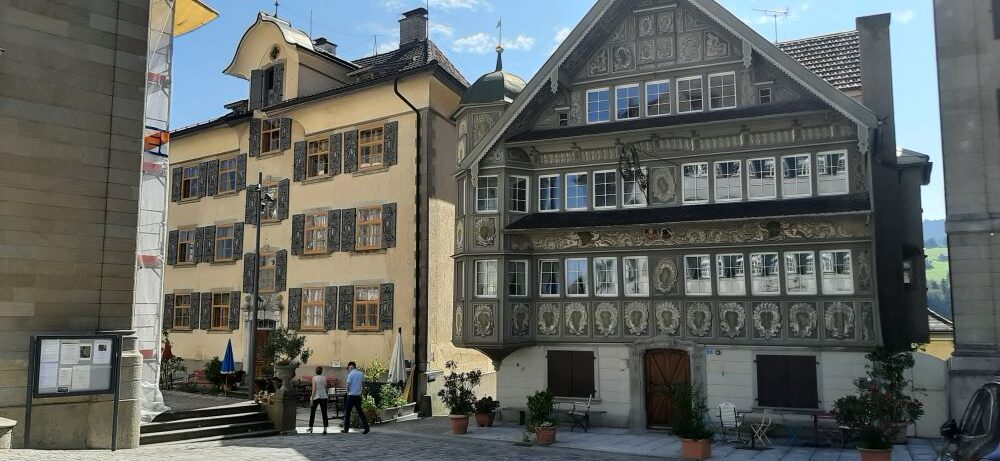
The Zellweger family shaped the town and international trading imperium in Trogen, a small village. The great wealth they acquired through international trade was partly invested in their hometown.
They founded social, cultural and educational institutions and built magnificent palaces and a (protestant) church. The palaces on the Landsgemeindeplatz speak for themselves.

Johann Ulrich Fitzi (1798-1855), 1829. The village after the construction of the palaces and the church.

The church was built in 1779, financed by the Zellwegers. The rich stuccowork, paintings, and other decorations are untypical for a Protestant church. The church and its furnishings correspond to the (religious) self-understanding of the upper class of the village. Those who recognise God have their role in society and act accordingly.
Despite their wealth, the Zellwegers remained true to their strict Protestant ethos. In ethical and religious matters, they were conservative, very innovative in trade and socially committed.



The success story began with the textile trading company “Gebrüder Zellweger”. The trading network expanded to Malta, Cadiz, Lisbon, London, Genoa, Lyon, Glasgow, Hamburg, Königsberg, St. Petersburg, Moscow, Kaluga, Istanbul, and Rijeka, as well as to and from North and South America and the French West Indies. Trading banks in London, Amsterdam and Augsburg (the Fugger) were the financial intermediaries.
(Source and further information: www.jahrhundertderzellweger.ch;www.trogen.ch)

