Ardez and Steinsberg Castle

The region has been a battlefield for centuries. The Counts of Tyrol, the (Austrian and Spanish) Habsburgs, local dynasties, the Bünder alliances and their (French) allies were the main protagonists until the last war, the Bündner Wirren (1618-1639).

The Lords of Frickingen of Überlingen am Bodensee built the Steinsberg castle in Ardez (Community of Scuol, canton Graubünden) in the eleventh century. The castle was destroyed in the Swabian War (der Schwabische Krieg) of 1499. Only the tower survived; it is the village’s hallmark today.

The village was destroyed by a fire in 1622, but was rebuilt soon after. Most houses were built in the seventeenth century. Today, it is an open-air monument.

(Source and further information: www.ardez.ch)

The Prince-Bishopric of Basel, Bern, Jura and Saint-Ursanne

Saint-Ursanne (canton of Jura), named after the saint, is located on the River Doubs. The (Irish) monk Ursicinus (after the Latin word urs or bear) died here around the year 620.

Ursicinus and his bear

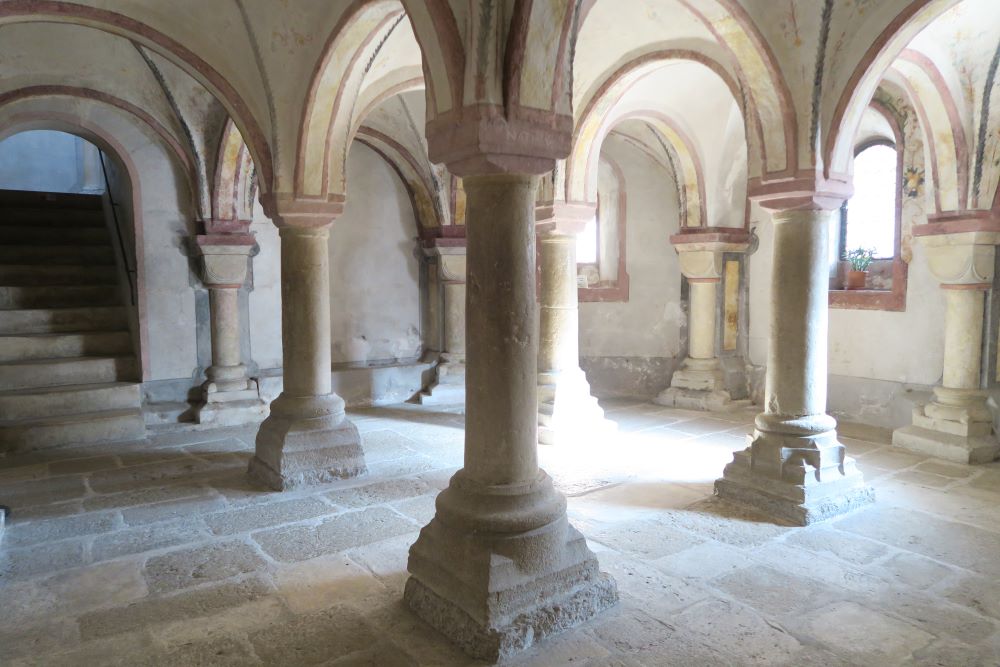
The town and its Benedictine abbey still have their medieval character. The monastery appeared in documents in 830. The (presumed) mortal remains of St. Ursanne are buried under the altar of the abbey church.

The Romanesque church and the monastery were among the most important and interesting buildings of the 12th and 13th centuries.

The city has three historical gates, the St. Peter Gate (Porte Saint-Pierre), the St. John Gate (Porte Saint-Jean) and the St. Paul Gate (Porte Saint-Paul).

Various other buildings and objects are also worth seeing. The bridge of Saint-Jean Népomucène (Nepomuk) and the so-called bell of La Berbatte are just a few examples.

The beautiful location in the Jura and the natural park of Doubs do credit to the status and the classification of one of the most beautiful towns and villages in Switzerland.

The prince-bishopric of Basel

The prince-bishopric of Basel acquired the Benedictine abbey of Saint-Ursanne in 1146. In the 13th century, the prince-bishopric was the strongest secular power on the Upper Rhine.

The territory of the prince-bishop included the current canton of Jura and the northern area of the canton of Bern, the Sundgau, southern Alsace, Birseck, the Birstal, and possessions in south Germany. The bishop was also a prince of the Holy Roman Empire of the German Nation, hence the title of prince-bishop. 

When Basel changed faith in 1527, the bishop moved his seat to Porrentruy. The southern part of the Jura and the towns of Biel and Moutier came under the influence of the Protestant canton of Bern. The northern region and the cities of Délemont, Porrentruy, and St. Ursanne remained Catholic.

The Confederation (Eidgenossenschaft) controlled the Protestant southern part of the Jura. However, this area still belonged to the prince-bishopric of Basel.

The abbots of the monastery 1119-1793

This situation changed after the French annexation of the Catholic northern part on 17 December 1792. This part of the Jura became the République rauracienne. On 23 March 1793, it was merged with the French department of Mont-Terrible.

In 1797, France also annexed the southern part of the (Protestant) Jura. It marked the end of the prince-bishopric. The northern and southern Jura were added to the department of Haut-Rhin on 17 February 1800. This situation persisted until Napoleon’s defeat in 1813.

The Canton of Bern acquired the area of today’s Canton of Jura in 1815, including Saint-Ursanne. Finally, on 1 January 1979, the new canton of Jura was created, including Saint Ursanne.

(Source and further information: Jean-Paul Prongué, Saint-Ursanne, DHS, 18.05.2020)


From the stars to atoms and the history of timekeeping and precision watchmaking

The Observatory of Neuchâtel (l’Observatoire cantonal de Neuchâtel) has long been at the heart of watchmaking certification and chronometry competitions. Today, the Cantonal Observatory of Neuchâtel is a cultural and scientific heritage, dedicated to its role in the history of timekeeping and precision watchmaking.

Pavillon Hirsch

The Observatory of Neuchâtel

For a long time, only observing the sky made it possible to verify a clock’s accuracy. This relationship is reflected both in watchmakers’ practices and in educational systems and local initiatives that sought to structure the measurement of time. Astronomy thus became a major scientific reference, serving an industry in search of reliability and recognition.

The Observatory’s foundation responded to the need to professionalise timekeeping, control chronometers, and strengthen the competitiveness of Neuchâtel watchmaking in international competition. Certifications, regulations, technical instruments and rating certificates (bulletins de marche) bear witness to the gradual establishment of a genuine economy of quality.

The chronometry competitions occupied an essential place in this framework. They made it possible to attest to the excellence of products, to showcase the know-how of precision adjusters, and to feed a prestige widely exploited by watchmaking communication.

The Musée international d’horlogerie de La Chaux-de-Fonds, telescope of the  Observatory of Neuchâtel

The end of the competitions at the Observatory does not mark the disappearance of the demand for precision, but its transformation. That demand continues today through institutions such as the Contrôle Officiel Suisse des Chronomètres (COSC) and METAS, which inscribe the Neuchâtel legacy within current standards and renewed perspectives on timekeeping.

Christiaan Huygens (seated left) among other scholars of his time. Wallpainting Musée International d’Horlogerie

The exhibition Des étoiles aux atomes

Through a programme spread over four sites and an associated programme, the project invites visitors to explore the various ways time has been observed, measured, preserved and shared — from astronomical practices to contemporary atomic technologies.

Collection of ancient sundials. Musée international d’horlogerie de La Chaux-de-Fonds.

Following this chronological and conceptual thread, the exhibition Des étoiles aux atomes highlights the close links between the observation of the sky and of atoms, scientific instrumentation and the development of precision watchmaking, as well as the social and scientific uses of measured time.

The exhibition highlights the emergence of a culture of precision in the Neuchâtel Mountains, as well as the Observatory’s role in certifying watchmaking products and organising the chronometry competitions. These missions are placed within a broader history at the crossroads of navigation, astronomy and the watch industry.

Le Musée international d’horlogerie de La Chaux-de-Fonds, equipment for the femtosecond

The exhibition, organised by the Automates & Merveilles Association, offers a chronological and thematic journey through the history of precision watchmaking, showing how it was built at the intersection of scientific challenges, economic stakes and institutional choices.

It opens on the origins of this culture of precision, marked as early as the 18th century by the quest for longitude at sea. The demands of long-distance navigation stimulated the development of marine chronometry and encouraged watchmakers of the Jura Arc, and especially of the Montagnes neuchâteloises, to perfect their instruments.

Conceived as a coherent whole, the exhibition unfolds across four locations with self-contained chapters, each approaching timekeeping from its own angle. Visiting the four sites makes it possible to connect these approaches and understand how, over the centuries, time has been observed, measured and transmitted — from the sky to the most precise instruments.

The four locations are: Musée international d’horlogerie in La Chaux-de-Fonds, Musée d’horlogerie du Locle — Château des Monts, Musée d’art et d’histoire de Neuchâtel, and  l’Observatoire cantonal de Neuchâtel.

(Source and further information: l’Association Automates & Merveilles)

Pictures: Sternewarte St. Margarethen in Binningen (Canton Basel-Landschaft)

The Convent of St. John in Müstair

The Benedict Convent of St. John, Claustra Son Jon in Müstair (Canton of Graubünden) was founded around 774 by Charlemagne (748-814) and has been a UNESCO World Heritage site since 1983.

The monastery is a complex of historical (Carolingian) buildings and wall paintings, a museum and a house of prayer and work for more than 1200 years.

The museum shows the history and many objects of priceless features, including unique Carolingian and Romanesque frescoes, the statue of Charlemagne and a late Gothic vaulted ceiling.

The Holy Cross Chapel also dates back to the 8th century and offers insights into paintings from several periods. The Planta tower was built in the 10th century. This residential tower is the oldest of its kind in the Alpine region. The tower houses a museum today.

(Source and further information: A. Dind, J. Goll, Kloster St. Johann, Müstair, 2017).

Een authentiek Klooster. Oktober 2022. Foto: TES.

Pyramides, Ossona, Evolène, Triton Alpestre and Marie Métrailler in Val d’Hérens

The name Valais (French) or Wallis (German) is derived from the Latin word valles (valley). During the conquest of what is now Switzerland between 15 and 13 BC (Geneva, inhabited by the Celtic Allobroges under the name Genava, had already been conquered in 120 BC), four Celtic tribes lived in Wallis: the Nantuates, Veragri, Seduni, and Uberi. Present-day place names still sometimes refer to the Celtic and Roman past of this region.

Evolène

Evolène

The village of Evolène, for example, owes its name to the Celtic word evo or aua (water) and the Latin word lenis (calm): “calm water.” This phenomenon of a combined Celtic-Roman culture can be observed throughout Switzerland under the name Gallo-Roman culture (acculturation). Only Romansh in Graubünden (also conquered by Rome around 13 BC) and Roman culture in Ticino (conquered by Rome in the 2nd century BC) form exceptions.

The phrase nomen est omen applies to Wallis. Not only does the Rhône carve its way, surrounded by mountains, from the Furka Pass to Lake Geneva, but on both sides, there are also numerous valleys, sometimes surrounded by 4000+ meter peaks.

The Rhône

Val d’Hérens

The Val d’Hérens, located near the old episcopal city of Sion (Sitten in German), is home not only to Evolène but also to Hérémence and its famous Saint-Nicolas church, built in 1971.

Much older, however, are the Pyramides d’Euseigne. These “pyramids” are even older than the famous Egyptian pyramids and, moreover, shaped by nature.

A few kilometres from Hérémence lies a creation of humankind: the Grande Dixence dam. At 285 meters high, this gigantic concrete structure, along with the 1961 reservoir and hydroelectric plant, is among the largest of its kind.

Arolla and the bishop

Arolla, the last village before the Italian border in the Val d’Hérens, is famous not only for the Notre-Dame des Hauts d’Arolla, but also for its glaciers, Mont Collon, and the Grand Hôtel & Kurhaus d’Arolla. The main street in Arolla is called Rue de l’Évêque.

Grand Hôtel & Kurhaus d’Arolla

It is no coincidence. The name refers not only to Mount L’Évêque but also to the proximity of the Bishop of Sion. This powerful prelate, with his religious and secular buildings, was for centuries one of the most important landowners and rulers in Wallis.

In 1474, in collaboration with the seven Zehnden (tithings) of Upper Valais, he conquered Lower Valais from the Duke of Savoy. As a result, this duchy could not come to the aid of its ally, the Duke of Burgundy, during the Burgundian Wars (1474–1477). The German-speaking Upper Valais then governed the French-speaking Lower Valais as a subject territory until 1798.


Lac bleu

Lac d’Arbey

Nature

The flora, fauna, streams, valleys, meadows, mountain lakes, and forests of the Val d’Hérens are impressive not only for their diversity but also as encounters with nature at its finest: from alpine roses and alpine newts (Triton alpestre) in mountain pools to Hérens cows and breathtaking landscapes.

The cow fights, where the reine des vaches (queen of the cows) emerges as the winner, are annual events in Wallis with a relatively animal-friendly character. They establish a natural hierarchy among the cows. Each valley organises such events in spring that hold a status similar to the Alpaufzug or désalpe in September.

Mankind

Over the centuries, humans have also left their mark. Today, Wallis and its valleys are easily accessible, but this was not the case before the rise of tourism in the 19th century.

Though beautiful, nature was also a source of drought, failed harvests, cold, heat, avalanches, and floods until then. Ingenious inhabitants adapted to these conditions: through suonen or bisses (irrigation canals), barns for storing grain and crops, and houses built of stone on the mountainside for protection against avalanches and wood on the other side.

Marie Métrailler

Within this environment, people not only lived but also created. Almost every Swiss village has a notable personality or cultural heritage. This is true in the neighbouring Val d’Anniviers as well as in Val d’Hérens. One remarkable figure is Marie Métrailler (1901–1979).

She came from a family of teachers in Evolène, with a dogmatic and severe Catholic mother and a liberal father. Her father supported and encouraged her intellectual development, but the spirit of the times and family responsibilities made further education impossible.

She worked as a weaver and founded her weaving workshop in 1938, which by around 1950 employed approximately 250 women! At that time, a female entrepreneur in a village in Wallis was exceptional.

Her business success enabled her intellectual development, her critical stance toward the Church, and her battle against the discrimination of women. She sold her products not only in Wallis and other cantons but also exported them to nearby Italy.

She interacted with tourists and the European elite of the time. She became well known—Marguerite Yourcenar (1903–1987), among others, visited and admired her.

Evolène honours its most famous resident with the Fondation Atelier de Marie Métrailler and a circular route in the village. Shortly after her death, her life story was published in 1980 as La poudre de sourire / Die Reise der Seele, recorded by Marie-Magdeleine Brumagne. This biography offers insight into the life of a woman in a Valais valley in the early 20th century and the possibilities for personal and social development.

Apart from this figure and her atelier, the village offers traditional Valais houses, welcoming hotels, views of the Dent Blanche, and many hiking opportunities. In largely Catholic Wallis, chapels and churches are never far away, and a dona nobis pacem remains an inspiring moment. Villages worth visiting include Les Haudères, La Sage, Villaz, La Forclaz, Euseigne, Saint-Martin, Luette, and Vex.

Lannaz

Evolène

Euseigne

Les Haudères

La Sage, Saint-Christophe

La Sage

Saint-Martin

 Ossona

Ossona deserves special mention. Around 2005, this village was deserted. With financial support from federal and cantonal authorities, it has since been revived through sustainable agriculture, an inn, and a few permanent residents.

The two two suspension bridges

 Passerelle des Gorges de la Borgne, 76 m.

Passerelle de la Grande Combe. 133 m.

Its earlier abandonment is not surprising. It lies on a slope above the deep gorge of the wild Borgne River. Today, two suspension bridges connect it to Euseigne, and a sandy road provides another link to the outside world. The experiment appears successful, and the village now even has a playground again.

Conclusion

The warm, dry summer climate creates conditions for Mediterranean flora and fauna in Wallis. Winters, however, used to be cold, snowy, and long. The influence of the bishop and the Catholic Church was—and still is, to a lesser extent—strong. For example, the construction of the large Saint-Nicolas church in Hérémence did not require municipal approval, nor resident consultation. In retrospect, fortunately so, as it is an extraordinary church.

Vex

It is partly thanks to individuals like Marie Métrailler that change becomes possible—often beginning on a small, personal level in the Swiss bottom-up model, which differs from that of the European Union.

This is especially true for respect for nature, climate, and the environment. In this regard, Wallis, like much of Switzerland, demonstrates the right mindset at a local level: organic herb gardens, information boards, guidelines, protected areas, and beehouses are everywhere.

La Sage

Although Hérens cows are ultimately raised for human consumption, it is no exaggeration to say that a Swiss cow (perhaps with the exception of the Indian cow) enjoys one of the highest qualities of life.

This valley in Wallis also reflects a distinct Swiss quality: engagement and innovation, combined with the preservation of valuable traditions and structures.

(Source and further information: Val d’Hérens)

Impressions from Val d’Hérens

HAP Grieshaber and the Basel Dance of Death in Arlesheim

The medieval Dance of Death was a familiar theme in Switzerland, southern Germany and France during the 14th and 15th centuries. Its emergence was influenced not only by the plague epidemics of the time but also by the orders of the Dominicans and Franciscans.

The Dance of Death combined three medieval motifs: the dance motif, based on the belief that the dead dance in the cemetery at night; the ‘vado mori’ motif, in which representatives of all classes lament their inevitable fate; and the legend of the three living and the three dead, in which three dead and three living meet and engage in a dialogue in which the dead have the final word: ‘…..What you are now, we once were; what we are now, you will become.’

The Basler Totentanz,  Matthäus Merian (1593–1650),  ‘Todten-Tanz, wie derselbe in der löblichen und weitberühmten Stadt Basel zu sehen ist”, around 1621. Collection: Historisches Museum Basel, inv. 1932.1162

Johann Rudolf Feyerabend (1779-1814), Basler Totentanz, Collection: Historisches Museum Basel

The Dance of Death was also widespread in Switzerland, featuring on the walls of cemeteries and churches. During the Reformation and in the centuries that followed, these depictions were removed. However, artists captured the originals on paper at the time, including in woodcuts. Thanks to these works, we are now well informed about the earlier Dances of Death.

Forum Würth Arlesheim, (Einschnitt I Ausdruck), 28 April 2026-2 May 2027

Contemporary artists, too, continue to draw inspiration from this theme. Helmut Andreas Paul Grieshaber, better known by his artist’s name HAP Grieshaber (1909–1981), even dedicated a separate series of woodcuts to the Dance of Death.

HAP Grieshaber, Basler Totentanz und Bücher aus Leipzig, 1964. Collection Würth, inv. 9564

He was born in Swabia, where the Dance of Death tradition existed in the 14th and 15th centuries, a tradition that may have influenced him.

HAP Grieshaber, Der Basler Totentanz, 1965, boek met 40 houtsneden. Collection Würth, inv. 9556

In any case, the Basel Dance of Death also represented a ‘homecoming’ for him, following the removal of the last Basel Dance of Death in 1805. However, the artist also addressed contemporary themes in his Dance of Death.

HAP Grieshaber was one of the best-known and, at the same time, an unconventional artist in the fields of woodcut, typography, printmaking and painting. He was not only innovative in his own right, but was also inspired by other artists, such as Carl Orff (1895–1982) and his Carmina Burana.

HAP Grieshaber, Carl Orff, Carmina Burana, 1965. Collection Würth, inv. 2110

HAP Grieshaber, Carmina Burana, 1965. Collection Würth, inv. 2110

In his works, he paid tribute to artists such as Pablo Picasso (1881–1973), Caspar David Friedrich (1774–1840), Marc Chagall (1887–1985) and Paul Cézanne (1839–1906). The significance and use of language are central to his works, also incorporating the work of writers such as Pablo Neruda (1904–1973). His painted letters were another expression of his friendship and appreciation for other artists.

HAP Grieshaber, Pablo Neruda, Aufenthalt auf Erden (on the left), 1972. Collection Würth, inv. 2109

Pablo Neruda, Alturas de Macchu Picchu, Buch mit mehrfachen Holzschnitten und einem Titel-Holzschnitt von HAP Grieshaber, 1965 , Collection Würth, inv. 9579

His unconventional working methods are also evident in his “Osterritt” (1964). The artist depicted a journey on an Icelandic horse from Reutlingen to his birthplace, Rot an der Rot (Upper Swabia), in 38 woodcuts. This clearly demonstrates that he interpreted Christian pictorial traditions in a modern way.  He used Christian symbolism, amongst other things, to depict experiences of war and reconciliation.

HAP Grieshaber, Osterrit, 1964. Collection Würth, inv. 9583

Greek mythology was also a source of inspiration that he discovered during his 1932 stay. For him, the gods Zeus, Athena and, in particular, Pan embodied forces such as beauty, nature, passion and energy.

His inspiration for woodcut art lay not only in the Expressionist tradition but also in Old German forms of expression. Furthermore, he revolutionised this art form through his technique, his large-format works and his own style of expression, which straddled figuration and abstraction. His legendary posters exemplify this connection between word and art.

Junge Aegyptische Welt, Wandteppiche, 1963, Collection Würth, inv. 9565b; Herbst, 1963, Sammlung Würth, inv. 9565a

Künstlerbund Baden-Württemberg, 8. Landesausstellung, 1962. Sammlung Würth, inv. 9566,; Jahresausstellung und Gedächtnisausstellung Georg Rohde, 1963, Sammlung Würth, inv. 9568

From 28 April 2026 to 2 May 2027, the Forum Würth in Arlesheim is hosting an impressive exhibition (Einschnitt I Ausdruck) showcasing the vast diversity of this artist’s works, themes and techniques. Woodcuts, self-portraits, book illustrations, posters, magazines, photographs, and even painted letters provide comprehensive insight into his artistic world, his social commitment, his literature, and his spirituality. For him, the woodcut was not merely an artistic technique, but also a means of expression – comparable to words and poems.

HAP Grieshaber, Malbrief an Paul Swiridoff. Collection Wurth, inv. 4162

More than 100 works from the Würth Collection, dating from 1960 to 1980, are on display and accompanied by documentation and a catalogue. HAP Grieshaber is also a child of 20th-century German history.

Two world wars, an empire, the Weimar Republic (1919–1933), the dictatorship (1933–1945, including a ban on practising his profession), the dictatorship of the GDR, and the reconstruction of the democratic Federal Republic of Germany shaped his era.

For him, it went without saying that an artist should express political views and that art and social engagement are inextricably linked. This was evident, among other things, in his environmental activism and in his magazine ‘Engel der Geschichte’.

As usual, the Forum Würth offers visitors the opportunity to try out HAP Grieshaber’s artistic forms of expression for themselves in the “Hap Lab” (in collaboration with the Basler Papiermühle). A documentary on his life and work provides background information.

(Source and further information: Forum Würth Arlesheim; O. Class, C. Sylvia Weber, R. Wachsmann, HAP Grieshaber und der Holzschnitt. Collection Würth und Leihgaben, Künzelsau, 2017)

The Swiss Yodelling Festival Unites Nations and Continents.

It is not easy to describe a music festival in words, but words combined with illustrations can speak for themselves. This is particularly true of vocal (yodelling) and instrumental (Alphorn) music, which form part of Switzerland’s and UNESCO’s cultural heritage. Moreover, the Eidgenössische Jodlerfestival, recently held in Basel (26–28 June), also features a non-musical element: Fahnenschwingen.

Be that as it may, it was a fantastic event: well organised, with music of the highest standard, and competitive performances by 1,200 participants in medieval churches, the Stadtcasino, the university auditorium and school buildings.

In addition, there were performances by thousands of participants in the Jodlerdorf, the Jodlermeil, on the Jodlerberg, along the Rhine, in parks, cafés, restaurants, gardens and other venues. Due to the heat, even some of the city’s many fountains served as performance venues.

The theme of the 32nd Eidgenössische Jodlerfestival was the relationship between urban areas and the countryside. However, this connection extends much further, transcending not only municipal and cantonal but also national borders, and even reaching as far as other continents, such as New Zealand, the United States and Australia.

The United States

Australia

New Zealand

It was not just the coolness that ensured packed houses at the performances in churches and other buildings. It was an inspiring festival in terms of content, organisation and music, as evidenced by the crowds in the town, the Jodlermeil, the Jodlerdorf and the Jodlerberg.

The traditional ceremony (Festakt) on the Marktplatz and the parade (Festumzug) across the Mittlere Brücke also attracted considerable interest, with the younger generation of yodellers making an appearance.

The Eidgenössische Jugendjodlerfestival will take place in Grindelwald from 11 to 13 September.

Another festival occurs from 7 to 9 July in Davos.

This time, it’s not just another ‘douze points’ for Basel, but also for the thousands of participants.

(Source and further information: Eidgenössischer Jodlerverband)

Impressions from the festival 

The ceremony on 28 June

Carlo Conti, President of the Organising Committee, 32nd Swiss Yodelling Festival, Basel 2026

Conradin Cramer, President of the Cantonal Government of Basel-Stadt

Karin Niederberger-Schwitter, President of the Swiss Yodelling Association


Der Abschluss der musikalischen Collage aus den Schweizer Regionen: das wunderschöne „Dorma Bain, Buna Not“ aus dem Unterengadin.

The parade on 28 June

The other UNESCO-Cultural World Heritage

Augusta Raurica Museum

Before the conquest by Roman armies, the Celtic tribe of the Rauraci (also known as the Rauraken) inhabited the area. On the Münsterhügel of present-day Basel, a small settlement, the oppidum Basilia, existed around 30 BC.

The Colonia Augusta Raurica was founded in 44 BC but remained small until the Roman conquest in 15-13 BC. By 30 AD, some 10,000 people were living in this Roman colony.

Augusta Raurica around 117 AD. Picture: Museum Augusta Raurica

Augusta Raurica around 240 AD. Picture: Museum Augusta Raurica

The Forum nowadays

Fifteen thousand fully Romanised Rauraci lived in this typical Roman town two hundred years later. The city was situated at the crossroads of several long-distance roads. The Rhine Harbour was a centre for trade and the storage of goods.

The theatre

Reconstruction of the Amphitheatre. Picture: Museum Augusta Raurica

Kaiseraugst, the castle (Kastell) today and around 300 B. (Picture: Museum Augusta Raurica).

A severe earthquake caused significant damage in 250. The city was destroyed by war and an Alemannic invasion around 260 BC. The castle (Kastell)was built shortly after 300. This fortress remained inhabited until the early Middle Ages, but Augusta Raurica was deserted by the sixth century.  The population lived within the castle walls during the 5th-7th centuries.

In the year 1000, the settlement had only around 400 inhabitants. Basel was the new town in the region. The bishop had already moved to Basel at the end of the 5th century.

The open-air museum Augusta Raurica in Augst/Kaiseraugst and the archaeo-zoological animal park opened in the twentieth century. The Collection Centre (Sammlungszentrum Augusta Raurica) underwent a renovation in 2022.

(Source and further information: www.augustaraurica.ch).

The St. Gallus Church

The ‘new’ church of Kaiseraugst

Kaiseraugst. Palace of the bishop, 5th century. The St. Gallus Church is just visible

Kaiseraugst, Roman thermes

The Curia (reconstruction)

Augst, Roman bath (reconstruction)

The Temple auf Schönbuhl. (Picture: Museum Augusta Raurica).

The remains of the foundations

The reconstruction of a Roman bakery inside these remains

Lapidarium

The coach (reconstruction)

Tempel complex 

Augst today

The Swiss Federal Yodelling Festival in Basel

Although yodelling is also practised in other Alpine countries, it is in Switzerland that it reaches the highest musical standard in terms of the number of practitioners, the associations, the quality and the (modern) interpretations.

The Swiss Federal Yodelling Festival in Basel

In December 2025, UNESCO inscribed Swiss yodelling on the Representative List of the Intangible Cultural Heritage of Humanity. The Swiss Federal Yodelling Festival (Das Eidgenössische Jodlerfest) takes place from 26 to 28 June in Basel, with over 12,000 participants.

In keeping with the festival motto ‘Stadt und Land mitenand’ (City and Countryside Together), Basel will feature a large yodelling village right in the city centre, as well as a ‘yodelling mile’ and a ‘yodelling mountain’.

Lyôbâle am Rhein, März 2026

The festival site stretches from Petersplatz through the narrow streets of the old town to Marktplatz. In total, there are over 100 festival cafés and stalls, where yodellers, alphorn players and flag-wavers immerse themselves in a world of sound and emotion until the early hours.

For participants from all over Switzerland, there are around 1,200 judged performances in the categories of yodelling, alphorn playing and flag-waving, taking place in churches, concert halls and school buildings in the city centre. Before the jury, the participants aim to perform the pieces with perfect intonation and in a moving manner, whether in groups, individually or in small ensembles, in venues with optimal acoustics. They do so whilst wearing their traditional costumes.

Jahresfest SAC-Sektion Basel, November 2025

The event begins on Friday afternoon at 12.00, with the opening ceremony on Petersplatz at 14.00, performances from 14.00 (Alpine horn); 4.00 pm flag-waving; 6.30 pm yodelling. On Saturday, all activities run from 9.30 am until 8.00 pm. On Sunday, a festive ceremony takes place at 10.00 am on the Marktplatz. A festive parade begins at 2.00 pm. The festival concludes at 6.00 pm

Festive ceremony and parade

The festive ceremony on Sunday morning is part of the tradition of yodelling festivals. A musical programme featuring numerous groups and soloists will be presented on the Marktplatz in Basel. The joint performances are particularly impressive, with songs ringing out simultaneously from hundreds of voices and alphorns.

The Basel element will certainly not be missing from the festive gathering. The festival concludes with a colourful parade. On Sunday afternoon, the parade – featuring 2,500 participants in over 80 groups with traditional themes – winds its way through Basel, from Münsterplatz via Freie Strasse, across Marktplatz and on to Messeplatz.

Basel, Februar 2026

The festival badge: the Basel ‘Jodlerfest-Blaggedde’

Entry to the festival grounds is free. Visitors can, as a token of support, wear the official festival badge, the so-called Jodlerfest-Blaggedde, just like the participants – it is sold for 10 francs each. An admission ticket is required to attend the judged performances in yodelling, alphorn playing and flag-waving in the ten performance halls.

(Source, further information, Blaggedde and Tickets: www.jodlerfestbasel.ch)

The Swiss Sustainability Initiative in Perspective of Direct Democracy

Whilst in the Netherlands, according to the most recent polls, as many as 76% of citizens want to see a limit on the number of migrant workers, asylum seekers and economic refugees, 55% of eligible voters in Switzerland rejected a 10 million-inhabitants cap on 14 June.

Nachhaltigkeitsinitiative (Sustainability Initiative), 14 June 2026

Small Switzerland, around 30 per cent of which is uninhabitable, is the fastest-growing country in Europe and is taking in large numbers of migrant workers and refugees, both in absolute and relative terms. Since the year 2000, the population has grown by more than 2 million, from 7.1 million to over 9.1 million in 2026. Net population growth exceeds 100,000 inhabitants annually.  Low unemployment, a traditionally innovative economy and high-quality industry, Europe’s best universities, excellent vocational training, quality of life, good infrastructure and the healthcare system act as a magnet.

Every day, more than 400,000 cross-border workers from France, Germany and Italy work in the country; 2 million foreign nationals live and work there permanently. In what sense is Switzerland a free-rider? The EU and many citizens beyond its borders have benefited from Switzerland for centuries; the country can look back on a successful economic, constitutional, scientific, cosmopolitan, and travel-loving history.

However, the pressure on infrastructure, the housing market, healthcare, education and integration has become too great. Unaffordable and scarce housing, overcrowded streets and public transport, an education system that is effectively no longer functioning due to a lack of integration, and a rise in serious crime. Parallel societies, a declining sense of security (once taken for granted), and a healthcare system reaching its limits are the reality.

These are facts that are also familiar in the Netherlands and other EU countries. A quantitative limit of 10 million may be neither appropriate nor practically feasible, but the message is clear. In the Swiss context, the fact that more than 55 per cent are against this proposal may seem convincing, but the result calls for a nuanced view.

The public debate

Firstly, the initiative came from just a single political party (the SVP), which represents around 30 % of the population. The entire establishment (radio, television, (social) media, universities, the government, other political parties, trade unions, employers, numerous refugee organisations and other NGOs, etc.) was opposed to the initiative. The budget also speaks volumes: around 1.5 million compared with some 9 million for the opponents.

Feelings of shame (the ‘xenophobic’ and ‘isolated’ image of Switzerland, isolationism (Abschottung), the ‘far-right’ SVP), fear of the predicted ‘chaos’ and of EU sanctions were the main driving forces behind the opponents’ campaign. There was no analysis of population growth or of the (lack of) government policy. In effect, it was a campaign against the SVP. It was more a case of direct demagoguery than direct democracy – right up to the highest political level and in the media.

This comes as little surprise from parties such as the Socialist Party and the Greens. They have replaced the Socialist International with the European Federalist movement. They are what they are, and that is legitimate – seeking new voters (including 16-year-olds, the rapid naturalisation of migrants, and democratic quantity rather than quality, as in the good old days of international socialism) outside the bubble of urban ‘highly educated’ people and students.

It often results in populism and intolerance, which also exist on the left of the political spectrum and are perhaps even more dangerous than right-wing extremism, partly due to their growing links with Islamism.

The federal government and the Minister of Justice

However, the public statements made by the national Minister of Justice, Beat Jans (Socialist Party), contravene the law and the Constitution. This (former) activist has rebranded the officially (constitutionally) recognised name ‘Nachhaltigkeitsinitiative’ (sustainability initiative) as the ‘Chaosinitiative’. This has subsequently been adopted by other opponents of this citizens’ initiative.

But it did not stop there. He speculated and spread falsehoods about the consequences (including that hospitals would have to close immediately if the initiative were adopted, that it would amount to a ‘Brexit’, that the state pension age would have to rise, that the elderly would no longer receive care, and that the economy would collapse due to a labour shortage). Instead of leading the country as Minister of Justice, he waged a personal campaign by fearmongering in his capacity as a member of the national government.

Sustainability Initiative

The initiative aimed to introduce concrete measures once the population reached 9.5 million, develop a plan for labour migration, deport rejected and criminal asylum seekers, and restrict family reunification. Whether this would have worked is unknown, but it is at least a signal to a passive government and political establishment. In other countries, the mood is similar, but there is no direct democracy.

It is noteworthy that members of the SVP also had the courage to highlight, regardless of the vote’s outcome, the need to raise the AHV retirement age (currently 65). The other parties and the government, however, rejected it, whilst at the same time threatening those who voted ‘yes’ with an increase and suggesting that a ‘no’ vote would mean no increase. That is populism and demagoguery. The media reported it uncritically.

In no country – not even in the Netherlands, where the retirement age is 67 (and the trend is upwards) – is a link drawn with migration. After all, migrants are also living longer. This illustrates the manipulation of public opinion not by the right but by the left, including directionless centre-right-wing parties (a parallel in the Netherlands).

Switzerland and the European Union

However, the initiative has another dimension: the ‘Bilateral III’ agreement with the EU submitted by the government. The agreement involves a far-reaching transfer of legislative, executive and judicial powers to the EU. Furthermore, this agreement will lead to significantly higher levels of immigration from (future) EU member states.

These migrants will automatically be granted a permanent residence permit after five years, including family reunification – which contravenes the Swiss Constitution (Art. 121) and current practice.

Although settlement in Switzerland is linked to an employment contract or self-employment status, the European Court of Justice already considers even a small number of working hours per week sufficient. And entitlement to social assistance after just a few months.

Given that millions of migrants in Spain (around 1 million with residence permits granted without adequate scrutiny) and neighbouring countries – particularly in Germany – have obtained an EU passport relatively easily, and that family and clan structures often prevail, it is easy in Switzerland to find an employment contract with a friendly (dubious) company.

Direct democracy is a thing of the past

Moreover, (direct) democracy is turning into a farce – as the Dutch example in the field of EU law demonstrates. The Dutch parliament is systematically not informed, informed too late or only partially informed about EU legislation; the EU sometimes fails to comply with legal requirements; or the country is regularly overruled by other countries (on the euro, climate, migration, construction policy, fisheries, the budget, reforms, etc.). Direct democracy does not exist; there are only elections every four years, and European issues never play a significant role, not even in the European elections. Citizens have only had a say on the EU once (in 2005, when 62 per cent voted against further integration).

Citizens in Switzerland can already barely cope with the large number of referendums at the municipal, cantonal and federal levels, let alone decide on hundreds of complicated EU laws or organise referendums on them. Moreover, the EU could even impose sanctions if EU legislation is rejected in a referendum. Furthermore, the Netherlands has only around 3% influence over decisions (and the government is often outvoted); Switzerland could have a say (around 2% influence), but there are already plenty of other avenues for this.

Furthermore, the agreement blatantly disregards Article 2 of the Constitution: Art. 2: Switzerland protects the rights of the people and guarantees the country’s independence. Direct democracy is perhaps the people’s most important right, but in practice it is being undermined, and independence is turning into dependence on Brussels.

The majority of the cantons

The most problematic aspect, however, is the violation of the Swiss Constitution regarding the Ständemehr (the majority of the cantons, Art. 140 of the Constitution). The people and the cantons are the founders of Switzerland. As many representatives of the political parties are suspicious of the federal structure and the people, they disregard this constitutional principle in the case of a people’s vote on the Bilateral III agreement with the EU.

Federal Constitution:

Art. 1: The Swiss people and the cantons form the Swiss Confederation.

Art. 3: The cantons are sovereign insofar as their sovereignty is not restricted by the Federal Constitution; they exercise all rights not transferred to the federal state.

Opponents of the ‘Standemehr’ argue that Switzerland is not joining the EU – although, through the transfer of institutional powers, it will be a part of the EU. Moreover, by transferring these powers to the EU, the EU is undermining the sovereignty of the cantons. This is also the beginning of a dynamic process, not the end.

This line of reasoning is reminiscent of dogmatic 19th-century jurists (‘the law is the law’), whereas for many generations now, the legislator’s purpose and intent have usually been the deciding factors. In other words, 19th-century dogmatism is being used to achieve a political goal in the 21st century.

Furthermore, there is no clarity whatsoever regarding the many current and future areas of the European Union that, in decentralised and federal Switzerland, still fall under the sovereignty of the cantons (for example, taxation or the monopolist cantons-owned company Salinas).

In short, any encroachment by the European Union must be subject to an obligatory referendum in order to provide this transfer with a constitutional basis. In fact, the Bundesrat has no idea of the EU’s current and future competences in relation to the cantons.

A majority of the cantons is required for institutional transfers of power to international organisations, restrictions on cantonal sovereignty, and constitutional amendments. These conditions have been met. Other positions are of an opportunistic-political nature.

It is also reminiscent of the Netherlands: since 1815, no national referendum has taken place in this centrally governed country, not even on matters relating to the EU. In 2005, the time had come, and 62 per cent did not want further EU integration. The referendum was subsequently not only ignored but immediately abolished. After all, the people are too stupid. These days, only 4 per cent still have confidence in politics, and riots and unrest are the order of the day. Ignoring the majority of the cantons is similar.

Conclusion

This sustainability initiative – regardless of whether it is feasible – has turned into a crusade against the SVP and the voice of the people. In reality, far more people than the 45 % who voted ‘yes’ feel uneasy about population growth and the emergence of parallel societies. The message from this 45 % is unambiguous.

Apart from the Minister of Justice’s activist past and current behaviour, the forthcoming referendum on the Bilateral Agreement III (expected in 2028) also explains his tone  – an attitude unworthy of a member of the government and even contrary to the law and the Constitution. The EU and an international career appear to be his ambitions, not the Swiss Constitution, Switzerland’s interests or the concerns of the people.

“….dass der Bundesrat durch das Kollegialprinzip dazu gezwungen wird, gefällte Entscheide als Gremium zu kommunizieren und persönliche Meinungen zurückzuhalten. Eine schweizerische Besonderheit besteht in der Aufgabe des Bundesrates, die Stimmberechtigten über die Vorlagen bei Volksabstimmungen zu informieren.

Im Ergebnis zeichnet sich die Argumentation der Regierung dadurch aus, dass sie eher informativ, pragmatisch, sachlich, deeskalierend und kaum konfrontativ ist. Der Bundesrat muss sich bei seinen Informationsaktivitäten vor Abstimmungen insbesondere an die Grundsätze der Sachlichkeit, der Transparenz und der Verhältnismässigkeit halten.

Es ist ihm untersagt, einseitige Propaganda für eine Vorlage zu betreiben. Eine Verletzung der Abstimmungsfreiheit durch die bundesrätlichen Erläuterungen aufgrund der Unterdrückung wichtiger Sachverhalte und der Weitergabe irreführender Informationen kommt vor. So wurde eine solche Verletzung vom Bundesgericht festgestellt.

Das Bundesgericht folgerte daraus, dass die falschen und intransparenten Informationen des Bundesrates eine schwerwiegende Verletzung der Abstimmungsfreiheit der Stimmbürgerinnen und Stimmbürger darstellen würden (BGE 1C_315/2018)“. (Quelle: A. Vatter, Der Bundesrat, Zürich 2020).