

The Prince-Bishopric of Basel, Bern, Jura and Saint-Ursanne
10 July 2026
Saint-Ursanne (canton of Jura), named after the saint, is located on the River Doubs. The (Irish) monk Ursicinus (after the Latin word urs or bear) died here around the year 620.

Ursicinus and his bear
The town and its Benedictine abbey still have their medieval character. The monastery appeared in documents in 830. The (presumed) mortal remains of St. Ursanne are buried under the altar of the abbey church.

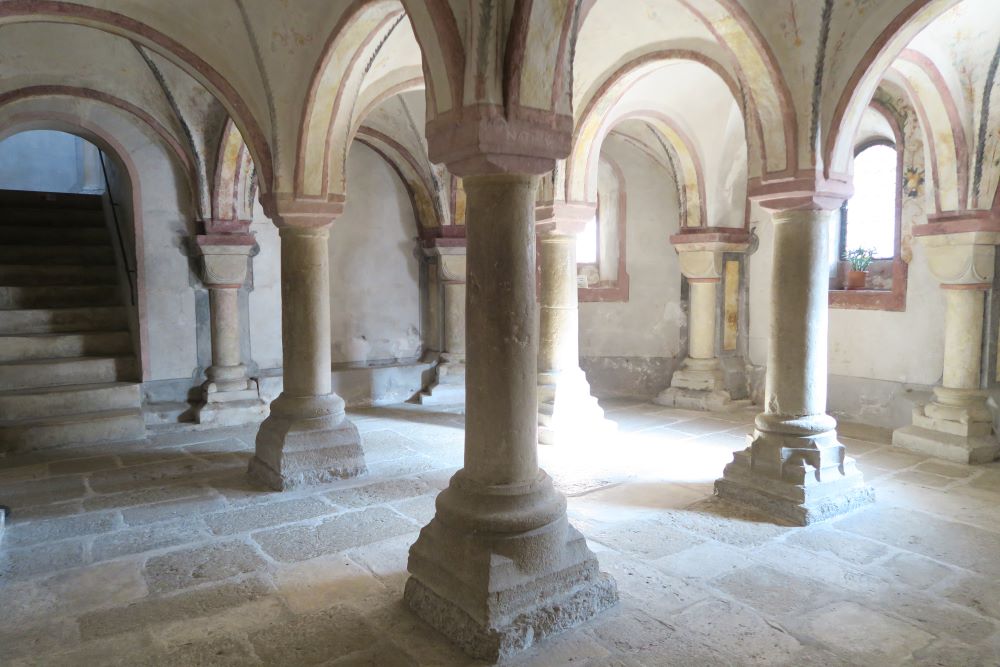
The Romanesque church and the monastery were among the most important and interesting buildings of the 12th and 13th centuries.
The city has three historical gates, the St. Peter Gate (Porte Saint-Pierre), the St. John Gate (Porte Saint-Jean) and the St. Paul Gate (Porte Saint-Paul).


Various other buildings and objects are also worth seeing. The bridge of Saint-Jean Népomucène (Nepomuk) and the so-called bell of La Berbatte are just a few examples.

The beautiful location in the Jura and the natural park of Doubs do credit to the status and the classification of one of the most beautiful towns and villages in Switzerland.


The prince-bishopric of Basel
The prince-bishopric of Basel acquired the Benedictine abbey of Saint-Ursanne in 1146. In the 13th century, the prince-bishopric was the strongest secular power on the Upper Rhine.
The territory of the prince-bishop included the current canton of Jura and the northern area of the canton of Bern, the Sundgau, southern Alsace, Birseck, the Birstal, and possessions in south Germany. The bishop was also a prince of the Holy Roman Empire of the German Nation, hence the title of prince-bishop.
When Basel changed faith in 1527, the bishop moved his seat to Porrentruy. The southern part of the Jura and the towns of Biel and Moutier came under the influence of the Protestant canton of Bern. The northern region and the cities of Délemont, Porrentruy, and St. Ursanne remained Catholic.
The Confederation (Eidgenossenschaft) controlled the Protestant southern part of the Jura. However, this area still belonged to the prince-bishopric of Basel.

The abbots of the monastery 1119-1793
This situation changed after the French annexation of the Catholic northern part on 17 December 1792. This part of the Jura became the République rauracienne. On 23 March 1793, it was merged with the French department of Mont-Terrible.
In 1797, France also annexed the southern part of the (Protestant) Jura. It marked the end of the prince-bishopric. The northern and southern Jura were added to the department of Haut-Rhin on 17 February 1800. This situation persisted until Napoleon’s defeat in 1813.
The Canton of Bern acquired the area of today’s Canton of Jura in 1815, including Saint-Ursanne. Finally, on 1 January 1979, the new canton of Jura was created, including Saint Ursanne.
(Source and further information: Jean-Paul Prongué, Saint-Ursanne, DHS, 18.05.2020)


