The Ormont Valley, Glacier 3000 and Les Diablerets

In the 13th century, Val d’Ormont (Canton of Vaud) was divided into several areas belonging to the Count of Savoie, the Abbey of St Maurice, the Lords of Saillon in Valais and other noble families.
In 1475, during the Burgundian Wars (1474-1477), Bern acquired the valley. The Bernese rule was apparently tolerable to the inhabitants, as during the French invasion (1798) they supported Bern.
In 1798, a detachment led by Colonel Tscharner marched towards Aigle to try to stop the French troops, but in vain. Another contingent under Colonel Forneret suffered the same fate at the Col de la Croix. Finally, in 1798, ministers in the valley announced Vaud’s independence from the pulpit.
Between 1836 and 1840, the road connecting Aigle to Sépey via the Grands Rochers was built, and later, the roads between Sépey and Château d’Oex and between Sépey and Les Diablerets were completed.
In 1913, the Aigle–Sépey–Les Diablerets electric railway line opened, sparking winter tourism. From 1950 onwards, the period of prosperity saw the construction of Glacier 3000, the cable cars, ski lifts, and the Gstaad – Pillon (Glacier 3000 stop) – Les Diablerets.

Les Diablerets

The village of Les Diablerets (municipality of Ormont-Dessus) lies at the foot of the Diablerets massif and on both banks of the Grande Eau. The first hotel, the Grand Hotel Les Diablerets, was built in 1856.

In 1881, the Grand Hotel built a chapel in the Anglican rite for its increasingly numerous English clientele. In 1946, the English chapel was taken over by the local Protestant church.

The summit of Les Diablerets and the Quille du Diable

The summit of Les Diablerets (3,209 m), located between the alpine pastures of Anzeindaz in the south and the Ormont valley in the north, was once considered a place of evil. According to legend, Les Diablerets was a refuge for evil spirits, a suburb of hell, and a meeting place for demons.

The sound heard high up in the mountains came from demons playing with rocks. They were even said to be playing skittles, hence the name ‘Quille du Diable’ (Devil’s Skittle), which was given to the tower-shaped rock south of the Tsanfleuron glacier (Blumlisalp) and Les Diablerets.

Glacier 3000

Nowadays, you can see this rock up close and even visit it without encountering any demons. In the heart of the Vaud Alps, Glacier 3000 and the area connected to Villars and Gryon are a paradise for skiers, hikers, cross-country skiers and sledgers.


Impressions from Les Diablerets

Pascal Bettex, installation cinétique à la  Jean Tinguely, 2017. 

The many names and celebrities of Villeneuve on Lake Geneva

The Many Names and Famous Figures of Villeneuve on the Shores of Lake Geneva
The town of Villeneuve (Canton of Vaud) has borne various names throughout its long history, dating back to Celtic and Roman times. However, the area was already inhabited after the last Ice Age, about 10,000 years ago.
Its location on the shores of Lake Geneva, the connection between France and Italy, and the relatively mild climate provided favourable conditions for trade, settlement, fishing, viticulture, agriculture, and hunting. The Helvetian Celtic tribe inhabited the region as early as the Bronze Age. Later, the Romans called the place Pennelocus.
The Tauredunum, Savoie and Chillon
After the Romans withdrew at the beginning of the 5th century, the settlement declined. The event known as Tauredunum marked the end of habitation; this tsunami destroyed the inhabited area as far as Geneva in the year 563.
Nevertheless, the settlement was rebuilt under the name Compendiacus, later Compegniez, named after Compendius, a landowner. The current name and city rights of Villeneuve date back to the Counts of Savoy, who were also lords of Chablais. In 1214, they founded the town of Villeneuve de Chillon near their castle, Chillon.
Shortly thereafter, Villeneuve already had more than 2,000 inhabitants (at that time, Aigle had “only” 160)! From 1536 to 1798, Villeneuve was administered by Bern, then belonged to Vaud in the Helvetic Republic (1798-1803), and from 1803 to the Canton of Vaud. On 11 May 1800, Napoleon briefly stayed in this town with his army during his Italian campaign (against the Habsburgs).
Like other places on the lake (and in Switzerland), Villeneuve had many internationally renowned residents and visitors, including Lord Byron (1788–1824), Léon Gambetta (1838–1882), Victor Hugo (1802–1885), Richard Wagner (1813–1883), Mahatma Gandhi (1869–1948), Tomás Masaryk (1850–1937), Edvard Beneš (1884–1948), Oskar Kokoschka (1886–1980), and the Nobel Prize-winning author Romain Rolland (1866–1944).
Chillon Castle, the Church of Saint-Paul, and the artworks along the lake are still preserved today. Vevey may have its fork in the lake, but Villeneuve has its tree!
(Source and further information: Commune de Villeneuve)

St. Paul Church

Trains and Tunnels in Switzerland

Switzerland is renowned not only for its visionary public transport policy and commitment to environmental preservation (for example, the transport of goods by train through an extensive network of tunnels, connecting the continent in a climate-friendly way without European Union (EU) subsidies, even in the most inhospitable regions).
EU Policies and Swiss Railway Constructions
It is regrettable that, partly due to EU intervention, the 1994 referendum could not be fully implemented. Furthermore, the EU, Germany, and Italy, despite billions in European subsidies, do not respect or are significantly delayed in fulfilling their conventional obligations to construct rail links with Switzerland.

The drill head of the Gotthard Base Tunnel.Verkehrshaus der Schweiz, Luzern

For instance, Germany refuses to protect the interests of the port of Hamburg, to complete the connection to the Dutch Betuwelijn. What does “Zämme in Europa” (Constitution of the Canton of Basel-Stadt) mean then? And this is just one example of European disunity.

The Rhätische Bahn  runs (almost) always on time

Swiss Trains
But travelling by train is also a comfortable pleasure for business travellers and tourists alike. Famous routes include, among others, the Glacier Express, the Pilatusbahn, the Rigibahn, the Gornergrat line, the Jungfrau Express, the Matterhorn Gotthardbahn, and the Bernina Express.
Other lesser-known routes are also worth the trip, for example, the Aigle-Leysin Line, the GoldenPass Line from Montreux to Zweisimmen or further to Lenk im Simmental, the GoldenPass-Express from Montreux to Interlaken, the MOB Line from Montreux to Rochers-de-Naye, or the SBB Line from Montreux to Lausanne and Geneva through Lavaux.


From Montreux to Zweisimmen

This train, with its Belle Époque design, passes through Montbovon, Rossinière, Château d’Oex, Rougemont, Saanen, and Gstaad, crossing magnificent landscapes and offering panoramic views all the way to Zweisimmen.

From Montreux to Rochers-de-Naye

This journey takes the traveller to over 2,000 metres above sea level on the Rochers-de-Naye, with splendid views of Lake Geneva, grand hotels, and the Alpine scenery.


Het regionale natuurpark Gruyère Pays-d’enhaut 


Montreux to Lausanne or Geneva through Lavaux

Lavaux is the country’s most famous wine region and is even listed as a UNESCO World Heritage Site. A trip is worthwhile in any season, but especially in spring and autumn, when the vineyards, towns, and picturesque villages offer a colourful backdrop.

Ftan, the Contredanse française and the Hochalpines Institut

The village of Ftan is located on the south side of a mountain ridge in the middle of Unterengadin, between Ardez and Scuol. There are two Ftans: Ftan Pitschen (the small Ftan) and Ftan Grond (the big Ftan).

The area extends north into the Silvretta region, with the border of Paznaun (Austria), the Futschöl Pass, and the 3,230-metre-high Augstenberg (Piz Blaisch Lunga).

The great importance of the Futschöl Pass has been proven by archaeologists, who have found traces of prehistoric human presence dating back 10.500 years. This region was also inhabited during the Roman period, with notable practices including Alpine agriculture and cattle breeding.

The medieval ones also reveal centuries-old disputes between the villages of Ardez and Ftan over meadows, pastures, and access to the Futschol Pass. The Counts of Tyrol, the Habsburgs, the bishopric of Chur, and the monasteries of Marienberg (South Tyrol) and Müstair disputed control of the Lower Engadine until the valley bought itself freedom from Habsburg rule in 1652. By then, it had joined the Gotteshausbund.

Ftan has been hit by avalanches (1682, 1720 and current threats), fires (1723, 1784 and 1885) and wars (1499, Engadine, Schweizer or Swabian War (depending on perspective) and in 1622 during the Bündner Wirren (1619-1639).

It was a predominantly agricultural area. Some inhabitants of Ftans chose military careers and returned wealthy from service in the French or Dutch armies. For example, Jon Peider Schmid de Grüneg served the French king in the Bündner regiment and reached the high rank of lieutenant colonel. Augustin de Saint-Aubin (1736-1807), gravure 1774, La contredanse française.

The most relevant dances at the French court and for the bourgeoisie at the end of the eighteenth century were the contredanses and the menuet. (Bron: Erika Schneiter, “Contredanses in plaats van ordes: the ‘Contredanses françaises’ van Martin Peider Padrotsch Schmid von Grüneg zu Ftan”, in Bündner Monatsblatt, uitgave 5, 1992).

His nephew Martin Peider Padrotsch Schmid von Grüneg also served in this regiment and wrote the ‘Contredanses françaises’. It is how ‘Haute Culture’ reached the Engadine. Dances were essential to the education and culture of aristocratic society and the wealthy bourgeoisie.

In autumn 1792, after the storming of the Tuileries in Paris, priest Andrea Rosius à Porta (1754-1838) returned to his native village of Ftan, where he opened a private school on 1 October 1793, the Institut à Porta. He enriched education with Romanesque teaching material, “Il magister amiaivel” (the kind teacher). Due to competition from public schools, the institute closed its doors in 1869. But half a century later, the Hochalpine Institut Ftan opened its doors. In 1993, the boarding school was also founded, the name changed to “Hochalpines Institut / Institut otalpin Ftan”.

(Source and further information: P. E. Grimm, J. Wirth, Ftan, Scuol, 2016)

The first French-speaking Reformed territory of the Confederation

Aigle is the first French-speaking Reformed territory of the German-speaking Swiss Confederation (only the Catholic Fribourg was also Fribourg). Aigle first appeared in a document around 1140. This document refers to the Priory of St. Maurice of Aigle, founded by the Abbey of Agaune (St. Maurice).
The monastery in Aigle no longer exists, as it was dissolved during the Reformation (1526-1528). The former monastery chapel became the parish church in 1528. The first church was built during the Burgundian period in the 6th century.
The Romanesque church dates from the 11th or 12th century. At the end of the 15th century, the vault and choir were renovated in Gothic style. This former monastery church, with its mixture of Romanesque and Gothic styles, is a monument protected by the Swiss Confederation.
In 1476, Aigle became the first French-speaking territory of the German-speaking Swiss Confederation when Fribourg ceded its dominion over Aigle to the Republic of Bern.

St. Jacques Church, the Deutsche Evangelische Kirche nowadays 

The dominion of Aigle, consisting of the regions of Aigle, Ollon, Bex, and Les Ormonts, was also the first bastion of the Reformation in French-speaking Switzerland! The reformer Guillaume Farel (1489-1565) preached for the first time in French-speaking Switzerland at the Church of St. Jacques on 30 November 1526.

Aigle is therefore not only the first French-speaking town on the territory of the German-speaking Swiss Confederation, but also the first Reformed town in French-speaking Switzerland, ahead of Neuchâtel (1530), Lausanne (1536), and Geneva (1536).


The Magic of the Murten Light Festival

From the old town to the shore of the Murtensee/Lac Morat, immersive and interactive works transform Murten (from 21 January to 1 February 2026) into an open-air stage. The magic of the Murten Light Festival does not just happen on the streets – it begins long before, in the creative process.

A programme committee carefully selects works that will shape the tour: poetic installations, interactive works, spectacular or immersive contributions – a balanced mix that invites a wide audience to marvel.

This artistic journey is made possible by everyone who participates: established artists, young creatives from the canton and school classes taking their first steps in light art.

Together, they transform Murten (Morat in French) into an open stage for twelve days, immersing visitors in a dream world where the old town becomes a place of experience and exchange.

(Source and further information: Murten Lichtfestival)

Vogel Gryff, Leu and Wild Maa

The drums and (march) music resemble the Basler Fasnacht. This Kleinbasel tradition has a different origin, however. The Fasnacht takes place from 23 to 25 February this year. The Vogel Gryff tradition was celebrated on January 13, 2024.

Three centuries-old societies (Ehrengesellschaften) welcome their patrons Vogel Gryff (Bird), Leu (Lion) and Wild Maa (Wild Man) in January.

This tradition dates back to the thirteenth century, when Kleinbasel and Grossbasel were two towns located on the left and right banks of the Rhine.

The (wooden) Rhine bridge was built in 1225. This bridge connected the two Basels and led to significant growth of trade and economic prosperity in Kleinbasel.  Rudolf I of Habsburg granted Kleinbasel city rights in 1285.

Prominent citizens founded various societies, including zum Rebhaus and its symbol, Leu (first mentioned in 1304), zur Hären and the figure Wild Maa (first mentioned in 1384), and zum Greifen and its patron, Vogel Gryff (first mentioned in 1409).

The societies represented the interests of the citizens of Kleinbasel. Their members also guarded the city walls. The societies presented their weapons once a year on a march through the city.

Wall Painting in Kleinbasel

The companies have organised their parades through Kleinbasel on 13, 20, or 27 January ever since. The three figures, Vogel Gryff, Wild Maa, and Leu, present a ritual dance to the dignitaries and citizens of Kleinbasel. They are accompanied by drums, the four Ueli (jesters) and the three flag bearers of the societies. The Members of the societies have a joint meal in the afternoon, the Gryffemähli.

The separation from Grossbasel is strictly maintained in this tradition. The parade never enters Grossbase but halts precisely in the middle of the Mittlere Brücke and the Käppelijoch.

The figures always keep their faces to Kleinbasel and turn their backs to Grossbasel, like figures in Grossbasel stick out their tongues to Kleinbasel. However, the heraldry of the three societies is depicted on the cathedral’s windows.

.

The societies march through Kleinbasel until late in the evening, accompanied by their drums, Uelis, flag bearers, the members of the three societies and citizens of Kleinbasel.

(Source and further information: www.vogel-gryff.ch).

The old costume ( till 2015) of Vogel Gryff. The costume weighs over 40 kilograms. Museum Kleines Klingental

Wall Painting in Kleinbasel

 Café/Hotel Merian, Kleinbasel side

The Grossbasel side 

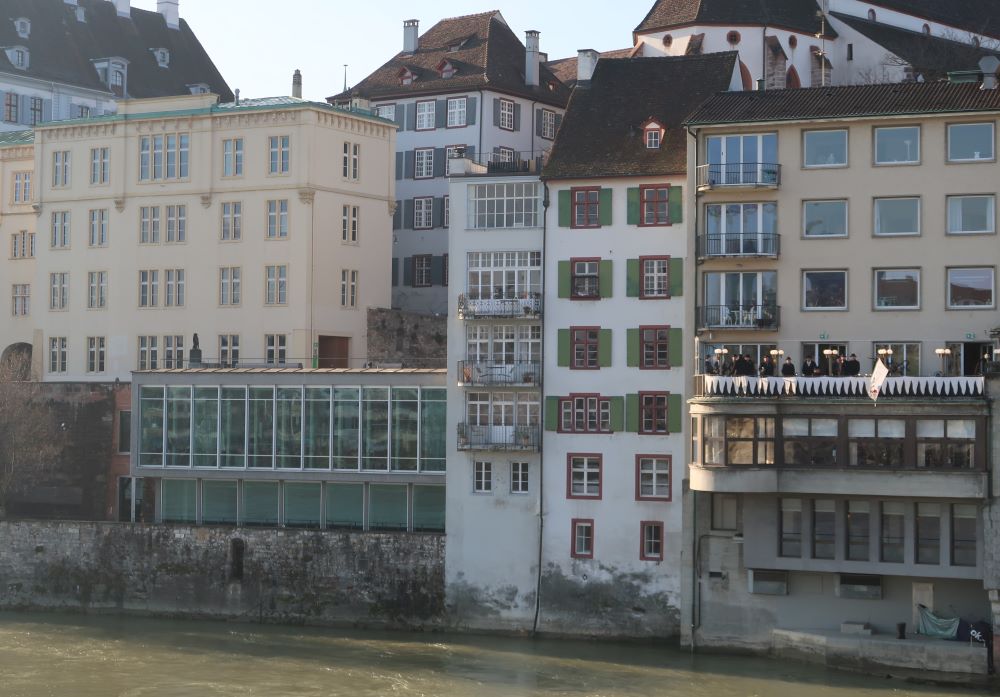
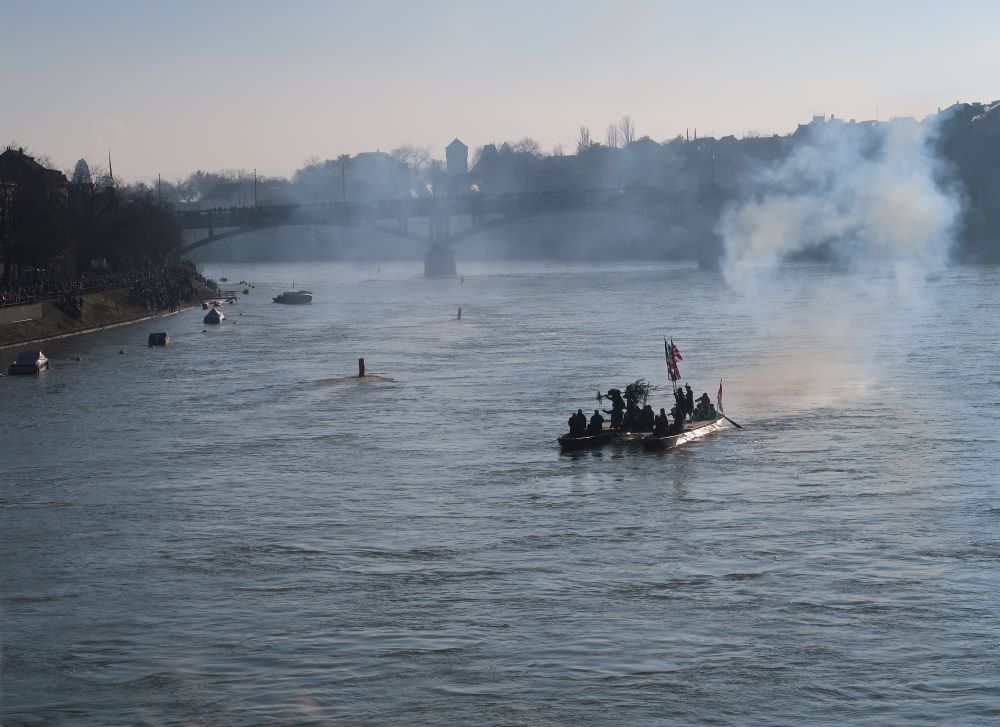
Wild Maa and company on the Rhine and the arrival near the Klingental Museum


Leu and Vogel Gryff. The Police wear their traditional Bobby Helmets for this event

The three flags of the Ehrengesellschaften on the bridge, just to the Käppelijoch

Montreux Riviera, Artists, Nature and Smoke on the Water

More than two centuries before the ‘famous’ fire in the Casino of Montreux on 4 December 1971, Jean-Jacques Rousseau (1712-1778) wrote his Nouvelle Héloïse in 1761. Lord Byron (1788-1824) wrote his Prisonnier de Chillon in 1816.

Both works significantly influenced the reputation of the village of Montreux (canton of Vaud) among the European beau monde.

Chillon is located a few kilometres from Montreux; Rousseau wrote enthusiastically about the Swiss countryside, including the region around Lake Geneva.

The region became one of the first tourist destinations in Switzerland. From 1840 onwards, the first Grand Hotels, casinos, restaurants, and later golf courses, tennis courts, and other tourist facilities appeared.

Until the Second World War, Montreux was a top destination for the aristocracy, artists, politicians, top athletes, film stars, and other public personalities.

Freddie Mercury (1946-1991), Gustave Coubert (1819-1877), Fjodor Michajlovitsj Dostojevski (1821-1881), Keizerin Sisi (1837-1898), Ignacy Paderewski (1860-1941), Henryk Sienkiewics (1846-1916), Charlie Chaplin (1889-1977), Carl Gustaf Emil von Mannerheim (1867-1951) or Gustave Eiffel (1832-1923) lived or died in this city or were regular visitors. After the Second World War, many musicians found their way to Montreux.

The world-famous hit “Smoke on the Water” by Deep Purple (Smoke on the Water) was written in Montreux on the shores of Lake Geneva (lac Léman).

(Source: www.montreuxriviera.com)

The Casino

Queen The Studio Experience in the Casino

David Richards (1956-2013), producer of various Queen albums in the Mountain Studios in Montreux

Montreux Jazz Festival

Impressions from Montreux

Aigle, its Castle, Monastery and Musée de la vigne, du vin et de l’étiquette

The Chablais is a region located in Switzerland and France, comprising the Swiss Chablais in the cantons of Valais and Vaud, and the French Chablais, situated south of Lake Geneva in the northern part of Haute-Savoie.

Aigle (Aiglon) first appeared in a document around 1140. This document refers to the Priory of St. Maurice of Aigle, founded by the Abbey of Agaune (St. Maurice).

The castle of Aigle was built in the 12th century. The castle tells the (medieval) history of the region, the rule of the Kingdom of Burgundy (888-1032), the rule of the House of Savoy (1034-1475) and the occupation by Bern (1475-1798).

The former monastery St. Maurice, only the church survived the Reformation

The occupation of Aigle in 1475 was the first conquest of a French-speaking region. Bern also introduced the Reformation in 1528. The castle was the seat of the Bailiff (Landvogt).

Richly painted decorations and the bear of Bern from the 16th and 17th centuries still adorn the rooms and the castle gate.

Aigle

The castle was acquired by the commune of Aigle in 1804, following the establishment of the canton of Vaud in 1803. It is a monument that houses the wine museum Musée de la vigne, du vin, de l’étiquette today.

The towns and villages of Aigle and Pays d’Enhaut Districts

(Source and further information: A. M. Barelli, Le Chablais, Viterbo, 2011).

Impressions from the castle


Impressions from the 

Fête des Vignerons, 1927

Fortyseven in Baden, Bathing in Aquae Helveticae

Mario Botta (1943), an architect from Tessin, worked on this project for 15 years. The bathing complex Fortyseven along the banks of the Limmat River is 160 metres long and has eleven saunas and eight water pools.

Fourteen springs bubbling from the earth provide the water. The complex is not a water theme park. The beneficial and healing effect of the spring water is the primary focus. The name also refers to this use: the sulphur water from the springs has a maximum temperature of 47 °C.

Baden was already prominent in Roman times because of its thermal baths. The Roman name was, therefore, Aquae Helveticae, Helvetic waters. For this reason, the legionary camp Vindonissa (today’s Windisch) was established there. The Vindonissa Museum shows this history and the amphitheatre of Vindonissa.

Baden became the largest spa centre north of the Alps in the Middle Ages. After the Confederation (Eidgenossenschaft) occupied the Habsburg Aargau in 1415, Baden became the meeting place of the Confederation’s Tagsatzung (States General). The presence of the springs played an essential role in this decision.

Residenz and Brasserie Bad Schwanen

However, the great heyday was in the 19th century. Investors built huge hotels and spas along the Limmat. Some of them, such as the Verenahof, Ochsen, and Bären, still exist.

The Grand Hotel, three times as big (!) as the current new complex of 160 metres, was demolished in 1944. The casino, Kurtheater, Kurpark and Kursaal in the centre of the city are reminders of the grandeur of the Belle Époque.

After the First World War, the health resorts in Switzerland and Baden declined. The old Roman quarter on the Limmat, with splendid hotels and Spas, sank into a deep sleep.

The initiative of investors in 2006, combined with the architect’s creativity and craftsmanship, the involvement of Denkmalpflege and Heimatschutz, and the commitment of local authorities, companies, and citizens, has reawakened the Sleeping Beauty of Swiss spas.

Bathing in Open-Air Springs

On the banks of the Limmat River, the Bagni Populari Association (Verein) has revived the old tradition of hot springs accessible to all.  Aquae Helveticae still seems to be an appropriate name.

On the other side of the recently opened Fortyseven bathing complex in Baden (Canton Aargau), another opening occurred in November, marking the revival of this two-thousand-year-old bathing culture.

The hot springs in Baden produce thousands of litres a day. In Roman times (15 B.C.- c. 400 A.D.), the numerous bathing houses (thermae) and springs were freely accessible to the inhabitants and soldiers from the nearby legionary camp of Vindonissa (today’s Windisch).

After the immigration/invasion of the Alemanni in the fifth century, the bathing culture disappeared. However, in the fourteenth and fifteenth centuries, Baden again became the most important bathing resort in Central Europe.

However, there is one notable difference with Roman times: the aristocracy and bourgeoisie had their own bathing houses. Ordinary people used the many hot springs in the open air. This tradition continued until 1870.

In this period, the large bathhouses and spas for the Beau Monde were built in the city’s bathing district (the Roman quarter). This clientele shouldn’t be confronted with poor people bathing in the open air on their way to their destination. The open-air baths disappeared, and a ban was even in force until recently.

The association Bagni populari, founded in 2017, has taken the initiative to reopen these springs (between 37 and 43 degrees Celsius, depending on the outside temperature) to the public. After all, the springs still exist, and they otherwise go straight into the Limmat.

And an artificial hot open air spring in Basel (15 December 2025)!