
A random selection of impressions from Fasnacht 2025


Monday, March 10th, 03.58 AM


The Morgenstraich

The new generation



A random selection of impressions from Fasnacht 2025
Monday, March 10th, 03.58 AM
The Morgenstraich
The new generation
The first hermits lived in Egypt and Syria in the second and third centuries. The first Christian communities had emerged in this region in the first century. These areas were prosperous Roman provinces at the time.
Hermits were recluses dedicated to the Christian faith in isolation and poverty. They are considered the first monks, and the first monastic orders also originated in Egypt and Syria. Some hermits gained cult status, and their sites became pilgrimage destinations. One of the most famous is Simeon the Stylite.
He did not live in a cave or a self-built hut but on a pillar, not in the wilderness, along the road leading to Damascus. He had many followers, the Pillar Saints, and even a tomb monument and pilgrimage site.

Daniël the Stylite (fifth century), unknown Byzantine artist, 11th century. Picture: Wikipedia
Switzerland also has a history with hermits. Finding suitable shelter was not too difficult due to the (inhospitable) mountains, forests, rock formations, and many caves.
The founders of the first monasteries in Switzerland were also hermits. Still, due to the emergence of the first European monastic order, the Benedictines, in the 6th century, they mainly aimed at spreading the Christian faith. Their place of settlement and isolation was called Einsiedelei. The abbeys of St. Gall and, for example, Einsiedeln started this way.
Due to the rapid growth of the population and the expansion of villages and towns over the past two centuries, some of the residences of less prominent hermits are now located within or just outside the built-up area.

The Eremitenhäuschen
An example is the Einsiedelei St. Verena in the Verena Gorge near the city of Solothurn. According to legend, Verena was the fiancée of Viktor, a Christian soldier in the Theban Legion in the 3rd century AD.
The troops came from the Roman province of Egypt and stayed in Agaunum (the present-day Saint-Maurice, canton of Valais). They refused to recognise the Roman emperor Maximian (250-310) as a god and the Roman gods. The entire legion, including the commander Mauritius and Viktor, was killed.
Verena fled to Salodurum (Solothurn) and found shelter in the caves of the current Einsiedelei. She later moved on to Bad Zurzach, where the final resting place and church of Saint Verena is located.

The Martinskapelle
The Einsiedelei near Solothurn also became a pilgrimage destination. The Martinskapelle dates back to the 12th century, and St. Verena is said to have lived in the cave located behind the chapel. The Verenakapelle, located opposite, is situated in a cave and dates back to the 13th or 14th century.


The Verenakapelle
In addition to this chapel, there are two more hermit places, the Magdalenagrot and the Ölberggrot. However, this Einsiedelei still has a hermit who finds shelter in the so-called Eremitenhäuschen. He is considerably more comfortable than his predecessors. The municipality of Solothurn takes care of their livelihood.


The Magdalenagrotte and the Ölberggrotte
Not entirely selflessly, because the Verena Gorge is a well-known tourist attraction, partly thanks to the French refugee Baron Louis Auguste de Breteuil (1730-1807), who initiated and financed the road through the Verena Gorge in 1791. Solothurn was then the seat of the French embassy in the Confederation. Romanticism and the rise of tourism in the 19th century did the rest.
(Source and further information: Gesellschaft der Einsiedelei St. Verena; Gemeinde Solothurn)
The Aare flows into the Rhine at Koblenz (Canton of Aargau). On its 295-kilometer journey from its source in the Oberaar Glacier, it flows through the Aareschlucht (Aare Gorge), Lake Brienz and Lake Thun, the capital Bern, Lake Biel, Solothurn, and through various places that bear its name, such as Büren an der Aare, Aarwangen, Wangen an der Aare, Aarburg, and Aarau, the capital of the Canton of Aargau.
In the 19th century, the Aare was regulated during the first Jura Water Correction (1868-1891), a century before the Dutch equivalent, the so-called Deltawerken.
Afterwards, some adjustments were made, including during the Second Jura Water Correction (1962-1973). Since then, the country’s most water-rich river, with more water than the Rhine, has been “tamed”.
The inhabitants of the many beautiful villages and towns, agricultural areas, and infrastructures are spared from floods, except in some exceptional circumstances.

Wangen an der Aare
One of these beautiful medieval towns is Wangen an der Aare (Canton of Bern). In the 11th century, a Benedictine priory of the Abbey of Trub existed. The Dukes of Zähringen founded the town, which the Counts of Kyburg later acquired after the extinction of the Zähringen dynasty in 1218.
After the devastation by the Guglers (French mercenaries during the Hundred Years’ War, 1337-1453) and the conquest of Aargau, Bern acquired the town in 1437. The bailiff resided in the bailiff’s castle (15th-18th century).

Wangen was then an important transhipment point for shipping on the Aare. Salt was one of the most precious goods. It came from Bavaria, Tyrol, and Lorraine. The striking salt house (1775) reminds us of this time. The prosperity is still visible.

The Salzhaus


The wooden bridge over the Aare was built in 1552. The rich past is also evident in the town hall, the clock tower (Zytgloggeturm), and a monumental centre.


(Source and further information: Gemeinde Wangen an der Aare)

Aarwangen
Aarwangen is also such a small place that one passes by. However, Aarwangen is also worth a visit. The Celts, Romans, Alemanni, and Burgundians were familiar with this location on the Aare because it served as a transhipment point for goods between the west and east of Switzerland. The first written mention dates back to 12129.
The Lords of Aarwangen lived in the castle on the banks of the Aare. Their successors were the Lords of Grünenberg, who served the Habsburgs. After the conquest of Aargau, Bern acquired the town in 1437.

The bailiff resided in the castle until 1798. Seventy-five bailiffs ruled until 1798, when the Helvetic Republic (1798-1803) was created. The castle shows the coats of arms of these 75 bailiffs in a gallery. Since 1803, when the new Confederation (1803-1813) was established, Aarwangen has been the capital of the Aarwangen district in the canton.
(Source and further information: Gemeinde Aarwangen)


Helvetia gazes westward from the Mittlere Brücke in Basel, downstream along the Rhine. What is she thinking about? In the good old days, when the Rhine was still called Renos (Celtic) or Rhenus (Roman), was it meandering and flowing wherever and as high as it wanted?
About the river landscape on both banks of the Rhine without buildings and human intervention? About the Petite Camargue Alsacienne few kilometres further? About the salmon that inhabited the Rhine, numerous and well-fed? Or has she found peace in the old bishop’s city of Basel?

The Rhine near Rekingen
Helvetia can also direct her gaze upstream. The once flourishing salmon fishery is no longer, buildings are more abundant, and the Rhine is ‘tamed’ and partly canalised with busy shipping traffic. Yet, even the modern Rhine still has many nature reserves, and human intervention can also be beautiful.

The Rhine near Eglisau
Moreover, the Rhine is not everywhere a border river between Germany and Switzerland. For example, the town of Eglisau (canton of Zurich) is located on the right bank of the Rhine. The cantons of Schaffhausen (excluding the German enclave Büsingen) and Basel-Stadt (partly the city of Basel, Riehen, and Bettingen entirely) are also partly or mainly on the right bank of the Rhine.


The bridge near Eglisau
Although the Rhine is ‘tamed’, nature reserves in various places still give an impression of the situation before human intervention. Switzerland would not be Switzerland if the flow of the Rhine were not used for ‘white (and clean) energy‘, which covers about 50% of the country’s electricity needs.


Hydroelectric power station Eglisau


Hydroelectric power station Rekingen
For example, two hydroelectric power stations are 20 kilometres away. These do not make life easier for the salmon, although fish ladders may offer perspective in the long term.
Until the French conquests by Napoleon (1769-1821) in 1798, the Rhine was not so much a border river as it was a primary trade route and the preferred means of transportation for people. The large wooden rafts, measuring 300-400 meters in length, sometimes 50 meters in width, and accommodating more than 500 paying passengers and goods, also testified to this.

Beeld: Museum De Bastei, Nijmegen
They sailed, or drifted, with the current, mainly via Nijmegen to the delta in Rotterdam. Many Swiss emigrants also used this means of transport! The trade of goods, including wood and salt, primarily took place on the Rhine, with Schaffhausen, Rheinfelden, and Basel serving as important transhipment points.
Wooden rafts have long been replaced by motorised shipping, but the Rhine is still a vital traffic artery. Towns like Kaiserstuhl (canton of Aargau) show the prosperity and importance of the Rhine region in earlier times.
The centuries-old political, economic, judicial, and personal relationships between the Bishopric of Konstanz (Constance) and the old Swiss Confederation, including the county of Baden, show this. Moreover, the Alemannic language was also shared.

The bridge over the Rhine from Kaiserstuhl to Hohentengen
The current stone bridge over the Rhine nowadays connects Kaiserstuhl again with Hohentengen (Baden-Württemberg) without obstacles, as it has done for centuries, until the rise of nation-states in the 19th century and the tightly closed borders during the war periods of the 20th century.

Poets and writers also found the Rhine. One of the most famous Swiss writers, Gottfried Keller (1819-1890), even has a riverside path named after him.

Nevertheless, the Rhine has not always been a place for poetic inspiration. Many bunkers on the Swiss banks give an impression of defensive works from the 1940s.

Rümikon

Kaiserstuhl
Kaiserstuhl is now part of the municipality of Zurzach, which includes Bad Zurzach and its renowned bathing culture, Saint Verena and its castle, as well as the villages of Rekingen and Rümikon.

Bad Zurzach Castle
The Swiss Alpine Club
The Swiss Alpine Club (Schweizer Alpen Club, SAC / Club Alpin Suisse, CAS) regularly organises hiking tours in this area and elsewhere in the country.
Although the name suggests otherwise, the SAC not only organises ski tours, mountain climbing, and other sports in the high mountains and the Alps but also (walking) activities in other regions.
Impressions


Available in German, French and Dutch
On Monday, March 10, at 04:00, the Martinskirche will herald the Basler Fasnacht with the Morgenstreich (Morgenstraich). This UNESCO World Heritage site (since 2017) has undergone numerous changes over the centuries and continues to evolve.

Collection: Museum der Kulturen Basel
The Museum der Kulturen in Basel, the Fasnachtcomité (and its annual publication Rädäbäng), and various other publications provide extensive information about this centuries-old yet contemporary cultural heritage and its versatility.

The French word for Fasnacht is Carnaval de Bâle. Interestingly, the vocabulary of Fasnacht contains many French words (cortège, clique, chaise, répertoire, requisit, sujet, for example), but the word “Fasnacht” does not exist in French.
Apart from French influence, Fasnacht (spelt as Fastnacht until 1924) also had German origins, including the Prinz Karneval and German words, until 1909. The cliquen receive Frau Fasnacht ever since, and Basel-German (Baseldütsch) is the language.

The priest receives Frau Fasnacht in the Elisabethenkirche, the Sunday morning before the Morgenstreich, Fasnacht 2024
The current Fasnacht took shape after the Fasnachtcomité (Faasnachts-Comitée) was established in 1910. This commité (also a French word) partly emerged from the Quodlibet association (founded in 1858). Quodlibet still exists today, but it only has one activity: bridge.
In the second half of the 19th century, lanterns (Ladäärne/Lampe) with the sujet (Süschée), the theme of the cliques, also appeared. A large rectangular lantern is decorated with texts and features the visualised theme of a clique. These lanterns have continuously developed into true works of art.

Lanterns of the clique Verschnuuffer

Lantern ‘Das Quodlibet den Schweizer Turnern, Quodlibet, around 1885. Collection: Museum der Kulturen Basel
The members of a clique vote on the theme for that year. A special committee then develops the project. The themes usually relate to local and national events, politics, and happenings (this year, for example, the ESC, Eurovision Song Contest in Basel), international politics, personalities, or topical issues.


The lanterns are so large that they are usually made in workshops. Members, artists, and specialised ateliers contribute to them. Members or third parties also attribute other elements to the Fasnacht, such as masks (larven), costumes, and other objects. The cliques finance these projects with support from the Fasnacht Committee through the sale of Fasnachtsplakette (Blaggedde).
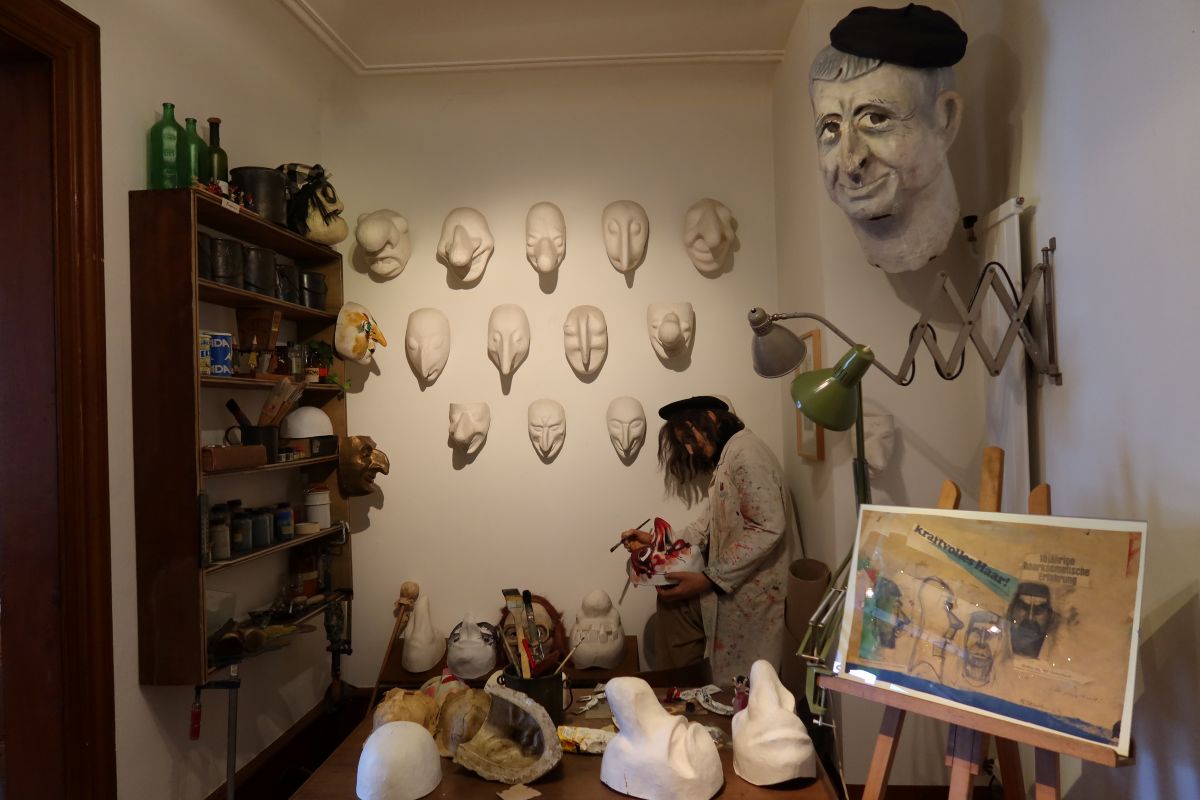
Stage of a workshop. Collection: Museum der Kulturen Basel


On Sunday afternoon, before the Morgenstreich, the cliques present their lanterns to their members in the clubhouse. They are then transported, accompanied by piccolos, to the Morgenstreich’s departure location under a concealing covering. The covered lanterns are only accompanied by piccolo players.

The lanterns are lit a few minutes before 04:00. On Tuesday evening, hundreds of lanterns and their subjects can be viewed and admired on the Münsterplatz. On Thursday morning at 4:00, the Fasnacht and its lanterns become part of art history.
(Source and further information: Museum der Kulturen Basel)
Impressions of the Lanterns on the Münsterplatz





The prince-bishopric (Furstbistum) of Basel (not to be confused with the diocese (religious power) of the bishopric stretched over areas in present-day France, Switzerland and Germany from the year 1,000 until the French invasion in 1792. It was one of the largest and most powerful bishoprics north of the Alps.
Not only the grandeur of Basel, Porrentruy (from 1529) and Arlesheim (from 1678) testify to this, but also places in present-day France and Germany. The bishop was a loyal ally of the Habsburgs (unlike the bishop of Constance!), and various possessions, castles, and residential palaces of the bishop and his allies were their residences or defensive locations for centuries.


Istein
The French King Louis XIV (1638-1715) was the first Frenchman to curtail this power. However, his countryman Napoleon (1769-1821) did it much more thoroughly and decisively, ending the secular power of the bishop (and the Holy Roman Empire).


Schliengen and the castle Entenstein of the bishop
Nevertheless, reminders of the extended stay of the Basel bishop can still be seen in several places in Germany, for example, in Schliengen, Altingen, Mauchen, Steinenstadt, Istein, and Huttingen (Baden-Württemberg), which were for centuries possessions of the prince-bishopric of Basel.
(Source and further information: Schliengen; Istein (Gemeinde Efringen-Kirchen)


Istein, the Isteiner Klotz and Fort Istein with the St. Veits-Kapelle

The card game Jass originates from another Republic: the Republic of the Seven United Provinces. Mercenaries from the Eidgenossenschaft who served the Republic introduced the game to Switzerland in the late 17th century. In the Netherlands, the game is called ‘klaverjassen’.
Bridge did not develop until centuries later, in the 1920s. It is called bridge worldwide and lives up to its name socially, game-wise, and multiculturally.
Many celebrities meet and have met at the bridge table: Winston Churchill, Dwight D. Eisenhower, Mae West, Martina Navratilova, Bill Gates, Omar Sharif, James Bond, Hercule Poirot, Snoopy, Gandhi, Nehru or W. Somerset Maugham, to name but a few personalities.

However, the world-famous and popular card game is played mainly by ordinary people, in clubs and privately. The Fédération Suisse de Bridge (FSB) was founded in Geneva on 18 March 1950, hence its French name.
The first member clubs came from Baden, Zurich, Biel, Freiburg, Winterthur, Geneva, Bern, Neuchâtel, and Lausanne. The FSB office was initially located in Lausanne but has been in Zurich since 1996.

Image: Archive FSB
The FSB publishes the magazine ‘Bulletin’ four times a year, organises and coordinates the national and regional competitions of the FSB, keeps track of the scores and FSB points of clubs’ tournaments, initiates or assists with courses, e.g. mini-bridge for youngsters and petit-bridge for children, various tournaments ( four “cups” for multiple groups and national championships) and brings bridge to the attention of the public as an interesting, social and publicly accessible card game for (very) young and (very) old. In this fun, thinking and sociability go hand in hand.

Learning young is done old, and a few regret starting later in life. Many even found solace in the bridge. W. Somerset Maugham (1874-1965) considered bridge ‘the most entertaining and intelligent card game, the wit of man has so far devised. When all else fails – sport, love, ambition- bridge remains a solace and entertainment.
To celebrate the 75th anniversary with its thousands of members, the FSB is organising a tournament on 19 March for its members in the country’s 26 cantons to play under the common name of ‘Bridge’. In this respect, too, Bridge unites not only multicultural and quadrilingual Switzerland but also Europe and the rest of the world!
(Source: P. van Zinnicq Bergmann, Het Bridge Epos, Amsterdam, 2010)

Suvretta House, International Bridge Tournament 2023
On 20 February a momentous event took place at the Musée International d’Horlogerie (MIH) in La Chaux-de-Fonds (Neuchâtel canton).

Joost Albers, chairman of the Haegsche Tijd Stichting (Foundation), during the opening speech
On 25 February 1675, the French journal Journal des Sçavans published an article on a pioneering discovery and application for clockworks: the balance-spring (le spiral réglant) by Christiaan Huygens (1629-1695).

The Dutch ensemble La Sfera Armoniosa performed compositions by his father, Constantijn Huygens (1596-1687), under the watchful eye of Christiaan (see below).
At the time, Huygens was living in Paris as research director of the Académie Royale des Sciences. This balance spring mechanism has been and remains of fundamental importance for watchmaking and precise time measurement. This invention was the culmination of a long quest by several European scientists.


As far as it is known, Isaac Thuret (1630-1706) made the first clock with the balance-spring in Paris in 1675. Collection: Bert Degenaar. The Planetarium Zuylenburgh Collection (Oud-Zuilen).

Journal des Sçavans with the drawing of Christiaan Huygens’ regulating balance-spring. Collection: Bibliothèque publique et universitaire de Neuchâtel. Right: reconstruction of the original balance-spring by the restoration centre of Musée International d’Horlogerie.
In its world capital and cooperating with the Haegsche Tijd Foundation, the watch industry commemorates this still indispensable piece of a watch and timepieces in the exhibition ‘Innovation in Movement. 350 years of hairspring’ (L’innovation en mouvement. 350 ans du ressort spiral) with unique clockworks and documentation from this period.
(Source and further information: Musée International d’Horlogerie; Stichting Haegsche Tijd)

Christiaan Huygens (seated left) among other scholars of his time. Wallpainting Musée International d’Horlogerie
Impressions of the exhibition


Bernard Vaillant (1632-1698), Christiaan Huygens, 1686

Current Dutch watchmaking in the exhibition. Christiaan van der Klaauw’s planetarium in watch format
The previous war was less than a generation old, and new acts of violence continued to occur on both banks along the High and Upper Rhine.
The Peace of Basel (1499) occurred during a period of significant changes. Although historical comparisons are mostly anachronistic (as are current criticisms of our ancient ancestors), it is nevertheless interesting to mention them in the context of the period around 1500 (Humanism-Renaissance) and 2000 (too early for a label).


Printing around 1525. Collection: Dreiländermuseum Lörrach
New communications (printing press (1500), digital media and artificial intelligence (2000), the discovery of new continents (1500), globalisation and exploration of the universe (2000), (radical) reform and protest movements of Protestants, Anabaptists peasants and citizens (1500), presidents (USA), citizens and peasants (various European countries (2000), fear of other religions/countries Ottoman Empire (1500), immigration and terrorism (2000), opposition urban oligarchies/politics-countryside (1500) and urban society-countryside (2000).

The Dreiländer Museum in Lörrach has achieved this through the informative bilingual exhibition ‘Umbrüche/Ruptures‘. It discusses the 1525 revolt in the context of the Reformation, particularly the movement of the Anabaptists (Wiedertäufer).
While the future is unknown, the situation around 1500-1525 can be broadly mapped, including the peasant war (Bauernkrieg) and its relation to the Reformation.

Woodcut around 1500. The three classes were the church on the left (praying), nobility on the right (fighting and protecting) and peasants below (working). Private loan during the exhibition
The title ‘Umbrüche’, or upheaval, characterises the period. The privileges of the aristocracy and the church, oligarchic town councils, church abuses, poverty, hunger, and a lack of perspective and co-determination for most inhabitants (peasants and poor townspeople at the time) formed the basis for the Peasants’ War of 1525.
However, the Reformation from 1517 onwards was the ideological spark for the uprising:
„Hier liegt die These nahe, dass in der Radikalisierung der reformatorischen Bewegung der revolutionäre Aspekt des Bauernkriegs zu suchen ist. Der Bauernkrieg war eine Massenbewegung. Getragen wurde sie vom Schwung der evangelischen Bewegung, deren Ziele in Bezug auf die Abschaffung des geistlichen Standes die Empörer mit radikalen Mitteln umzusetzen suchten. Überdies zielte der Aufstand mit einem großen Spektrum von Beschwerden und Forderungen“, G. Schwerhoff, der Bauernkrieg, S. 581/583.
The existing power structures of the church, aristocracy, and leading bourgeoisie in the cities became the target of rebellious peasants and disgruntled townspeople. However, the reformers did not seek a change in social structures, but rather a reform of the church.

Collection: Dreiländermuseum Lörrach
While the reformers could disagree on religious matters (Martin Luther and Huldrych Zwingli, for example), they were united in the (very) violent suppression of the rebels. The Anabaptists deserved the same treatment because this religious movement also challenged existing power structures.
As a result, the Anabaptists and the (Protestant) peasants became allies. Although Anabaptists formally rejected violence, they sometimes sided with the rebellion in this war with weapons.

The Catholic and Protestant areas in the Eidgenossenschaft around 1700. This situation existed from around 1530 onwards. The Catholic regions remained relatively peaceful in 1525. Image: Historisches Museum Baden (CH)
The peasant war of 1525 and the Anabaptists in the Eidgenossenschaft
The peasant war that set large parts of central Europe ablaze, particularly southwestern Germany and Alsace, began with the Reformation in Zurich in the Eidgenossenschaft of 13 cantons.
Huldrych Zwingli introduced the Reformation in Zurich around 1524. Soon, opposition to the church and the ‘correct’ interpretation of the Bible translated into German took on a social dimension.

Collection: Dreiländermuseum Lörrach
In this religious reform movement, the peasants saw the momentum for social change as a means to gain more control, democratisation, and a change in privileges for landowners.
The peasants organised themselves, and due to the printing press, the movement spread as fast as the Reformation. Riots, iconoclasts, looting, and armed revolt occurred in several cantons, especially in Bern, Zurich, Schaffhausen, Solothurn and Basel.
One notorious example is the looting of the Kartause Ittingen (the Ittinger Klostersturm, 18 July 1524, at the time a subject territory (Untertanengebiet) of the Eidgenossenschaft). It is no coincidence that precisely these cantons were or would soon become Protestant. It even applies to Solothurn, which, after all, was also Protestant for a short period.

Kartause Ittingen today
The pragmatism, willingness to compromise, and moderate repression ensured a quick end to the peasant revolt. The peasants got some concessions, which did not eliminate dissatisfaction on several issues (see, for example, the peasant uprising in 1653). Overall, the compromise model worked satisfactorily.
Only towards Anabaptists did positions remain irreconcilable well into the 18th century, although the number of executions remained limited compared to other countries.

The Roman-German king and emperor, the seven electors, were positioned to the left and right of the ‘imperator’ and other members of the Holy Roman Empire. Collection: Dreiländermuseum Lörrach
Peasant war and Anabaptists in Germany and Alsace
The revolt of peasants, or rather the population (about 80%) outside the cities, and dissatisfied city dwellers quickly spread to areas on the right bank of the Rhine in southwest Germany and from there to northern regions and Alsace.
The motives, role of the Reformation, and demands were the same. These were even summarised in the ‘Twelve Articles of Memmingen’ of 15 March 1525 (Die Zwölf Artikel von Memmingen).


The Twelve Articles of Memmingen in contemporary German and the original title page. Collection: Dreiländermuseum Lörrach
By today’s standards, these were moderate and reasonable demands. To the Protestant and Catholic rulers, however, they were ‘heretical’ views that challenged God-created social structures. Unlike the Eidgenossenschaft, however, the rulers in this region were noble dynasties and monarchs who were not willing to compromise in any way.
The Swabian League (Schwäbische Bund), already discussed in a previous article, has now turned against its subjects. The ill-trained peasants were no match for their opponents’ armies. After initial successes and looting of monasteries, churches, castles and other institutions, they suffered defeat after defeat.
The rulers were as ruthless towards these insurgents as they were towards the Anabaptists. The exhibition at the Three Nations Museum focuses on the motives and course of the peasant war, as well as the role of the Anabaptists in this region.

The choreographer and dancer Marie da Silva addresses the ‘Umbrüche’ theme in a video presentation with students of the Lörrach dance school ‘Art & Dance’.
Conclusion
The museum aims to connect the past with the present. However, it does not do so from an anachronistic point of view; instead, it allows visitors to interpret and judge for themselves.
The peasant uprising in the Eidgenossenschaft was short-lived and relatively peaceful. The same applies to the Reformation, although it led to a split between (strictly) Catholic and (strictly) Protestant cantons or divisions within towns, families, and cantons. There were a few more excesses in 1529, 1531, 1656, 1712, and finally, the Sonderbundskrieg of 1847.
Persecution of Anabaptists was also relatively mild, although they were not tolerated in the Eidgenossenschaft either. Catholic and Protestant cantons agreed on that.
The decentralised set-up of cantons, the Landsgemeinden, and the absence of monarchs and their associated dynasties prevented the situation from getting worse. The peaceful division of Appenzell (1597), the Simultaneum and the toleration of Protestant or Catholic communities also indicate this.
Moreover, the Eidgenossenschaft was an alliance of equal Catholic and Protestant cantons. Protestant Bern and Catholic Bern, for example, worked closely together in several areas on an equal footing. Protestant Basel experienced only a brief period of repression of Catholics (1529-1533), and catholic Erasmus (1466-69-1536) was even buried in the protestant Münster in 1536, not far away from the reformer Oekolampad (1482-1531)!

The siege of Molsheim in Alsace in 1610. Alsace was Habsburg territory until 1648, but had Catholic and Protestant areas. Protestant troops besiege the Catholic town of Molsheim in this copper engraving (around 1615). Collection: Dreiländermuseum Lörrach
Political organisation differed in Germany and Alsace despite many free imperial towns (i.e. towns with Reichsunmittelbarkeit). Over a hundred years later (1618-1648, 1672-1697, 1702-1714, 1756-1763), this region was again embroiled in dynastic conflicts, which largely bypassed the Eidgenossenschaft.
To end with the beginning of this contribution. The current period also has developments that make residents anxious and uncertain. However, as one statesman proclaimed around 1976, ‘rien ne dure sans les institutions’.
In this respect, the old Eidgenossenschaft and the new Confederation of 1848 have proven to be the least bad political system in several crises.
It is of great importance that the Three Nations Museum pays attention to the first major organised popular uprising in German territories and places it in the context of the Reformation and Anabaptists. After all, every protest or reform movement stems from several causes; this was true around 1500 and remains true today.
(Source and further information: Gerd Schwerhoff, Der Bauernkrieg. Geschichte einer wilden Handlung, München, 2024; Dreiländermuseum Lörrach)


