

Canton of Basel-Stadt and the City of Basel
17 April 2021
The Celtic tribe of Rauraken inhabited the region of Basel before the arrival of the Romans. The foundations of the ancient fortress, a Celtic oppidum known as the Murus gallicus, can still be seen on the hill near the Münster (the cathedral). Its location on the Rhine was important for fishing and trade.

Town Hall (Rathaus), statue (1580) of Lucius Munatius Plancus, the mythical founder of Basel, in reality, the founder of the Roman Colonia Augusta Raurica
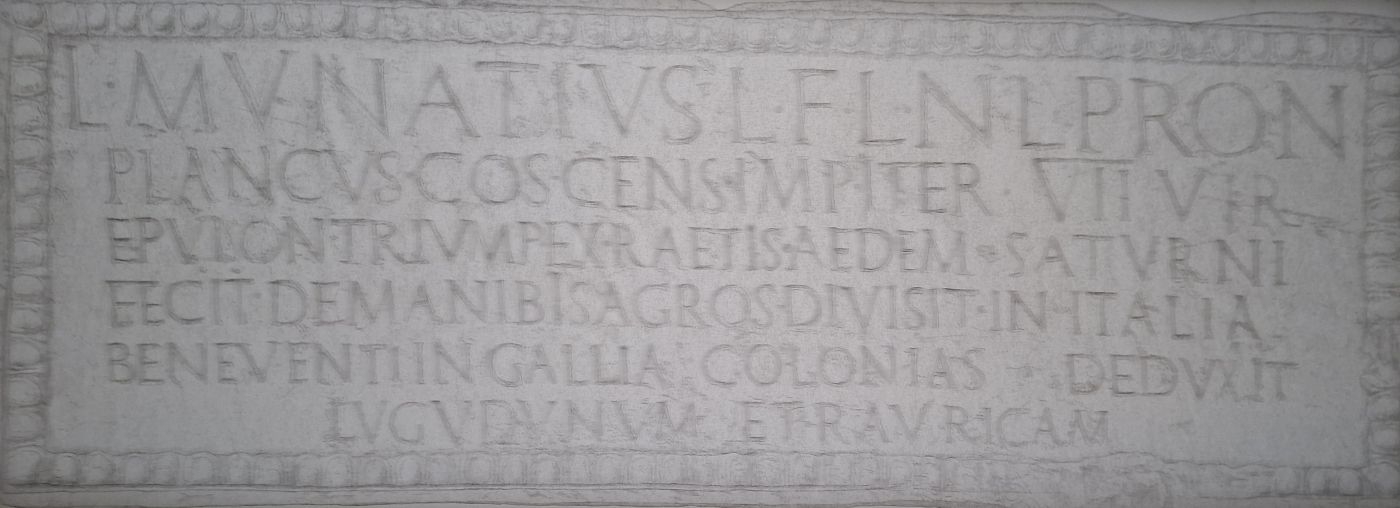
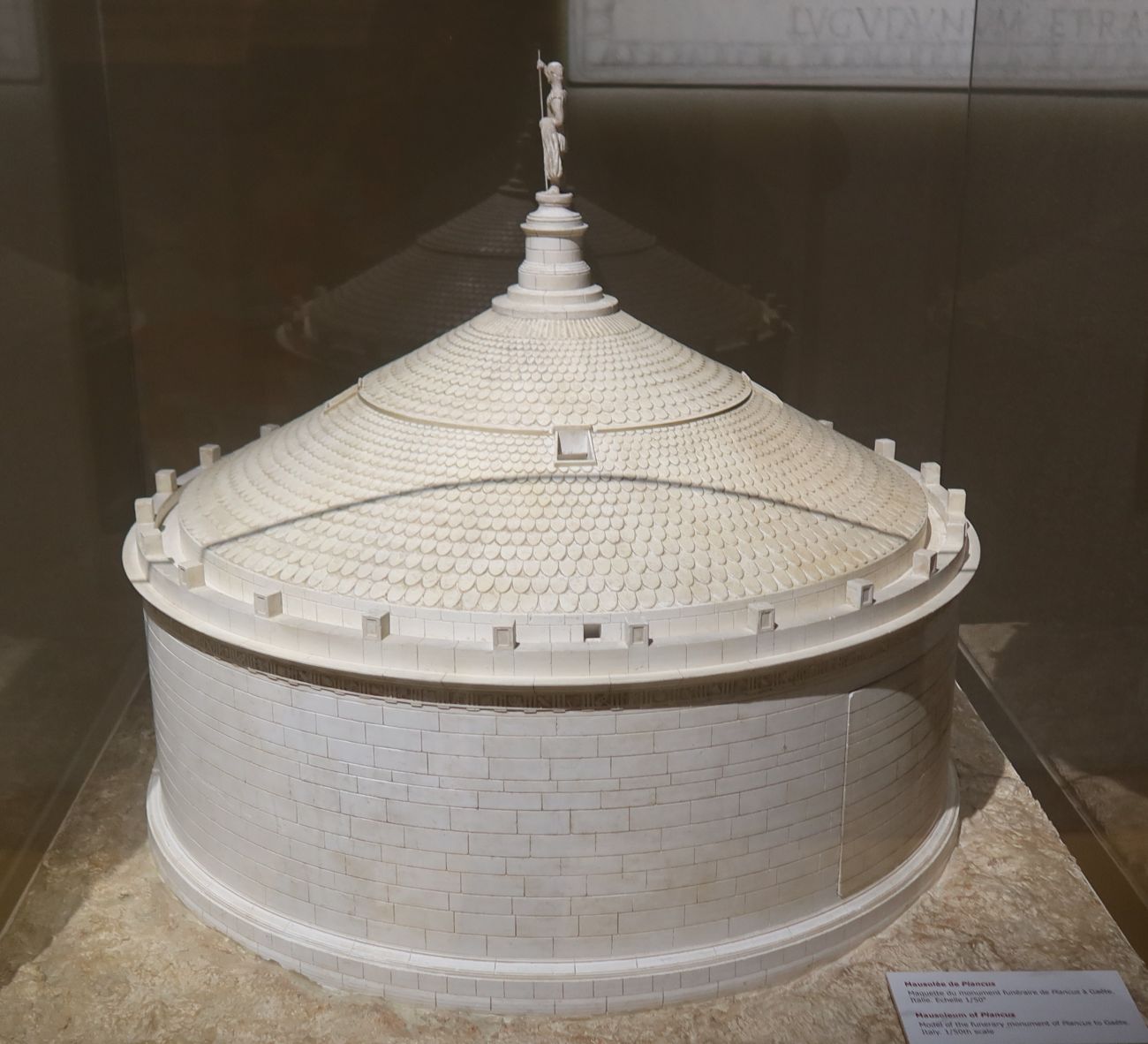
Model of the Mausoleum of Lucius Munatius Plancus in Gaeta. Collection: Musée gallo-romain in Saint-Romain-en-Gal
Roman era and Alemanni
The city of Basilia remained small in Roman times. The nearby Roman colony Augusta Raurica (Augst) was a large provincial town at the time. The Augusta Raurica Museum provides a detailed account of this history. After the Romans left around 400, the arrival of the bishop was crucial for the town’s development.


The bishop and the prince-bishopric
Basel became the new bishop’s seat, probably because of the invasions of the Germanic tribes (the Alemanni) at the end of the fourth century. The bishop previously had its seat near Augusta Raurica. The hill on which the cathedral was built provided a good refuge. Until the Carolingian Empire of Charlemagne (742-814), the diocese and the city led an unremarkable existence (politically and culturally).

Two bishops stood out in this period: Waldo (740-814) and Haito (762-836), cultural innovators and advisers to Charlemagne. In 999, the diocese would also become a secular and military power. In that year, the diocese acquired the rights of the abbey of Moutier-Grandval (a gift from Rudolf III (971-1032), the last king of Burgundy).
Around 1000, the bishop became a vassal of the Emperor of the Holy Roman Empire and thus a prince, marking the inception of the prince-bishopric, which is distinct from the ecclesiastical province or diocese. The (financial) involvement of Emperor Henry II (953-1024) made the construction of the Münster possible. The Sculptures of the emperor and his wife Cunegonde (980-1033) are visible in various places.

With the acquisition of St Ursanne Abbey in 1146 and through military expeditions in the 13th century, the Principality became the most potent secular power on the Upper Rhine. Its territory included today’s Jura, the Sundgau, southern Alsace, Birseck, and Birstal, as well as scattered possessions in southern Germany.

The City
In the 13th and 14th centuries, the power of wealthy citizens and guilds increased steadily. Due to its location, Basel was a trade hub and already an imperial free city (Reichsunmittelbarkeit).
After losing battles (1315, 1386, 1388 and 1415, the loss of the Aargau and Baden, including the essential archives with all documents and treaties, restitution in 1474 by the Ewige Richtung/Eternal Peace Treaty, Innsbruck, Vienna and in Vorderösterreich, Ensisheim and Freiburg were the centres of government.

A major earthquake destroyed much of the city and almost all its churches in 1536. At that time, Basel was still divided into Kleinbasel, located on the right bank of the Rhine, and Grossbasel, situated on the left bank of the Rhine. Kleinbasel fell under the Diocese of Constance and the Archbishopric of Mainz until 1801. Grossbasel was a diocese of the Archbishopric of Besançon.
Another crucial moment was the construction of the Mittlerbrücke in 1225. Trade and population increased rapidly, and both Basel were united in 1392.
Basel had close connections with the Alsace and Baden regions, as well as the Confederation. However, the city remained neutral in military conflicts.


Unknown artist. Dreiländermuseum Lörrach
However, in 1444, the town was the scene of a battle between French troops and the Eidgenossen (the Battle of St. Jacob’s on the Birs, 26 August 1444). This battle occurred during the Council of Basel (1431-1449).


St. Jacobs Kapelle
The University of Basel was founded in 1460 with the support of Pope Pius II (1405-1464). The city became a centre for publishing, printing, humanism, and science. Basel remained neutral in the Burgundian Wars (1474-1477) and the Schwabenkrieg (1499).

1501-1529
The accession of Basel to the Eidgenossenschaft in 1501 complicated relations between the bishop and the city. After the bishop and the (aristocratic) chapter’s departure in 1529, the city council and elite were the main political forces.
The Catholic Erasmus of Rotterdam (1467-1536) lived in Basel and was buried in the Protestant Münster in 1536.
Basel acquired the villages of Riehen and Bettingen in this period. They are the two other municipalities of the canton nowadays.
1798-1848
After Napoleon’s fall, Basel joined a new confederation in 1815 with part of the territory of the Principality of Basel (the Birseck). In 1833, there was a split between Basel-Stadt and Basel-Landschaft (Baselbiet). In 1848, the new constitution gave both cantons the status of semi-canton (with one seat in the Ständerat per canton instead of two).
1875
In 1875, the canton introduced a new constitution including the following features:
The introduction of the separation of powers, universal suffrage (for men, with the introduction of women’s suffrage following in 1966), the popular initiative, and the referendum (including the mandatory referendum for all constitutional amendments and the optional referendum). The Citizens’ rights go further in the canton than at the federal level.

Government
The Grand Council (der Grosse Rat) is the legislature. This institution, a tradition dating back to the Middle Ages, is elected every four years under the proportional system (Proporzsystem). The seats (200) are allocated to the parties according to the number of votes. The Government Council (Regierungsrat) is the executive. The governing council is elected according to the absolute majority system (Majorzsystem).
What distinguishes Basel-Stadt from the other cantons is that the Government Council and the Grand Council are responsible for both the canton of Basel-Stadt, including the municipalities of Riehen and Bettingen and the city of Basel.


Town Hall of the City of Basel
The flag
The flag symbolises the episcopate and the diocese of Basel. What remains of the bishop is the city’s heraldry: the black bishop’s staff. The bishop’s staff is the heraldry of the canton of Basel-Stadt, which was already known in the 13th century.
In the 11th and 12th centuries, the bishop already used the red bishop’s staff to show the identity of the Prince-bishopric. The red bishop’s staff was the bishop’s heraldry, still visible on the flags of the Cantons of Jura and Basel-Landschaft.
(Source and further information: A. Berchtold, Bâle et l’Europe. Une Histoire culturelle (Deux tombes, Lausanne 1991).


Medieval and modern Basel


Kanton Basel-Stadt, view from Ötlingen (Baden)


Numa Donzé (1885-1952), Johannes der Taufer (John the Baptist), 1919, the city has around 250 springs and sources of water

Laterne, Fasnacht 2023


The old FCB-Stadion in Kleinbasel

