The Wolf, the Beaver and Trees

In some cantons, including Tessin, Valais and Graubünden, the wolf is the talk of the day and even the subject of a referendum at the national level. Man has hunted the wolf for centuries, and she had disappeared from the country until recently.
However, she has been back on the scene for a few years. As is well known, the wolf is a carnivore, which does not increase its popularity and leads to heated public debates.

However, vegetarians also cause controversy and discussion in society. One example is the beaver in Auvernier (municipality of Milvignes, canton of Neuchâtel). Incidentally, the French name castor does the animal more honour than beaver. Castor ( its scientific name is castor fibre) is derived from the Latin word castrare, meaning to cut.

With razor-sharp and iron-like teeth, it gnaws down trees. Its teeth are orange-yellow because of the iron in the enamel. His preferred species include willow, poplar, alder, cherry, and similar woods.

In Auvernier on Lake Neuchâtel, colonies of beavers have been staying for several years, initially to the delight of residents. After a few years of nibbling, some citizens are beginning to worry about deforestation. The beaver is a protected animal and has no natural predators. Moreover, there are two waves of births every year.

The municipality has recently issued a public appeal for a form of cohabitation (cohabitation) with this vegetarian.

Last Latest News of 2022

The year 2022 comes to an end, the war and aggression unleashed on 24 February are not over yet, unfortunately.

Christmas is a symbol of hope, light and reflection and notwithstanding these and other events, have a Merry Christmas and a Happy New Year.

Humankind does not know what the future brings and can not change the past. The present-day, however, is the opportunity for reflection, planning and (small) deeds.

The Swiss Constitution

The Founders

There are two founders of the Swiss Confederation (Confoederatio Helvetica): the people and the cantons, as stated in the Preamble and Article 1 of the Federal Constitution (FC) (Bundesverfassung, Constituziun federala, Constitution fédérale, Costituzione federale).

The Swiss people and the cantons (Das Schweizervolk und die Kantone, Il peuple svizzero et les cantons suisses, Il Popolo svizzero et l’Cantoni, Präambel, Preambel, Préambule, Preambolo) constitute the Swiss Confederation (bilden die Schweizerische Eidgenossenschaft, furman la Confederaziun svizra, forment la Confédération suisse, costituiscono la Confederazione Svizzera, Art. 1 FC ).

The People 

The people and the cantons are the supreme sovereign power and legislative bodies. Art. 51 FC also reflects the highest sovereign power of the people.

Each canton has a democratic constitution, which only comes into force with the consent of the people. A majority vote of the people can always amend the Constitution.

The canton’s Constitution must comply with the principles of the federal Constitution and all applicable (human rights) treaties.

For example, the Supreme Court (Bundesgericht/Tribunal fédéral) in Lausanne recently ruled (on 29 July 2019) that the electoral system for the government (der Grosse Rat) of the canton of Graubünden does not meet the democratic conditions set forth in the federal Constitution. A new electoral system has replaced the old system.

But who or what is meant by ‘the people’? The term encompasses all inhabitants who hold civil rights and the right to vote and be elected in municipalities, cantons, and the Confederation (Art. 37(1) FC.

Voting rights

The cantons’ constitutions have delegated civil rights to the municipalities based on the (minimum) conditions of the federal government (Art. 38, 1-3 FC).

The procedure and justification must always adhere to the principles of the federal and cantonal constitutions (i.e., they must not be based on procedural irregularities, arbitrariness, or discrimination).

Articles 39 and 136 FC grant the right to vote, be elected and reside in any canton  (Art. 24 FC).

The powers are mainly defined at the cantonal and municipal level, except for national conscription (compulsory military enrolment) for men, including the possibility of performing substitute service and voluntary or non-compulsory military service for women (Art. 59 FC).

Only Swiss citizens have political (voting) rights at the federal level.

Foreigners

The cantons may grant political rights to non-Swiss residents. However, non-Swiss citizens-residents can participate in municipal and cantonal politics in eight cantons.

They have the right to vote and, in some cases, to be elected to office. Five (French-speaking) cantons (Jura, Neuchâtel, Vaud, Genève, Fribourg) give foreign residents the right to vote and to be elected in municipalities.

The constitutions of three German-speaking cantons (Graubünden, Appenzell Ausserrhoden, and Basel-Stadt) permit municipalities to implement this system for foreigners.

The municipalities, i.e. the people, grant the right to vote and stand as a candidate. As a result, this possibility may exist in one municipality but not in another within the same canton.

Two cantons grant the right to vote for cantonal representations (Jura, Neuchâtel).

The sovereign

The explicit mention of the People in the Swiss Constitution is not an empty word.

On the contrary, citizens have extensive and guaranteed political rights. They are often used at the municipal, cantonal, and federal levels.

The Swiss Confederation and the federal government were created in 1848  by the (male) citizens and the cantons.

The last major revision of the Constitution was also ratified by the people (including the female population) and went into effect on 1 January 2000.

This extraordinary political continuity, mutual trust, and dialogue between the federal government, the cantons, the municipalities and the people are the fundamentals of Switzerland’s (economic, monetary, social, and cultural) success.

The people (and the cantons) were and are the country’s sovereign power, founded by them in 1848.

The Sonderbund War that brought Peace

Switzerland has a reputation for slow decision-making in politics. However, the country introduced Europe’s first democracy (for men and with many exemptions) and first trilingual confederal republic in 1848.

The cantons are the experimental gardens of new political concepts; ultimately, the citizens always have the last say, as all citizens are, in a sense, politicians. So it was also in the cantons and their municipalities that the political discussions and polarisation preceding the Sonderbund War of 1847 began. The long-smouldering discord in the new Swiss Confederation of 1815 erupted in 1847.
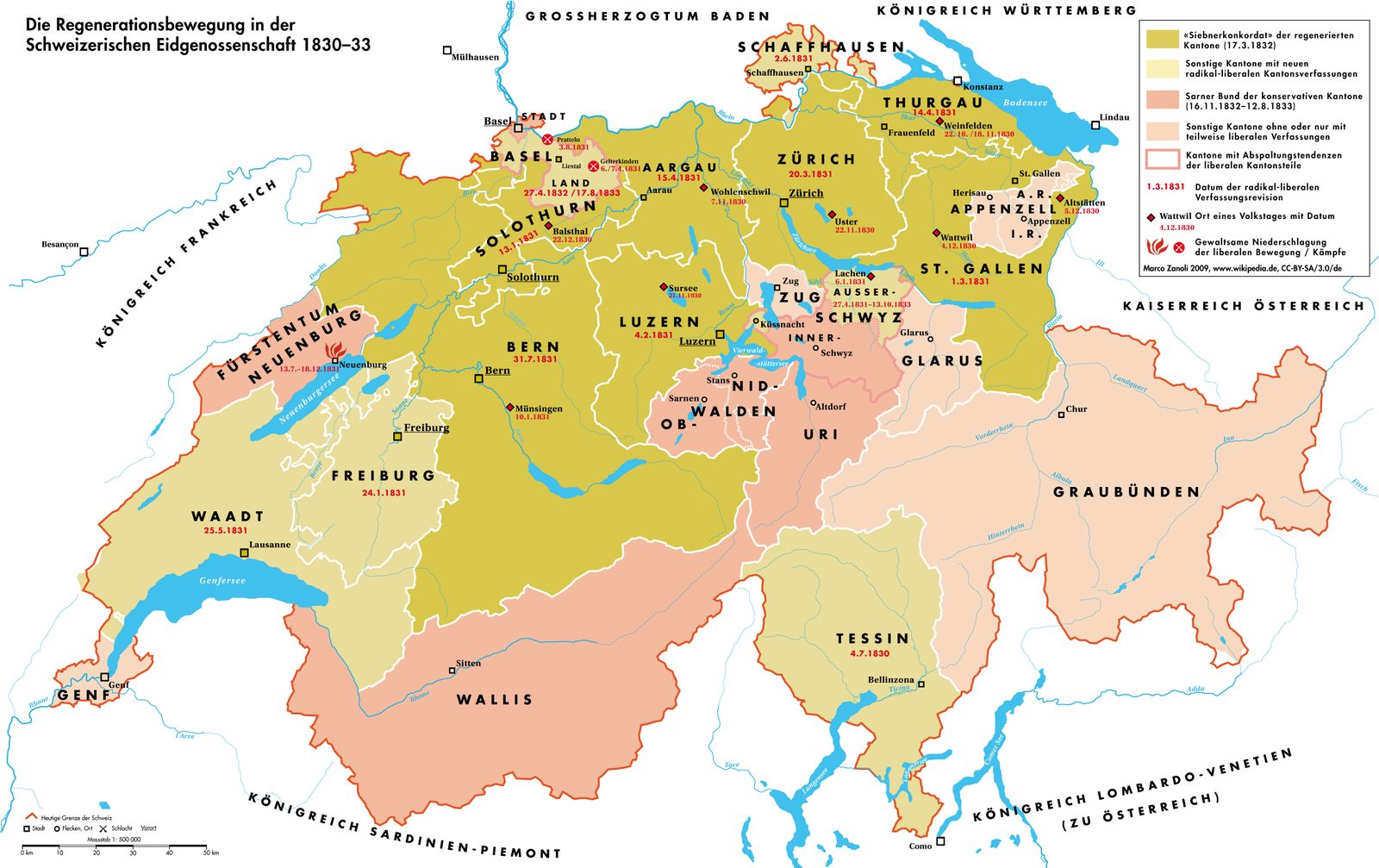
The political situation after 1831. Map: Marco Zanoli/Wikipedia

Background

The Constitution of the new Confederation of 1815 restored the ancien régime in most cantons. The sinecure was the revision of the Constitution of 11 cantons in 1830/1831, the so-called Regeneration. Impressed by the French and German revolutions in 1830/1831, 11 cantons introduced a liberal Constitution, including universal suffrage for male citizens (with some restrictions).

This liberal Constitution in these cantons focused mainly on the trias politica, liberalisation of the economy and trade, universal suffrage (for men), equality before the law (although not yet for women and Jews), and other fundamental freedoms and democratisation.

Religious motives did not play a decisive role at this moment. Religious conflicts increased after 1831, and from 1841 onwards, the situation escalated. The dissolution of monasteries in the Protestant and Catholic canton of Aargau, and the role of the Church and Jesuits in the Catholic canton of Lucerne, were the immediate causes.

The distribution of catholic and Reformed religions (1850). National Museum Zurich

A new Constitution in Canton Aargau (5 January 1841) ended Catholics’ equal rights. They revolted in vain. The Catholic cantons did not accept it, and the Jesuits regained a prominent role in politics and education in the canton of Lucerne. This subsequently led to armed incursions from neighbouring cantons.

The deeper cause, however, was disagreement over the Confederation’s constitutional future. The Protestant and some liberal Catholic cantons wanted a stronger federal government, while the Catholic-conservative cantons opposed it.

The conflict also had economic motives. The cantons in central Switzerland had a different geographical and economic orientation across the St Gotthard. The urban Protestant cantons were more oriented towards contacts with the north, west, and far beyond.

Poverty and famine also prevailed in the so-called Urkantone of Schwyz, Obwalden, Nidwalden, and Uri, which is always a fertile breeding ground for rebellion. For centuries, young men had served as mercenaries in foreign armies. This lucrative business collapsed after 1815 and was forbidden in 1848.

The Sonderbund. Map: Marco Zanoli/Wikipedia

The Sonderbund

In 1845, the Catholic cantons of Schwyz, Obwalden, Nidwalden, Zug, Uri, Lucerne, Valais/Wallis, and Fribourg/Freiburg founded the Sonderbund. The Protestant-liberal cantons, supported by three predominantly liberal Catholic cantons (Solothurn, Tessin, and St Gall), opposed the Sonderbund, invoking the Confederal Constitution.

The Protestant Cantons of Basel-Stadt and Neuchâtel, along with the Catholic canton of Appenzell Innerrhoden, remained neutral. In July 1847, the Tagsatzung, the Confederal Parliament with representatives from the cantons, declared the Sonderbund and the presence of Jesuits in Lucerne illegal, but only by a small majority.

Despite the mediating role of Canton Basel-Stadt, the escalation culminated with the mobilisation of an army of 80,000 Sonderbund soldiers in October 1847. Subsequently, the Confederation mobilised an army of 100,000 men.

The Tagsatzung appointed Guillaume Henri Dufour (1787-1875) as general. The general of the Sonderbund was a Protestant (!)  and a colonel from the Federal army (!), Johann-Ulrich von Salis-Soglio (1790-1874) from Graubünden, a canton that fought against the Sonderbund(!). It shows how intertwined the cantons already were.
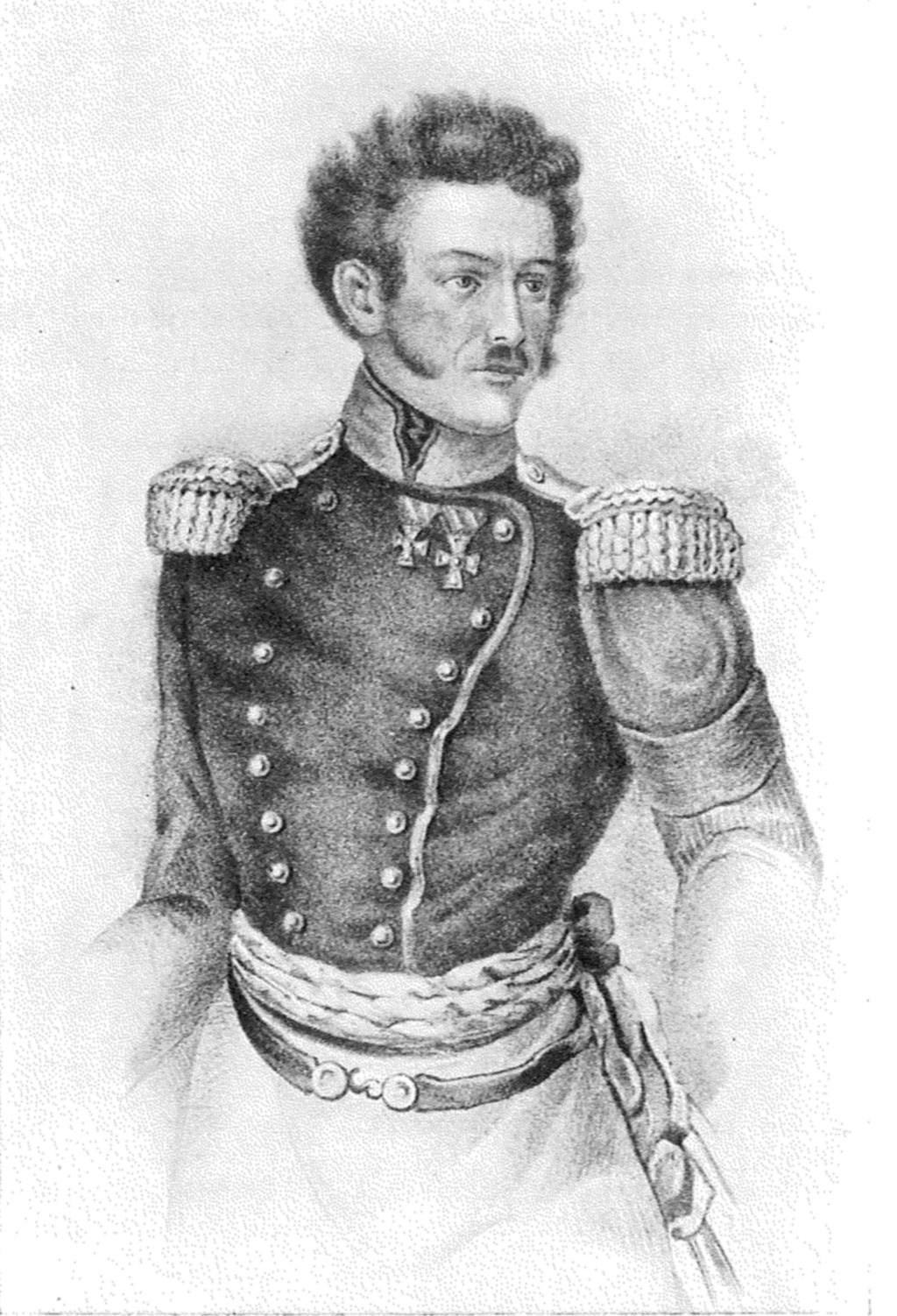
Johann-Ulrich von Salis-Soglio, mid-19th century. Anonymous engraving. Photo: Wikipedia

Dufour’s choice was also not self-evident. He came from the French-speaking canton of Geneva, and although Protestant, he opposed a powerful federal government.

On 4 November, the Sonderbund attacked the canton of Tessin, an old Untertanen territory across the St Gotthard. It was a failure, and its subsequent course is well known. On 23 November 1847, the decisive battle occurred near the village of Gisikon (canton of Lucerne). After a short war of 25 days, 93 killed and 510 wounded, Canton Valais capitulated as the last Sonderbund canton on 29 November.

The European context

The Great Powers, including Russia, Austria, Prussia (the Holy Alliance), and France, considered intervening militarily in favour of the Catholic-conservative cantons and against the liberal, in their eyes, radical-democratic cantons.

The Monarchs did not want a second Revolutionary experiment after the experiences of 1789-1815. Klemens Wenzel von Metternich (1773-1859), the long-serving Austrian foreign minister and chancellor, advocated for a military intervention. Moreover, the Pope financially supported the Catholic canton of Lucerne and the Jesuits.

Thomas Lawrence (1769-1830), Prince Klemens Wenzel von Metternich, 1818. Royal Collection of the United Kingdom. Photo: Wikipedia

Because of its refuge for asylum seekers, revolutionaries, and anarchists, Switzerland has been a problem for the European monarchs since 1815. The problem was that they had guaranteed the country’s neutrality in 1815 at the Congress of Vienna (1814/1815).

Although the Catholic cantons had requested it, there was no invasion in 1847. This was not because these monarchs respected neutrality but because England vetoed an invasion, and these countries faced revolutions and unrest in 1848. Moreover, the conflict in Switzerland was short-lived, and order was restored in 1848.

After 1847 

What makes the Sonderbundskrieg special is the follow-up. A Civil War often disrupts societies, leaving them in irreconcilable camps for many generations. Not so in Switzerland. This Civil War also left its mark, but the former enemies were soon back on speaking terms, and there was no long-term hatred or feelings of revenge.

The centuries-old cohabitation, dating back to the 13th century, in the predominantly German-speaking Eidgenossenschaft and the relatively mild regimes in the occupied territories (Untertanengebiete) had created a national identity despite all the differences.

The cantons of Aargau (1415), Thurgau (1460), Vaud (1536), and Tessin (1512) were occupied and administered by the Eidgenossenschaft until 1798. In 1803, they got the status of sovereign cantons (by Napoleon).

Neuchâtel was a sovereign county until 1395, then a German, French, and finally a sovereign Prussian principality, formally until 1857. However, it was a member of the Confederation as a sovereign canton from 1815. Geneva and Valais had always been sovereign territories (except in 1798-1813). They joined the Confederation in 1815.

The citizens of Geneva, Neuchâtel and Valais (and by decision of the Congress of Vienna in 1814/1815) chose the Swiss Confederation in 1815 after their French experience.

The citizens of Tessin in 1798, when Napoleon gave them a choice to join the Italian Republica Cisalpina and later the Repubblica Italiana (Siamo Svizzeri italiani). Tessin chose the Swiss Confederation.

The spirit of compromise, centuries of experience, the pursuit of the attainable, the ‘agree to disagree’ mentality, the priority of democracy and sovereignty and shared economic interests created ‘unity in disunity’.

The war ended as it had begun: in General Dufour’s words, on the eve of victory:

“Eidgenössische Wehrmänner, Ihr werdet in den Kanton Luzern einrücken. Zieht dem Feinde kühn entgegen, schlagt Euch tapfer und steht zu Eurer Fahne. Sobald aber den Sieg für uns entschieden ist, so vergesset jedes Rachegefühl, betragt Euch wie grossmütige Krieger, verschont die Überwundenen, denn dadurch beweist Ihr Euren wahren Mut”.

It brings to mind the words of Winston Churchill (1874-1965): “In War: Resolution, In Defeat: Defiance, In Victory: Magnanimity, In Peace: Good Will.” (Winston Churchill, The Second World War, Volume I, The Gathering Storm, London 1948).

The Conciliatory Constitution of 1848 remains the country’s foundation for liberalism, social democracy, federalism, and decentralisation. Direct democracy has been an indispensable ingredient since the 1874 and 1891 amendments.

Lithography by  C. Studer, Winterthur, 1848, printed by J.J. Ulrich, Zurich. Collection Burgerbibliothek Bern. Photo: Wikipedia

Conclusion

Religious issues do not play a significant role in today’s politics. Even the country’s quadrilingual concept, and particularly the Röstigraben, is politically of secondary importance. The cantons of the Sonderbund maintained their identity and largely their sovereignty and developed economically innovatively and versatilely.

They benefited from the liberal spirit of the Constitution, economic modernisation, industrial revival, tourism, the development of railway and road networks, the establishment of Europe’s top universities (ETH Zurich and EPFL in Lausanne), social legislation, and prosperity.

Conflicts and conflicts of interest still exist, but less between cantons and more within cantons. The ‘Stadt-Landgraben’, which pits urban against rural and old against young, is the new divisive line.

The current choice of a French-speaking minister (Bundesrätin/Conseillère fédérale) from canton Jura instead of a German-speaking representative from canton Basel-Stadt in the government (Bundesrat/Conseil fédéral) or a majority (four French-Italian speaking and three German speaking) in the government is of less importance than the under-representation of the big cities.

The Sonderbund War was a civil war that lacked the traumatic long-term consequences typically associated with such conflicts. It is a merit and characteristic of the country that has a leading role in the fields of cartography, humanism, geography, politics, engineering, and soldiering, as exemplified by the notable figure Guillaume Henri Dufour.

(Source and further information: J. Jung, Einigkeit, Freiheit, Menschlichkeit. Guillaume Henri Dufour als General, Ingenieur, Kartograf und Politiker, Zurich, 2022)P. du Bois, La guerre du Sonderbund (Neuchâtel 2020); Historisches Lexikon der Schweiz, Der Sonderbund.

Swiss Democracy at Work

Switzerland’s political system is unique and functions relatively well. The country is the world champion of direct citizen control over municipal, cantonal, and national policy.

The people directly elect the governments of municipalities and cantons through the absolute majority system per candidate. Moreover, the number of municipal council members or cantonal government members is limited to five or seven. This maximum is stipulated in the Constitution of the cantons and municipal laws.

However, prosperity, political stability, and coherence in this culturally, linguistically, historically, economically, and religiously divided country are not solely a result of its direct democracy. The fundamentals are federal organisation, decentralisation, and subsidiarity.

The cantons are sovereign in many areas, including education, healthcare, social security, justice, and, for example, policing. Based on their constitutions, the cantons can delegate powers to municipalities.

However, cantons and municipalities must respect international treaties, federal law, and the Constitution. The highest federal court (the Bundesgericht/Tribunal fédéral in Lausanne) and the European Court of Human Rights in Strasbourg are the supreme judges in these cases.

Powers of federation

The federal government’s powers are limited and only transferred after approval by the cantons and citizens. Since the creation of the modern Confoederatio Helvetica in 1848, and especially after 1945, more and more powers have been transferred.

The recent COVID-19 pandemic has also exposed the tension in the relationship between the 26 sovereign cantons and the federal government. This discussion has been ongoing for a long time and remains open regarding possible reforms. This system also has its weaknesses.

The federal government has about 40,000 civil servants. According to the Constitution of 1848, it is limited to seven ministers (Bundesrat/Bundesrätin/conseiller fédéral). 

The government’s composition is based on the principles of collegiality (Kollegialitätsprinzip), cooperation (Konkordanzprinzip), and the magic formula (Zauberformel).

The government (Bundesrat/Conseil fédéral )

Other contributions cover the functioning of the government, the executive, the relationship between parliament and the government, the composition of parliament, and the legislature, which consists of the Council of States (Ständerat/Conseil d’Etats) and the National Council (Nationalrat/Conseil national). This article focuses on the appointment procedure of the seven federal ministers.

The seven ministers are elected one by one by the parliament (the 246 members of the two chambers) and appointed after the general national elections under the proportional system or if ministers resign or die during their mandate.

The magic formula’s distribution is fixed based on the four largest parties: 2-2-2-1 in parliament. The government is always a coalition government. A new primus/prima inter pares is elected annually from the seven ministers as head of state but without prime minister status.

After the ministers are chosen by parliament, the seven departments are distributed based on experience, competence, ambitions and qualities. Ministers are appointed for four years and cannot be forced to resign mid-term (except in particular circumstances). The government, on the other hand, cannot dissolve parliament.

The appointment procedure 

Candidates must meet some constitutional requirements (including Swiss citizenship with political rights, not being a member of parliament or the Federal Court and a proportional representation of government members by (language) region).

An absolute majority of the votes is required, which sometimes necessitates two or three rounds of voting.

However, based on the magic formula, the choice is limited to the membership of one of the four largest parties. Today, these are the Schweizerische Volkspartei (SVP, two ministers), the Sozialistische Partei (SP, two ministers), the Freie Demokratische Partei (FDP, two ministers) and die Mitte (1 minister). If a minister resigns or dies mid-term, members of their party become the new minister.

The procedure’s strength is its carefulness. Lengthy processes and voting rounds occur within the party at both the cantonal and national levels. Based on this selection, two or three candidates usually remain for the decisive vote in parliament. The party’s favourite does not automatically get the majority. Sometimes, in 14% of cases, party outsiders are elected against the will of the party’s faction!

The election

Candidates often have long-term experience in (cantonal or federal) politics, support within the party, organisational expertise, and personal characteristics, with career and engagement/involvement in the country’s functioning as essential criteria.

A concrete example is the appointment of two new ministers following the interim resignation of Minister Ueli Maurer of the SVP and Simonneta Sommaruga of the SP. Several candidates applied for both vacancies.

After lengthy procedures within the cantons, at the national level, and in the parliamentary groups, two candidates remained for each party. The SP wants a woman. That in itself is not remarkable these days. However, the new canton of Jura (since 1979) may get a ministerial post for the first time or the canton of Basel-Stadt for only the third time since 1848!

7 December 2022

Albert Rösti (SVP) from Bern and Elisabeth Baume-Schneider (SP) from Jura, an outsider, were elected on 7 December. Thus, the canton of Jura, founded in 1979, is represented in the Federal Council for the first time in its history.

With the election of Elisabeth Baume-Schneider from the French-speaking Jura, the German-speaking part of Switzerland no longer forms the majority in the Federal Council, as it now has four members from Latin (Tessin and Romandie) Switzerland.

Moreover, the Nationalrat has recently appointed Martin Candinas from Ilanz/Glion as its president, a Romansh-speaking (Surselvan) region (canton of Graubünden).

Conclusion

Who the new ministers will be is not the subject of this contribution, and the outcome of the decisive votes in parliament on 7 December is irrelevant from this perspective.

The individual scrutiny of candidates, the structures, procedures and the political system are relevant. They are the foundation of the prosperity, stability, cohesion, state of law and (social) security of the country and its cantons and communes.

This system was created over a long period, through centuries of cooperation, (armed) conflicts, different economic and geographical orientations and interests, experiences, statesmanship, pragmatism, and willingness to compromise.

Due to its federal, decentralised, bottom-up concept and direct democracy, the political system is virtually immune to the delusion of the day.

(Source: A. Vatter, Der Bundesrat, Basel 2020).

Castellio, Basel and Tolerance

As a centre of book printing, where Erasmus worked, and through its role as a mediator in religious policy, Basel became a place of refuge for religious dissidents and representatives of the Reformation in the mid-16th century.

They engaged in a (multilingual) discussion among themselves and with Basel citizens. When the Spaniard Michael Servet (1511-1553) was burned for heresy in Calvin’s Geneva in 1553, Basel became the centre of the protests.

The Savoyard humanist Sebastian Castellio (1515-1563) raised his voice with his courageous writings, which combined mystical piety with Enlightenment argumentation. Throughout the following centuries, his voice was heard across Europe for religious freedom, human rights, and tolerance.

The Reformation 1545-1620. Photo: Universitätsbibliothek Basel

The correspondence network of Castellio. Universitätsbibliothek Basel

The exhibition (Laboratorien der Toleranz. Sebastian Castellio und sein Erbe) presents Castellio’s life and works based on documents in the University Library of Basel. It encompasses historical upheavals and conflicts, networks and media, discourse, and the realm of thought, marking his work as a pivotal moment in the history of European tolerance thinking.

(Source and further Information: Universitätsbibliothek Basel)

Markus Böhmer, the commemoration of Sebastian Castellio. St. Albankirche, Basel.

Memorial Geneva

The Ancient Via Romana is a Road without Borders.

The approximately 400-kilometre road follows the course of the old Via Romana, which connected the Roman legionnaire’s camp Vindonissa (Windisch, canton Aargau, Switzerland) with the settlement Grinario (Köngen, near Stuttgart, Germany).

This road is also shown on the Tabula Peutingeriana, an ancient Roman road map. The original map is lost, but a medieval copy shows the road.

The road — which consists of three parts: Neckar-Alb, Neckar-Aare and Neckar-Hochrhein —  leads to museums, ruins, and other Roman (and Celtic) remains in the following towns and places

Neckar-Alb route:

Köngen, Nürtingen-Oberensingen, Pliezhausen, Kirchentellinsfurt, Rottenburg am Neckar, Bad Niedernau, Obernau, Eutingen im Gäu, Hirrlingen/Rangendingen, Hechingen-Stein, Burladingen, Geislingen-Häsenbühl, Rosenfeld, Sulz am Neckar, Oberndorf am Neckar, Rottweil and Niedereschach-Fischbach.

Neckar-Aare route:

Schleitheim, Hüfingen, Bad Zurzach, Brugg and Windisch.

Neckar-Hochrhein route:

Wurmlingen, Engen, Tengen, Stein am Rhein, Eschenz, Pfyn and Frauenfeld.

(Source and further information: www.roemerstrasse.net).

Allerheiligen Monastery Schaffhausen

The Romanesque church of the Benedictine monastery of All Saints (Allerheiligen) in Schaffhausen was consecrated in 1103/1104, replacing the church consecrated in 1064 of the first complex of the monastery founded by Count Eberhard III of Nellenburg (1015-1078).

The church is a three-nave basilica with a transept in the style of the Hirsau building school. The church’s structure has remained unchanged in style to this day.

Since 1524, it has been a parish church, while the monastery was converted into a provostry. The Reformation came in 1529.

The narthex dates back to 1857, replacing the 12th-century hall that extended up to the still-preserved pilasters. The last major renovation of the church was in 1950.

The well-preserved Romanesque tower is richly structured, featuring round-arched friezes, girts, and arched windows. The former monastery complex includes the cloister, the herb garden, the Old Abbey, the New Abbey, the library and the music school.

The Old Abbey, the monastery chapels and the Gothic refectory house the Museum zu Allerheiligen today.