

Available in German and Dutch
Author: Maarten Koning
The Mélisande-Fresco at the Grimsel Pass

Available in Dutch and German
The Rhine Source Lighthouse

No mountain is too high for Swiss people, but what about the lighthouse on the Oberalp Pass at an altitude of 2,046 meters?
The Rhine Lighthouse is an hour’s walk from the source of the Rhine. The Gotthard massif is the source of four rivers: the Rhine, Reuss, Rhone and Ticino, flowing to all four quarters of the compass. The 85-kilometre-long hiking Trail Vier-Quellen-Weg (the Four Headwaters Trail) shows the way.

The Lighthouse is intended as a call to travel to the source of the Rhine, as a siren. It was built in 2010 in the Swiss village of Alpnach, and then transported to the Oberalp Pass.

The Lighthouse is intended to serve as a visual icon for the entire Rhine region and its 50 million inhabitants. It is a replica of a Lighthouse in Hoek van Holland (the Netherlands), 1,233 kilometres from the Gotthard Massif. The original can be seen in the Maritime Museum of Rotterdam.
The lighthouse may be located on a beach again within 20 million years.
(More information: www.leuchtturm-rheinquelle.ch).


Open Air Museum Ballenberg

The open-air museum (Freilichtmuseum Ballenberg) features a collection of over 110 rural houses and farm buildings relocated from all over Switzerland. To furnish the buildings, the museum collects objects from rural life and farming before the advent of agriculture.
These items and related secondary information relate to earlier ways of living, social structures, and economic activities in the farming community, as well as crafts and commerce.
The site features magnificent farmhouses, humble workers’ quarters, alpine huts and stalls, barns, storehouses, washhouses, and drying ovens, providing architectural and socio-historical testimony to the everyday life and rural culture of the past. Gardens, fields, pastures and meadows, set up according to historical models, surround the farmsteads and houses.

Some craftspeople work with traditional tools in the buildings, while various theme exhibits give insight into scenes from rural pasts.
Moreover, approximately 250 farm animals, representing the full range of native domestic animals, provide lively scenes. However, to get a good impression of typical Swiss houses, one could also visit the nearby villages of Ballenberg and Brienz before or after visiting the museum.
(Further information: www.ballenberg.ch)
Impressions from the Open Air Museum Ballenberg


The little Versaille L’Isle in the Canton of Vaud

Available in French, German and Dutch
Two Ivory Dolls and Romanisation

Underneath a Roman necropolis with 311 graves in Yverdon-les-Bains (Eburodunum in Roman times), excavations revealed numerous remains, including earthen and wooden buildings.
Two tiny ivory dolls were also found. They are related to the first models that appeared in Rome. The hairstyle imitates the models in vogue at the imperial court in Rome. Without a precise archaeological context, this is a good dating criterion. The best comparisons come from the early fourth-century hairstyles worn by women of the Constantinian family between 306 and 330 AD.
While these figurines were relatively common in the 4th century in Spain, southern France, and Italy, few examples from Switzerland and Roman Germany are known.
The two dolls from Yverdon-les-Bains, dated between the 4th and 6th centuries, reveal a high technical and artistic quality that has, until now, rarely been found in equal measure north of the Alps.
The discovery of such pieces remains an exceptional phenomenon that can be explained by the presence of a fully Romanised Gallo-Roman wealthy family.
(F. Rossi, “Deux poupées en ivoire d’époque romaine à Yverdon-les-Bains” in Archéologie suisse, 1993, No 4).
Auvernier and Lake Neuchâtel

The first mention of Auvernier (canton Neuchâtel) was in 1011 in a document confirming a donation of Averniacum by Rudolph III (970-1032), the last king of the Kingdom of Burgundy (888-1032).
Auvernier is located on the shores of Lake Neuchâtel. The place has been inhabited since Neolithic and Gallo-Roman times.


The Church (Le temple) of Auvernier. The village became Protestant in 1532.
The lake-dwelling houses are a UNESCO World Heritage site. Over a length of 1.5 km, at least ten places were inhabited between the fourth and the first millennium B.C. (see also the museum Laténium in Hauterive).

La Roche, 16th century

Fishing and viticulture were the main economic activities until 1945. The heraldry of the village
The town is also known for its castle of Auvernier, built in 1559, as well as other notable buildings, squares, and medieval streets.

The village (municipality of Milvignes since 2013) is a tourist destination nowadays, with the marina and beach of Auvernier.
(Source and further information: www.hls-dhs-dss.ch, Auvernier, Michel Egloff et Germain Hausmann, 2019; https://www.milvignes.ch).


The Romandy, Latin, French and Patois

Today, French is the official written and spoken language in French-speaking Switzerland (the French-speaking cantons of Neuchâtel, Jura, Geneva, and Vaud) and the bilingual cantons of Freiburg/Fribourg, Wallis/Valais and Bern/Berne. However, behind this modern linguistic unity lies a great diversity.
French, which gradually entered Switzerland after the 11th and 12th centuries, competed for centuries with Latin and the local dialects (Patois).
The breakthrough in French-speaking Switzerland only came in the 19th century. However, the Patois has left its mark. It explains why French differs in Neuchâtel, Geneva, Lausanne (canton of Vaud), Porrentruy/Pruntrut (canton of Jura) or Fribourg.
The middle ages
Gallo-Roman culture and language remained dominant in western Switzerland long after the Romans left in the 5th century. They didn’t speak French in this Gallo-Roman area. Francoprovençal was the daily language.
However, there were many local differences and dialects.
In today’s canton of Jura, the langue d’oïl or franc-comtois was the spoken language. Latin was the written language of the church and the elite. This situation remained unchanged in the Burgundian kingdoms (446-534 and 888-1032) and the later Frankish kingdoms.
German
The German of the Alemanni became dominant in western Switzerland from the 5th century onwards. It gradually led to the Germanization of the upper Rhone valley (Upper Valais to Brig), the left bank of the Aare (Bernese Oberland), the right bank of the Sense and the region around Lake Biel.
The second German-speaking expansion took place from the 11th to the 13th century, namely in Visp and Raron by the Walser, on the left bank of the Sense, in the area of Murten and Seeland (space between Lake Biel, Lake Murten and Lake Neuchâtel) and on the left bank of Lake Biel by the Alemannic settlers.

L’Armorial by Jacques Huguenin (1642-1728).
16th and 17th centuries
The first literary texts in French appeared in French-speaking Switzerland in the 15th century. At the beginning of the Reformation (first half of the 16th century), there were three languages in Romandy. Patois and its numerous local dialects were the mother tongue of most people.
French became more important, particularly among the urban Protestant elite. It was a language of prestige and the written word (the Bible!). Latin remained the language of legal documents, universities, scholars and the Catholic Church. The spoken languages Patois and French coexisted long after nearly 80,000 French Huguenots fled to French-speaking Switzerland in the 17th century.

La Petite Chronique by Jeanne de Jussie, in Gustave Revilliod (éd), Levain du calvinisme ou commencement de l’hérésie de Genève, Geneva 1853.
The 18th and 19th centuries
However, the situation changed in the late 18th century and the French epoch (1798-1813). French became the dominant language in everyday life, the classroom and administration. In the second half of the 19th century, Patois disappeared in the Protestant urban and industrialized areas (Geneva, Vaud, Neuchâtel and Bernese Jura).
In other cantons, Patois existed longer. In Evolène,Val d’Hérens in Valais, it is still spoken. Patois in Valais is just as particular as German in this canton.
At the end of the 19th century, Louis Gauchat compiled an extensive dictionary of Patois and its numerous local dialects, le Glossaire des Patois de la Suisse romande (Glossary of the Patois of French-speaking Switzerland).
For almost ten years, he collected information using questionnaires. He received more than 500,000 reactions! They are still the most important source for the current knowledge of Patois. His glossary is an invaluable source of knowledge.

Louis Gauchat. Photo: Wikipedia
The 20th and 21st centuries
In today’s Romandy, French is the language of everyday life, both spoken and written. Patois is only spoken in a few villages in the cantons of Valais, Fribourg and Jura. However, traces of the patois are still visible in the names of families and villages.

L’Atlas linguistique audiovisual des dialectes francoprovençaux du Valais romand (ALAVAL)
The Federal Council adopted Switzerland’s seventh report on the implementation of the European Charter for Regional or Minority Languages of the Council of Europe at its meeting on December 7th, 2018.
The Federal Council recognizes Franco-Provençal and Franc-Comtois as minority languages and gives an overview of the language policy.
(Source: A. Paravicni Bagliani, J.-P. Felber, J.-D. Morerod, V. Pasche, Les Romands au Moyen Age, Lausanne 1997); Bibliothèque Publique Neuchâtel, exhibition: Pourqoui parle-t-on le français en Suisse romande? Neuchâtel, 2022).
The Swiss Police
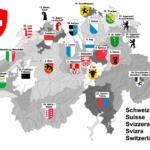
Available in German, French and Dutch, see also: www.admin.ch; www.polizei.ch)
The Romansh Spell Checkers

As part of the project “Programs da correctura ortografica rumantscha” (programmes for correcting Romansh), the organisations Pro Svizra Rumantscha and the Lia Rumantscha are launching a new programme for correcting written texts with and on the computer.
Six programmes for the five idioms (Puter, Surmiran, Sursilvan, Sutsilvan, Vallader and Rumantsch Grischun) will be available when the project is completed. They can be integrated into different operating systems and programmes. As a first step, a programme for Surmiran is being launched.
Although Romansh is a minority language with around 50 000 active speakers in Graubünden and tens of thousands elsewhere in Switzerland, the national government and the canton of Graubünden support this language and culture.
(Source and further information: Lia Rumantscha and Pro Svizra Rumantscha)