

Available in German and Dutch
Author: Maarten Koning
Adieu Belle Époque in Tinguely

The century ended in 1896. Revolutionary discoveries, inventions, art movements, and new political realities and parties created a new world. The Belle Epoque and the Fin de siècle also show the surge of cinema. The famous Cinématographe of the brothers and the anoscope are not the only relevant personalities (see also Chaplin’s World).
François-Henri Lavanchy-Clarke (1848–1922) made films of Switzerland to show at the Swiss National Exposition in Geneva in 1896. His pavilion was perhaps the world’s first cinema.
He was an inventive media pioneer and Switzerland’s first colour photographer, but he was long forgotten. His oeuvre, which presented Switzerland’s Belle Epoque, seemed lost.
This exhibition brings his films and photographs back into the limelight. His biography from that phase of his life, when he toured Switzerland with his Cinématographe Lumière, sheds light on what reality looked like for most Swiss two generations after the founding of the Swiss Confederation in 1848.
It is also a piece of Swiss media history. Some fifty of his films were recently rediscovered in a Paris archive. Thanks to modern image-processing technology, they can now be shown to the public once again—for the first time since 1898!
Not only are they moving documents of an era that disappeared five generations ago but still reverberates today, but they are also the ground-breaking work of a man who was the world’s first pioneer of early cinema to have a command of all the fields that together make up the medium of cinematography today: chronophotography, automation, the chemical industry, banking, lobbying and marketing, entertainment and the Showbusiness!
(Source and further information: museum Tinguely, Basel).
The Prince-Bishopric of Basel after 1813

The Prince-Bishopric of Basel experienced two significant revolutions after 1500. The title of Prince-Bishopric is a consequence of the status of the Bishop in the Holy Roman Empire. The Bishop was a prince (Reichsfürst/Fürstbischof) of the Empire.
The Reformation, which occurred between 1527 and 1529, marked a clear break. The Bishop moved to Porrentruy (Pruntrut in German, present-day canton of Jura). The cathedral is still Evangelical-Lutheran. The chapter settled in Arlesheim (Canton of Basel-Landschaft) in 1678; Solothurn has been the episcopal seat since 1828, but the diocese is still referred to as the Bishopric of Basel.
However, the Prince-Bishopric did not survive the second infringement. The French revolutionary troops occupied the northern Catholic part (roughly the canton of Jura) in 1792 and annexed it to France (Mont-Terrible department).
The southern Protestant part (the French-speaking part of the canton of Bern and the German-speaking territories of Birseck and Laufen in the present-day canton of Basel-Landschaft) was protected by the Confederation of cantons.
However, this area was also occupied in 1797, just before the French invasion of the Confederation in 1798. The Prince-Bishopric was formally dissolved in 1803. The territory was divided into new political units. The area of the Prince-Bishopric was assigned to the department of Haut-Rhin in 1800.
The French period came to an end in 1813. The cantons of Bern and Basel wanted to restore the old situation. The city of Biel aspired to be a canton. The new canton of Neuchâtel, which was still formally a principality of the King of Prussia (even until 1857), also claimed some territory.
Supporters in the northern part of the Jura (Porrentruy and Delémont) wanted to join France. However, these Swiss interests were irrelevant to the great powers at the Congress of Vienna (1814-1815).
The outcomes were the kingdoms of Sardinia-Savoie and the Netherlands, and the expansion of Prussian territories on the right bank of the Rhine. The containment of France was the priority.
Canton Bern got the territories of the Jura and the Laufental. The Birseck was assigned to the canton of Basel.
The discussions were not over yet. In 1833, Basel-Landschaft, inclusive of the Birseck, became a new canton, and Laufen joined this canton after a referendum in 1994. The canton of Jura became a new member of the Confederation in 1979. Moutier will leave the canton of Bern in 2026 to join the canton of Jura.
(Quelle: J.-C. Rebetez, D. Bregnard (Hrsg.), De la crosse à la croix. L’ancien évêché de Bâle devient suisse (Kongresse von Vienne – 1815), Neuenburg 2018).
The Largest Museum in the World

The Museums-PASS-Musées is the admission ticket to 345 museums, castles and gardens in France, Switzerland and Germany. It is the first trinational museum pass within Europe.
The Association of Museums-PASS-Musées was founded on December 14th, 1998. The official introduction took place on July 1st, 1999. Today more than 345 sites in the three countries are members of the association.
The Museums-PASS-Musées has been financially independent since 2004 and sells over 50‘000 passport memberships in 2017. The earnings are redistributed between the member museums.
Source and further information: The Association of Museums- Pass-Musées
The Rhine in 38 Exhibitions

The Three Countries Museum (Dreiländermuseum) in Lörrach opened its series of 38 cross-border exhibitions on the theme of the Rhine on 11 November with a vernissage in the Evangelische Stadtkirche.

Vernissage, the choir with French, German and Swiss songs from the nineteenth century.
On 12 November, the annual meeting of the network of historical societies on the Upper Rhine (Netzwerk Geschichtsvereine/Réseau des Sociétés d’Histoire) took place at the Dreiländermuseum. Over 200 historical societies are a member of this network.

Speakers and organisers of the colloquium (‘the Rhine’) of the network of historical societies on the Upper Rhine, 12 November 2022
The exhibition is the result of the cooperation of the network of museums (Netzwerk Museen/Réseau des Musées) on the Upper Rhine. This network is the largest cross-border project of museums in Europe coordinated by the Drieländer Museum.
As its name already suggests, the Three Countries Museum focuses on the shared history of France, Germany, and Switzerland. The museum lives up to its name and more than that.
It is an example of concrete and practical regional cross-border cooperation. The Three Countries Museum and the network of museums organise a major trinational exhibition every four.
The Rhine


Basel and the Mittlere Brücke 2022 (top) and sixteenth century (bottom, after a woodcut by Johannes Stumpf or Sebastian Münster). Collection: Dreiländermuseum (DLM K 16-233).
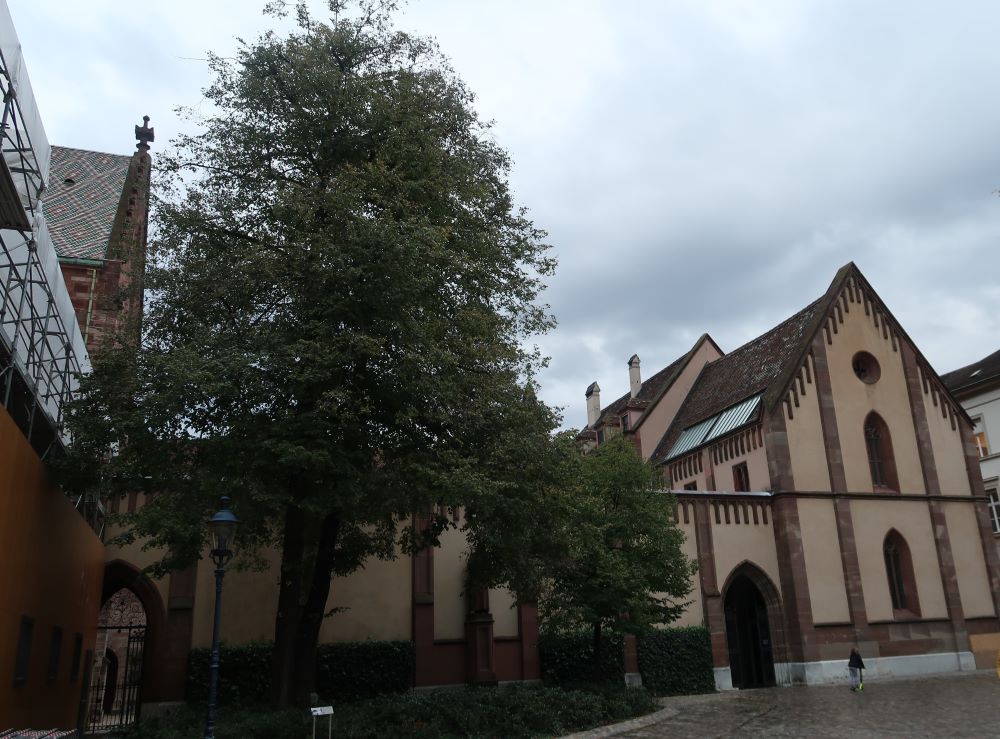
The Albert and Hélène Schweitzer-Bresslau tree at the Münsterplatz in Basel was planted on 24 March 2013. The Linde commemorates the couple’s departure from Alsace to Lambaréné (Gabon) in Africa on 24 March 1913.
The Rhine means emotion and identity. The German-French couple Albert (1875-1965) and Hélène (1879-1957) Schweitzer from Alsace named their daughter Rhena. Basel’s hymn is ‘Z’Basel an mym Rhy‘, (written in 1806 by Johann Peter Hebel, 1760-1826, melody by Franz Abbot, 1819-1885).
Other emotions were less peaceful but nationalistic and focused on territorial expansion. This history goes back to the Celts, Romans, and Germanic tribes.
After the division of the Carolingian Empire at the Treaty of Verdun in 843, the Upper Rhine was, for centuries, until the Reformation (from 1517) and the Peace of Westphalia (1648), an economically, linguistically (Alemannic), religiously (Catholic) and culturally closely linked region. After 1648, It was a war zone between France and Germany until 1945.

Detail of a customs game, showing the dozens of customs posts along the Rhine until 1798. Collection: Drieländermuseum
This agony is also reflected in the perception of the Rhine. France and Alsace commemorate ‘La Grande Guerre’, a day of mourning, on 11 November. Germany has then just passed the ninth of November, and 11 November is a day of reflection. In Basel, however, the sounds of piccolos and tambourines mark the beginning of Fasnacht on 11 November, St. Martins Day!
For France, the Rhine has long been an apparent natural border: the Pyrenees to the south, the Atlantic/North Sea to the west, the Alps to the east, and the Rhine as far as the Netherlands to the north.
Napoleon (1769-1821)implemented this view as well. The Netherlands was part of the French Empire from 1810, the Rhine was the Franco-German border (with the Rheinbund as German satellite states), and he divided Rheinfelden, Kaiserstuhl, and Laufenburg into a German and Swiss part, separated by the Rhine. He respected only Schaffhausen and Klein-Basel on the ‘German’ side of the Rhine as Swiss territory because of centuries-old claims.
Alsace
Alsace was German-speaking and Habsburg territory for centuries until the conquest of Strasbourg in 1681 by Louis XIV (1638-1714). Habsburg renounced its rights to Alsace at the Peace of Westphalia (1648).
However, the German-speaking cities in Alsace (The Zehnstädtebund or Dekapolis) remained linked to the Holy Roman Empire of the German Nation after 1648. Some towns were even connected to the Swiss Eidgenossenschaft! Louis put an end to this through conquests.
The Peace of Nijmegen (1679) definitively ended the aspirations of these German-speaking cities. After the conquest of Strasbourg, Alsace was French territory. The German neighbours did not accept it until 1945.

Left: French poster 1918, view of Strasbourg with the Tricolore from the trenches in the Vosges mountains. Right: German vision of future consequences of French occupation, 1918. Collection: Trinity Museum (DLM PI 1663 and DLM PI 2207).
The conflicts over Alsace in the periods 1840 (the Rhine Crisis), 1871-1918 (German Empire), 1918-1940 (French Republic), and 1940-1945 (German Third Reich) are the climax of this centuries-old conflict.
Die Wacht am Rhein (1840, composed by Max Schneckenberger, 1819-1849) on the German side and the Marseillaise (1792, written in Strasbourg by Claude Rouget de Lisle, 1760-1836) but sung by soldiers from Marseille) on the French side are the most famous belligerent songs of this period. The innocent hymn ‘Z’Basel an mym Rhy‘ symbolizes the difference in perception.

Jean-Jacques Waltz, (Hansi, 1873-1951), Lithographie caricature, 1919, right Breisach (Germany). Collection: Drieländermuseum (DLM GrGeXVIII 83).
The collateral damage was the expulsion of 100 000 Germans from Alsace and Lorraine in 1918/1919 and the banning of the German (Alemannic) language in education after 1918 and 1945. However, German (the Alsacian/Alemannic dialect) was the spoken language until 1918.
Exhibitions and related events
The Rhine is not among the top-ten longest rivers in Europe, but it is the most sailed, sung about, contested, connecting industrialised, mythical, and prestigious river. Its length from its source at Lake Toma near the Oberalp Pass in Switzerland to its mouth in the North Sea is about 1230 kilometres, of which 375 kilometres are in Switzerland.
The Upper Rhine (Oberrhein) flows from Basel to Bingen in Rhineland-Palatinate, and from Schaffhausen to Basel, it has the name High Rhine (Hochrhine). The exhibition covers this area.
The unique series of 38 exhibitions discusses a wide variety of topics. They will not be discussed here. The museums’ websites provide excellent information. With two exceptions. The already discussed exhibition ‘Ave Caesar! Römer, Gallier und Germanen am Rhein‘ and the exhibition (Der Rhein. Die Überblicksausstellung/Le Rhin. L’exposition générale) at the Dreilländermuseum.
The retrospective exhibition and events
The Rhine flows through the museum, including a half-hour cruise in a comfortable boat from the Mittlere Brücke in Basel to the Dreiländerbrücke.

The Dreiländerbrücke. Photo: Michael Sesiani

Well-chosen objects, documents, topographical maps, videos, and audiovisual presentations illustrate or present various topics. The museum’s impressive collection is also reflected in the fact that only its collection has been used.
The French, German, Swiss, and European perspectives are the beginning and starting point of this cultural-historical journey along the Rhine, with sensitivity and respect for detail, without losing sight of the big picture.
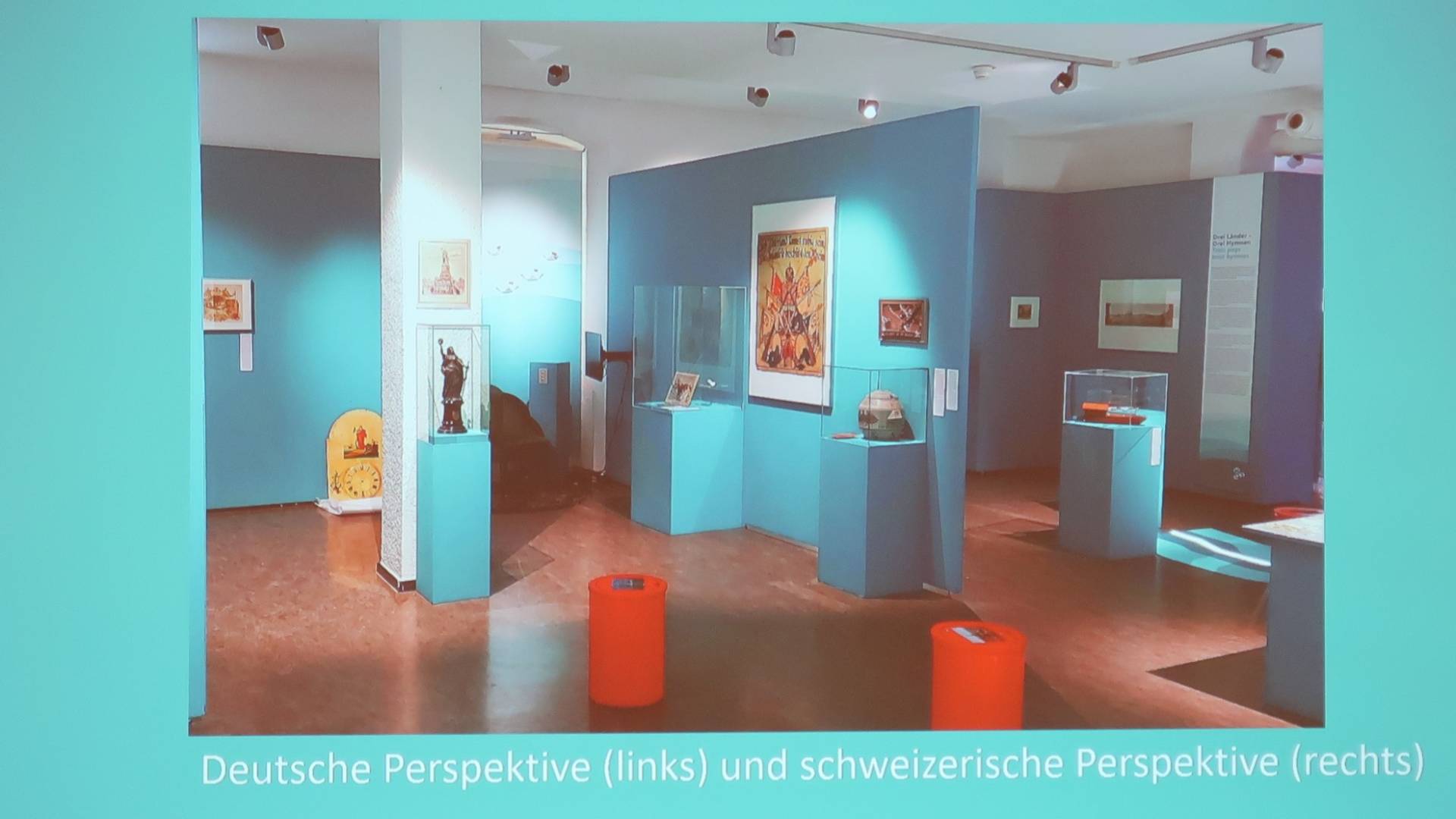
One part of the exhibition shows the construction of forts along the Rhine, with particular attention to Sébastien de Vauban (1633-1707) during Louis XIV and the structure of the Maginot Line after 1918 on the French side and the German forts of 1871-1918 and the Westwall of 1940-1945 on the German side. Attention to the irreconcilable Treaty of Versailles (1918-1919) and the other conciliatory approach after 1945 conclude the period 1870-1945.

Hydropower Kembs (1932). The Treaty of Versailles gave France back the Rhine as a border and all rights to use the Rhine. Collection: Drieländermuseum (DLM FoD 2)

Eduard Tennner (1830-1901), Der Isteiner Klozt, 1882, Rhine romanticism. Collection: Drieländermuseum (DLM BKVer 25)
Numerous other topics pass are being dealt with: geology, gold mining, religions and church building (from Chur to Utrecht, the Rhine was a ribbon of Romanesque and Gothic cathedrals), fishing, Rhine regulation, shipping, hydropower plants, canalisation, pollution, floods, art, literature and music, Rhine romanticism, archaeology, (Alemannic) dialects, bridges over the Rhine and various other topics. What is the Rhine without wine? That, too, has been thought of.

The museum also organises dozens of lectures, conferences, concerts, excursions, children’s programmes, and other events on these topics.
(Source and further information: Drieländermuseum in Lörrach)


Neuenburg am Rhein, the Rhine


Burgdorf Castle and City

The Counts of Rheinfelden owned a castle in Burgdorf, which passed into the possession of the Dukes of Zähringen in 1090.
The castle was renovated and given its present form with a residential tower (palace), a defence tower (donjon) and a hall. The castle is reminiscent of royal residences. The large town church also suggests that Burgdorf was the centre of the Zähringen territory.

The castle passed to the Counts of Kyburg in 1218. The castle served as their residence until 1384. After the Burgdorf War in 1383, they sold the county of Burgdorf to the city republic of Bern.
Burgdorf Castle is considered the best-preserved Zähringen castle complex and a historical monument of national importance. Today, it is used as a museum, restaurant, and youth hostel, with a municipal banqueting hall.
The town church was built in 1490 on the foundations of an old Romanesque church. The church was renovated in a neo-Gothic style around 1870.
Source and further information: Schloss Burgdorf


The Emme, summer 2022
Impressions of Burgdorf


The City Church (Stadtkirche)
Impressions of Burgdorf


Bronze Sculpture in the Jura

It happens in Switzerland: on the banks of a stream, near the village of Undervelier (canton of Jura), near Lac Vert d’Untervelier on the road to the former abbey of Bellelay and the Maison de la Tête de Moine (canton of Jura), there is a studio for a wide variety of bronze sculpture. A freely accessible sculpture park in the middle of the Jura.
(Source and further information: Bronze Art SA)


Lac de la Gruyère

Available in German, French and Dutch
The National Conferences on Federalism

The National Conferences on Federalism (Die Nationalen Föderalismuskonferenzen) were created by the government (Bundesrat), the Council of States (Ständerat) and the 26 cantons.
Since then, six conferences have taken place: 2005 in Fribourg, 2008 in Baden (Canton of Aargau), 2011 in Mendrisio (Canton of Ticino), 2014 in Solothurn, 2017 in Montreux (Canton of Vaud) and 2021 in Basel.
The conferences had the following themes: Federalism facing new challenges (Fribourg), Swiss federalism under pressure (Baden), Federalism and new territorial challenges (Mendrisio), What does Federalism contribute to cohesion and solidarity (Solothurn), Will Switzerland still be federalist in 50 years? (Montreux), Federalism and dynamics (Basel).
The Basel 2021 Declaration begins with the words:
The 2017 Montreux Declaration underlined the understanding and foundation of Federalism for the Swiss state. The Basel 2021 Declaration confirms this understanding and emphasises that Federalism constantly evolves.
(See conference overview at: www.foederalismus2021.bs.ch).
The Montreux Declaration 2017: Federalism: the strength of Switzerland
The Swiss Confederation is a federal state where each state level exercises its powers entirely and sovereignly.
This division of responsibilities ensures a balance of political power and protects citizens from excessive state interference.
Switzerland respects the principle of subsidiarity and the means specific to each institutional level. Federalism is synonymous with citizen involvement and efficiency in carrying out tasks.
The autonomy of the cantons, which is anchored in the political structures of Switzerland, promotes innovation and strengthens the country’s competitiveness.
Federalism also makes it possible to experience diversity together and to protect minorities, regardless of whether the differences are based on language, culture, religion or special geographical-topographical conditions.
Without its federal organisation, Switzerland, with its 8.4 million inhabitants, would not have such a rich economic, social and cultural diversity. This diversity makes Switzerland attractive and is responsible for its high quality of life.
These federalist structures, combined with direct democracy, exist nowhere else in the world. They are the basis of our country’s prosperity and (cultural) richness and contribute to understanding and internal cohesion.
Federalism is an integral part of Swiss identity and deserves our full attention, increasing the understanding of and foundations for Federalism.
However, the functioning of the institutions, the specific features, and the benefits of Federalism are little known, if at all.
The signatories of this declaration reaffirm their commitment to the Federalism that has made Switzerland what it is today. They are aware of the importance of promoting Federalism and wish to participate in the public debate to clarify the background and benefits of this system.
(Source and further information: www.www.federalisme2017.ch).
Forum of Bilingualism
At a time when (young) Swiss citizens from German-speaking cantons sometimes have to communicate with their fellow citizens in French-speaking cantons in English, the Forum of Bilingualism (Forum du bilingualism/ Forum für Zweisprachigkeit) in Biel/Bienne is not a luxury.
Citizens of the canton Grisons (the only trilingual canton: German, Italian and Romansh) and the Italian-speaking canton of Ticino face similar problems.
The Forum is a foundation in Biel/Bienne, the largest bilingual city in Switzerland. Its main activity is raising awareness of the benefits of multilingual/bilingual practices in education, politics, business, culture, and other fields.
The Forum advises on matters concerning bilingual and multilingual situations. The Forum is in close contact with research institutions.
(Source and further information:www.bilinguisme.ch).