

Available in Dutch and German
Author: Maarten Koning
From Stagecoach to the Postauto

Kaspar Stockalper (1609-1691), the entrepreneur, politician and diplomat from Brig (Canton of Valais), established professional postal services across the Simplon Pass.
The museum in the Stockalperschloss highlights this activity in the exhibition “Passage Simplon”. His successful (and lucrative) business delivered mail from Milan to Lyon in less than eight days.
The couriers and later the mail coaches drove through the gate of the Ursuline convent, hence the name Simplonstrasse, later changed to Alte Simplonstrasse.
Napoleon ordered the modernisation of road construction over the 2005-metre-high Simplon Pass. Over 5,000 workers completed this project in under a year. It also marked the beginning of the stagecoach era and later the advent of the Postauto.
Eight or ten horses pulled the stagecoach or diligence. The journey from Brig to Domodossola (at the foot of the Simplon Pass in Italy) took 12 hours.
The distances were indicated with so-called Distanzsteinen, distance stones. Until 1875, the length was measured in French miles, a legacy of Napoleon. One mile was 4.445 km. From 1875 onwards, it was measured in today’s kilometres.
The stagecoach enjoyed great popularity. Until 1905. In that year, the first car crossed the Simplon. In 1906, the Simplon railway tunnel was completed.
The Postauto replaced the stagecoach after World War II. The last professional stagecoach on Swiss soil disappeared in 1961 (Avers in Graubünden).
(Source: Stockalper Museum, Brig, www.stockalperstiftung.ch/museum).
Monuments and the Schweizer Volksmusikzentrum

Switzerland was neutral in World War I (1914-1918). Yet, there are monuments across the country to commemorate soldiers who died between 1914 and 1918. About 3,000 soldiers died from the Spanish Flu or unnatural causes during this period.
The Spanish Flu resulted in approximately 2,000 casualties in 1918/1919. In addition, there were about 1,000 fatal accidents in traffic, with aircraft, military exercises, or other incidents.

One of the most famous monuments is on Mount Lueg, 887 m (canton of Bern) in the Emmental, near the village of Affoltern i/E (im Emmental). The verb Luege in Swiss German means ‘to look intently’. Lueg, in this context, means ‘view’.
Nomen est omen because the panorama is impressive, even if the Alps cannot be seen clearly in foggy weather. Twenty soldiers from a cavalry regiment from Bern are commemorated at this spot.
Moreover, thousands of Swiss fought for either side in the conflict due to dual citizenship or personal involvement. Several thousand did not survive.
A monument at the Col des Roches in Le Locle commemorates about 2,000 Swiss who died on the battlefield for France. No one commemorates the losers. No monuments exist for the Swiss killed in action for the German or Austrian Kaiser.
Some other monuments, such as in Clarens (canton of Vaud) or the Kannenfeld Park in Basel, commemorate interned soldiers who died in Switzerland. Thousands of soldiers from both sides crossed the Swiss border and remained interned until 1918. Sometimes, they died of their wounds, and the Spanish Flu also claimed many victims.

Grellingen
Another category includes works of art or decorations created on location by Swiss soldiers between 1914 and 1918. The designations of cantons, towns, military units and the officers depicted in sculpture near Grellingen (canton Basel-Landschaft) are well-known examples.
The village of Wynigen, 15 kilometres from Lueg, lies on the border of the Emmental and Oberaargau. This village has many monumental houses, inns, and farms for its modest size. There are also many large farmhouses in the Emmental.


Zum Wilden Mann. Foto: Gemeinde Wyningen


The private railway company ‘Schweizerische Centralbahn’ built the line Herzogenbuchsee to Bern (Wylerfeld) in 1857 and halted in Wyningen. In 1902, the SBB took over the company.
From 1925, this train also ran electrically. Switzerland started building its railway network relatively late (from 1850 onwards), but by 1875 it was the leader in Europe. Electricity replaced coal as the source of power for trains after 1918.
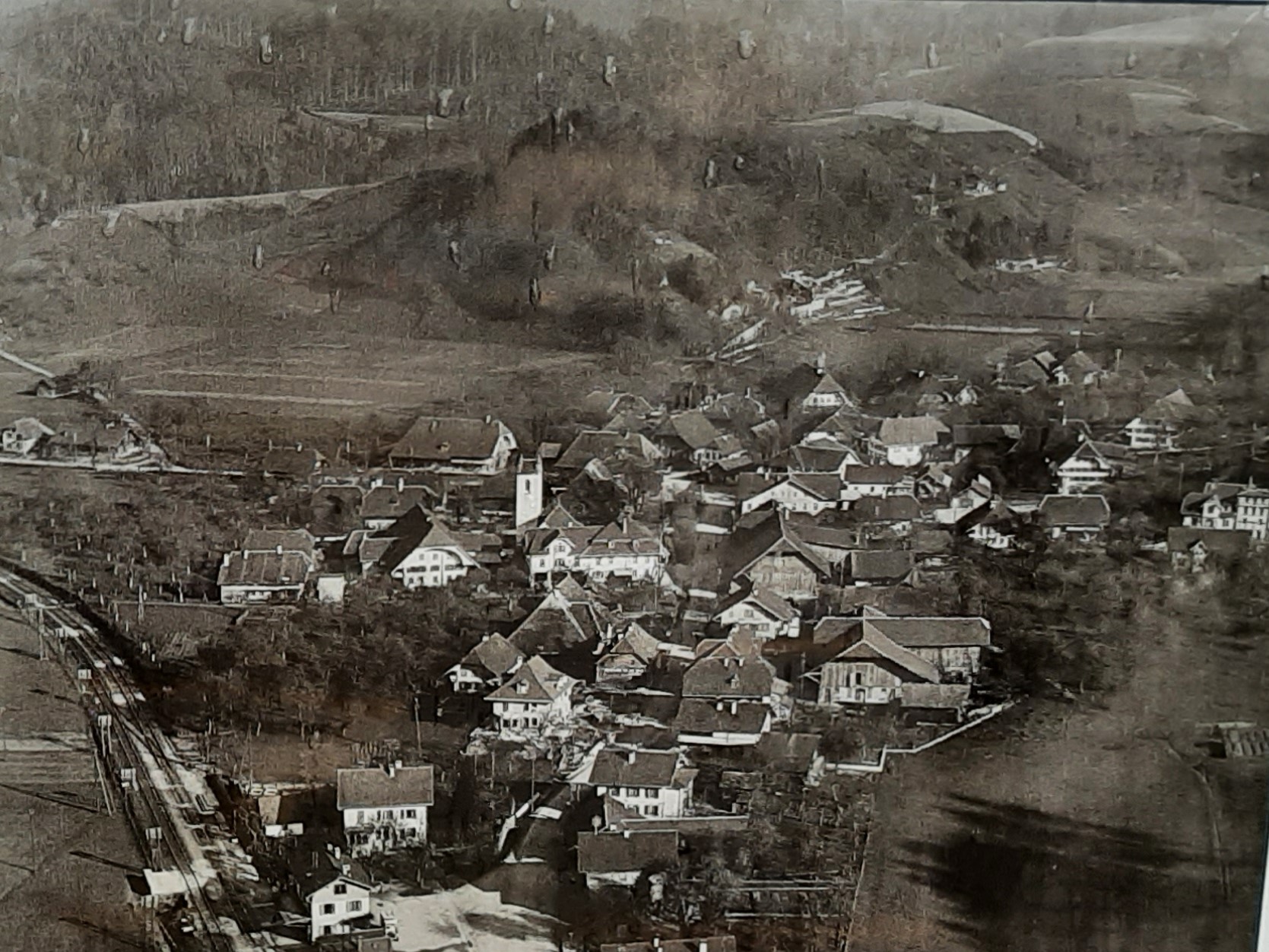
Wyningen 1925, and the electric SBB railway
However, it is rewarding to make the trip to Lueg not by train but on foot. The scenery, large farms, and views of the Alps are rewarding. The poet Jeremias Gotthelf, a pseudonym of Albert Bitzius (1797-1854), put it as follows:
Eng begrenzt ist sein Horizont von waldigen Hügeln, an deren Fuss sich unzählige Täler ziehen, von rauschenden Bächen bewässert, die in stillem Murmeln ihre Geschiebe wälzen, bis sie den Schoss der Emme finden.
The largest nearby town is Burgdorf, with its medieval castle and town centre, remarkable church, and cultural institutions.

From Lueg, it’s another two hours on foot. After a break at the Landgasthof Lueg, the musical centre of the Emmental, these hours also keep flying.
The Spanish Flu has given way to the temporary Covid-19, but nature is still there as the earth turns for another billion years, with, or perhaps better for, nature, without humankind.
The Swiss Alpine Club (SAC)
The Swiss Alpine Club (Schweizer Alpen Club, SAC/Club Alpin Suisse, CAS) organises ski tours, mountaineering, hiking trips and other sports.


A beneficial Democracy

The Constitution of 1848 is still the political foundation of modern Switzerland. Partially based on the American model of 1787, it establishes the country’s confederal status, the cantons and communes, and the role of the citizens. The last major revision of the Constitution took place in 2000.
The Referendum
One of the most striking provisions of the Constitution is the referendum, introduced by the constitutional amendment of 1874, followed by the popular Initiative (Volksinitiative) in 1891. The referendum and the Volksinitiative were introduced to allow citizens to control politics at the federal level.
The establishment dared to introduce the referendum and initiative because the establishment trusted and respected the citizens. The composition, working method, government election, referendum, and initiative are safety measures to prevent backroom politics.
Politicians must always look for the broadest possible consensus at all levels. The citizen is the sovereign: No is No, and Yes is Yes.
There are two types of referendums: optional referendums and mandatory referendums.
The Constitution clearly defines mandatory referendums (on international treaties or any change to the Constitution, for example). A positive result requires the ‘double yes’: a majority of ‘yes’ votes at the national level and in the Senate.
An optional referendum takes place when 50,000 citizens request it within 100 days of the publication of new legislation. The majority of votes at a national level is decisive.
Both referendums have the power of a veto. The strength of the referendum lies in the public discussion, the involvement of citizens and organisations, and the legitimacy of the legislation and decisions. The citizens know that they always have the last say.
People’s Initiative
Citizens also have the opportunity to request an amendment or modification of the Constitution (Volksinitiative). They can submit a request to amend the Constitution with the support of at least 100,000 citizens. This request may contain broad outlines or a detailed proposal. Sometimes, the government even makes a counter-proposal so that citizens can choose between two versions.
A ‘double yes’ is required for a positive result, meaning the majority of ‘yes’ votes at both the national level and in the Senate.
Conclusion
For a mature and well-functioning democracy, the referendum and the People’s initiative effectively reconcile citizens and politics. The citizens can never blame politicians for bad policies because they are the ones who make the policies.
175 Years Swiss Railways

At last, on 9 August 1847, 175 years ago, the first train carrying passengers ran on the Zurich-Baden railway (Canton Aargau) to the station in Baden.
The railway was named Spanisch-Brötli Bahn because, according to the story, a patisserie in Baden transported Spanish sandwiches quickly and fresh to Zurich.

Railway Station Baden, 1890. Photo: Staatsarchiv Baden.

Railway Station Olten, commemorated by Paul Gugelmann (1929-2022), presented by the city of Olten to the SBB in 2006 on the occasion of the 150th anniversary of the Olten station (1856).

Olten, railway station. In 1856, the ‘zero hour stone’ marked the starting point for measuring the railway in terms of travel time. In 1875, the metre replaced the hour and the foot. Since then, it has been the Km 39.292 stone, measured from Basel, the seat of the railway management at the time. The stone remained popularly known as the ‘Kilometre Null-Stein’. However, the correct name is ‘Stunde Null-Stein’. The cross is a symbol for the central position of the station in the railway network; the ‘O’ is the hour zero.
Switzerland was last in Western Europe in 1848. The United Kingdom already had 10,000 kilometres of railway, Germany around 6,000 kilometres, and Switzerland only 2 kilometres, from St Louis to Basel, in 1844, as the last track of the Strasbourg-Basel railway.

The French Railway Station, Basel, 1845. Source: Ein Jahrhundert Schweizer Bahnen 1847-1847. Jubiläumswerk des Eidgenössischen Post- und Eisenbahndepartementes in fünf Bänden. Bd. 1, Frauenfeld 1947. Photo: Wikipedia

SBB Railway Station Basel 2022
Disagreements between the sovereign cantons, the lack of coal for the steam locomotives, the absence of large urban agglomerations, and the mountainous landscape hampered construction.
However, after 1850, things moved quickly. The cantons had granted concessions to railway companies, and the federal government was not involved.
By 1864, Switzerland had about 1,400 kilometres of railway. These connected Geneva to Lake Constance, Basel to Chur (canton of Graubünden), and Bern to Brig (canton of Valais).
However, the Alps were still an obstacle. The railways stopped at Brig, Lucerne, Chur, and Thun. Credit Suisse was founded in 1856 to finance these ventures.
Tourism in the mountain regions led to further steps to build, continue or operate the mostly unprofitable railways. The travel agency Thomas Cook was one of the advocates.


Collection Museum zu Allerheiligen, Schaffhausen

The cantons, railway companies, and later, the federal government also relied on the experience and knowledge of foreign (mainly English, German, and Austrian) engineers.
Moreover, ETH Zurich, founded in 1855, and later EPFL in Lausanne, combined knowledge, talent, and experience within their institutions. The wonders and achievements of bridges, viaducts, and tunnels can be seen throughout the nation.
In 1872, the federal government made an important decision: the railways became a federal competence (after the cantons’ agreement).
This was partly motivated by lagging behind France (the Mont-Cenis tunnel of 1871) and Austria (the Brenner tunnel of 1864). The Gotthard base tunnel was the result in 1882.
The federal government took over (often bankrupt and unprofitable ) railway companies in 1898.
The Schweizerische Bundesbahnen (SBB)/ Chemins de fer fédéraux suisses (CFF)/ Ferrovie federali svizzere (FFS)/Viafiers federalas svizras (VFS) was established in 1902.
By 1914, all regions of the country were accessible by train, and the country had the densest railway network in Europe.

Bahnmuseum Albula, Bergün/Bravuogn
Three regional private initiatives are particularly worth mentioning. The initiative to set up the famous Rhaetian Railway was taken by Dutchman Willem-Jan Holsboer (1834-1898).

Oberalppas. End of the railway
Another feat is the railway station at 3,454 meters on the Jungfrau (4,158 meters). The initiator, Adolf Guyer-Zeller (1839-1899), began construction; his successors completed the project in 1912.

Dampflok.7, 1873. Photo: Rigibahnen AG
The 1871 rack railway on the Rigi by Niklaus Riggenbach (1817-1899) was also revolutionary
Another notable fact is the early use of electricity. Switzerland has no oil, coal, or gas reserves. It made the country innovative in the Industrial Revolution, even visionary from today’s perspective.
The first hydropower plants for generating electricity were commissioned in the late nineteenth century. Steam trains disappeared relatively quickly. Since 1967, all trains have been running on electricity.
Switzerland also had its railway barons. Martin Escher (1788-1870) and Alfred Escher (1819-1882) stand out in particular.
However, the people and the cantons always had the last say in various referendums. The last two major projects, the Gotthard Base Tunnel in 2016 and the Ceneri Base Tunnel in 2021, were completed on time or ahead of schedule and without EU interference or subsidies.
Some other projects cannot be realised for the time being due to external reasons. The Rotterdam/Hamburg to Milan/Genoa direct rail link and the environmentally friendly transport of freight traffic on trains (1992 Transitabkommen and 1994 NEAT project) have been stalled due to delays/delays in other (EU) countries and EU blockades.

Lötschenbergbahn Kandersteg (canton Bern)-Goppenstein (canton Wallis)
However, the SBB and Switzerland have every reason to be proud of the operation and service in all seasons under almost all conditions, even if the timetable no longer always runs like Swiss clockwork on wheels!
(Source and further information: Bahn Extra, 3/2022, 175 Jahre Eisenbahn in der Schweiz. Geramond, 2022).

Which railway company has a play garden for children on board?

Railway station Olten, Johann Jakob Speiser (1813-1856), founder of the Centralbahn.
Bursins and the network of Cluny

The history of the village of Bursins (canton of Vaud) is closely linked to the Kingdom of Burgundy (888-1032) and the Abbey of Cluny. The well-preserved church and village centre have their origins in this period. The church bears a strong resemblance to the church of Saint-Sulpice, a village near Lausanne. Lausanne was the diocese of Bursins in this period.

The first (Carolingian) church of Bursins dates from the 8th century. A Romanesque reconstruction took place in the 11th and 12th centuries.
Bursins is also the centre of a unique document. The first official mention of the village is in a document from 1011. Rudolph III, the last king of Burgundy, donated the village to the monastery of Romainmôtier.

Archives cantonales vaudoises
The deed is the oldest surviving document, which mentions the Burgundian king (966-1032) Rodulfi regis, Cluny and its abbot Odilo (962-1049) Odilonem abbatem de romano monasterio and Bursins (Brucins). This document of 1011 is known from later transcriptions.
In 1276, Romainmôtier, belonging to the order of Cluny, acquired other possessions in the region. In the 13th century, the prior built the fortified house that still stands behind the church. The Romanesque church was rebuilt and extended in the 13th, 14th and early 16th centuries. In 1536, Protestant Bern conquered Vaud (Le Pays de Vaud) from the Duke of Savoy, and the church became a temple.


The Saint-Martin Priory is still a remarkable architectural ensemble. Located at the highest point of the village and surrounded by patrician houses and the prior’s house from the 13th century, it is an impressive complex. The medieval castle Le Rosey and the beautiful landscape of Vaud are the settings of this town.

The European Federation of Cluny sites provides information on the extraordinary influence of the Abbey of Cluny (Southern Burgundy) across Europa from the 10th to the 18th centuries.
This abbey’s spiritual, artistic, economic, political and social influence was enormous, including in Switzerland. The French Revolution put an end to the abbey and its network. In Cluny, only a tiny part of the vast complex has been preserved.

The abbey and the monks of Cluny were behind the creation of hundreds of towns and villages in Europe. The European Federation is an essential cultural route of the Council of Europe. Bursins and 12 other Swiss towns are part of it.
Les Chemins de Cluny en Suisse/Cluny Wanderwege in der Schweiz is an eleven-stage route that connects thirteen monasteries in Switzerland: Bassins, Bursins, Mollens, Romainmôtier, Baulmes, Montcherand, Bevaix, Corcelles-Cormondrèche, Douanne (Twann), Ile Saint-Pierre (Insel St. Peter), Münchenwiler/Villars-Les-Moines, Payerne, Rüeggisberg and Rougemont.
Also recommended: the Romanesque church in Donatyre, near Avenches!


Concertgebouw Orchestra on Tour

The Concertgebouw Orchestra Amsterdam is going on a tour of Switzerland from 13 to 16 November, with four concerts in four cities, various masterclasses and a public performance with young local talent.
The orchestra is playing in Lugano, Bern, Zurich and Geneva. The orchestra is travelling by trains of the SBB (Schweizerische Bundesbahn).
On 13 November, Mahler’s Ninth Symphony is played in Lugano. On the following evenings the orchestra plays the Brahms Violin Concerto with Leonidas Kavakos as soloist, followed by Beethoven’s Sixth Symphony, Pastorale.
On 15 November a special performance will take place at the Zurich train station. Eight Orchestra musicians will play alongside twelve young talents from Swiss conservatories.
They will play the Holberg suite by Edvard Grieg. Prior to the performance, the Orchestra members are giving several masterclasses, first online and later also during the train journey from Bern to Zurich.
Going on tour to Switzerland is a decades-old tradition of the Concertgebouw Orchestra. The first concerts the Orchestra ever played in Switzerland took place in May 1927. That was just seven years after the creation of the world´s first Chamber Orchestra in Zurich. Since 1988 the Orchestra has been playing every season in Switzerland.
Source and further information: Het Koninklijk Concertgebouworkest Amsterdam
Ave Caesar. A greeting from the Celts

The exhibition “Ave Caesar! Römer, Gallier und Germanen am Rhein” shows the relations between the civilisations of the Mediterranean and the tribes of the Celts (or Gauls) and Germans along the Rhine.

The Host Gaius Julius Caesar (100-44 BC) and his successors. Bust of the statue, legionary camp near Nijmegen, marmor, late 1. Century BCE. © Rijksmuseum van Oudheden, Leiden
The Celts are a name for many tribes that lived in central and western Europe. They had a common culture with many regional differences. They had no written culture and were not a political unity. Germans are the name for the tribes on the right bank of the Rhine.
The direct sources are archaeology and Roman and Greek authors. Nevertheless, a good picture of Celtic society exists today. The terms Gauls and Celts are both used and come from Greek (Keltoi/Galatae) and Roman (Galli/Celtae) authors.
This exhibition focuses in particular on the Celts on the left bank of the Rhine in the Basel region in the period from 500 B.C. to 260 A.D. It is part of the project ‘The Rhine. 3 countries – 38 exhibitions’

The Tabula Peutingerian and Rhine cities in blue
The Rhine has always been a frontier and a battlefield, a communication- and trade route and place of exchange of people and cultures. Until the arrival of the Romans, however, there were no bridges. While shipping on the Rhine already existed, it only flourished during Roman rule, from Basel to Nimwegen in the Netherlands.

Model Rhine pram, scale 1.22.5, c. 150 AD Original from Vleuten-De Meern. On loan : D. Usher
The arrival of the Romans dramatically changed Celtic societies along the Rhine. After their departure around 400-410 AD, a Gallo-Roman culture remained. The Alemanni and Franks filled the vacuum left by the Romans, but that is another story.
The Celtic Princes
The first part of the exhibition the Keltischer Fürstensitz deals with the Celtic society around 500 B.C. The Celts already maintained close contact with the Mediterranean (Greek and Etruscan) world at the time, centuries before the arrival of the Romans.
The Celts imported wine and luxury goods and mainly exported metals, salt, furs and slaves. The Rhone and its tributaries Doubs and Saône were important rivers as well. Trade was not limited to goods; there was also a lively cultural exchange
The smallest archaeological finds often have the greatest significance. The discovery of writing utensils and seal rings in Basel confirm the use of Greek script by merchants. This was already known from merchants from Genava (Geneva), inhabited by the Celtic tribe of the Allobrogens. After 52 BC and especially after 15-13 BC, Latin increasingly took over this function.


Seal ring and writing utensils, 2nd-early/ 1st century BCE, Basel Gasworks. Archäologische Bodenforschung Basel-Stadt.
The Celtic settlement
The second part is about the Celtic settlement (Celtic Siedlung). Julius Caeser called this fortified settlement an “Oppidum” in his de bello Gallico. In Basel, the oppidium was located on the Münsterhügel (next to the Cathedral).

The Murus Gallicus, an archaeological site on the Münsterhügel.
Hundreds of larger and smaller oppida existed, including in Avenches or on Mont Vully in Switzerland, Bibracte in France or various places in Germany and Austria. The Celtic pile dwellings, so beautifully reconstructed at Wauwil and in the Laténium at Hauterive, show another Celtic history.
Between 58 and 52 BC, Gaius Julius Caesar (100-44 BC) took advantage of the battle between the Celtic tribes and extended Roman rule to the Rhine. He defeated the tribes from Switzerland at Bibracte in 58 BC and conquered all of Gaul in 52 BC. The Romans founded the cities of Colonia Augusta Raurica (Augst) and Colonia Equestris Noiodunum (Nyon) around 44 BC.
In the years 15-13 BC, the Romans conquered all of the territory of present-day Switzerland and the Romanisation of the conquered peoples began. The Romans established numerous military camps on the left bank of the Rhine to secure the occupied territories, also in Vindonissa (Windisch).
Tens of thousands of Roman officers, soldiers, administrators, merchants and civilians lived along the Rhine. They stimulated the local economy and trade and expanded the infrastructure along the Rhine with bridges, roads, ports and warehouses. A modern road network guaranteed the supply of troops and supplies to the frontier.
The Roman legionary camp
The third part (Römisches Legionslager) shows the daily life of legionnaires lived and the campaigns against the Germanic tribes on the right bank of the Rhine. From about 85 AD, the conquered areas became Roman provinces. The Romans also occupied large (German) territories on the right bank of the Rhine by this time.
The Roman estate
Agricultural development is the next topic. More than 90% of the inhabitants lived outside the city. The elite also owned estates in the countryside, large villas with agricultural activities. This society is discussed in the section Römischer Gutshof.
The Roman colony
The last part of the exhibition (Römische Kolonie) shows the impact of the Roman presence and the romanisation of Celtic society. Cities were built, often ex nihilo, based on Roman city planning, with stone buildings, theatres, amphitheatres, bathhouses, temples and other public buildings, an efficient water supply and a road network.
The Celtic elite was the first to adopt the Roman way of life in just one or two generations. It had an added value and offered interesting (economic, military, political and governmental) possibilities, prestige and status.

Lucius Giltius Cossus, son of Celtillus. Priest of the imperial cult. Augusta Raurica, 50-150 AD. Augusta Raurica Museum.

The first known inhabitant of Basel was the Roman soldier Titus Torius, 20 BC-20 AD. Archäologische Bodenforschung Basel-Stadt.
Augusta Raurica, for example, had between 15 000 – 20 000 inhabitants around 200 AD, a thousand years later only a few hundred! It illustrates the growth, flourishing and prosperity along the (Upper) Rhine in Roman times.
And Augusta Raurica was just one of many new cities in the Roman Empire and along the Rhine. Basel was just a small settlement at the time and became important after the bishop settled on the hill in the fifth century.
After 260 AD
The economic and political situation deteriorated due to Germanic invasions, inflation, Roman civil wars and epidemics at the end of the 2sd and in the third centuries. Around 400-410 AD, the last Roman legions left the area north of the Alps for good.
Conclusion
The trilingual (English, German, French) audio guide, the catalogue and the plan of the show guide the visitor through this exciting history. For learning and entertainment purposes, a card game Vade Mecum is also available.
Source and further information: Antikenmuseum Basel und Sammlung Ludwig
The Swiss Direct Democracy

One of the most striking features of Switzerland’s political system is the absence of a dominant political party. Few Swiss citizens are familiar with the name of their head of state, also known as the federal president.
That is not surprising. They are appointed for one year and always belong to the government of seven ministers. The head of state is the primus/prima inter pares. The Prime Minister does not exist. All members of the government are equal.
As laid down in the Constitution, a government of seven ministers is already unique and has remained unchanged since 1848.
The government’s composition is also exceptional. The four largest parties share the ministerial posts. New parties are not automatically granted a place in the government after one or two successful elections, but must prove themselves over a more extended period.
Direct democracy gives citizens the final say through the (mandatory or optional) referendum and popular initiative. Another aspect is the militia system (Milizsystem/Le système de milice) type of political commitment, whereby members of parliament are part-time politicians. Although this system is under pressure, it shows the engagement of the citizens.
It is a system that guarantees a high degree of stability, legitimacy, continuity, and citizen involvement. Thus, the citizens are de facto politicians and always have the last say.
The most important features of this system are federalism, decentralised state organisation, direct democracy, a multicultural society, the electoral system, the formation of long-term coalitions, and citizen, organisational, and social partner participation.
Switzerland, as we know it today, was founded in 1848. The canton of Jura was established in 1979. The twenty-six cantons are sovereign republics unless they transfer powers to the Federal level. Political life in the cantons and around 2,200 municipalities is often much more relevant to daily life issues.
The importance of direct democracy goes beyond the day of voting. Direct democracy influences the whole political process, lengthy consultation procedures and compromises; it tamps down the madness of daily politics and the ambitions of individual politicians and their (patronage) networks. Above all, it provides legitimacy. The people are the sovereign rather than the political parties and politicians.
The cantons and their different languages, cultures, religions and economic models thrive under this system. Nevertheless, this system also has its weaknesses. It functions slowly and is complicated. It is difficult for other countries/organisations to imagine that citizens and their cantons can dispute European agreements and treaties.
The Swiss democratic model always offers an alternative. The doctrine of no alternative (Alternativlosigkeit) does not exist. The advantages of the Swiss democratic federal bottom-up system far outweigh the disadvantages.
In a referendum on the abolition of the referendum, a vast majority of citizens will vote in favour of the referendum. No politician, minister or political party is willing, able or constitutionally entitled to ignore a decision by referendum.
(Source and further information: W. Lindner, S. Mueller, Schweizerische Demokratie. Institutionen, Prozesse, Perspektieven, 4. Aulage, Bern 2017)
The Tafeljura, Chrindeltal, Stierengraben and Gelterkinden

The Tafeljura Plateau
The climate and nature have permanently changed since the beginning of planet Earth more than four billion years ago. From a geological point of view, the Jura and the Alps are relatively recent witnesses. The Gletsjergarten in Lucerne offers an impressive picture of these processes.
Nature, too, is constantly adapting to climatic conditions; this applies to flora and fauna, humans, viruses, fungi and bacteria.
Humankind
Humans, however, occupy a unique position in this process. Humans can influence and sometimes even radically change nature and the climate at short notice.
The explosive increase in the number of people, the paving of the earth with cities, concrete, cement, iron, and stone, the conversion of rivers into canals, the diversion of streams, the construction of reservoirs in valleys or the clearing of forest areas for agriculture and cattle breeding have a profound influence.


The Tafeljura Plateau
The Tafeljura Plateau is located east and southeast of Basel in the canton of Basel-Landschaft. A 58-hectare nature reserve stretches across Eselfluhholde, Chrindel, Stolten and Stierengraben.
The word plateau says nothing about the relief of the area. This region is a cross-section of the Jura mountains. Forests, meadows, gorges, rocks, streams and other water sources, ruins and castles and villages define the picture.
For centuries, this area was used as farmland and for cattle breeding. One of the human interventions was diverting streams and constructing dams in this wetland, a floodplain landscape, an Auenlandschaft.
The Chöpfliweg in the Chrindeltal led through this partially drained landscape and was intended for (cattle) transport. The St. George spring (the Jörkerbrunn) was even used to supply drinking water to nearby Sissach via a 5.3-kilometre-long pipeline, thus depriving nature of water.


The Chöpfliweg
The name Stierengraben also dates back to this time. In the mild seasons, the bulls (Stieren) pulled the plough and the wagons, and out of gratitude, they stayed outside from autumn to spring in this humid environment. At the end of the Stierengraben, the “Rünenberger Giessen” plunges into the Jura rocks from a height of 18 metres. It gives an impression of the bulls’ winter habitat.

The renovated stable for cattle

and its equipment today

The drinking trough for cattle
Evolution
Since 2011, however, the water landscape has regained its ‘freedom’, without human intervention. Human interventions can still be seen in several places, such as the centuries-old and renovated cattle shed, the cattle watering trough or the centuries-old Chöpfliweg.
Human intervention can still be seen in several places, such as the centuries-old and renovated cattle shed, the cattle watering trough or the centuries-old Chöpfli path. But nature also takes its course, including a fungus deadly to ash trees, the Eschenwelke. Within a short time, however, the vacated space is taken over by various plants shrubs and germinating trees. Evolution in a nutshell.
Revolution
The city of Basel had acquired the rights to the village of Gelterkinden from the lords of Thierstein-Farnsburg in 1461. Gelterkinden, derived from the Alemannic Gelterkingen, sided with the city of Basel in the uprising of the Basel region (Baselbiet) in 1831-1833.
The village even asked the city for military support against the Baselbieter insurgents. The troops of Basel-Landschaft then stormed and looted the town. Since then, the village has been part of the canton of Basel-Landschaft.

Reunification?
However, the desire for (re)unification with the canton of Basel-Stadt was still present. It manifested itself, among other things, in the unsuccessful uprising against the cantonal government in Liestal in 1840 (Gemeindejoggeliputsch). There are still initiatives and even (rejected) referendums for a union of the two cantons.


Liestal, Museum. BL. 1913, poster with a call for reunification

Referendum 1936, poster against reunification. Archiv Basel-Stadt

Archiv Basel-Stadt
The natural landscape

The hiker encounters this diverse natural landscape and history on the part of the Chirsiweg from Sommerau to Gelterkinden. Cherry trees have blossomed in the Upper Basel region in spring for centuries and are still an important economic sector.
However, this region has more to offer than cherry cultivation and, above all, shows the versatility of the Jura.


The village of Rünenberg