Potraits and Tronies in Dutch Art from the Golden Age


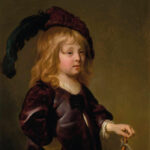
Box with Axe (1645). Kunst Museum Winterthur, Reinhart am Stadtgarten.
The Dutch art theorist and painter Samuel van Hoogstraten (1627-1687) described in his book ‘Inleyding tot de Hooge Schoole der Schilderkonst’  (1678) the human face as a “mirror of the mind”. He even thought he could read a person’s character from his or her features.
Faces also play an important role in painting. Thus, the faces painted in the Netherlands in the 17th century reflect many facets of human physiognomy in individual portraits. Just as they individually strive to reflect the reality of the life of a portrayed personality, they can, in combination, reflect the history of an entire society.

The human face became a theme in Dutch Baroque painting independently of the representative task of portrait art. As distinctive character heads with pronounced facial features, a new type of figure painting established itself.

Old and young people in plain clothes or extravagant costumes up to the self-representation of an artist were the preferred subjects, without the depicted being fixed to a certain role and identity.

In contrast to status portraits, which were commissioned works staging the status and rank of the models, faces sound out the spectrum of human expression.

Jacob Backer’s (1608-1651) recently acquired portrait of a boy with an axe(1645) is shown for the first time in the bilingual exhibition (Geschichten in Geschichtern. Porträt und Tronie in der niederländischen Kunst). Paintings by artists such as Ferdinand Bol, Samuel van Hoogstraten, and Jan Lievens are grouped around it, presented in an exquisite selection of historical, genre, and self-portraits by Rembrandt.

Illuminated manuscripts from the Middle Ages


Poster of the Exhibition

Calligrapher and illuminator craftsmen of the Middle Ages copied, illustrated and safeguarded crucial texts from antiquity to their times. Covering topics ranging from science to canonical law, music or world history, they allow us access to knowledge that would have otherwise escaped us.

The efforts of these men reach far beyond content: the precise, meticulous illustrations, drawn with quill or brush, applying colours based on natural pigments or gold leaf, are treasures beautiful beyond description.

Today, celebrating the 15th birthday of the e-codices project, the Martin Bodmer Foundation and the Abbey Library of St. Gall pay homage to these artists, custodians of this indispensable and rich heritage.

Digital operators preserve and continue their work by selecting the most impressive illuminated manuscripts from its vaults and fifteen Swiss libraries.

The exposition ‘illuminated manuscripts kept in Switzerland’ (Trésors enluminés de Suisse) gives an overview of the extensive collection in Switzerland.

The Swiss Constitution 1848-2023


The Constitution of Switzerland is 175 years old and dates from 1848. Switzerland was the only nation in Europe with a liberal constitution in 1848. The Federal Constitution resulted from only 51 days of negotiation between February and April 1848. After the votes and referendums in the cantons, the Tagsatzung (the assembly of the representatives of the cantons)  put the Consitution into force on 12 September 1848; although not all cantons agreed, the majority had decided.

The National Council or First Chamber (Nationalrat) and the Council of States, Second Chamber or Senate (Ständerat) were elected, and the first government  (Bundesrat) was chosen. Switzerland became a democratic republican island amidst monarchies.

Facsimile of the Federal Constitution of the Swiss Confederation, Bern, 12.9.1848. The original is in the Federal Archives in Bern.

In the autumn of 1847, Switzerland was still a loose republic in a civil war. What followed was no miracle but the result of pragmatism, realism, a willingness to compromise, centuries of federal cooperation, confrontation, conflict and solutions. International orientation was also important: the Declaration of Human Rights of the French Revolution (1789) and the American Constitution (1786). Moreover, Europe was in turmoil in 1848, and the interventionist monarchies of Prussia and Austria were preoccupied with themselves.

Bettina Eichin (1942). The human rights, 1998 – 2000. The Bronze Virginia Bill of Rights of 1776, the Franse Déclaration des Droits de l’Homme et du Citoyen of 1789 and the Déclaration des Droits de la Femme et de la Citoyenne of 1791, written by Olympe de Gouges (1748-1793) © Schweizerisches Landesmuseum. Schweizerische Eidgenossenschaft, Bundesamt für Kultur.  Schweizerische Eidgenossenschaft, Bundesamt für Kultur

At the same time, the Federal Constitution was constantly being developed by the citizens and the cantons after 1848. They are the sovereigns of the country. Social change and political conflicts led to several constitutional revisions.

While the federal state was still a representative democracy in 1848, it became a direct democracy with the introduction of the optional referendum in 1874 and the right of initiative in 1891. In 1971, women were also granted full civil rights.

Since 1974, the European Convention on Human Rights has significantly influenced Swiss law. More recent fundamental rights, such as the protection of privacy or the right to a fair trial, found their way into the Federal Constitution with the total revision of 1999.

The exhibition ‘Happy you have rights day. 175 Years of the Federal Constitution’ (Zum Geburtstag viel Recht. 175 Jahre Bundesverfassung) takes visitors on a tour of 175 years of the Federal Constitution, focusing on fundamental and civil rights.

In four interactive parts, visitors can explore the path to citizenship, the limits of freedom of expression, the protection of privacy or the right to a fair trial. The Federal Constitution is more than a document: it is part of the Swiss way of life.

The exhibition starts with the bronze sculpture ‘Menschenrechte’ (Human Rights) by Bettina Eichin and the animated film ‘Constituzia’ (Constitution) about the time before 1848, followed by the founding period 1848-1891, fundamental rights in the present and contemporary history 1971-1999.

(Source: Landesmuseum Zurich and the publication 175 Jahre Bundesverfassung. Zum Geburtstag viel Recht. This publication is also available in French, Italian and Romansh (Landesmuseum Zürich, Sandstein Verlag, 2023).

PS: See also The Landsgemeinde and the exhibition in the Nidwalder Museum: Ja, Nein, Weiss nicht. Musterdemokratie Schweiz ?

National Celebration Day after 1848. Collection: Landesmuseum Zurich 

The Green Princes of Lake Constance


Park Arenenberg. Napoleon Museum. Photo: Museum Thurgau

The Napoleon Museum Arenenberg and the (museum) Island of Mainau GmbH and partners are organising the exhibition Grüne Fürsten am Bodensee (Green Princes on Lake Constance).

The focus is on personalities who shaped the history of gardening in Europe in the nineteeth century through their parks and innovations: Prince Nicholas II Esterházy (1765-1833) on the island of Mainau in Lake Constance and Prince c.q. Emperor Napoleon III (1808-1873) on Arenenberg (Canton of Thurgau) on Lake Constance and in Paris.

Exhibitions at the Nature Museum Thurgau, the Archaeology Museum Thurgau and the Museum Ittingen show further aspects of garden and landscape design and use in this period of the 19th century.

The occasion for the exhibition is the 150th anniversary of the year of death of French Emperor Napoleon III, who grew up on Lake Constance, and the 190th anniversary of the year of death of Prince Nicholas Esterházy.

The exhibitions on the Arenenberg and the Mainau (Museum) Island are dedicated to these “green” monarchs and their botanical interests and creations and the (early) understanding of the importance of these green oases as public recreation areas and the function of gardens as places of agricultural innovation. 

A lively exchange soon developed between the aristocratic gardeners on Lake Constance. They visited each other and presented the progress of their projects, exchanging botanical experiences, knowledge and plants. The green princes’ gardens and way of life also attracted a scene of writers, artists, researchers and social innovators. 

Franz Xavier Winterhalter (1805-1873), Emperor Napoleon III, 1855. Collection: Arenenberg, Napoleon Museum.

Emperor Napoleon III

The Napoleon Museum focuses on the parks created by Louis Napoleon, the later Emperor Napoleon III, in Arenenberg and Paris. The young Prince Louis Napoleon was instilled with a passion for gardening. His grandmother Empress Josephine de Beauharnais (1763-1814) set standards throughout Europe by creating her park around the Malmaison chateau near Paris. She made gardening en vogue.

In his exile at Lake Constance in Arenenberg, the prince was also inspired by the interest of his mother, Hortense de Beauharnais (1783-1837). They developed the park around the Arenenberg castle.

Martin Knoller (1725-1804), Nikolaus II. Esterházy, 1793. Collection: Fürst Esterházy Privatstiftung Eistenstadt.

Nicholas II Esterházy

 It is little known that Nicholas II Esterházy bought the island of Mainau from the state of Baden in 1827. He transformed the park, designed in the Baroque style, into a modern English landscape garden with a network of paths.

Picture: Napoleon Museum Arenenberg.

Katharina Grosse. Studio Paintings 1988-2022


Katharina Grosse Ohne Titel, 2001 Acryl auf Leinwand 250 x 170 cm Photo: Olaf Bergmann © 2023, ProLitteris, Zurich

The Kunstmuseum Bern is showing a major exhibition devoted to Katharina Grosse. The largeformat, vibrantly coloured paintings from the 1980s until the present clearly show the importance of the works on canvas in the artist’s oeuvre.

Colour is central to her artistic practice. She experiments with its physical presence, its sensoryand political potentials and its ability to embody movement. The exhibition enables to take a close look at 42 canvases, from her earliest works in the late 1980s to her most recent works.

The exhibition is organised by the Mildred Lane Kemper Art Museum (Washington University in St. Louis, USA) in cooperation with the Kunstmuseum Bern.

Biel and the Röstigraben


Biel/Bienne (canton of Bern) is the only city in Switzerland that is bilingual in the true sense of the word. The road to bilingualism was long, however, from the Romanisation and the Gallo-Roman culture of the originally Celtic region and the dominance of the German language to the bilingual status in 1950.

Author: Marco Zanoli, Wikipedia

The Celts, Romans and Alemanni and Seeland

The linguistic landscape of the region of Seeland and Biel (canton of Bern) was shaped by the incorporation of the present-day Mittelland into the Roman Empire around 15-13 B.C.

As part of the new Gallo-Roman culture, the local population soon also spoke (vulgar) Latin. Over time, Gallo-Roman dialects developed, from which several dialects of today’s French-speaking part of Switzerland emerged, the patois.

The spread of the German language by the Alemanni, who settled in the Mittelland from the end of the 6th century, was decisive, however. The Gallo-Roman and Patois dialects were pushed back and Alemannic reached the Aare at the end of the 8th century.

Between the 9th and 13th centuries, first the region south of Lake Biel and later those on the northern shore became predominantly German-speaking. There was no clear language border. The current Franco-German language border in the Three Lakes region was finally consolidated in the 18th century.

Biel

For more than 700 years, German was the only official language in Biel, but Biel’s elite maintained close ties with French-speaking areas and as early as the Middle Ages, French could be heard in homes, craft workshops and the city hall. Biel early on became a laboratory of bilingualism.

Johann Rudolf Weiss (1846-1939), Biel, 1919. Collection: Neues Museum Biel

The watch industry

In the 19th century, the boom of the watch industry led to a huge immigration from French-speaking Jura. This fundamentally changed Biel’s language landscape. Labour immigration is always one of the main reasons for language change. What makes Biel unique is the political will to upgrade French, and in 1950 French became the second official language and Biel became bilingual.

Collection: Neues Museum Biel

Bilingualism

It was only in 1950 that Biel opted for the official status of bilingualism. However, German and French are not the only languages spoken in Biel. Besides more than 50 other languages, living space also creates identity. Buildings, parks, squares and meeting places create familiarity and a sense of home for the inhabitants of Biel/Bienne.

The exhibition “Biel and the Röstigraben” explores the question of how different cultures live together in the city, where they meet and how they communicate. It shows that centuries-old multilingualism always demands attention to find mutual understanding.

(Source and further information: Neues Museum Biel/Nouveau Musée Bienne).

Lake Neuchâtel and the Caves of the Areuse Gorge


Noé Cotter, 2020. Photo: TES

The exhibition Errances dans les méandres du temps (Wanderings in the meanders of time) takes us to places photographer Noé Cotter (born 1993) has known since childhood. His exploration takes us from the depths of Lake Neuchâtel to the caves of the Areuse Gorge in the canton of Neuchâtel.

The 28 photographs on display were taken in 2020. They invite you to discover familiar yet unfamiliar landscapes. Natural elements – water, rocks and vegetation – play a central role, while the place of humans is ambiguous.

The latter is suggested by material remains, the remnants of pile-dwellings, ancient ships and contemporary objects transformed into archaeological remains by an extended stay at the bottom of the lake.

The Future of Gardens


Piet Oudolf, Oudolf Garten, garden on the Vitra Campus, Weil am Rhein, 2020 © Vitra, Foto: Dejan Jovanovic

Gardens reflect identities, dreams, and visions. Deeply rooted in their culture, they can unfold immense symbolic potential. The recent revival of horticulture has focused less on the garden as a romantic refuge than as a place where concepts of social justice, biodiversity, and sustainability can be tried and tested. Gardens have become places of the avant-garde.

The exhibition »Garden Futures« at the Vitra Design Museum is the first to explore the history and future of modern gardens. Where do today’s garden ideals come from? Will gardens help us achieve a liveable future for everyone?

The exhibition addresses these questions using various examples from design, everyday culture, and landscape architecture – from deckchairs to vertical urban farms, from contemporary community gardens to living buildings to gardens by designers and artists. The exhibition architecture will be designed by the Italian design duo Formafantasma.

Henry Fuseli in Zurich


Johann Heinrich Füssli, La Débutante, 1807. Tate, presented by Lady Holroyd in accordance with the wishes of the late Sir Charles Holroyd, 1919, Foto © Tate

From 24 February to 21 May 2023, the Kunsthaus Zürich presents the drawings of the Swiss artist Henry Fuseli (1741–1825). Fuseli (Johann Heinrich Füssli) was one of the most idiosyncratic, original and controversial artists in 18th-century Europe. His art’s emphatically individualistic and sensationalist character divided public opinion throughout his career.

The Kunsthaus Zürich has gathered together some 60 works offering a unique opportunity to experience this draughtsman at his most innovative and exciting, as the creator of a fascinating pictorial universe as provocative as it is challenging.

The exhibition (Fuseli. Fashion – Fetishism – Fantasy) is the outcome of a close collaboration with The Courtauld, London.

Picasso Célébration 1973–2023


Pablo Picasso, Tetê d’homme, 1972. Anthax Collection Marx, Permanent loan Fondation Beyeler © Succession Picasso/2022, ProLitteris, Zurich

The Fondation Beyeler presents a selection of ten late paintings concerned with images of the artist and his models. These works, created in the last decade of Picasso’s career, attest to the artist’s productivity up to the end of his life.

In these paintings, Picasso explores the (self)-image of the artist, the creative act, and the image of the female body. Contemporary viewers, also raise questions regarding the representation of women in art today.

Picasso Celebration 1973-2023 marks the fiftieth anniversary of his death and places 2023 under the sign of the celebration of his work in France, Spain and other countries.

The Picasso Celebration 1973-2023 is initiated by the Musée national Picasso-Paris and Bernard Picasso, the artist’s grandson and president of the FABA and the Picasso Museum in Malaga. It is structured around some fifty exhibitions and events to be held in cultural institutions in Europe and North America.