The Treaty of Lausanne


Photographie des hommes ayant pris part à la cérémonie de la signature du traité de Lausanne devant l’Hôtel Beau-Rivage, 24 juillet 1923. © Les Archives de la Ville de Lausanne (AVL), CH-000100-3 ADM-B1-224.10.2.89-12

After the First World War (1914-1918) and the collapse of four empires (the Austrian Ottoman, Russian and German Empires), violence and instability undermined  Southeastern Europe.

Signed on 24 July 1923, the Treaty of Lausanne is the only agreement signed in the aftermath of the war that is still in force. Of considerable importance for the history of Europe and the Middle East, it established the birth of modern Turkey, but overlooked the aspirations of minorities.

The exhibition looks back at the key decisons and moments of this conference, which lasted almost nine months. It also shows and considers the questions of remembrance and the treaty’s present-day significance in this part of Europe and the Middle East.

Art, Science and the Kulturstiftung Basel H. Geiger


(Deutsch) Riikka Tauriainen, Meike Vogt, Plankton Imaginary, 2023, Installation, Experimental Ecology, KBH.G Foto: Kulturstiftung Basel H. Geiger | KBH.G

Anyone wondering what plankton, bacteria, smell and scent, salmon, empathy for fish and the wonderful but largely unknown ecosystem of the oceans have to do with art should visit the new exhibition at the Kulturstiftung Basel H. Geiger | KBH.G.

The Kulturstiftung is showing an interactive exhibition devoted to the ecological challenges of our time. The exhibition is an interactive spectacle and a challenging olfactory experiment and is always accompanied by specific workshops as part of the Public Program.

Following Experiments in Art and Technology (E.A.T.), an initiative founded in New York in 1967 promoting the cooperation between art and new technology, the curators Martina Huber and Gianni Jetzer started EXPERIMENTAL ECOLOGY in 2022 as a platform for artists and scientists working in the field of ecology.

The five international teams and their projects

Ingo Niermann, Alex Jordan, Welcome to My World, Installation, Experimental Ecology, KBH.G. Photo: Kulturstiftung Basel H. Geiger | KBH.G

Welcome to My World

The artist and author Ingo Niermann and the biologist Alex Jordan are asking the question: “How do fish feel?” or “How does one feel like a fish?”. They create a scenario using an AI- game with a fish avatar where visitors can develop empathy with a rather inconspicuous sea creature, its life, and its sense of feeling. A workshop accompanying the exhibition will take place on 12 September.

Sissel Tolaas, Christina Agapakis, The Suiss_ The Cheese, 2023, Installation, Experimental Ecology, KBH.G. Photo: Kulturstiftung Basel H. Geiger | KBH.G

The SUISS_The Cheese 

The artist and olfactory researcher Sissel Tolaas and the American biologist and artist Christina Agapakis deal with the perception and acceptance of smell in our society. They research the microbial elements of human body odour, which has a very similar microbial origin to the smell of cheese. To further explore this connection, they experiment with making cheese using starter cultures collected on human skin. A workshop will be organised on 7 October.

Michelle-Marie Letelier, Karin Pittman, Salm Ethos, 2023, Installation, Experimental Ecology, KBH.G. Photo: Kulturstiftung Basel H. Geiger | KBH.G

Salm Ethos

The maritime and fishery biologist Karin Pittman and the artist Michelle-Marie Letelier pursue the question as to what extent a lack of empathy stands in the way of successfully fighting climate change. In their project, they explore the “geopolitical consequences of salmon. Firms from the global North farm salmon in the global South. This is precisely the problem: salmon is not native to the southern hemisphere, yet it is farmed there for the global market. These and other questions are addressed in the interactive play Salm Ethos, which will be performed three times during the exhibition (20 September, 1 October and 29 October).

Zheng Bo, Matthias Rillig, The Political Life of Plants 2, 2023, Installation, Experimental Ecology, KBH.G. Photo: Kulturstiftung Basel H. Geiger | KBH.G

The Political Life of Plants 2

The artist Zheng Bo and the biologist Matthias C. Rilling discuss the relationship between humans and plants. To do this, they include the biology, economics, communication and politics of plants and the accumulation of plastic in soils and the water environment. How do plants change due to climate change, how do they adapt, and how can humans take their perspective? Revering perspectives and roles reveals plants in a whole new way.

Riikka Tauriainen & Meike Vogt, Plankton Imaginary, 2023, Installation, Experimental Ecology, KBH.G. Photo: Kulturstiftung Basel H. Geiger | KBH.G

Drifting into the Plankton Imaginary (see also: Microscopia. Le plancton, du Léman à l’océan)

What role does plankton play in the marine ecosystem and regulating Earth’s climate? With this question in mind, the artist Riikka Tauriainen, climate researcher, and marine ecologist Meike Vogt immerse us in the imaginary world of plankton. “Plankton is sensitive to environmental changes, and its condition corresponds to the well-being of all marine life. The fact that phytoplankton, driven by photosynthesis, provides up to 50 per cent of our oxygen supply and binds large amounts of carbon dioxide is a service for which we should all be grateful.” A workshop on the exhibition project will take place on 21 October.

Martina Huber and Gianni Jetzer (and the Kulturstiftung Basel H. Geiger | KBH.G)  are convinced that art can trigger change: “Today, ecology is a wide field of knowledge in which interesting subcategories have emerged. In the last decade, the impact of humans on the Earth’s biosphere has become a pressing issue that is being addressed at various levels. However, artistic and scientific approaches are often separated because there is hardly any space for exchange. We want to change that.”

Fauvism and its artists and trade


(Deutsch) Maurice de Vlaminck, «André Derain», 1906, The Metropolitan Museum of Art, Jacques and Natasha Gelman Collection, 1998, © 2023, ProLitteris, Zurich

At the outset of the twentieth century, a group of artists centring around Henri Matisse, André Derain and Maurice de Vlaminck conducted revolutionary experiments in color. The name Fauves was bestowed on the group in 1905 by art critic Louis Vauxcelles.

It was in the group’s expressive approach to the application of color, its striking, often virulent color schemes, as well the rejection of naturalistic renderings of local colors, that Vauxcelles discerned the break with academic precedent.

Fauvism was to emerge as the twentieth-century’s premier avant-garde movement. For a brief period between the years 1904–1908, it set the pace in the Paris art scene, whereby its impact endured long into the future. Georges Braque, Raoul Dufy and Kees van Dongen, among others, were to later join the movement. Fauvism coincided with the Belle Époque, an era which heralded the rapid rise of urban mass society. Fast-emerging mobility and the nascent advertising and tourism industries.

The exhibition shows the outstanding experimentation of Fauvism with color and provides insights into the trade in Fauvist art

Caspar Friedrich and his inspiration


Caspar Friedrich, Mondaufgang am Meer, 1822 Staatliche Museen zu Berlin, Nationalgalerie

Caspar Friedrich’s (1774-1840) paintings express a new, romantic relationship between humankind and nature. With his atmospheric landscapes and pictorial inventions, he redefined the genre of landscape painting and gave it new dimensions.

His outstanding artistic position, his innovative power and his groundbreaking contribution to art history are undisputed, but his work is still controversially discussed today.

Some interpret them as religious symbols, others as political messages. At the same time, they are expressions of emotional sensitivities and sober depictions of scientific precision.

Only now, more attention is being paid to the inspiration of Friedrich, which artists he admired and how they influenced it.

In the exhibition (at the Reinhart am Stadtgarten Museum), the representatives of early mood landscape are put into the perspective of Friedrich’s works. These include Dutch landscape painters of the Golden Age, masters such as Claude Lorrain or Adrian Zingg and other landscape painters of the 18th century.

Friedrich’s work can be discussed and discovered by juxtaposing these important artistic precursors.

The Kunst Museum Winterthur has the most important group of works on German Romanticism outside the Federal Republic.

A Bath of Colours – Renoir and Monet at the Grenouillère


Pierre-Auguste Renoir, La Grenouillère, 1869 Öl auf Leinwand, 65 x 92 cm © Sammlung Oskar Reinhart «Am Römerholz» / P. Schälchli, Zürich

The exhibition ‘A Bath of Colours – Renoir and Monet at the Grenouillère’ (Im Bad der Farben – Renoir und Monet an der Grenouillère) brings together two iconic works of Early Impressionism for the first time.

Two young painters – Pierre-Auguste Renoir and Claude Monet – spent the summer of 1869 side by side, just outside Paris. They were both highly ambitious and sought to produce tableau paintings depicting real-life scenes.

They found real-life scenes in their frequent visits to a local bathing resort called La Grenouillère on the Île de Croissy on a branch of the Seine. The two artists produced six pictures of this dreamlike summer scene which would revolutionise European art history.

Renoir’s Grenouillère from the Oskar Reinhart Collection ‘Am Römerholz’ and its sister painting by Claude Monet from the National Gallery in London can now be seen side by side for the first time.

Monet’s small individual study of two boats from the Kunsthalle Bremen completes the ensemble. The exhibition also features other loans depicting moving water, inspired by the Grenouillère paintings. Reproductions of other works painted at the Grenouillère and historical documents will stimulate further discussion and are supplemented by contemporary recordings of the famous location.

The Night on Five Continents


(Nederlands) Juan S. Hernandez, ontwerp voor vuurwerk Castillo, Octolán de Morelos, Oaxaca. Mexico, 1960. Sammlung Valetin Jaquet, ME 95

The Museum of Cultures in Basel presents the night as the subject of an exhibition in a, how could it be otherwise, multicultural story. The exhibition guides visitors through the night, showing art and everyday objects from five continents.

Today’s night in modern (European) society differs from the night of two centuries or even longer ago. Light or noise pollution at night are notions of the last century.

Nights used to be mainly pitch-dark periods between dusk and first dawn. Before the advent of gas and electricity, modern media and means of transport by fossil fuels, a different rhythm of life and perception of night existed.

Several topics of the night on different continents are portrayed. Below is a brief impression of this multifaceted show.

Bat mask, Burkina Faso, before 1973. III 19733

Papua New-Guinea, Windflag with bats, Awar, 1930. Vb 9304

The exhibition associates the bat as a nocturnal animal with a negative or positive significance. About 1 000 species exist in the world. Art dedicated many objects to the bat, from Batman as a defender of good to the bat as a bringer of doom and diseases.

The demons king Kala Rahu, Bali, arond 1940. A gift from Georg Andre Schlager. IIc 16412

The night always had something ominous about it. Witches, demons, ghosts, devils and other fable creatures came to life at night. Amulets, evening prayers and other objects brought or were expected to bring protection.

The night is not only for lullabies, dreams and sleep, a natural necessity but also for sleepwalking, brooding, nightmares and insomnia. Apart from modern medicines, this issue has always concerned humans and artists.

Selection of beds and sleeping objects and amulettes for adults and children/babies

The night is also the time of nightwear and the bed in all shapes and sizes, with particular attention to babies and children. The bedroom interior, curtains, ground covers and heating materials also varied. Again, human creativity and adaptation are almost inexhaustible on all continents.

The towns and villages used to be pitch black and virtually silent at night. Only vagabonds, carriages, church bells and night guards made themselves heard. Lanterns and torches illuminated the city. Night guards and lantern lighters did their rounds in all European cities well into the nineteenth century and had their rituals.

Selection of the vast diversity of lanterns

The night was also the time of (religious) celebrations and events. Fasnacht, full moon, St Nicholas, fireworks or spiritual manifestations often occurred or started in the dark.

The setting and rising sun, the stars, the moon and dark landscapes were also depicted in art on all continents in the most distinctive ways.

Nowadays, a city at night offers a different (light and sound) spectacle. High-tech presentations of modern nightlife also address this facet.

The Diorama Polyorama Panoptique, 1850, France, with reproductions of slides (2023). A gift from Sophie Zahn-Sarasin 1950. VI 19090.00,01-03, 05-07,09-11

The Champs d ‘Élysées in Paris by night and day 

The diorama was a popular box presenting slides before the advent of the moving image and photography. A unique effect was to darken the light, giving the picture two dimensions.

The exhibition gives an impressive and vivid picture of the (artistic) experience of the night on different continents. It is a challenging subject, but the versatile presentation, the wide variety of (art) objects, and modern techniques give a good impression of the experience of an eminently international and multicultural phenomenon.

The city of Chur (Canton of Graubunden) had 12 night guards until 31 December 1887. They announced the evening guard (Abendwache, from 19.00 (sibni) and later the morning guard (Morgenwache) by singing verses. No alarm clocks existed yet! Photo: TES

The Abendwache:

I träta jezz uf d’Abedwacht,

Gott geb üs allna a guati Nacht.

Und löschan all Füür und Liacht,

Dass üs dar liabi Gott whol b’hüat.

Sibni hätts g’schlaga, das tuan ieu kund,

Gott gäb üs allna a guati Stund

The Morgenwache:

Stönd uuf im Nama Jesu Christ,

Dar helli Tag vorhanda isch

Dar helli Tag üs nia verlaat,’

Gott gäb üs allna guata Tag.

A guatta Tag, a a glückseeligi Stund:

Das bitt’i Gott vo Herzansgr

The Rhine in Transition


(Deutsch) Plakat der Ausstellung. Museum am Lindenplatz

Over three years, 38 museums from France, Germany and Switzerland developed exhibitions on the Rhine in the Museums Network.

The project is the largest Rhine project since Johann Gottfried Tulla (1770-1828) and his Rhine regulation and correction of 1817. The exhibition “Lebensader: Rheim im Wandel” (Lifeline: The Rhine in Transition) highlights the local and regional importance of the Rhine.

The Rhine was once a branching stream with sandbanks and reed beds. Industrialisation, Rhine harbours and its development into a central traffic route have changed the river.

Peter Birmann (1758-1844), the Rhine near the Isteiner Klotz, (19th century) Kunstmuseum Basel

For many, however, the Rhine remained a romantic place of longing, as Rhine motifs from the municipal art collection show. The Rhine has always been an ambivalent habitat: it is threatened by man and is considered a threat.

Neuenburg am Rhein (Germany), 2023

Flood protection, species protection, microplastics, pollution and climate change, are significant issues of the 21st century. The exhibition focuses on problems, challenges, and environmental protection projects in Weil am Rhein and the region.

Édouard Vuillard and Japanese art


Woman with comb in front of mirror, 1800-1865. Museum Jenisch Vevey - Cabinet cantonal des estampes, Collection of the City of Vevey © Photo Musée Jenisch Vevey / Julien Gremaud

The Fondation revisits the work of Nabi master Édouard Vuillard (1868-1940), seen through the lens of Japanese art. Centred on the delicate landscape held at the Hermitage, La Maison de Roussel à La Montagne (1900), the exhibition shows the influence of Japanese art on Vuillard’s work.

The artist was a great collector of ukiyo-e prints, in which he found formats hitherto unknown in Europe. Around a hundred paintings and engravings of everyday life and nature scenes, created by Vuillard between the 1890s and the First World War, will be shown here in dialogue with some fifty Japanese masterpieces.

The great exhibition of Japanese art of 1890 at the École des Beaux-Arts in Paris fostered his interest in Japanese aesthetics. While all the Nabi painters appreciated Japanese art, Vuillard collected the greatest number of prints, acquiring 180.

In 1890-1914 Vuillard’s paintings, drawings and lithographs were deeply imbued with references to Japanese art. He enriched his art by freely adopting Japanese codes, which offered him entirely new formats, viewpoints and asymmetrical compositions.

The exhibition will be organised around the different genres in which Vuillard worked, seen through Japanese aesthetics. A group of paintings by Vuillard’s Nabi friends, including Pierre Bonnard, Maurice Denis, Paul Élie Ranson and Félix Vallotton, who were also influenced by Japanese art, are also on display.

Contemporary Myths from the Arabian Gulf.


The exhibition (Evaporating Suns. Contemporary Myths from the Arabian Gulf) considers an approach of corresponding positions highlighting the spectrum between myth and fact.

The title originates from the contradiction ‘evaporating’, the change process from liquid to gas. The sun is the permanent, unchanged factor, the source of life.

The spectrum is introduced via the stories passed through oral histories between generations. The Arabian Sea defines the geographical boundaries of the Arabian Gulf and points to various cultural nuances shared across the peninsula.

The title and the exhibition aim to introduce an unorthodox landscape, a new composition created by modifying and fusing the surrounding realities, highlighting the pull between myth and fact.

Abdullah AlOthman, (1985), The Legend of Zahwa. Commissioned by Kulturstiftung Basel H. Geiger I KBH.G.

Its manifestation has been presented in the exhibition through expressions of local natural and built environments, social arrangements and structures and perspective negotiations.

The Fact becomes the framework that dissolves and demystifies. Myth plays a formative role in understanding the law of time and the changes marked through its passing in relation to place.

Alaa Edris (1986), Al Kursi (the Chair). Commissioned by Kulturstiftung Basel H. Geiger I KBH.G.

The Famous Residents of Château de Prangins


Affiche de l'exposition 'Galeries des portraits'', Foto/Photo: Musée national suisse Château de Prangins

François Marie Arouet, better known as Voltaire (1694-1778), Jacques Necker (1732-1804), Charles-Jules Guiguer (1780-1840), William Beckford (1760-1844), Joseph Bonaparte (1768-1844), Katharine McCormick (1875-1967) and Bernie Cornfeld (1927-1995) are amongst the well-known figures who have lived or stayed at Château de Prangins (canton of Vaud), one of the three national museums of the country.

Other residents of the castle were the members of the Moravian Brethren, one of the oldest protestant organisations, founded in 1457, long before the statements of Martin Luther in 1517!

They lived in the castle between 1873 and 1920. They were a Christian community originally from Bohemia and Moravia (present-day Czech Republic). From 1739 onwards, they established themselves in German-speaking Switzerland to escape the catholic Habsburg rule. 1873 they moved to Château de Prangins, remaining there until 1920. Their history is one of the fascinating stories of the exposition.

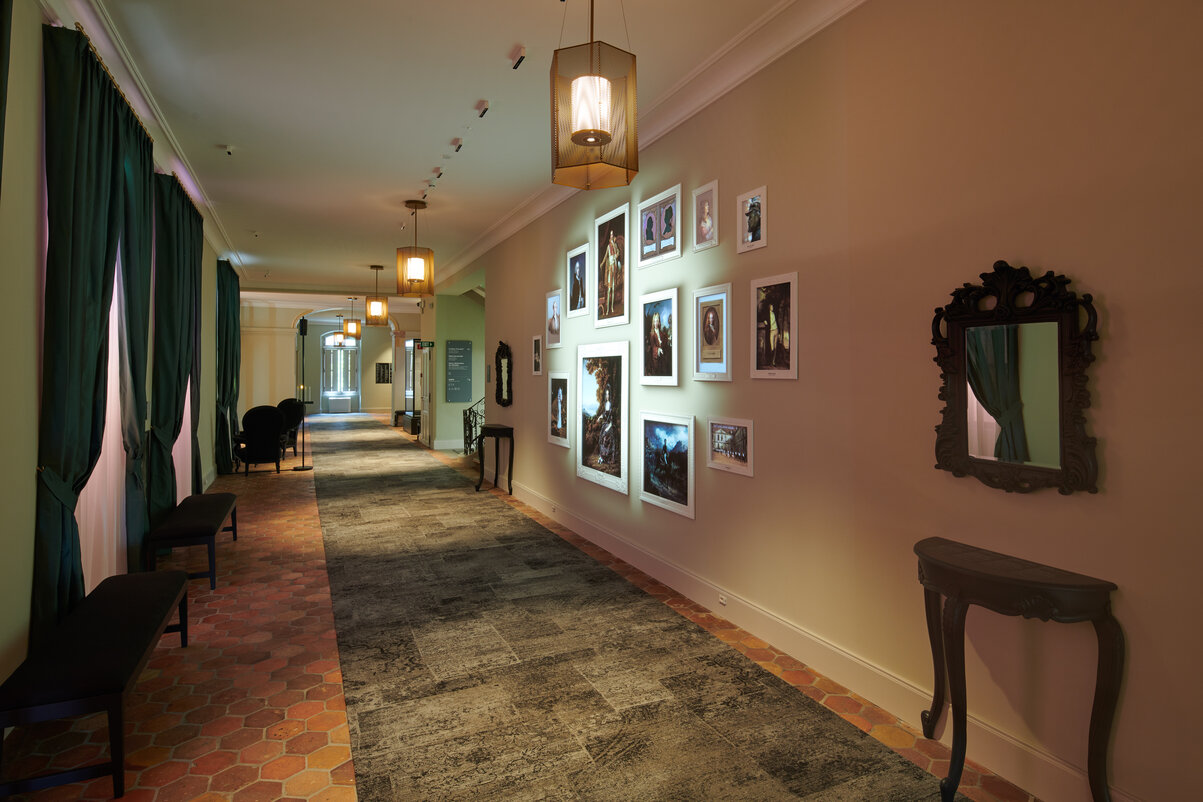
The exhibition ‘Galérie des portraits’. Copyright: ©Musée national suisse

In the large hallway on the first floor, these former inhabitants reappear to surprise visitors and recount anecdotes. Historically, the gallery of a stately home links separate wings together and acts as a place of transition between different spaces.

Often sizeable, it became somewhere to stretch one’s legs or walk around when the weather was terrible. Since it was an area that everybody had to pass through, it was frequently used to hang family portraits for all to gaze at. These former functions are respected but addressed in a contemporary way.

Bringing together the above individuals from the past, this permanent exhibition (Portrait Gallery) also sets out to recreate the castle’s sense of place or soul, shaped by all those who lived, wrote, dreamed, wept, studied or collected there. In an interactive presentation, visitors will learn about the lives and stories of these personalities in their historical context.

The exhibition ‘Galérie des portraits’. Copyright: ©Musée national suisse