Jakob Scheuchzer and the Climate


Global warming has been noticeable for decades. Unlike previous warmer periods, this trend is rapid and worldwide development. Interdisciplinary research tries to identify the causes of this process and develop scenarios to slow it down.
This situation is an opportunity to look to the past to put the current processes in a historical context.

The data collected in this exhibition goes back to prehistory. Based on archaeological finds and numerous historical and scientific documents, it highlights the climatic history of Zurich from the Neolithic to the present.

Special attention is paid to the work of the Zuricher universal scholar Johann Jakob Scheuchzer (1672-1733). He was the first Swiss scholar to introduce a scientific approach and worked on a European network for weather observation and prediction.

Jakob Scheuchzer, foto from the Physica Sacra (Band I 1731). Photo: Wikipedia

He studied natural philosophy, obtained a doctorate in medicine, specialised in botany and geology, and eventually became a general practitioner. He corresponded for years with other scientists and published dozens of books and writings. Over 6 000 letters have survived and are kept in Zurich

He lifted Swiss and European research to a new level by systematically measuring water levels, drought, sunshine hours, air pressure, temperature, and precipitation, among others. He created the first data sets, which he exchanged with colleagues abroad.

The exhibition places the results of this scholar in the perspective of the present, thus painting a scientific picture and understanding of temperature changes from the Stone Age to the present.

Particular attention is paid to the Little Ice Age (1350-1840). Although this phenomenon was only scientifically recognised around 1730, it already attracted attention in Scheuchzer’s lifetime. Indeed, he observed that flora and fauna changed due to the cooling, but nature and humans adapted, as polar bears do today at the North Pole.

Even then, there were long periods of great drought or too much rain, the Rhine and Limmat dried out, and there were floods or tornadoes that split cathedrals in half (the Dom in Utrecht, for example).

The exhibition does not put global warming into perspective. It is moving faster than ever, mainly due to emissions, industrialisation and overpopulation and the subsequent exhaustion of the earth. However, it shows how societies reacted and adapted then, often with irrational measures and reactions, such as witch burnings or pogroms. In that respect, conspiracy theories or denials are relatively harmless phenomena.

And who knows, a proper analysis of cause and effect may not be possible until a hundred years from now. In any case, the Gletschergarten in Lucerne is an excellent addition to this well-documented and topical presentation.

Baroque. An Age of Contrasts


Baroque is more than a matter of style. This cultural epoch, between 1580 and 1780, was a time of enormous contrasts: opulence and innovation on the one hand, death and crises on the other.

Ongoing religious wars and the opening up of global trade networks resulted in power gains and cultural exchange, but there was also famine and exploitation. Switzerland played its part in all this radical change: Swiss architects designed major works throughout Europe, Swiss artists and scientists were part of international networks, clothing and interiors reflected the culture of the French court, and the worldwide circulation of products and knowledge had life-changing impacts.

The exhibition presents beautiful objects from Baroque architecture, garden culture, fashion and art, focusing on the historical context of these items in order to illuminate this creative epoch in all its glorious ambiguity.

Niki de Saint Phalle


Niki de Saint Phalle, Nana Mosaïque Noire, 1999. Würth Collection. Foto/Photo: Archiv Würth, © 2022 Niki Charitable ArtFoundation, All rights reserved / ProLitteris,Zurich

Niki de Saint Phalle (1930–2002), a leading female artist of the 20th century, gained worldwide fame with her ‘Nanas’, which exemplify the seemingly carefree cheerfulness typically associated with the artist. Yet there is much more to her than that.

Her output is surprisingly multifaceted – eccentric, emotional, dark and brutal, humorous, enigmatic and often challenging. Its remarkably broad spectrum ranges from painting and drawing to assemblages, actions and large-format sculptures, and even theatre, film and architecture.

She was intensely concerned with social and political issues, challenging institutions and establishing societal roles in ways that give her work enduring and contemporary relevance.

With her legendary ‘Shooting Paintings’, created in provocative actions as far back as the 1960s, Niki de Saint Phalle made a pivotal contribution to the art of performance that is so topical today. Against this backdrop, retracing her artistic career casts a different light on many of her works, especially the ‘Nanas’ and the large installations in the public space.

The selection of works for this exhibition offers an insight into the complex and highly interesting career of this exceptional artist.

The Pastrymakers of Grisons


(Deutsch) George Kuhnt, Konditorei Barth & Cloetta, Breslau, c. 1854. Ausstellung 'Die Bünder Auswanderungsgeschichte von Zuckerbäckern'. Foto: TES.

Trade agreements between theRepublic of Venice and the Free State of the Three Leagues (Canton les Grisons or Graubünden since 1803)) allowed for free access to the republic of Venice and the right to exercise free trade.

New professions appeared, among them the pastry makers.
This profession comprised those of confiseur, cafetier, chocolatier, or beer brewer. They also produced liquors, lemonades, fizzy drinks, and almond products like marzipan. Venice exported its products across the alpine passes to Northern Europe.
Apart from trade, there were political and strategic concerns.

The Three Leagues, with their subjugated Italian-speaking territories Chiavenna, Valtellina and Bormio, formed a buffer zone between the republic of Venice, the Habsburg Empire, who were present in parts of Lombardy and Milan, Habsburg Spain and France. The agreements were regularly renewed.

In 1766 Venice cancelled the agreement, and the city-state expelled the Bündner (all those from the Grisons). After their expulsion, the pastry makers ventured all over Europe and later the New World. They often set up businesses in towns and villages. They were masters in their trade, enterprising, well organised, and willing to endure long and dangerous travels.

What has come down to later generations mainly concerns those who had been successful, such as the Redolfi and the Castelmur. This exhibition tells their fascinating history.

Four Hundred Years Celtic History


La Tène is a of the Celtic civilisation of the period 500-100 B.C. This culture was dominant in most of Central and Western Europe. Near the small village of La Tène, on Lake Neuchâtel, this Celtic culture was discovered by a fisherman in 1857.

After the Hallstatt period (1200-500 B.C.), this discovery filled the gap of the centuries before the arrival of the Romans. This Celtic culture is named after its village of first discovery, the La Tène period. The (open-air) museum Laténium is named after it.

With the new exhibition Between two Waters. La Tène, place of Remembrance (Entre deux eaux. La Tène, lieu de mémoire), the Laténium (canton of Neuchâtel) gives a complete overview of more than one and a half centuries of research through objects, information, animated films and (interactive) visualisation.

To make this cultural history accessible to a broad audience, the Laténium has opted for a complementary approach. Four animated films tell the story of La Tène, complemented by the musical creation of Marek Hunhap.

The visual world of La Tène inspired the musician, and his composition accompanies the visitor on his journey to the Celts. The central element of the exhibition is the huge collection of finds from La Tène.

The Draughtsman Federico Fellini


German poster of the movie «Il bidone», 1955, Collection Deutsches PlakatMuseum, im Museum Folkwang, Essen© 2022, ProLitteris, Zürich

Federico Fellini (1920–1993) is one of the most important directors in cinema history. Films such as ‘La strada’ (1954), ‘La dolce vita’ (1960), ‘Amarcord’ (1973) and ‘La città delle donne’ (1980) are classics.

They are incisive commentaries on Italian society but also on Western values in the 20th century. Less known is the fact that Fellini had been a tireless draughtsman since his youth, initially sketching out his  ideas on paper before arranging them on the set.

The presentation Federico Fellini: Von der Zeichnung zum Film includes some 500 exhibits: drawings, on-set photographs and props used in the films.

Art and Medicine


Kiki Smith, Untitled, Graphit auf Metho-Zelluloseund handgefärbtes Nepalpa-pier, D.Daskalopoulos Collection,© Kiki Smith

Concern with physical well-being in art is as old as art itself. The sensitive body is at once a working tool and object of observation. Six chapters examine the productive interplay of sickness and pain, medicine, care and healing through 300 exhibits.

A large spectrum of media, from drawing, painting and sculpture to video, spatial installation and performance, is displayed in this asynchronous and associative sequence. The main focus of the artworks is on physical infirmities. The themes covered include the ‘golden age’ of medicine, ‘plagues and pandemics’, ‘prophylaxis, complementary medicine and self-healing’, ‘the diagnostic gaze and the hospital system’, ‘pharmaceutics and cutting-edge research, and finally ‘patients at the crossroads of the normed and singular body’. Familiar names from the past meet young artists in their twenties who address the broad spectrum and fascinating evolution of the discourse surrounding the sick body.

The exhibition (Kunst und Medizin) comprises the positions of 50 artists from the 19th to the 21st centuries, with detours as far back as the 15th century.

Bridget Riley’s Colours, Space and Form


Bridget Riley in her workshop in West-London, 1983 Photo: Bill Warhurst. Courtesy of the Bridget Riley Archive.

Bridget Riley (1931) is one of the most prominent representatives of post-war abstract painting. The starting point of the exhibition Bridget Riley: Looking and Seeing, Doing and Making is a visit she made to Egypt from 1979–to 1980. This trip had a profound effect on the development of her colour work.


Bridget Riley has made the selection of works with which she retraces the twenty-year creative period following that visit. The exhibition includes rarely shown preliminary work, drawings and studies, which reveal Bridget Riley’s day-to-day life in her studio. She explores the dynamics of colour, form, and pictorial space with great precision and playful ease.


Both Bridget Riley and Paul Klee drew artistic inspiration from their respective travels to North Africa. In 1914, Paul Klee travelled to Tunisia, where he experienced a “breakthrough into colour.” Later, when he went to Egypt in 1928, he was struck by the relationships between light and colour and the cultural landscape in the Nile Valley.


Bridget Riley visited Egypt in the winter of 1979/1980. The tomb paintings in ancient places of worship, the architecture, and the abrupt contrast between desert and vegetation in the Nile Valley had a lasting impact on her. She also studied the technique of Egyptian painting, which led her to develop the so-called Egyptian palette, consisting of seven colours: turquoise, blue, red, yellow and green, black and white.


The exhibition begins with the stripe paintings of the early 1980s, which are based on the Egyptian palette. It demonstrates how this artistic turning point reverberated in Riley’s work through the early 2000s.


Most of the 44 works displayed in the exhibition are part of Bridget Riley’s collection. They are supplemented with works from the Sammlung Lambrecht-Schadeberg, Museum für Gegenwartskunst Siegen and the Kirkland Collection.


The 17 paintings and 27 studies illustrate a crucial period in Riley’s artistic development and offer an extraordinary insight into the artist’s everyday working life.

El Greco and Picasso in Dialogue in Basel


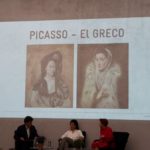
(Nederlands) Press Conference, Kunstmuseum Basel, 8.6.2022, f.l.t.r.: Josef Helfenstein (Directeur Kunstmuseum Basel), Pamola Picasso, Carmen Giménez (Curator). Foto: TES.

Pablo Picasso (1881-1973) wrote Yo-Greco (I El Greco) and El Greco Vélazquez inspirarme (El Greco Velázquez inspire me) on his first drawings after viewing works by these old masters in the Museo del Prado.

Picasso was studying at the art academy in Madrid and discovered his artistic partners for life. He remained, in his own words, in permanent dialogue with these masters throughout his career.

El Greco

El Greco (Doménikos Theotokópoulos, 1541-1614) was soon forgotten after his death, although he had been a successful painter. As the name suggests, he was of Greek origin (Crete), when Venice ruled the island. Byzantine art and icons were his sources of inspiration. El Greco left for Venice in 1567. There he came into contact with Titian (1490-1576), Tintoretto (1518-1594) and other masters.

He settled in Rome in 1572 and got in touch with Spanish artists. In Rome, he  became acquainted with the artistic inspiration of the Council of Trent (1543-1563) and its Baroque and Mannerism soon afterwards.

In 1577, he moved to the court of the Spanish King Philip II (1527-1598) and his new palace El Escorial in Madrid. However, El Greco did not receive the commissions and recognition he expected, and he left for Toledo, where he settled as a free artist. This position allowed him to develop his style. 

Picasso

At the end of the nineteenth century, artists and art dealers rediscovered his qualities as a ‘modern’ artist in terms of composition and colours. For Picasso, he was the founder of Cubism, which Picasso subsequently gave a place in art history through his Les Demoiselles d’Avignon (1907).

El Greco and Picasso

The exhibition (Picasso – El Greco) shows the intense artistic attention of Picasso for El Greco. Picasso did not call it an imitation but a dialogue. Diego Velázquez (1599-1660) and Rembrandt van Rijn (1606-1669) also belonged to his ‘conversation group’. In 1967, Picasso expressed this commitment on the back of his ‘The Musketeer’. He wrote on the backside Doménikos Theotokópoulos van Rijn Da Silva (Velázquez).

Paloma Picasso was also present at the press conference preceding the show’s opening. She confirmed this lifelong relationship. For her father, Picasso, there was no time difference. An old master from 350 years ago was as much present and a part of the dialogue as contemporaries such as Henri Mattise (1869-1954), Paul Cézanne (1839-1906) or, for example Georges Braque (1882-1963).

The relationship between El Greco and Picasso is not new. The Kunstmuseum Basel, however, presents the lifelong ‘dialogue’ in words, drawings, paintings and a catalogue. Both masters are at the centre of the attention, as if there were no centuries between them, just as Picasso saw it.

The exhibition starts appropriately with Picasso’s first drawings and their references to the old masters. Twelve works of Picasso from the Kunstmuseum Basel and around sixty masterpieces by the two artists from museums in New York, Madrid, Barcelona, London, Budapest, Washington, Paris, Toledo and Berlin present their relationship comparatively. Exceptional is the presence of masterpieces from churches in Toledo.

Picasso and Basel

Picasso has a unique, even affective relationship with Basel. Inhabitants of the city organised a referendum in 1967 to save two paintings (Two Brothers and the Seated Harlequin) for the Kunstmuseum Basel.

The owner and lender, in need of money, wanted to sell them for CHF 6 million. The population voted in a referendum with an overwhelming majority to buy ‘their two Pablo’s’. Picasso was very touched by this spirit and donated four paintings to the museum.

As part of one of the oldest public art collections in the world and in view of its capacity and commitment to organise great exhibitions and to involve the citizens of Basel, the Kunstmuseum Basel can write Yo Kunstmuseum Basel on its façade.

Anne Frank and Switzerland


The Frank Family, Exhibition 'Anne Frank und die Schweiz', Landesmuseum Zurich. Photo: TES,

Anne Frank’s diary became a global phenomenon in the wake of the Holocaust. However, few people are aware of the extent to which the Frank family and the dissemination of Anne’s diary are associated with Switzerland.

Only Otto Frank, the father of Anne, survived the concentration camps. He eventually settled in Switzerland, and it was from here that he launched his quest to take the legacy of his daughter Anne to the whole world. Her diaries are a plea for more humanity and tolerance, and they have become part of world literature.

The history of Anne Frank is representative of the fate of Jewish families during World War II. The exhibition (Anne Frank und die Schweiz) interweaves the flight of Anne Frank’s family to Amsterdam from Frankfurt am Main in 1933 with the lives of the relatives in exile in Basel.

The parallel stories of the two branches of the family, and how their lives unfolded during World War II, makes the viewer keenly aware of the specific threats to Jews in two small European nation, the one occupied by Germany, the other under a permanent threat of an invasion.

The exhibition’s central theme is the diary of Anne Frank, which is presented in facsimile with displays and exhibits adding further detail to her accounts of life in hiding. It paints a picture of the conditions under which the texts were created, and examines the history of their impact and appeal. Using objects, photos and documents, the exhibition gives a glimpse into the family’s life.

The exhibition presents an authentic narrative and opens up a view of their life, also covering refugee policy and refugee assistance in Switzerland during World War II.