Bulle and Gruyère

Gruyère is world-famous for its cheese and its castle, but who outside Switzerland knows the town of Bulle, the capital of the Gruyère district in the canton of Fribourg (Freiburg) since 1848? The first written mention of Butulum dates back to 855. In later centuries, the place was referred to as Bollo, Bullo, and Boll.

Heraldry of the county of Gruyère. Collection: Musée gruérien

The Counts of d’Ogo (better known as the Counts of Gruyère) and the Bishop of Lausanne were the principal landowners at this crossroads of roads to Fribourg, Vevey, Romont, the Valley of Jogne (la vallée de la Jogne) and the Pays-d’Enhaut.

The bishop of Lausanne ruled the town until 1536. That year, Bern conquered the area of today’s canton of Vaud and the bishopric of Lausanne.

Bulle was part of the bishopric’s (secular) territory but refused to surrender to Protestant Bern. The town turned instead to Catholic Fribourg for protection.

The bailiff had his seat in the castle of Bulle from 1537 to 1798

A bailiff of Fribourg then governed the city until 1798 (the French invasion). Fribourg’s rule had the character of an occupied territory  (Untertanengebiet or territoire sujet), and many citizens of Bulle resisted. The main (unsuccessful) revolt took place in 1781 under the leadership of Pierre-Nicolas Chenaux (1740-1781).

Pierre-Nicolas Chenaux (1740-1781)

Even in the new Confederation of 1815, the city resisted the (restored) ancien régime in the canton. Bulle even played a leading role in the Régénération and the liberal Constitution of the canton in 1831. However, conservative forces regained the upper hand after 1840, and the canton joined the Sonderbund.

After the defeat of the Sonderbund in 1847 and the adoption of the new Constitution in 1848, Bulle has been the capital of the Gruyère district, acknowledging its economic (especially in cattle trade, timber, and cheese) and political role.

The Chapelle de Notre-Dame de Compassion or Notre-Dame-de-Pitié was founded around 1350. The Capuchins settled in the complex in 1665, 120 years after establishing the first Capuchin monastery on Swiss territory in Bigorio (canton of Tessin). The monastery garden, complex, and the Capuchins are still neighbours of Bulle Castle.

The Museum of Gruyère (Musée gruérien) has a richly illustrated overview of the history, present, and past of the town and the former county of Gruyère.

In addition, the museum displays unique photographs from 1840-1850 by Joseph-Philibert de Prangey (1804-1892). These were made based on the Daguerre type (named after the French inventor and artist Louis Daguerre (1787-1851).

(Source and further information: Ville de Bulle)

The Monastery and its Garden

Impressions of Bulle


Lavaux Vinorama

Lavaux Vinorama is the centre for discovering the wines and terraced vineyards of Lavaux, an area registered as a UNESCO World Heritage Site. Visitors can explore the cultural and sensorial aspects of wine and its origins.

The building, conceived with its original architectural concept in mind, respects the environment and is perfectly integrated into a rehabilitated site adjacent to a magnificent waterfall. The Vinorama showcases the work of the grower-vintners throughout the seasons in this wine-producing region, presenting over 250 wines from across the region.

(Source and further information: www.lavaux-vinorama.ch).

La Motta Chapel

Near the town of La Tour-de-Trême (canton of Fribourg) is a small chapel on a hill. It was built in 1635 and dedicated to St. Roch and St. Sebastian.

Both were patrons against infectious diseases and the plague. The chapel owed its existence to an epidemic in 1635.

The interesting thing about this chapel is its name. It is not named after the saints, but its location. Its name derives from the Celtic word mutta, meaning height, which became the French word motte, a fortified place on a hill.

The aesthetic of this simple chapel is set against the backdrop of trees, cattle, and the silhouette of the mountains in the distance.

Source: La Chapelle de la Motta

Two villages, two inns, a medieval bell and nature in Emmental

The source of the Emme, at 2197m between the Hohgant and Augstmatthorn mountains, is the border area of the Bernese Oberland and the Canton of Lucerne. The river flows into the Aare at the border of Canton Solothurn near Luterbach. Between lies the Emmental, with Langenthal as the regional centre of the Obere Emmental and Burgdorf as the larger town in the Untere Emmental.

The Emmental is a district of the Canton of Bern, with 98,000 inhabitants in an area of 690m2. There are eight cantons with fewer inhabitants and even ten cantons of a smaller size!

Emmental is famous for its Meränggen in Kemmeriboden-Bad and its cheese (König der Käse/King of Cheese). Anyone who says cheese also refers to the agricultural sector (about 10% of Emmental’s workforce).

The numerous mostly large Emmental (wooden) farmhouses, their crops and livestock, lone lime trees on hills and wooden bridges characterise the landscape. From Burgdorf to the source of the Emme, more than 30 wooden bridges span the river, including the famous 60-metre-long Hasle-Brücke near Hasle-Rüegsau.

The author Albert Bitzius alias Gotthelf-Jeremias (1797-1854) knew and wrote about life in the Emmental and its inhabitants (Das Emmental ist ein Hügellland, düster aussehnend von weitem, aber lieblich und heimelig in der Nähe) like no other. He set the beauty of the landscape against the ugly themes of his time.

In the middle of the Emmental lie the villages of Ursenbach and Dürrenroth. Dürrenroth’s history is as fascinating as its name, ancient bell and two major establishments.

Dürrenroth

A document mentions the town in 1275 under the name ‘Rota’, probably referring to the red colour of the stream’s water. In 1326, the name ‘Ze der Dürren Rot in dem Dorf’ appears, referring to the dried-up Rot (the stream’s name). However, the Rotbach flows again, as it has for centuries. 

The village has long been owned by the Teutonic Order of Knights (Deutsche Ritterorde) and the lords of Sumiswald. The mighty castle in Sumiswald still oversees the Emmental. Bern bought the village from the Lords of Sumiswald in 1698.  

The village centre has several characteristic buildings. The church from 1486 (a new construction of an older Romanesque church) has one of the oldest church bells in Switzerland. The St. Laurentius bell, dated 1392 (apparently from the Romanesque church), is one of five bells in the tower.

Landgasthof Bären

The late Baroque guesthouses ‘Bären’ (1752) and ‘Kreuz’ (1806) are not only colossal in size and monumental in status but also complexes with beautiful gardens, hotel, and restaurant facilities. Both buildings were already Taverns in the 16th century.

Hotel Kreuz

Kreuz owes its name to the cloister in the building. The cloister is enclosed on four sides by identical oak doors, located to the north, east, south, and west. The north-south axis refers to the church porch opposite. 

The two guest houses were important stopping points for changing horses on the Lucerne-Bern route during the era of the stagecoach, until the arrival of the railways in the Emmental in 1908.

In the ‘Kreuz’, carriages with horses could even enter the guesthouse in the so-called Kreuzstock in lousy weather. Landgasthof ‘Bären’ and Hotel ‘Kreuz‘ are now members of Swiss Historic Hotels.

Ursenbach

A few kilometres north is the village of Ursenbach ((Ursibach in a charter from 1139). This village has been part of Bern since 1414. The main feature of the town is its church and, in particular, the letter of 11 November 1515 from the city of Bern.

The letter of 11 November 1515 (copy in the church)

Bern kindly requested the village inhabitants to finance the renovation of the old Romanesque church (12th century). Bern’s will was, of course, law, and soon afterwards, the rebuilding in the late Gothic style was completed, including 14 windows as gifts from Bern, Lucerne, Solothurn, Freiburg, and Basel.

Photo in the church

The current church is the result of this renovation. However, not everything has remained the same since then. Faith changed soon after, following Protestant Bern.

However, the landscape, with its many farms, and the great importance of the agricultural sector have remained largely unchanged over the centuries. 

The Swiss Alpine Club

The Swiss Alpine Club, section Basel (www.sac-basel.ch) regularly organises hiking trips in this region (and elsewhere).

The SAC (www.sac-cas.ch) organises ski tours, mountaineering, and other sports in the high mountains and the Alps, as well as activities in different regions.

(Source and further information: www.emmental.ch).

Impressions of the Emmental


Colonia Iulia Equestris or Nyon, the oldest town of Switzerland

Julius Caesar’s last political decision was to establish Colonia Iulia Equestris, today’s Nyon (canton of Vaud), in 45 BC. This Roman general had defeated the Celts at Bibracte, near present-day Autun in France, in 58 BC. 

Several Celtic tribes, including the Rauraken and Helvetic tribes, moved towards Burgundy that year to settle far away from the Germanic tribes. At this time, Rome had not yet occupied this part of France (Gaul), and Celtic tribes also lived there. 

The bad luck for the ‘Swiss’ Celts was Caesar’s ambition to conquer Gaul, and new Celtic tribes in Gaul did not fit into this picture. The defeated ‘Swiss’ Celts returned to their territory and concluded treaties with the Romans. Caesar wanted Roman strongholds at two strategic locations: the Colonia Iulia Equestris on the shores of  Lake Geneva and Augusta Raurica (founded around 45 BC) along the Rhine. 

Nyon’s rich Roman history is evident in the city centre, the Roman Museum, and the site archéologique majeur, which features the foundations of an amphitheatre, forum, basilica, aqueduct, bathhouses, insulae (residential areas), and the original street plan.

After the Romans left in the fifth century, Augusta Raurica decayed into two small fishing villages, Augst and Kaiseraugst, with a few hundred inhabitants. However, the Colonia Iulia Equestris developed into a monumental regional town of significance.

Place du Château

The Dukes of Savoy ruled Nyon for centuries, using the castle (12th century) as their administrative centre. Nyon was strategically important, situated on Lake Geneva, between Lausanne and Geneva, and along key trade routes.

Bern conquered the Pays du Vaud and Nyon in 1536. The castle was the residence of the Berner bailiff until 1798 (French invasion). Today, the castle is a museum.

Another important monument is the Temple de Nyon, built in the 12th century and a Protestant church in 1536. 

Le Temple de Nyon

The Park du Bourg de Rive on the edge of the lake and of the old city walls proudly displays the (later installed) Roman columns. The monastery of the Friars Minor (Frères mineurs) in the park dates back to the 13th century and was converted into a hospital in 1537. Today, it is the site of the Musée du Léman.

Musée du Léman

Above all, Nyon is a perfect city for strolling and a good starting point for visits to Aubonne and the countryside, as well as other cities such as Lausanne, Geneva, Rolle, or Morges, offering stunning views of the Alps and Lake Geneva.

(Source and further information: www.nyon.ch)


Tour de l’Horloge

Park du Bourg de Rive


Place du Château

Europe´s Oldest Army in Vatican City and Women

On 22 January 1506, Pope Julius II (1443-1513) founded the Swiss Guard. During this period, Europe experienced numerous wars, and princes frequently fought these conflicts with mercenaries from other territories.

At the time of the Swiss Guard’s establishment, the Eidgenossenschaft was a military superpower renowned for its victories over the most powerful royal houses: Habsburg (1315-1499) and Burgundy (1476 and 1477). What set their soldiers apart was not just their military might but their loyalty and bravery, making them highly sought after.

This warlike pope was also impressed and decided to establish a Swiss Guard as his bodyguard. Not only at the Sacco di Roma on 6 May 1527, but the Guard also lived up to its prestige on 10 August 1792 when defending the Tuileries Palace of King Louis XVI (1754-1793). 

Pratteln, Galerie Beyeler, Exhibition Die Schweizer Garde, 2019

The Swiss Guard still exists today, consisting of 135 men with Swiss citizenship who are Catholic, unmarried, and between 19 and 30 years old when they join.

Today, the Swiss Guard is a unique institution, comprising 135 men with Swiss citizenship who are Catholic, unmarried, and between 18 and 30 years old when they join. 

Their roles are diverse, ranging from military to representative functions. They also play a role in border control, overseeing the borders of Vatican City, a sovereign state of the Holy See since 1929. The term of service is at least 25 months, with the option to leave or re-sign at the end of the term.

Under the Swiss Constitution of 1848, Swiss citizens were no longer allowed to enter foreign military service except for the Swiss Guard. Thus, many centuries of Swiss mercenary service came to an end.

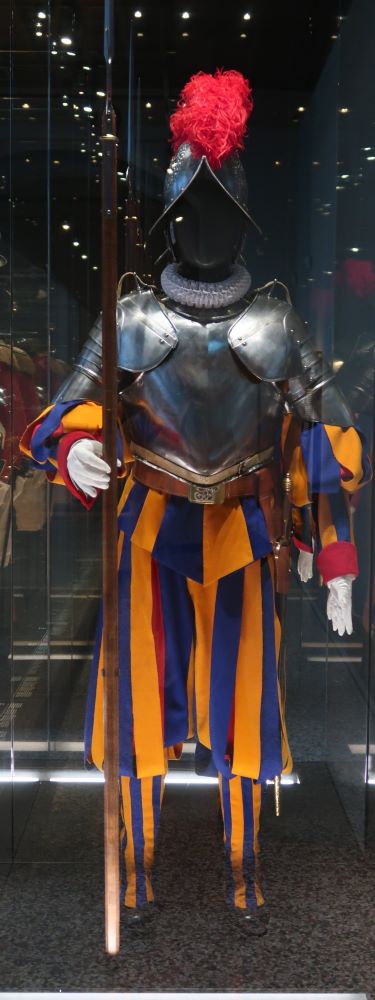
Gala-Uniform of the Schweizer Garde. Landesmuseum Zürich

On 6 May 2024, 34 new guardsmen were installed in Rome in the Saint-Damas Court of the Apostolic Palace. Women were not yet among them, but that is about to change. If all goes according to plan and with papal approval, the new guard barracks will also house women in 2030.

Work on the barracks, including rooms for women, is in progress. The Kasernenstiftung, established in 2016, was created to fund projects after the Gardestiftung had already been established in 2000. Next step: priesthood for women and the end of celibacy?

(Source and further information: Museum der Schweizergarde; Päpstliche Schweizergarde)

The Monastic Island of Reichenau

The monastic island of Reichenau (Die Klosterinsel Reichenau, Baden-Württemberg, Germany) is one of the most historic places on and in Lake Constance, and it will celebrate an important anniversary in 2024.

One thousand three hundred years ago, in 724, the travelling monk Pirmin founded the monastery, which became an important inspiration for art, culture, and politics in the Middle Ages.

The island had been inhabited before the 8th century. However, with the monastery’s foundation, the island began to flourish. After the monastery, two more churches were built, St. Peter and St. Paul, and St. George, in the 9th century.

St. George Church

St. Peter and St. Paul Church

The island and the monastery benefited from its favourable location on the trade routes between the Rhine and the main Alpine crossings of the time.

In 780, Charlemagne (748-814) visited the monastery, elevated it to a royal abbey, and placed it under his protection.

The abbey of Reichenau was a centre of illuminated book publishing. The monks were highly skilled in using parchment, ink and seals, including forging documents that were corrected or wholly rewritten for patrons. People also speak of the ‘Reichenau school of forgery’ (die Reichenauer Fälscherschule).

Writers worked only to a limited extent for the monastery’s needs. Princes and kings commissioned most books. Reichenau’s library was one of the largest in the Carolingian Empire. The island was a centre of knowledge for centuries before universities existed.

Liber Viventium Fabariensis, 810-820, Stiftsarchiv St. Gallen

 The Archaeological State Museum in Constance (Das Archäologische Landesmuseum in Konstanz) is dedicated to the history of the monastery and the island from its foundation to its dissolution in the 18th century.

 The exhibition ‘Monks, Mission, Adventure, Archaeology & Playmobil‘ shows many manuscripts, sculptures, altars, everyday objects, writing utensils, notebooks and the history of the monastery and the island, among other things. It provides insight into monastic life and demonstrates that the monastery and monasticism had an extensive network throughout Europe at the time.

From the early 9th century, the brotherhood book was kept with the names of monks. It included more than 50 monasteries; the lists eventually contained 38,000 names of monks!

The world of monks and abbeys was very European in those days. St Gallen monastery was also among them. In 2000, the monastery island of Reichenau was added to UNESCO’s World Heritage List.

(Source and further informations: Das Archäologische Landesmuseum in Konstanz; Thomas Ribi, ´Wo Mönche Urkunden fälschten´, Neue Zürcher Zeitung, 25 April 2024).

Lake Wohlensee, the Niederried-Oltigenmatt Reserve and the European Court of Human Rights

Many of Switzerland’s 1,500 lakes are reservoirs. The country pioneered eco-friendly electricity, or ‘white energy,‘ in the nineteenth century. Even trains have been running on this energy since the 1920s.

Switzerland is also a forerunner in a city heating system. In the 1950s, for example, this facility could already supply 40,000 homes and businesses in Basel. Business and government institutions also respect natural heritage and resources.

However, citizens are the most important asset for respecting nature and natural resources. Even cigarette butts often (still) end up in the appropriate waste bins. The (predominantly small-scale) agricultural sector gives stock, flora and fauna space as far as possible in this densely populated country. 

The agricultural sector is also subsidised in Switzerland, but more effectively, selectively and restrictively than the European Union’s budget (around 40%). This European Union also torpedoes environmentally friendly investments by Dutch fishermen (electric pulse fishing, derived from the ancient Danish Snurrevod fishery) to maintain environmentally damaging fisheries in other countries. 

Dutch farming is also decimated because of dogmatic national and European politics, ignoring the context of one of the world’s most densely populated areas and showing a lack of respect for the agricultural sector, which has also been subsidized by the European Union, to be decimated.

Switzerland is a role model for pragmatic information, nature and environmental management in Europe. Hikers, summer and winter sporters, picnickers, and other tourists along the shores of lakes, streams, and rivers generally (still) clean up their litter. Otherwise, clean-up services are on standby. 

Across the country, there are numerous (private) museums and information offices and their pragmatic approach to the themes of environment and energy transition. Switzerland is a bottom-up country and not a centralised top-down nation!

The Erlebniswelt für die Energiewende (above) and the Science- und Erlebniscenter Primeo Energie Kosmos für Klima und Energie,  Primeo Energie in Münchenstein (canton Basel-Landschaft)

From this perspective, it is also incorrect to classify Switzerland as an ‘environmental sinner’ (European Court of Human Rights, Case 53600/20 Verein of Klimaseniorinnen Schweiz and others versus Switzerland, 09-04-2024). In fact, it was the European Court of Human Rights and Greenpeace & C0 versus Switzerland. 

A judge’s first task is to prove the facts. This judge did not do so, neither in terms of (historical) government measures at national, cantonal, and municipal levels nor in terms of citizen engagement and involvement, not to mention the lack and arbitrary use of legal grounds. 

The Wohlensee in canton Bern is unaware of this juridical mismanagement at the European level. This lake is de facto a widened Aare over 12 kilometres. It supplies power to the city of Bern and surrounding villages. 

The first large hydroelectric power station in Europe was built in Rheinfelden (canton Aargau) in 1898. Two (Swiss) engineers, Agostino Nizzola (1869-1961) and Charles E.L. Brown (1863-1924), subsequently developed a global network (present-day ABB) of electricity and machinery devices.

Not only is the Mühleberg power station an impressive structure, but the region is also a beautiful nature reserve, as is the other power station in the Aare at Niederried, a few kilometres upstream. 

Switzerland was also one of the pioneers in establishing protected nature reserves, and the densely populated habitable part has many nature reserves, large and small.

The World Wildlife Fund (WWF) wrote its manifesto in Morges (canton of Vaud). Moreover, Switzerland was among the first countries to create national parks.

The Church in Dürrenroth and the circle of life.  Even decayed nature is treated with respect in this country

Conclusion

This judge can now also start interfering in matters of road safety, computer use and crime, health policy or areas posing risks to older people.

Moreover, older people do not die from the heat, but from underlying health problems associated with old age, just as with a common flu. This shows just how populist, factually and legally arbitrary this judgement is.

 The European Court of Human Rights ruling is not only an insult from a legal point of view but also based on activism rather than the facts.

A Federal Councillor who is in favour of this ruling is himself (still) an activist and not (yet) ready to be and to act as a Federal Councillor.

The Wohlensee and the Niederried–Oltigenmatt Nature Reserve do not take this ruling seriously.

Even the Christmas tree in Basel’s Ratshaus is lit up by a bicycle dynamo!

Impressions of the Wohlenseeregion and nature

The church of Wohlen bei Bern, 13th century

Impressions of the Niederried-Oltigenmatt Nature Reserve and Power Station in the Aare


Samnaun, its customs and Vallader free zone and Wintersport

The border town of Samnaun (canton of Graubünden) has a special status. This history dates back to the eleventh century. The village was first mentioned in a charter of the Lord of Tarasp in 1089. Farmers from the villages of Ramosch and Vna in the Lower Engadin (Unterengadin) populated the valley of Saumnaun.

The fertile climate enabled farming at altitudes exceeding 1,800 metres (see also the centuries-old agricultural terraces in this region).

They founded Compatsch, Laret, Plan, Ravaisch, and Samnaun-Dorf villages. The villages have baroque or modern catholic churches because the valley remained catholic in 1530 (like Tarasp and Rhäzuns).

Samnaun (and Lower Engadin) belonged to the county of Tyrol until the acquisition by the Habsburgs in 1363. The villages, including Samnaun, bought themselves free in 1652. They already belonged to the Free State (Freistaat) of the Three Leagues (Drei Bünde) as part of the League of God’s House (Gotteshausbund) led by Chur.

The other two leagues were the Grey League (Grauer Bund) and the League of the Ten Jurisdictions (Zehngerichtebund). In 1803, the Lower Engadin region became part of the new canton of Graubünden.

Martina

Samnaun had been a customs town for centuries. From 1848 onwards, however, the customs post moved to Vinadi and later to Martina.

Samnaun was only connected with Unterengadin by the alpine passes. Henceforth, the contacts were limited to Tyrol in the winter period. For this reason, the Swiss Confederation granted the town the status of a customs-free zone.

The construction of the road from Samnaun to Martina and Lower Engadin in 1912 did not change this situation for practical reasons.

Saumnaun is still a ‘hochalpinen Shopping-Paradies’, as it presents itself. Indeed, many border visitors from Austria also visit the ‘zollfreie Paradies’ at an altitude of 1,800 metres. The popular winter sports resort of Ischgl, located in Austria, is nearby. At peak times, around 20,000 tourists stay in and around Ischgl and often shop in Samnaun.

However, the village has another trump card. While in other regions of Switzerland, ski resorts open for shorter periods or even close due to a lack of snow, the village actually expands its ski facilities.

Most of the slopes are at a (relatively) snow-sure altitude between 1,800 and 2,900 metres, and, in addition, the area is connected to Ischgl. The region has more than 240 kilometres of slopes, making it one of the largest ski areas in the Alps.

Samnaun is still a duty-free enclave today, but is also renowned for its winter sports facilities and stunning natural scenery.

(Source and further information: www.samnaun.ch).

Vufflens Castle, Vullierens Castle and L’Isle Castle

Vufflens Castle near Morges (canton of Vaud) is the most impressive example of late medieval castles in western Switzerland (the French-speaking part of the country).

Unlike many other medieval castles in this region, it was not built in the Savoyard style, which was the ruling style of the Pays du Vaud at the time. The main features are the use of brick and an architectural style from Piedmont, both unique to this region.

Morges Castle, Savoyard style

The complex was built around 1415 during the reign of Henri de Colombier (1368-1437). There was already a castle on this site in the 11th or 12th century. However, he built an entirely new castle. At the time, he was serving the Duke of Savoy and was an army commander in Italy, where he drew inspiration for his castle.

Only the castle’s core is intact of the originally very elaborate complex. The medieval outer walls and defences have disappeared. The current castle comprises a residential Palais, a massive watchtower surrounded by four corner towers, and a walled courtyard.

The castle is unique in this region in its monumentality. It combines the pursuit of residential comfort, defence, prestige, self-presentation, and exclusivity.

From 1641 to 1860, the De Senarclens family from nearby Senarclens owned the castle. De Saussure family has owned the castle since 1860. Its most famous member is the scientist, alpinist and Mont-Blanc climber Horace-Bénédict de Saussure (1740-1799).

The Dutch heraldry of De Senarclens 

In 1822, Onno de Senarclens (1780-1836) was raised to the peerage in the Netherlands (Baron, Lord of Haanwijk, Boxtel and Liempde ) because of his merits in the army and perhaps in connection with the prominent role of Hendrick Jan van Oyen (1750-1821) in Waadt and Morges in particular.

The castle cannot be visited. However, the vineyards surrounding it, along with the villages of Vufflens-le-Château and Denens, offer breathtaking views of this fairytale castle, Lake Geneva, the Alps, and, on a clear day, Mont Blanc.

Was the castle the inspiration for the castles of Vullierens and L’Isle?

Or:

“Vufflens n’est pas un château. C’est un conte de fées. C’est Chillon en plus ciselé, c’est Neuschwanstein en plus raisonnable. C’est un rêve, une carte postale. Avec la silhouette élancée de son formidable donjon, son vignoble sereinement étalé plein sud au pied du colosse de brique, il symbolise le Pays de Vaud: tradition sans rigueur malgré sa facture piémontaise, élégance débonnaire, sagesse souriante. Oui, ce château apparaît comme un phare luxueux veillant paternellement sur l’océan de vignes qui déferle sur les hauteurs morgiennes” (Source: Editions 24 heures, Les Châteaux viticoles du Pays de Vaud, 1990).

(Source and further information: www.swisscastles.ch)