Praz and the Celts, a small village with a great History

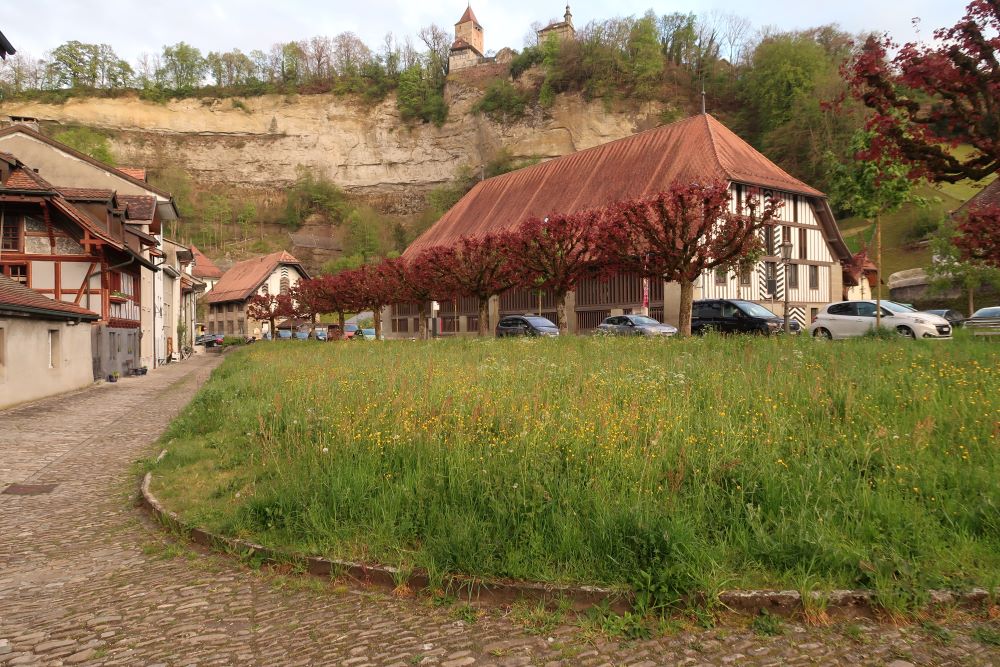
The small village Praz (commune de Mont-Vully) is situated near the ancient Celtic settlement (oppidum) on Mont-Vully (canton of Freiburg) at Lake Morat (Murtensee or lac de Morat).

This small village shares in the eventful history of the Romandie or French-speaking Switzerland. The Celtic settlement of Mont-Vully is one of the remains of the tribe of the Helvetians.

Mont Vully from Lake Neuchâtel and near Praz

This period was followed by the Roman period (15 B.C. – c. 400 A.D.), the invasions of the Alemanni, the first kingdom of Burgundy (c. 464- 534), the Frankish kings and emperors (534-843), the Kingdom of Lorraine (founded by the Treaty of Verdun in 843) and the (second) Burgundian Kingdom (888-1032).

Château de Praz

Praz became part of the Holy Roman Empire and the Duchy of Zähringen after that. The House of Savoy ruled until the conquest by Freiburg and Bern in 1476. Praz became part of the canton of Freiburg in 1803 (Mediationsakte).

The villages of Sugiez, Nant, Praz and Chaumont merged in 1850 into the municipality of Vully-le-Bas or Les Quatre Villages de la Rivière. Praz is a small village with a great history.

The Murtensee (lac de Morat) and Murten (Morat)

The canal de la Broye and le pont de Sugiez

Impressions of Praz and the region

Vullierens, its Church and Abbey

Vullierens (in the canton of Vaud) was already inhabited in Roman times. In the Middle Ages, it fell under the Barony of Cossonay. Bern conquered the Pays du Vaud (roughly the area of today’s canton) from the Duchy of Savoie in 1536.

From then on, the village fell under the jurisdiction of Morges and Bern. Bailiffs governed the area until 1798. In that year, France conquered the old predominantly German-speaking Eidgenossenschaft of 13 cantons (only Fribourg/Freiburg was bilingual) and their ‘Untertanengebiete'(including French-speaking Vaud (Waadt in German).

This Confederation, too, was not long-lived, lasting only until 1813, with Napoleon’s defeat. This construction was followed in 1815 by a new Confederation with three additional cantons, and the present Confederation was established in 1848.

The church

Throughout the centuries, Vullierens has maintained its agricultural outlook and size. The influence of Protestant Bern led to the transition from Catholicism to Protestantism after 1536. Despite these changes, the (Protestant) church, first mentioned in 1228 and rebuilt in 1733, and the former abbey, dating back to the early 16th century, continue to stand as witnesses to the village’s rich religious history.

The Abbey

(Source: F. Béboux, Vullierens, Dictionnaire historique de la Suisse)

The City of Fribourg, its Bridges, Abbeys, Cathedral, Churches, Museums, Port and Nature

Fribourg or Freiburg, la Sarine or die Saane, French- or German-speaking, the city is (or was) loyal to the Catholic faith during and after the Reformation in the first half of the 16th century. However, the diversity of monastic orders and abbeys is (or was) all the more significant.

La Sarine or die Saane, the so-called Röstigraben

The Gothic cathedral, dedicated to St Nicholas, was completed in 1490 after a two-century construction period. The city also has an icon. Today, the city is the seat of the diocese of Lausanne, Geneva, Neuchâtel, and Fribourg.

The city was founded in 1157 by the German-speaking Duke Bertold IV of Zähringen (1125-1186) in the predominantly French-speaking area of the former kingdom of Burgundy (888-1032).

His successor founded the city of Bern in 1191. The Counts of Kyburg acquired Zähringen in 1218. In 1277, the town came into the hands of the Habsburgs, who ruled until 1452.

The city became embroiled in the wars between the Habsburgs and the Duchy of Savoy, siding with Savoy from 1452 to 1477. However, Savoie was also an ally of the Duke of Burgundy.

 After Duke Charles the Bold’s three defeats against the Swiss Eidgenossenschaft in 1476 (Grandson and Murten) and 1477 (Nancy), the city joined the Eidgenossenschaft in 1481 after having significantly expanded its territory at the expense of Savoie.

The Rote Turm

The city wall, 13th century

Despite the Reformation in Bern, the Catholic city of Fribourg allied with Bern and conquered and split Vaud in 1536. Fribourg acquired Gruyère in 1555, reaching its present size. 

After 1530, the city was a bastion of the Counter-Reformation and Jesuit influence, culminating in the Sonderbund and its lost war in 1847.

The former Jesuit college Saint-Michel

The largest existing abbeys are Notre-Dame de la Maigrauge (a Cistercian monastery for women, founded in the 13th century, the Montorge Abbey (Franciscan monastery for monks, founded in 1621) the Abbey d’Hauterive (a Cistercian monastery for monks, founded in 1138), the Capuchin monastery (founded in 1617), the Franciscan-Minorites (or Couvent de Cordeliers, founded in 1256) and several smaller orders. The Jesuits and Augustinians have not been represented in the city since 1848 (after the lost Sonderbund War). The Dominicans are still present, but mainly as an institution of theology.

An almost forgotten history is Freiburg’s port. In the old town lies an area that has served as a storage and trading hub for shipping for centuries. Numerous buildings highlight this past.

As with any larger city in Switzerland (Zurich is the largest, with 400,000 inhabitants; Fribourg has only 80,000), nature is always close. Cattle also enjoy the view of St Nicolas Cathedral every day. Where in the world is that (still) possible?

(Bron en verdere informatie: Ville de Fribourg)

La Sarine of die Saane

Power station Oelberg

The Dam near Notre-Dame de la Maigrauge

The former Augustiner Order and Kirche

The former Johanniter Order and garden (now a restaurant)

The cathedral and the Liebfrauen Kirche

In the background, the snow-covered summit of Le Chasseral (canton of Bern)

The Liebfrauenkirche

Monasteries

Franciscan Monastery 

The Abbey of Montorge

The Abbey of Hauterive

Porte de la Maigrauge/Sonnenbergtor

The Abbey Notre-Dame de la Maigrauge

The Bridges

Pont du Gottéron

Pont de la Madeleine

The Viaduc de Grandfey , the railway Bern-Fribourg-Lausanne, 1862

Pont de la Poya

Pont de Zaehringen/Zähringenbrücke

Die St. Johannbrücke (le pont de Saint-Jean), die Mittlere Brücke (le pont du Milieu), and die Bernbrücke (le pont de Berne) are the three oldest bridges in the city (all dating back to the 13th century).

They were originally made of wood, but in the 18th century, the St. Johannbrücke/ pont de Saint-Jean and the Mittlere Brücke/pont du Milieu were rebuilt in stone. Only the Bernbrücke/ pont de Berne remained wooden for strategic reasons. In the event of attacks from the east, the people of Fribourg removed the bridge’s planks to keep the invaders on the other side of the Saane/Sarine.

Bernbrücke/ pont de Berne

Mittlere Brücke/pont du Milieu

St. Johannbrücke/ pont de Saint-Jean

Bourguillon Castle and the Lorette Chapel 

The heraldy of Habsburg

The Lorette Chapel

The chapel St. Jost (1684), belonging to the monastery of Montorge

The old town and port 

Impressions of the city 

The funiculaire (1899)

The Museum of Art and History (Musée d’art et d’histoire)

The city hall (Hôtel de Ville). The Eternal Peace Treaty (la Paix perpétuelle) with France was signed in this building in 1516  after the defeat at Marignano (1515)

Espace Jean Tinguely and Niki de Saint Phalle 

The Surroundings


The ancient mill in Richterswil

The bridge Sainte-Apolline brug in Villars-sur-Glâne

The existence of the Pont de Sainte-Apolline in Villars-sur-Glâne near the abbey of Hautrive (canton of Fribourg) was first confirmed in a document in 1243. The first stone bridge was built around 1508 to replace the wooden bridge. The chapel was first mentioned in 1147.

Saint Apolline was burned in Alexandria in 248 after her teeth were extracted; for this reason, people still blame her for bad teeth and toothache. Consequently, many rotten teeth have been found near the chapel!

The Pont de Sainte-Apolline and the chapel are on the pilgrimage route to Santiago de Compostella.

(Source and further information: www.fribourgtourisme.ch)

Le Pont de Sainte-Apolline. Vignette ornant la carte communale de 1851


Vullierens Castle, its Gardens and its Art

Every town, village, and even hamlet in Switzerland has one or more historical, cultural, or natural peculiarities. What they all have in common is the floral scenery and image.

The town of Morges (canton of Vaud), located on Lake Geneva, is known, among other things, for its annual tulip festival, Audrey Hepburn’s 1969 wedding, and the Dutch general in French and then Swiss service, Hendrick Jan van Oyen (1750-1821).

Lake Geneva’s shores host one flower festival, spanning from Montreux to Geneva, featuring a beautiful botanical garden.

Inland and just a few kilometres from Morges stands the castle of Vullierens. It takes its name from the village of Vullierens. In Roman times, a Roman villa stood on the site of the castle.

1712, the owner built a new castle based on the French model. The same family still owns the castle, which is not open to the public.

The immediate cause was the construction of a new castle in nearby L’Isle. 

However, the gardens and parks are open to the public. They offer stunning views of the Alps, Mont Blanc, and Lake Geneva, and are a destination for lovers of flowers, trees, plants, architecture, and sculpture.

Besides one of the largest iris collections in Europe, which has more than 400 different species, some 110,000 flowers create a mosaic of colours in impressive rose gardens, tulip fields, rhododendrons, and various other species.

(Source and further information: Château de Vullierens)

The castle 


The old ice cellar, one of the oldest and best preserved in Switzerland Its gardens and park

The gardens


Its surroundings and views

Portes des Iris

Laupen and its (Swiss) History

Switzerland has a fascinating and carefully cultivated history. Almost every trip leads to one or more interesting cultural and historical encounters.

Small towns or villages often have a rich past, whether it be a centuries-old sovereign republic, the smallest episcopal or abbey town, or an important but small medieval fortress city.

The town of Laupen (canton of Bern) is a miniature version of Switzerland’s history. The Romans already used the road near Laupen to cross the Saane and Sense rivers. It was an essential connecting road between the important Roman town of Aventicum (today’s Avenches) and the ancient Celtic settlement on the Enge peninsula (Engehalbinsel) near Bern.

After the Romans’ departure (early 5th century), Alemanni and Romanised Celts (Gallo-Romans) inhabited the area. After the Merovingians and the Carolingian Empire, the Burgundians ruled the region from 888 to 1032. The Burgundian king Rudolph II (880-937) built the first fortress on the hill due to its strategic location on the road and along the rivers. This fortress developed into a castle in the 12th century.

The Burgundians were followed by a period of successive rulers. King Rudolf I of Habsburg (1218-1291) granted the settlement at the foot of the castle city rights and the status of a free city (Reichsunmittelbarkeit) in 1275.

Although its population in this century was small (250), the strategic importance and prestige were all the greater. Laupen had the same status as its nearby, much larger neighbours, such as Bern, Solothurn, Basel, Freiburg, or Murten.

Johann Ludwig Nöthiger (1719-1782), castle and city of Laupen, 1744. Collection: Zentralbibliothek Zurich

Local and European rulers were interested in acquiring the town, and the castle often changed hands (the dukes of Zähringen and the Habsburgs, the counts of Kyburg and Savoy, the lords of Grandson and Thurn were owners for short or long periods).

But in 1324, Bern bought the seigniory of Laupen and the castle. Other rulers were less enthusiastic, and a broad alliance (Freiburg, Habsburg, Kyburg, the bishoprics of Basel, Lausanne and Sitten) declared war on Bern in 1339.

However, Bern was supported by Solothurn and the Orte (cantons) of central Switzerland (Innerschweiz) and won the Laupenkrieg (War of Laupen) led by Rudolf von Erlach (1299-1360).

Bern, monument of Rudolf von Erlach (1299-1360)

The castle and the city continued to expand over the following centuries. The castle became the bailiff’s residence, featuring a knights’ hall and other elements characteristic of a contemporary residence.

The city had three towers, city walls, squares and city palaces. The medieval city centre remains largely intact, and several buildings from the 13th and 14th centuries still exist.

However, the city’s economic and strategic importance declined with the construction of the new wooden bridges at Gümmenen and Neuenegg in the 15th century.

The rivers also regularly flooded the city and the region. Many inhabitants emigrated. Only at the beginning of the 20th century did the town begin to flourish again. The castle museum (Schlossmuseum) shows this history.

(Source and further information: Gemeinde Laupen)

Impressions of Laupen


View from the castle

Lake Schiffenen, its Nature, Castles, Magdalene Einsiedelei and History

Lake Schiffenen (Lac de Schiffenen in French, Schiffenensee in German) is a reservoir near the city of Fribourg/Freiburg. It is located in the Sarine Valley (Vallée de la Sarine), named after the river Sarine (Saane in German).

Kleinbösingen, St. Jakobskirche and ancient Roman columns

The dam near the villages of Kleinbösingen and Gurmels was completed in 1963, after which the valley filled up, marking the end of an era for the residents.

The Sarine flows further after the dam to the Aare at Oltigen (canton of Bern). On the other side of the lake, the famous Viaduc bridge (1862), near the city of Fribourg/Freiburg, marks the other end of the lake.

The dam

Its length is about 13 kilometres, and its maximum width is less than 500 metres. However, it is much narrower in most places, giving the lake a fjord-like appearance.

Several other villages are on the lake’s banks, including Barberêche, Düdingen, Granges-Paccot, and La Sonnaz. All have their charms. La Sonnaz is home to the rowing club Société d’Aviron Fribourg. Barberêche is the namesake of the largest of the three castles on the lake’s cliffs. Before the lake was created, these castles were on the edge of the valley. The other two castles are Grand-Vivy and Petit-Vivy.

This region also had a culture of bathhouses and spas as early as the 15th century. The village of Bad Bonn was famous for its mineral springs and bathhouse. Unfortunately for the village, it was located in the valley, and 1963 marked the end of a centuries-long culture. However, a new complex of the same name was built on the shores of the lake.

The Magdalene Einsiedelei in Räsch, near Düdingen, was a place of (religious) contemplation and hermits for centuries. The Einsiedelei (a hermitage) consists of a chapel and (living) spaces in the rocks.

It has been known since the 15th century and was consecrated on July 8, 1691, by Bishop Pierre de Montenach (1633-1707) in honour of St. Mary Magdalene.

The complex comprises various rooms for living and prayer, spanning a total length of 120 metres. The sandstone floor bears witness to fossilised dunes that testify to the presence of a sea around 20 million years ago (see also the Glacier Garden in Lucerne).

The Hermits are long gone, but the place and its fascinating geological history, including fossils, is open to the public.

The Magdalena Einsiedelei


Viaduc de Grandfey (1862)


The castle and village of Barberêche

Nature

Swiss Mill Day on 11 May 2024 in Flüh

The Swiss Association of Friends of the Mills (Die Vereinigung Schweizer Mühlenfreunde) annually organises the national Mill Day on the Saturday after Ascension Day.

During this national event, historic mills in all parts of the country open their doors, including the Flühmühle in Hofstetten-Flüh (canton of Solothurn), from 11:00 a.m.

At 13:00 and 15:00, two short presentations (in German) highlight the mill’s cultural-historical context, architecture, and function.

After 11:00 a.m., visitors can view the mill and its partially preserved grinding plant, as well as historical pictures and artefacts.  

At the same time, the mill invites you to linger on the mill square (in the Stube in case of rain). Coffee, tea, cold drinks and sweet and savoury delicacies will be available from 11.00 a.m.

The day will end at 16:00 with a solo performance by Christine Lauterburg. Christine has reinterpreted yodelling and made it accessible to a broader audience. Her music combines folk, pop, chanson, and world music elements.

The number of seats for the concert is limited, and registration is mandatory: [email protected]

Collection for the concert: indicative amount CHF 20.-

Programme and travel details: www.fluehmuehle.ch

Gampelen and Champion in the Grosse Moos

The hamlet at the present-day location of Gampelen (canton of Bern, Champigny in French) was significant in Roman times (13 BC—410 AD) due to the road from Aventicum (today’s Avenches) to Petinesca (today’s Studen). A route led via Gampelen to the Zihlbrücke over the river Zihl (Thielle in French).

Within a few generations, the Celtic inhabitants were Romanised and became Gallo-Romans. After the Romans left in the fifth century, pagan Alemanni migrated to the area.

Between 500 and 700, the population converted to Christianity. The village then belonged to the Frankish kingdoms and empire (seventh century to ninth century) and the Burgundian Kings (888-1032). After that, it fell under the control of the Holy Roman Empire and its local rulers.

A document from 1179 mentions the village under Champion (field). The later rule of the French-speaking county of Neuchâtel and the French-speaking duchy of Savoie confirmed this name or its designation Gamplon in 1377.

However, the German-speaking Bern acquired Erlach and, consequently, Gampelen in 1475, introducing the German name and language.
.
Until the water management improvements of the Jura rivers and lakes in the 19th century, the village was located in a swampy area with frequent flooding. These works made “Grosse Moos” Switzerland’s most important agricultural area.

The construction of the Zihl Canal, the Broye Canal and the Hagneck Canal also positively impacted economic development.

Today, Gampelen is a rustic village between Lake Biel and Lake Neuchâtel.

(Source and further information: Gemeinde Gampelen)

A new Familie of eleven Saint Bernhard Puppies

In March, the Saint Bernard dogs Haïka and Zeus from the “du Grand St. Bernard” kennel of the Fondation Barry in Martigny (canton Valais) became parents of 11 puppies.

Haïka was also born from the Fondation’s breeding programme. Her father, V’Barry, also from the kennel Grand St. Bernard, was crowned World Champion at the World Dog Show in 2023.

With her cheerful and friendly nature, Haïka has a likeable character that she hopefully passed on to her little ones.

The birth did not go as planned. Manuel Gaillard, head of breeding at Fondation Barry, recalls, “Four of the puppies were born naturally; the others had to be delivered by caesarean section shortly afterwards, which is not unusual for breeding dogs.”

The first few days after birth are crucial for their survival and subsequent well-being. All the foundation’s animal carers are on duty to care for them 24 hours a day and relieve the mother.

Photo: Fondation Barry

The four males and seven females will be given pedigrees and names beginning with “T”. At some time, the new owners will provide a name that always starts with “T.” On 25 March, exactly seven years ago, Zaskia du Grand St. Bernard also gave birth to a “T” litter at the kennel—what a happy coincidence.

Since 2005, the Fondation Barry has been committed to preserving and promoting the breeding of this particular breed and its equally unique history. The dogs’ health, character, and fitness are central to the breeding strategy, which this year made it possible to welcome the second litter.

Photo: Fondation Barry

One of the kennel’s quality standards is to support the individual pup in developing social behaviour so that it becomes a friendly dog that remains calm in different situations.

The first life lessons occur right from birth: each puppy is weighed daily to monitor growth. The little ones get used to being picked up and carried. They are also familiar with different voices and everyday sounds as their hearing develops.

The puppies also gradually learn where they can clean themselves so that they are housebroken when they move in with their new owners at ten weeks of age.

The puppies’ first steps can be followed live on Fondation Barry’s website until 6 May, thanks to a webcam. At the age of six weeks, depending on their stage of development, the puppies can be admired in Barryland.

Further information: Fondation Barry

Andrea Zollinger

Chargée de Communication institutionnelle
Projektleiterin Kommunikation