Ticks in Switzerland

Affiche: Bündner Naturmuseum Chur
There are over 900 species of ticks worldwide and they have one thing in common: they suck blood to reproduce and develop. In extreme cases they can be attached to an animal or human for up to nine days to suck its blood. They can also transmit pathogens to humans. Where are the risk areas for infections in Switzerland and how can you protect yourself against tick bites? Answers to these and other questions are provided by the new display case on the first floor of the museum
Remembering and forgetting

© MKB. Omar Lemke. Detail of the exhibition. Ancestors influence the lives of others. They are presented in figures, masks and reliefs.
Remembering and forgetting are ever-present features of life. The exhibition playfully reveals the manifold practices people rely on to recall specific moments in life, from birth to death, but also to forget about them. War and peace, colonialism and independence: the exhibits on display show similarities and differences in how significant events in society are passed on by word of mouth, carved in stone, or, as the case may be, never disclosed.
reGeneration Project

© C. Jennifer Abessira, from the series ElastiqueProject, since 2011.
The project is devoted to emerging international photography and will be holding its fourth event. The 2020 exhibition offers an overview of 2005, 2010 and 2015 shows and a reflection on the future by 35 works selected from among the 257 applications.
The Time and rhytm of life

Affiche of the exhibition (détail), design Unigraf.com
In Roman times there were only the hours, not minutes and seconds. Since the industrial revolution and the development of transport, the hours have also been divided into (60) minutes of 60 seconds. The current rhythm of life is therefore completely different. Deadlines, timetables, exact departure times for transport and alarm clocks determine the rhythm. It is this tension between human time and chronometry that is at the heart of this exhibition (le temps et moi) from Roman times to the present day.
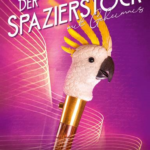
Gadget or System Canes

Photo: Spielzeug Welten Muzeum Basel
Gadget or system canes by inventive spirits are perhaps the most fascinating and most collected canes. These quirky creations feature hidden devices such as a fan, an umbrella, a bottle and drinking glass, a perfume bottle or a sword. Sometimes also scalpels and syringes in canes for doctors. Also, musical instruments, fishing rods, telescopes, sewing kits and corkscrews can be hidden in the head of a cane. More than 1500 patents were applied for during the 18th and 19th centuries. The two essential properties of the gadget cane are something hidden and a combination of several tools or functions.
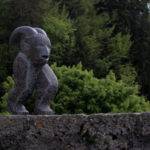
Sculpture garden in Valagin

Gaspard Delachaux (1947). Photo: chateau-de-valangin.ch
The project is based on the creation of a sculpture garden in the park of the Valagin Castle entitled “Jardin Mangelune – Gaspard Delachaux”. The sculptures combine the artist’s works (Stone Animals) in a setting that plays with the walls of the castle and the lush vegetation. This thematic project is a relationship between the imaginary world of monsters and art, architecture and legends.
The Silks of Medieval Spain

Photo:Silk fabric, decoration with stripes, and an Arabic inscription; Granada, 14th century; Abegg Stiftung, inv. nr. 5838.
The exhibition sheds light on the history of medieval Spain by presenting costly textiles from that period. Most of the exhibits are silks dating from the 12th to 15th century that were made by Muslim weavers but preserved in a Christian context. These objects are essential as contemporary sources for the changing balance of power between Christian and Muslim rulers. At the same time, they attest to the fruitful exchange that took place between religions and cultures. Silk-weaving also arrived on the Iberian Peninsula with Arab and Moorish culture in the eighth century. The Muslim weavers were masters of their trade, and they produced the most magnificent fabrics. Their silks were luxury products that attracted the attention far beyond the boundaries of their culture.
Whether as war booty, diplomatic gifts or expensive merchandise, they passed into the hands of the Christian kings and church dignitaries of northern Spain. Many fabrics survived due to the use by the church. These textiles were a defining element of the culture of representation in both Muslim and Christian Spain until well into the Late Middle Ages. The artistic centres of the north, by contrast, including cities such as Burgos and Barcelona, were known primarily for their exquisite embroideries with Christian motifs.

Carl Spitzweg

Carl Spitzweg (1808 - 1885), Der arme Poet (the poor poet), 1838. Oil on canvas, 37.9 x 45 cm. Privat collection. Photo: Kunstmuseum Winterthur
The painter Carl Spitzweg (1808-1885) is a well-known German artist from Munich, almost unknown in other countries. He was an accurate and critical observer of his (Biedermeier) time, which he described with humour and irony. The exhibition features his well-known and lesser-known works. He connects his region (Heimat) and the longing and nostalgia for it, the Idylle and the often harsh reality, tradition and modernity. The exhibition is organised in close collaboration with the Georg Schäfer Museum in Schweinfurt. This museum has the largest collection of the artist. The result is a representative exhibition about the work and life of this painter.
Albert-Edgar Yersin
Albert-Edgar Yersin, «Plissement du parc», 1965 - 1970. Encre et lavis sur papier. Musée cantonal des Beaux-Arts de Lausanne. Acquisition, 2012
Albert-Edgar Yersin (1905-1984) was a master of the art and craft of drawing. The exhibition showcases some of his most powerful creations. From his childhood in America to his final days in Lausanne, Albert-Edgar Yersin was an avid draughtsman, roughing out numerous landscapes, copying paintings by Old Masters, transferring his own sketches to metal plates, experimenting with a range of techniques, and inventing his own highly original style drawing on Surrealism, abstraction and figurative art. He influenced a generation of artists and sparking a new wave of interest in etching and artists’books.
When Wine and Paintings Meet
The museum (in the Château de Boudry) presents a new exhibition with works by Pierre Lavanchy (1912-1964), his oil paintings and watercolours, and by Walter Wehinger (1911-1988) and especially his graphic work and painting. The exhibition also includes many works by Gustave Jeanneret (1847-1927).