Last Major Border Adjustment

Tschlin. Photo: Wikipedia.
Although it is said that the Congress of Vienna (1814-1815) settled the frontiers of Switzerland, Austria and Switzerland stubbornly disputed control of twenty square kilometres in an area around the village Tschlin in Graubünden. The Austrian emperor’s commitment and compromise finally led to the solution in 1868 and the last major border adjustment of Swiss territory. The exhibition tells this fascinating, but forgotten story. With the creation of the border, smuggling also arose. Swiss, Austrians and Italians continued this trade well into the 20th century. The exhibition presents typical contraband goods and smuggling equipment.
The Park in Sent

Photo: www.sent-online.ch
The Park in Sent belongs to the Fundaziun Not Vital with its seat in Ardez. The artist Not Vital (1948) bought the land in 1998. He installed sculptures, built houses and created architectural installations. He united architecture and sculpture by the working group SCARCH. The park is open to the public each Friday from June till the beginning of October. Reservation at the tourist office in Scuol is obligatory. (Further information: https://notvital.com).
Evelyne Axell in Susch
This retrospective exhibition Body Double of the Belgian Pop-Surrealist Evelyne Axell (1935-1972) will present sixty exhibits spanning the broad spectrum of the artist’s entire oeuvre. Body Double brings together a large selection of collages, drawings, relief paintings, sculptures, filmic and photographic works. With her original feminist approach in the 1960s Axell became one of the pioneers of Pop Art in Europe.
Resonances

Romuald Hazoumè (1962, Bénin), Mutti / Mom, 2016. Collection Dragonfly Wood, metal and plastic. Photo credit: Sébastien Crettaz..
The exhibition explores the fundamental theme of human’s place in the universe through a journey in five chapters. With more than 90 works of around 50 artists from all over the world, it follows the previous exhibition Before Time Began that introduced the origins of contemporary Aboriginal art. The show starts with a (dark) night of times immemorial, before the creation of the earth. It starts with Tales of the earth and the skies, then follows with the Power of transformation, the Secrets of Mother Earth and The Origins to the First Being in the fresh daylight. It is all not that different from ancient (European) religions. RESONANCES is to be discovered until April 4th, 2021.
The World of soaps and fragrances
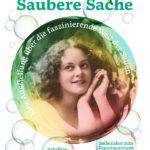
Poster Exhibition. Photo Burghalde Museum Lenzburg
The exhibition in the old soap factory in Lenzburg presents the fascinating world of soaps and fragrances. The industrial posters by Persil, Sunlight, Steinfels & Co. are graphic masterpieces of the last 125 years. High-quality toilet soaps and washing powder were produced in Lenzburg for just over a hundred years. The history of the soap factory founded in 1857 is also discussed. The Icon Museum shows the sacred aspect of purity, in particular the contrast between Russian sacred images and the industrial steel sculptures of James Licini (1937).
Two Centuries Underwear

Poster. Photo: Museum of Valagin
The Museum presents a small part of the textile collections of underwear. The underwear tells a lot about fashion and social changes. The exhibition shows more than fifty pieces of underwear from the last two centuries. A cultural-historical approach to the most worn garment.
Surrealism in Zug
Friedrich Kieslers Figue Anti-Tabou, Exposition Internationale du Surréalisme, 1947, (Ausstellungsgestaltung: Friedrich Kiesler, Photo: Rémy Duval) © 2019 Österreichische Friedrich und Lillian Kiesler-Privatstiftung,Vienna.
To begin its anniversary year, the House of Art Zug (Kunsthaus) shows what was a focus of the collection right from the start: Swiss surrealist and fantastic art. The maverick, idiosyncratic aspects of the surreal and fantastic trends in art are what remain attractive about this collection focus, down to the present day. The exhibition (Fantastisch Surreal. Die Sammlung) addresses the different styles of Surrealism.
“A Surrealist exhibition to outdo all others!” That was the aim of the Surrealist exhibition in Paris in 1947, organised by André Breton, Marcel Duchamp and Frederick Kiesler. The rooms in which the exhibition was held were part and parcel of its artistic concept. Architecture and art became a unity. The exhibition (André Breton, Marcel Duchamp and Frederick Kiesler. Surrealistische Räume 1947) will be recreated in Zug, using some 100 original sketches and photographs. This is the first time it is shown in this concept outside Vienna.
Photography from 1839 to the 1970s

unknown artist, Coney Island, 1950-1960 © Collection by Jacques Herzog und Pierre de Meuron Kabinett, Basel.
Ruth and Peter Herzog have built one of the most important photography collections, which now encompasses no fewer than five hundred thousand artifacts. It is a photographic encyclopedia of life in the industrial age. Ranging from the early days of the medium, which was invented in 1839, to the 1970s, the collection’s holdings span the complete history of analog photography, reflecting its manifold developments and physical materials.
The first comprehensive presentation in Switzerland showcases four hundred objects. The exhibition spotlights key themes of the collection and addresses questions around the photography collectors’ work and the relation between archive and museum. It also probes the interplay between photography and art.
The exhibition is being created in cooperation with the Jacques Herzog und Pierre de Meuron Kabinett, Basel.
Dürrenmatt a sketch artist and Painter

The Self-portrait of Friedrich Dürrenmatt, Collection Centre Dürrenmatt in Neuchâtel. Photo: PD/CDN/Schweizerische Eidgenossenschaft
The writer Friedrich Dürrenmatt (1921-1990) has left behind an extensive oeuvre of visual art. The exhibition (Dürrenmatt als Zeichner und Maler) shows a representative selection of his graphic works and drawings. His guiding principle is always the tension between myth and science. The formative influence of childhood in the village, Greek mythology and the Christian faith, the lifelong involvement in astronomy and the theory of evolution are always present. The paintings and drawings are embedded in the context of their historical, scientific, theological and ethical references. The exhibition has been produced by Spiez Castle (Schloss Spiez) The Centre Dürrenmatt Neuchâtel is the cooperating partner. Further information:
https://www.schloss-spiez.ch/museum-/-ausstellung-/-sammlung/kunstausstellung/duerrenmatt-2020
Switzerland and Greenland

Poster: landesmuseum Zurich
In 1912, Alfred de Quervain (1879-1927) travelled across Greenland. The data collected by the Swiss explorer on the seven-week expedition are still of great value for science today. The exhibition examines de Quervain’s pioneering feat in the eternal ice, and links it with the present. Switzerland still carries out glacier research in Greenland, making a significant contribution to one of the most crucial issues of our time: global warming.