Alphorn Poetry Lyôbâle on the Rhine

The Lyôbâle organisation has set itself the goal of filling the air along the Rhine in Basel with the beautiful sounds of the alphorn for 30 minutes once a year.

To this end, groups of alphorn players line up on both banks of the Rhine, whilst soloists perform on the ferries. This marks the sixth edition of the event.

It originated at a time when, due to the coronavirus pandemic (2020), hardly any cultural events were permitted. The message is that these sounds flow along the Rhine to other destinations.

This globally unique open-air concert is also a gathering of musicians from far and wide. They come from the Stuttgart area, the Lake Geneva region, France, Ticino, and, of course, north-western Switzerland.

With their impressive sound, produced by over 100 alphorns, they set hearts racing. The repertoire includes compositions written especially for the Lyôbâle event.

(Source and further information: Lyôbâle)

The Monasteries of Basel

Almost 500 years ago, between 1525 and 1529, the ten monasteries in Basel ceased to exist. The city became the new owner. The bishop, too, left the town and went to Porrentruy. The Reformation reached Basel, marking the end of 450 years of history.

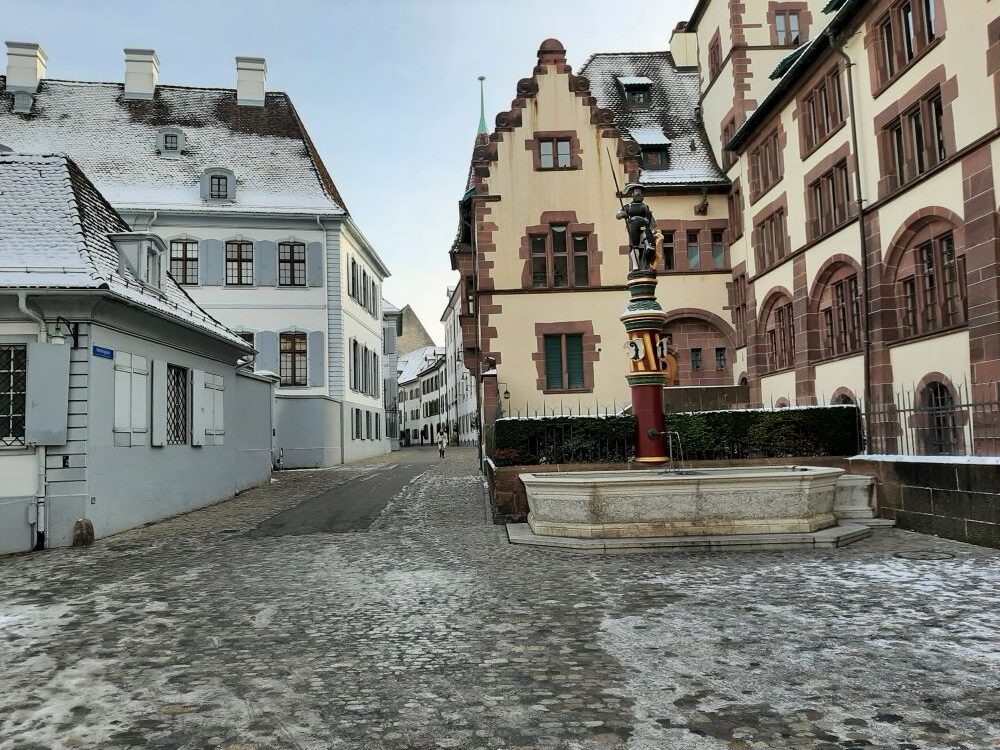
The first monastery, St. Alban, was founded in 1083. The second monastery, St. Leonhard, was consecrated around 1133.

The St. Alban Monastery, unknown artist, 19th century. Photo: Wikipedia

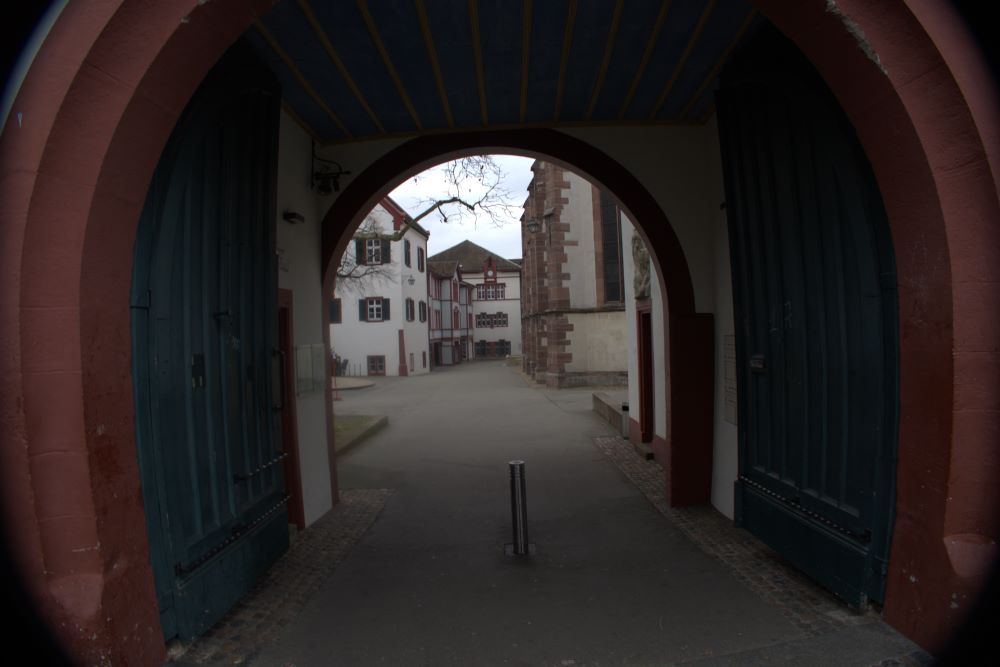
Today’s complex of the St. Alban’s monastery

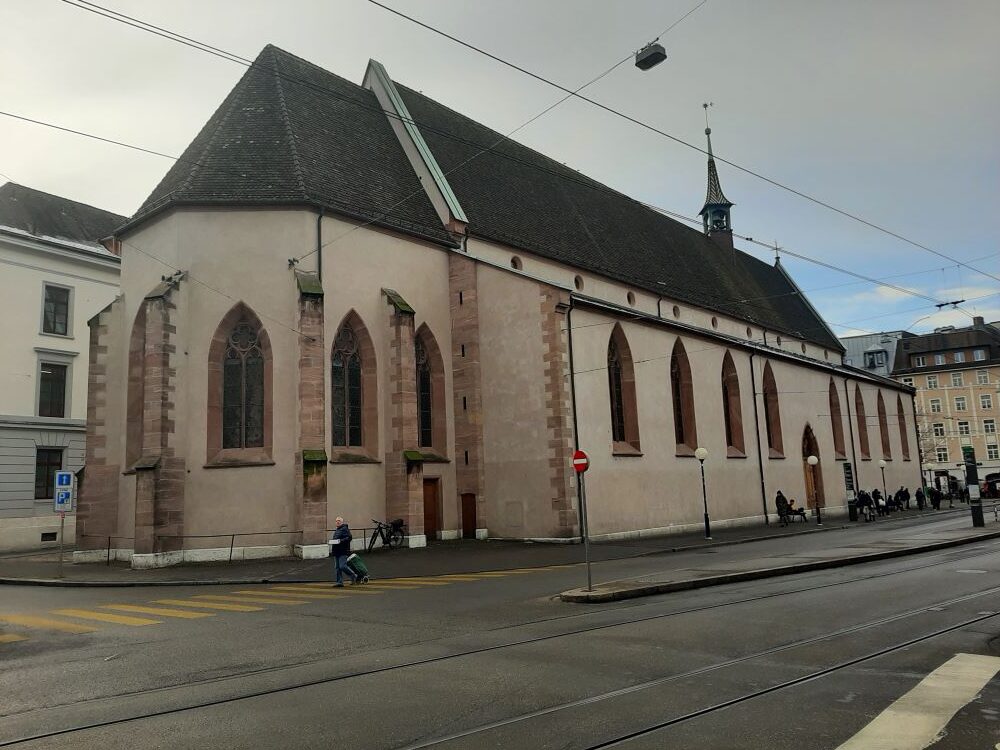
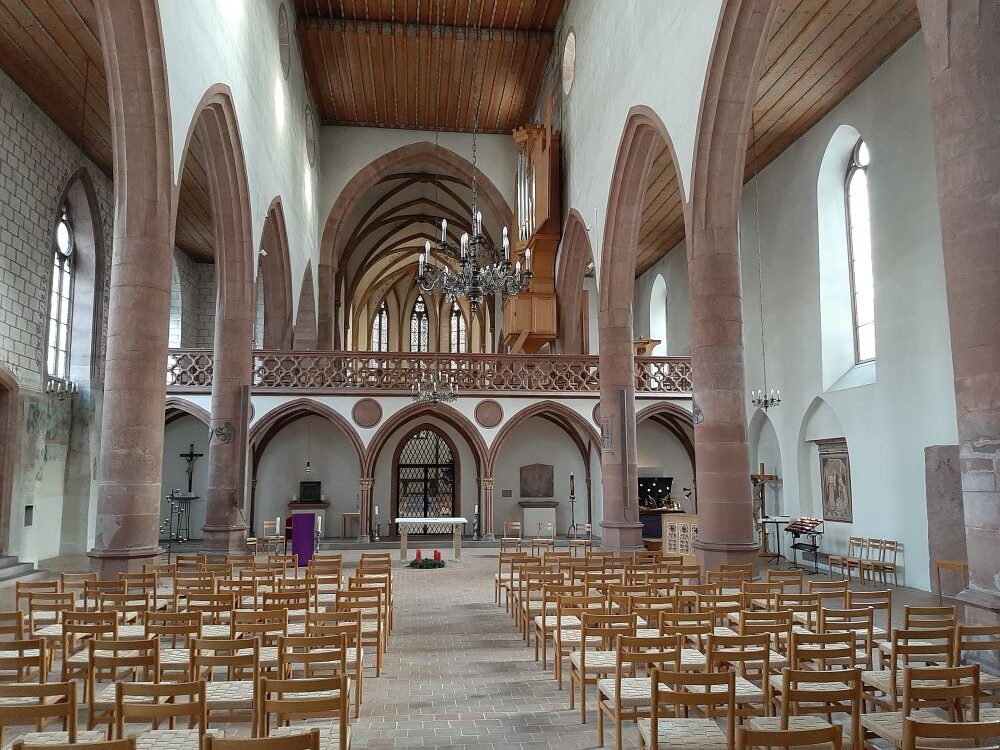
The Leonhardskirche and the Museum of Music

The number of monasteries increased in the thirteenth century due to the rise of the new mendicant orders. Between 1231 and 1279, Dominicans (also known as Preachers because preaching was their primary occupation) founded Franciscan and Augustinian monasteries, all of which had both male and female convents. The last monastery, the Carthusian order, was established in 1401.

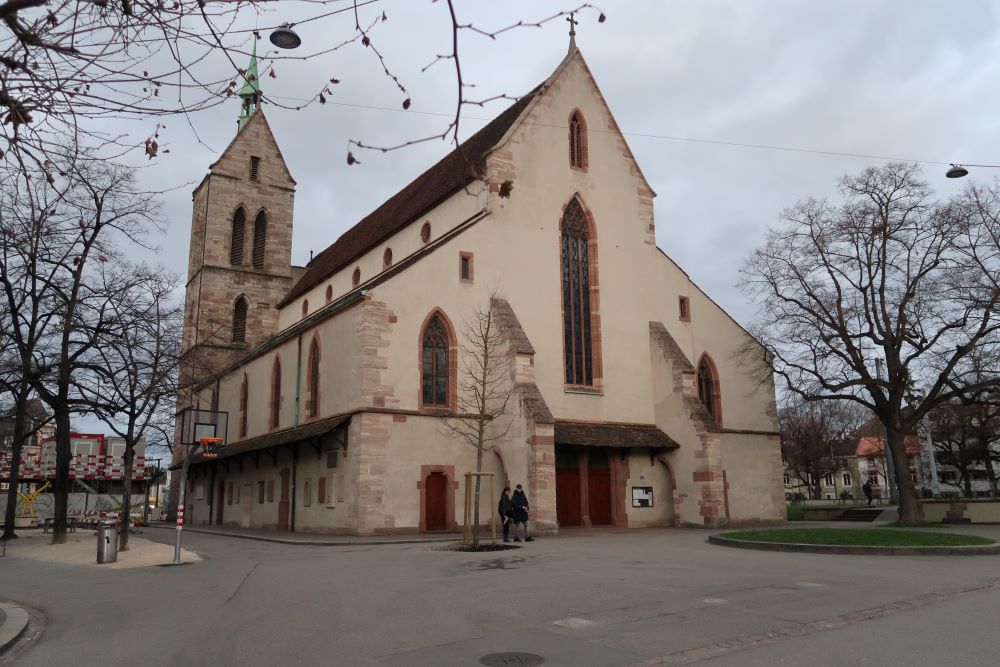
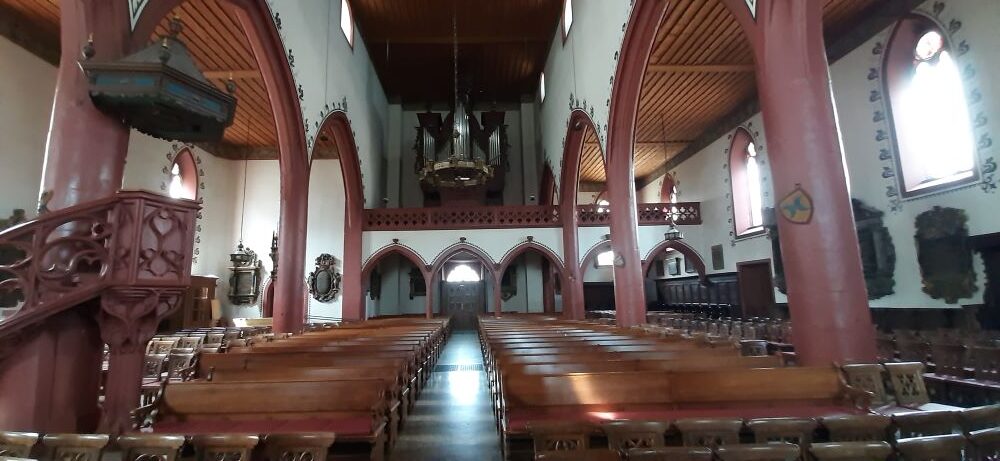
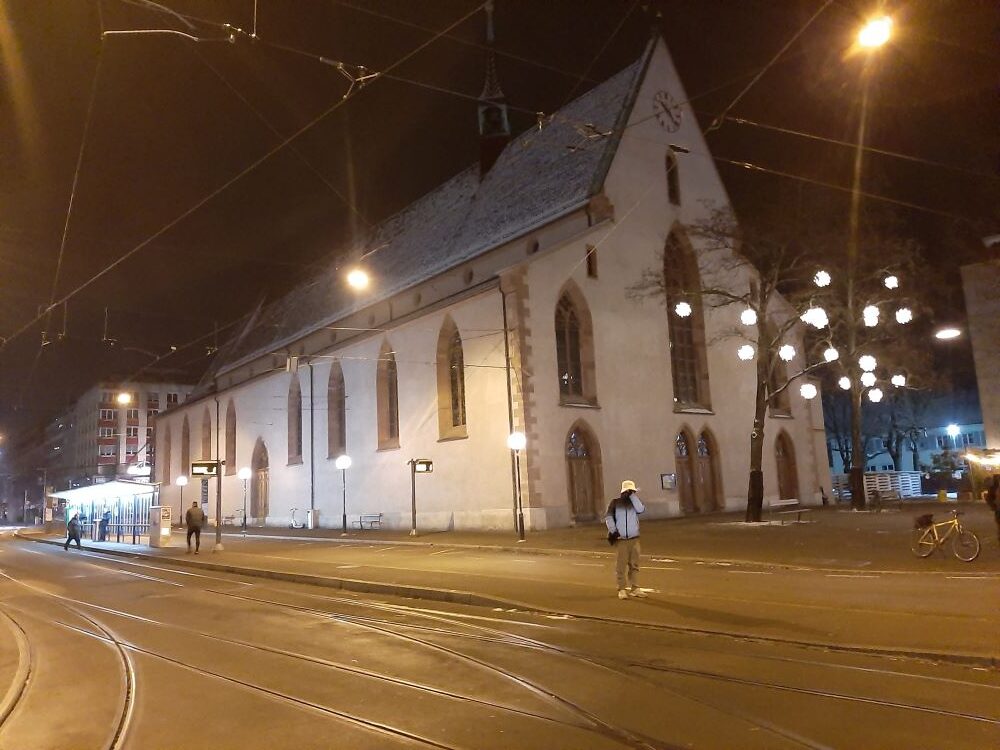
The Predigerkirche

The mendicant orders had three male monasteries (Barfüsser or Barfoot (Franciscans), Prediger (preacher) and Augustiner) and four female monasteries (Gnadental, St. Clara, Steinen Monastery and Klingental).

The complex of the Carthusians and the St. Theodorkirche

The complex of the Carthusians is the best preserved; other monasteries have been completely lost, including the Steinen Monastery (on the site of the Tinguely wells). Only the walls of the Gnadental and Augustiner monasteries have survived the fate of history.

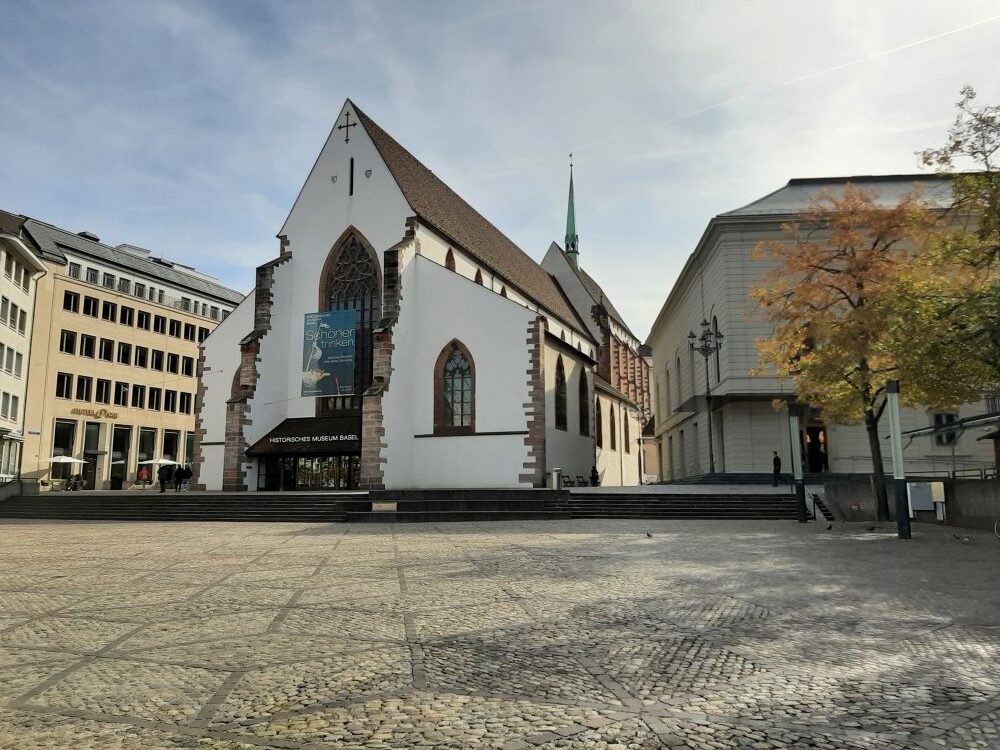
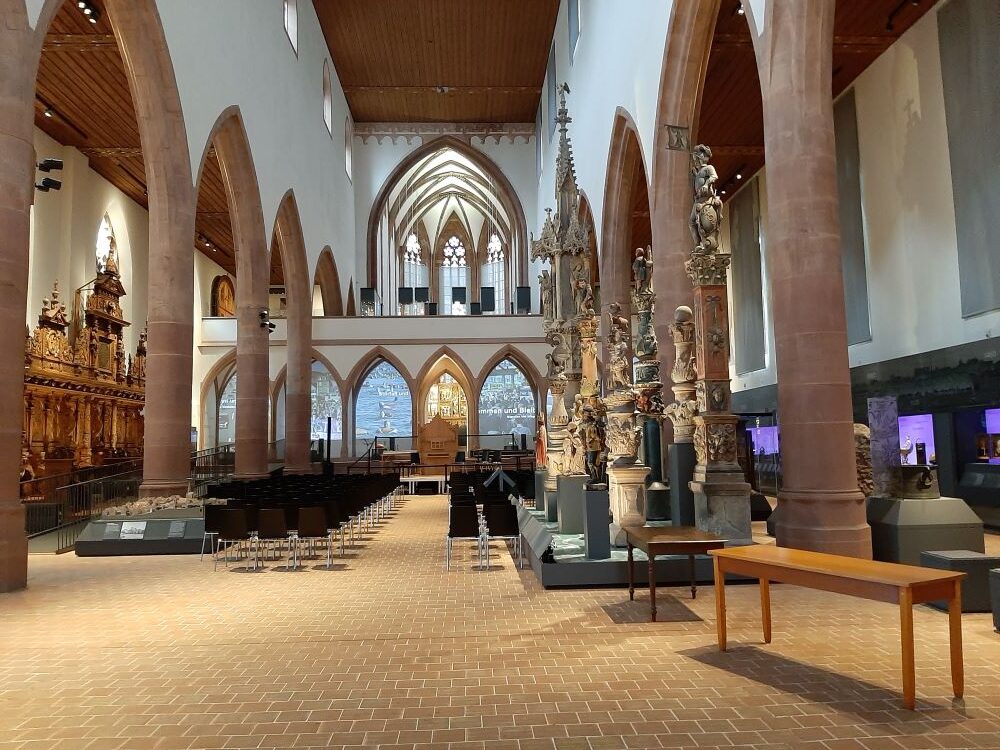
The Barfüsserkirche

The Martinskirche and the Martinsplatz

The Peterskirche

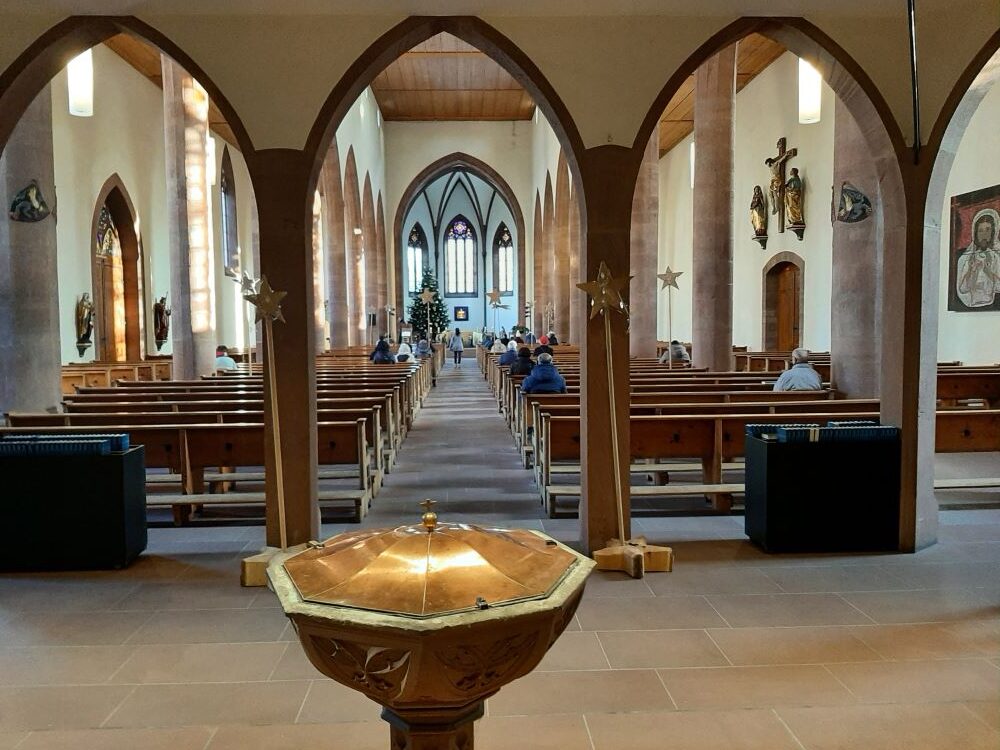
The Clarakirche

The Preacher’s Church (Predigerkirche), consecrated in 1269, has undergone thorough renovation with an eye for detail, preserving the medieval original. This includes a reconstruction of the Dance of Death (Totentanz) on the cemetery’s walls, which was destroyed in 1805.

The Barfüsserkerk is Basel’s historical museum. St. Clare is the monastery church of the Clarisses, the female Franciscans, and it is still in use.

The monastic life of Basel depended on the bishop’s presence. He was the head of the diocese, the prince of the Holy Roman Empire, and the most important secular lord of the town until the 15th century.

The Reformation changed monastic life forever.

(Source: F. Ackermann, Th. Wollmann, Klöster in Basel, Basel 2009).

Webergasse, wallpainting. 

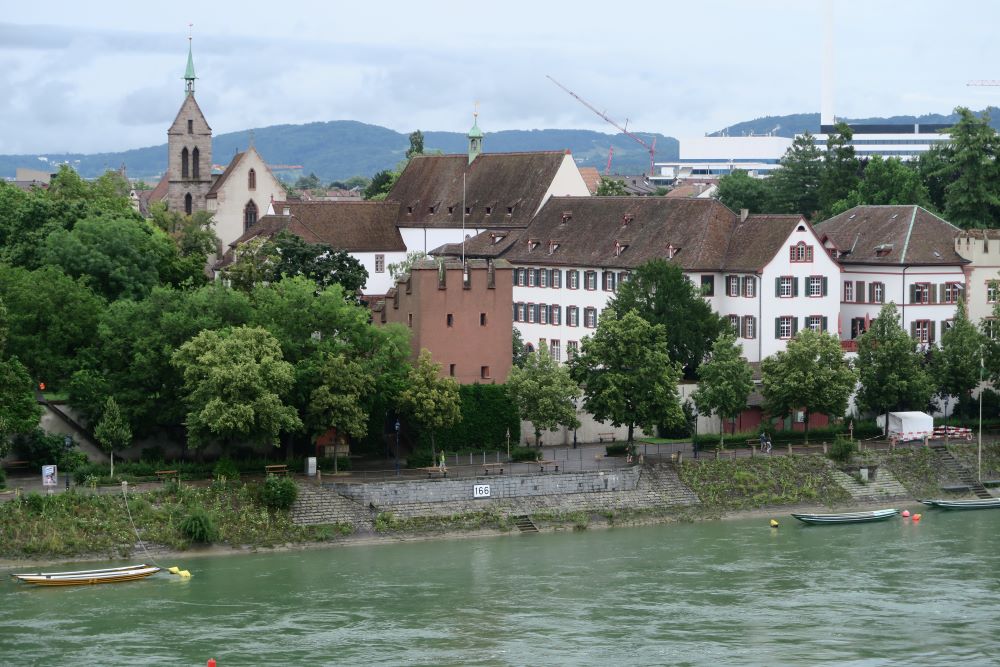
The former monastery in Klein-Basel

Swiss-, French- and German history, Montbéliard, Belfort and the Burgundian Gate

Few French, Germans, or Swiss today know where Mömpelgard is located. This is hardly surprising, since its French name today is Montbéliard (Franche‑Comté).

This town has held city rights since 1283 and enjoyed imperial immediacy (Reichsunmittelbarkeit). It is situated not only on the Franco‑German linguistic border, but also at the Burgundian Gate (Burgundische Pforte/Porte de Bourgogne) on the Doubs River.

From the Middle Ages until the French Revolution, it was also an independent county in personal union with the Duchy of Württemberg, almost without interruption. Today, the town has around 27,000 inhabitants and lies in a French‑speaking area. However, German cultural and linguistic influences are unmistakable.

Mons Beligardis, Montbéliard, or Mömpelgard

The name comes from Mons Beligardis, which became Montbéliard in French. In German, it became Mümpelgard and later Mömpelgard. The French‑speaking County of Montbéliard belonged to the Kingdom of Burgundy (888–1032) until 1032. Afterwards, until 1793, it was part of the Holy Roman Empire. The county and town always kept close contact with the French‑ and German‑speaking cultures of Lorraine, the Sundgau, Burgundy, and Switzerland.

This can be explained in particular by the nearly four‑hundred‑year link with the Duchy of Württemberg (1397–1793), as well as by Habsburg possession of the German‑speaking Sundgau (until 1648) and of Alsace (until 1681). Thus, Montbéliard—continuing to use this name—was, like Mulhouse/Mühlhausen (which was allied with the Swiss Confederation until 1792), one of the last independent strongholds during the reign of the French Sun King Louis XIV (1638–1715).

Louis XIV annexed Franche‑Comté (a Spanish Habsburg possession) and the Sundgau (an Austrian possession) in 1648 (Peace of Westphalia). Later, in 1681, he annexed Alsace. Only Montbéliard and Mulhouse were not (yet) annexed.

Montbéliard and the Duke of Württemberg

The male line of the Counts of Montbéliard died out in 1407. The daughter of the last count had already married the Duke of Württemberg in 1397. This dynasty had its administrative centre in Stuttgart in Swabia, but owned numerous other possessions (lands, villages, and small towns) on the left bank of the Rhine, including Héricourt, Blamont, Clémont, Franquemont, and Châtelot, and constituted an important power in the Upper Rhine region and within the Holy Roman Empire.

For Montbéliard, however, this meant integration into the Swabian sphere of influence. This possession was not a peaceful one for the duke: the Bishop of Basel, until 1477 the Duke of Burgundy, and later the King of France, the Habsburgs, and local lords (such as the Counts of Ferrette/Pfirt) coveted the town and its territories. The Swiss Confederation also expressed interest in an alliance as an associated state.

Musée d’Art et d’histoire Hôtel Beurnier-Rossel

After 1477, the Württemberg policy and its possessions in this region were shaped by the Franco‑Habsburg conflict. Through political and diplomatic skill, Württemberg kept both powers away from Montbéliard. The town didn’t want to surrender or fall into the Welsches’ hands, but was determined to remain with the German nation—even at the cost of perishing.

Legal status further shaped these relationships. From the sixteenth century onward, Montbéliard and Württemberg formed a personal union, though Montbéliard was not represented in the Württemberg parliament in Stuttgart. Montbéliard remained a principality. The duke resided only rarely in Montbéliard, preferring Stuttgart; distant relatives administered the county.

Still, a strong cultural, language, and—after about 1524—religious link grew between French-speaking Montbéliard and German-speaking Württemberg. The duke became Lutheran in 1534, after bringing the faith to Montbéliard. The town was even the first Reformed state in what is now France. Guillaume Farel (1489-1565), known in French-speaking Switzerland, was the leading figure of the Reformation in Montbéliard.


The castle and the Museum du château et des ducs de Wurtemberg

The small principality became a refuge for Huguenots and, at the same time, a field of religious conflict between Lutherans and Calvinists, with the Lutherans ultimately prevailing. For the Catholic kings of France, Montbéliard was a Protestant thorn in their side, but they never succeeded in conquering the town.

German culture exerted an increasing influence on originally French‑speaking Montbéliard, not only from Württemberg and Swabia, but also from the Sundgau, Alsace, and the Swiss Confederation. Court life, administration, and German‑speaking pastors, merchants, architects, and craftsmen profoundly shaped local culture. The most famous example is undoubtedly the architect Heinrich Schickhardt (1558-1635).

His buildings—especially the castle, St. Martin’s Church, urban planning, mills, bridges, and the Collegium—still shape the townscape today. At the same time, Montbéliard’s French‑speaking culture influenced court life in Württemberg.

Montbéliard was, in the literal sense, a Franco‑German society. A diplomat expressed it this way in 1681: “For the first time I saw the German customs with astonishment.” Indeed, German clothing, architecture, furniture, language, and culture were omnipresent.

Martins Church

Besides serving as a border town, the Burgundian Gate south of Montbéliard is a key divide between the French-speaking Rhône River area and the mostly German-speaking Rhine. The strong fortress of Belfort, built in the eleventh century by the Count of Montbéliard and rebuilt in the seventeenth century by Sébastien Le Prestre, Lord of  Vauban (1633-1707), was the main defence.

The Lion of Belfort

The landscape changed dramatically with the French annexation of 10 October 1793, which ended the County of Montbéliard and its personal union with Württemberg. Afterwards, the former county belonged sequentially to the Rauracian Republic (1793), the Department of Mont‑Terrible (1793–1800), the Department of Haut‑Rhin (1800–1815), and finally the Department of Doubs in the Bourgogne‑Franche‑Comté region.

Département Mont-Terrible (1793-1800). Image: Wikipedia

Porrentruy, Delémont, and the Ajoie

Shifting the focus to the region’s broader connections, in 1162, the Count of Montfaucon acquired the County of Montbéliard. He obtained not only extensive territories in the Pays de Vaud and the Ajoie, but also the town of Pruntrut (Porrentruy) as a fief from the Bishop of Basel.

Centuries later, under French rule from 1793 to 1813, Porrentruy and Delémont became the capitals of the two districts of the successive departments of Mont‑Terrible and Haut‑Rhin. Only in 1815, at the Congress of Vienna (1814–1815), was the (Swiss) link with Montbéliard (and Mulhouse) definitively broken.

Peugeot and Montbéliard

Conclusion

This brief history of Montbéliard illustrates not only the intense and centuries‑long relations among Switzerland, France, and Germany, marked by reciprocal influences and exchanges, but also their abrupt rupture from the nineteenth century onward and the emergence of nation‑states.

However, this historical entanglement does not justify merging into a European political, bureaucratic, and legal model incompatible with the Swiss model, which has been tried and tested for centuries—a model that is not outdated but, on the contrary, holds promise for the future.

Impressions from the castle

Impressions from the Vauban Fort and the city of Belfort


Josephine Baker and Belfort

The Säckingen Abbey, Glarus and Fridolin

The abbey in Säckingen (Baden-Württemberg) was founded in the 8th century. The monastery played a crucial role in securing the connection across Lake Walen (Walersee) and the mountain passes from Graubünden to Italy. Glarus bought itself free from the abbey in 1395.

The abbey had its heyday from the 10th to the 12th century. The Fricktal (today’s canton of Aargau) and Glarus were the most important possessions. Glarus joined the Eidgenossenschaft in 1352 and freed itself from Habsburg rule at the Battle of Näfels (1388).

Glarus and St. Fridolin remind us of the long association with the monastery.

The abbey church, named Fridolin Minster, is a Gothic building constructed between 1343 and 1360 on the foundations of Ottoman and Romanesque predecessors. The Baroque and Rococo restorations began in 1678 and 1753 and define the present image of the church. The coat of arms of the canton of Glarus still shows Fridolin as the patron.

(Source: www.sueddeutscher-barock.ch).

The Basel Carnival is also a Serious Affair

The Basel Carnival (Fasnacht, from Monday, 23 February, 4:00 a.m., until 26 February, 4:00 a.m.)—apart from the three following “Bummelsonntage”  (Bummel Sundays)—has once again come to an end.

After the events of the Vorfasnacht (pre-carnival) season and the Carnival Mass (Fasnachtsmesse) in the Elisabethen Church, the annual call “vorwärts, marsch” (forward, march) sounded punctually at four o’clock near St. Martin’s Church, and thousands of participants began their procession through the city.

Monday, 23 February, 3.59 AM

Monday, 23 February, 4.01 AM

Direct Democracy, Subsidiarity and Federalism

Every year the same ritual, and yet each time a different (emotional) experience. Not only do musicality, creativity, discipline, organisation, and the fairytale-like setting characterise this event, but so do the performers. Direct democracy, subsidiarity, and the decentralised federal system are also expressed here.
The citizens of the city share their concerns about local, national, and international developments, publicly express their opinions and feelings to decision-makers, politicians, and other authorities, and address their decisions or shortcomings—not only in the streets, but also in the Schnitzelbänke.
A Serious Affair and Swissness

The carnival is therefore also a serious affair. Apart from the long and intensive (musical and creative) preparation of the participants—whether organised in cliques or not—and the financial costs involved, the choice of a “subject” (Sujet) is discussed and ultimately put to a vote.

This is followed by the selection of costume, lantern (Laterne), and mask (Larve). Not all participants are organised in cliques or follow this procedure. Many take part in small groups or even alone, without a subject or a lantern.
All, however, share musicality, creativity, discipline, organisation, and respect for one another and for their surroundings. Two examples: at such a large festival, emergency services sometimes have to navigate in the crowds late into the night.
Spectators and carnival participants make room and do not obstruct the medical personnel. When a large clique with 100 or more members encounters a small group of just a few musicians, the smaller group is nevertheless given the right of way. There are never any arguments, not even in the narrowest alleys or in the greatest congestion.
Spectators also behave (so far) respectfully and exemplarily—despite the enormous crowds and the consumption of alcohol, which, however, offers no guarantee for the future.
Conclusion

Be that as it may, the quality and the serious undertone of the carnival perhaps come across best in the open-air museum of the lantern on the Münsterplatz and in the written explanations distributed by the cliques to explain the choice of their subject.

Where else can one find, at such an event, extensive discussions of democracy, society, neutrality, war and peace with references to philosophers, Nobel Prize winners, and other thinkers? Friedrich Nietzsche, Leo Tolstoy, Albert Einstein, or “Tic Tac instead of TikTok,” for example, were again integral parts of the carnival this year.

The Basel Carnival is indeed a unique event in the canton of Basel-Stadt, yet it also expresses Swissness. May Helvetia and Frau Fasnacht continue to protect this country and its unique democracy, system of government, cosmopolitan society, and quality of life, also for its own decisions.

Impressions from the Fasnacht 2026


Und der Besenwagen


The End 

Nature and Trees in Basel

In the Middle Ages, the forest was a place of danger and mystery. Nobody went for a walk for pleasure. Today, on the other hand, the forest is a refuge for rest, fresh air and the experience of pure nature.

The quality of life in the city is closely related to its size, particularly in terms of its proximity to nature and recreational areas. Residential areas are preferably located within a reasonable distance of green zones.

Bern. Photo: TES

The meaning of the tree

The exhibition showcases the history of trees and greenery spanning a thousand years in Basel. In the various phases of urban development, the tree has served multiple functions, such as decorative, city planning, private gardening, botanical purposes, or religious, political, or administrative significance. For example, court proceedings were held under the lime tree, the liberty trees of the French Revolution, or Christmas trees.

The philosophy of the Stadtgärtnerei Basel, summer 2021. Photo TES

The exhibition “Bäume in Basel: Das Grün im urbanen Wandel” (Trees in Basel: Greenery and Urban Change) presents the historical development of nature and flora in the city, from its past to the present, and even looks to the future.

The relationship between wood, trees, and the city is omnipresent in the Kleines Klingental museum. The cathedral’s Romanesque wheel of fortune (das Glücksrad) is made of oak from 1220.

The (ancient) university and its botanical garden. Photo: TES.

The botanical era

At the beginning of the modern era (around 1500), the intellectual and cultural developments changed the city. Scholars and entrepreneurs with international connections promoted the transformation of Basel into a cosmopolitan city.

Even then, botany was closely linked to pharmacology, medicine and horticulture. The founding of the University of Basel in 1460 strengthened the scientific interest. This period laid the foundation for the city’s current chemical and pharmaceutical industry.

The art of printing and the outstanding quality of the paper produced by the many paper mills (see also: www.papiermuseum.ch), the many (famous) publishers and the humanist, relatively tolerant city made Basel one of the leading university cities in Europe.

Renaissance

The city grew significantly in the sixteenth and seventeenth centuries. Citizens created Italian Renaissance gardens, and they built the first country houses and summer residences. During this period, the tree also emerged as a key element in urban development.

Baroque and Rococo

From the mid-18th century, the Baroque estates (e.g., Villa Merian and Wenkenhof) outside the city mark the heyday of Basel’s architectural culture. They express a new style of architecture, nature and gardens in Baroque, Rococo and English landscape styles.

Romanticism

Inspired by the Enlightenment and the French Revolution, a new relationship between the city and nature emerged towards the end of the 18th and 19th centuries.

The residential and garden culture in the late 18th and 19th centuries is characterised by the import of exotic trees and the construction of galleries. 
It is a mixture of Baroque, Rococo, the English Garden, Romanticism and Chinese and Japanese influences in stately private gardens. At the same time, hygiene problems in the ever-faster-growing city led to the creation of green areas.

The garden city

Around 1900, the city’s growth and other ideas stimulated a rethinking of urban planning. The garden city concept was first applied in 1912 in Münchenstein, near Basel. It was Switzerland’s first garden city.

Basel, Rhine Promenade. Photo: TES

The Green City

Cemeteries, old monasteries, and their gardens within the city ring, along with the demolition of ancient city walls, made room for the first urban green areas. Trees were planted along the river and streets, and the Rhine bank even became a leafy promenade, which it remains today.

The last decades of the 20th century and the first decades of the 21st century are characterised by redevelopment and the changed use or refurbishment of undeveloped areas and old factory sites.

The modern city

Nowadays, parks and green spaces are often enriched with works of art and recreational structures. This development reflects an increased environmental awareness in urban areas. The municipal department maintains no fewer than 27,000 trees carefully.

The motto: a healthy tree means a healthy city.

(Source and further information: www.mkk.ch).

The Münsterplatz

The St. Paul Church, St. Antonius Church and Badische Bahnhof in Basel

Basel’s population increased from 30,000 in 1850 to over 100,000 in 1900. The city expanded and planned neighbourhoods for various target groups: rental houses for workers, houses with business space for the middle class, and exclusive residential homes for the wealthy.

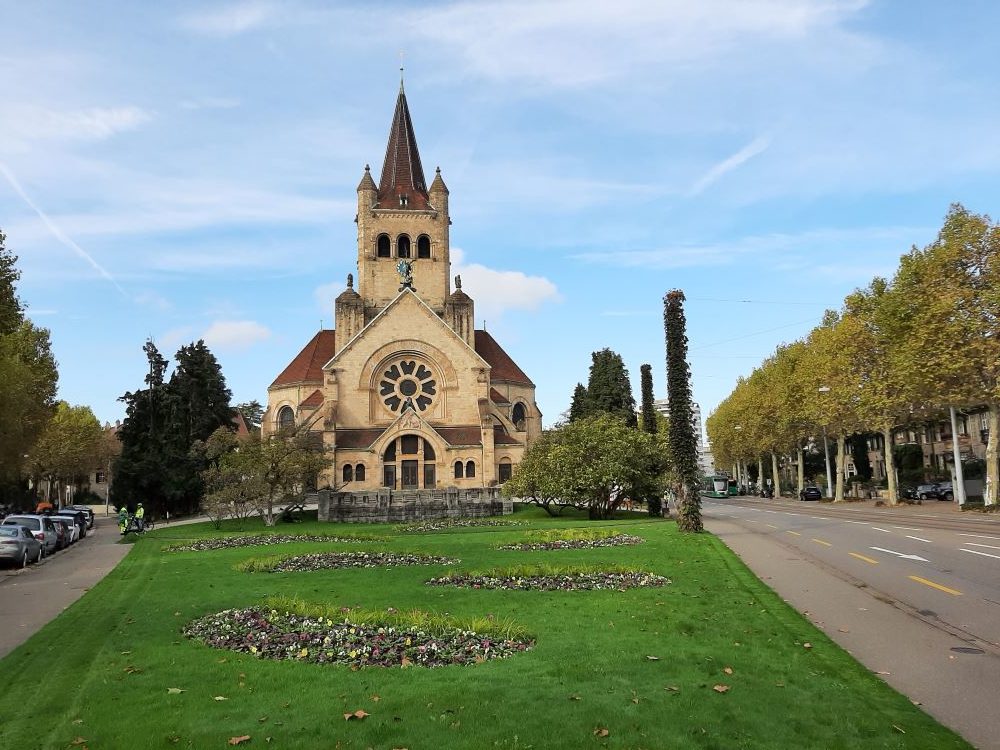
The area around Saint Paul’s Church was reserved for the bourgeoisie, characterised by large houses and extensive gardens. This new neighbourhood was also to have an evangelical-reformist centre, the Paulus Church.

The architects Karl Moser (1860-1936) and Robert Curiel (1859-1925) were commissioned. Several local artists provided stained-glass windows, sculptures, decorations, and other reliefs. Moser is also the architect of the Badische Bahnhof in Kleinbasel, the German railway station on Swiss territory.

The church was completed in 1901. The first remarkable feature is the religious sculpture of persons in this Protestant church. The Romanesque and Gothic styles, decoration, and architecture are also exceptional. These are typically Catholic.

The sizeable Gothic window also evokes a Catholic church. The Art Nouveau figures and motifs are fitting for the spirit of the time and are worth mentioning in a religious building. The portal, too, evokes a Romanesque or Gothic monastery.

The result, however, was a distinct style in the proper proportions. The style was so popular that several houses in the immediate vicinity adopted the church’s type. Twenty-five years later, a similar development occurred in Dornach near the Goetheanum, on a much larger scale and in the Art Deco style.

Since 2019, St Paul’s Church has no longer had a religious function. Since 2021, it has been a cultural centre, featuring musical performances due to its excellent acoustics and remarkable architecture.

It was exceptional in the 20th century for a religious building to set the tone for the architecture and style of the surrounding residential area. Although it may not have been enough to engage believers, religiously inspired chanting can often be heard there.

Karl Moser, The Antoniuskirche, 1927.  The first Swiss church in concrete. The windows were made by Hans Stocker (1896-1983) and Otto Staiger (1894-1967), and the sculpture was made by Max Uehlinger (1894-1981).

Karl Moser,  and something completely different, or not? Badischer Bahnhof Basel, 1913, and Carl Burckhardt (1878-1923), the ‘Brunnengruppe Rhein und Wiese’, 1921.

Source and further information: Kulturkirche Paulus

A Small Window and the History of Rheinfelden

In the spring of 1802, the last Austrian garrison commander left Rheinfelden. This marked the end of more than 450 years of Habsburg-Austrian rule. Although the Swiss Confederates had already conquered Aargau and Habsburg Castle from the Habsburgs in 1415, the Fricktal remained under Habsburg control until it was assigned to the newly created Canton of Aargau by the Act of Mediation of 1803.

This Act of Mediation was drawn up by Napoleon together with the old cantons after the French occupation of 1798 had led to the abolition of the Old Swiss Confederacy and the establishment of the Helvetic Republic (1798–1803). From 1803 onward, there were two Rheinfeldens: one in the Canton of Aargau on the left bank of the Rhine, and a German Rheinfelden on the right bank.

 The first Capuchin monastery was built and consecrated outside the city in 1598 and rebuilt within the city in 1657. The monastery was dissolved by the canton of Aargau in 1804.

Despite the withdrawal of the last Austrian soldiers in 1802, the Austrian coat of arms can still be seen prominently in many places in Rheinfelden (and also in other locations within the Swiss Confederation) to this day. This is also the case on the façade of the Commandant’s House (Commandantenhaus), the former residence of the garrison commander.

Gustav Kalenbach-Schröter (1821–1901). On the right is the commander’s house, on the left is the Capuchin church. Collection: Fricktaler Museum, Rheinfelden

The Commandantenhaus

The earliest foundations of the Commandant’s House date back to the first half of the 13th century. At that time, the site was part of an expansion of the town and was developed with stone houses for the nobility and the wealthy bourgeoisie. In 1613, the Commandant’s House underwent extensive renovation; magnificent late-Renaissance frescoes and painted ceiling beams from this period have been preserved.

The ceiling on the ground floor

These were uncovered and documented again during a 2003 renovation. Specialists also demonstrated that the house was originally significantly larger and was divided into two buildings in the 19th century.

One of the most remarkable discoveries, however, was a 13th-century Romanesque window. This window was found during the renovation of a pillar in the Commandant’s House. The pillar had originally been part of the wall of a 13th-century house that was later demolished—possibly as a result of destruction during the 1634 siege. Only the pillar with the window remained and was incorporated as a load-bearing wall of the Commandant’s House.

The garrison bakery (Garnizonsbackhaus) on the same street was built in 1732.

The window is the best-preserved Romanesque arched window in the Canton of Aargau. It features lilies and two columns of mythical creatures. Particularly interesting is the Gothic pointed arch that later replaced the original Romanesque round arch—possibly after the earthquake of 1356. In a later phase, the window was narrowed to a slot window. All three architectural styles have been preserved, however, and since the restoration in 2003, they have been presented together.

At first glance, a window in such a supporting pillar appears unusual, but this can be explained by the fact that it was originally installed in the wall of a house that was later demolished. The magnificent frescoes and ceiling paintings have been left in their original condition in part and restored in part.

There are probably more murals, including on the outside of the Commandantenhaus, i.e. on a wall of the house that no longer exists. However, these remain hidden for the time being under various layers of paint and lime.

The Commandantenhaus today

The location of the Commandant’s House is also of interest for another reason. Until 1657, the house stood on Neugasse, also known as Neustadt, an extension of the town of Rheinfelden. From 1657 onward, however, the street was renamed Kapuzinergasse, after the construction of the Capuchin monastery and monastery church. The former monastery outside Rheinfelden was destroyed during the Swedish siege of 1634 during the Thirty Years’ War (1618-1648) and was rebuilt within the town.

Today, the Commandant’s House largely retains the appearance of its 17th-century façade (apart from its later division into two houses). The interior is now used as an atelier and a modern residential space.

(Source and further information: H. Leuzinger (Ed.), Zeuge der Frühzeit von Rheinfelden und repräsentativer Bau der Spätrenaissance, Rheinfelden 2008)

A Digital Museum of Basler Laternen

The Basler Fasnacht is over again. It is interesting for historians, however, to gain insight into the (international) politics and (regional and national) themes of the moment 100 years later.

The lanterns and subjects (and the Schnitzelbängg) give an impression of what occupies people; they mirror the spirit of the times and society.

Impressions of Sujets of Fasnacht 2026