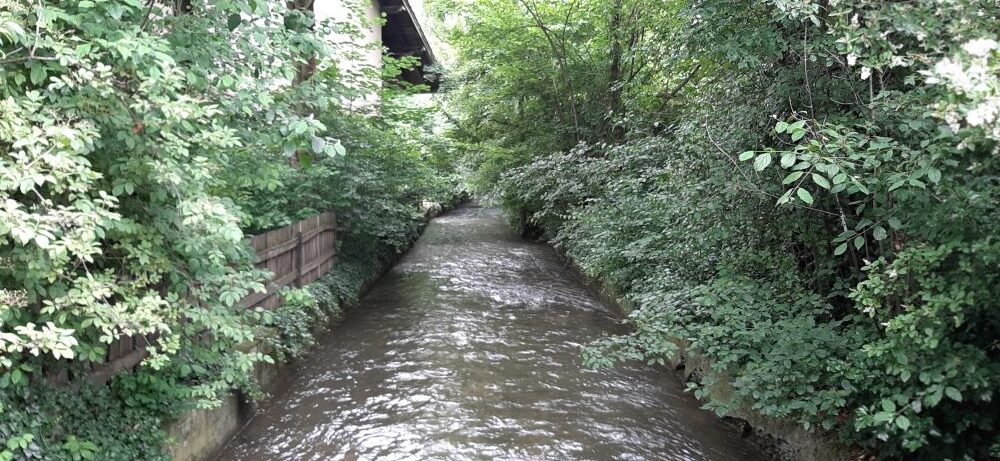
The Seebodenalp near Küssnacht am Rigi (canton of Schwyz) is a new hiking trail.
The glacier path is based on the last Ice Age (25,000 – 10,000 B.C.). The Rigi was surrounded by the Reuss Glacier 24,000 years ago. The glacier transported large quantities of rock material from the mountains.
(Source and further information: www.seebodenalp.ch).
The village of Wassen, situated at the foot of the Gotthard Pass, was quiet in the nineteenth century. The construction of the Gotthard railway (1882) changed life forever.
The Antonini quarry in Wassen changed the landscape. The jobs also attracted many workers, mainly from Italy. There were other granite quarries in Göschenen, Gurtnellen and other communes in the Urner Oberland.
The Antonini quarry in Wassen is a unique witness to the heyday of the quarries in the canton of Uri. The Antonini quarry is the only remaining quarry. The others have been recaptured by nature.
The stone from Uri was also used in Basel (Mittlere Rheinbrücke), Lucerne (Gotthard-Bahngebäude), Bern (Federal Palace, Bundeshaus) and many other locations.
(Source: www.wassen.ch).
The Swiss chocolate producers presented a carillon on the occasion of the first National Day of Swiss Chocolate, September 12, 2001.
The carillon (Glockenspiel of Sisikon) is the largest in Switzerland and consists of 37 bells with the tones e1-e4 and a bronze weight of about 6,000 kg.
Both chocolate and chimes represent innovation and staying current, as well as tradition, enjoyment, high-quality compositions, and a high level of craftsmanship.
Different melodies are pre-programmed and can be played by anyone.
(Source and further information: www.chocosuisse.ch).
The volumes in the Die Kunstdenkmäler der Schweiz, KdS (Swiss Monuments of Art) present the history of Swiss art and architecture since 1927. They are being published by the Gesellschaft für Schweizerische Kunstgeschichte, GSK (Swiss Society for Art History).
They are available online: www.ekds.ch. Digitisation will be completed by 2027, the 100th anniversary of the series.
The GSK takes another step into the new age after the interactive e-books, the 3D-project 360° Swiss Heritage, and the apps Swiss Art To Go and Europe Art To Go
(Further information: www.gsk.ch).
More than 2,000 years ago, the Celts (the tribe of the Rauraci) built the first fortification of Basilia, known as the murus gallicus.
Around 80 B.C., the Celtic population sought shelter behind fortified buildings, likely due to the arrival of Germanic tribes. Along the Rhine, fortified centres were built at strategic points, such as on the Münsterhügel.
A rampart surrounded the settlement, where trade, crafts, and rule were concentrated. Although the settlement was small by the standards of the time, protection was more important than direct access to water and traffic routes.
A Murus Gallicus, a Celtic rampart, consisted of an earthen wall reinforced on the inside by a framework of wooden beams. A dry stone wall rose in front.
The Murus Gallicus was about 6 m high and 12 m thick; the moat in front of it at a distance of 6 m was 30 m wide and 8 m deep. The inhabitants crossed the moat over a wooden bridge at today’s Rittergasse.
With the conquest of Gaul (52 B.C.) by Julius Caesar, the defeat of the Celts, including the Rauraci, in 58 B.C. at Bibracte (near Autun, France) and the foundation of Augusta Raurica (Augst) in 44 B.C., Basilia came under Roman control.
The Celtic Wall was demolished in Roman times. Over the last 2,000 years, the inhabitants dumped two-metre-thick layers of building rubble and other waste on the ruins. The moat, however, remained open until the Middle Ages, when it was also filled with debris and partially overbuilt.
The site is now a small archaeological park. The windows show the remains of the Celtic wall.
Further information: Historical Museum on Barfüsserplatz, Museum of Antiquities and the Ludwig Collection (Antikenmuseum und Sammlung Ludwig).
Switzerland and its rivers, roads and mountain passes have always been at the crossroads of European trade, ideas, culture and communication. Several Celtic tribes inhabited this area long before the Roman invasion (c. 15-13 B.C.).
These tribes were ruled by aristocracies and kings who derived their prestige from warfare and a clientage system. The Romans referred to settlements located on hills as oppida (plural of oppidum). An example is the reconstruction of the oppidum Mont Vully on the shore of Lake Morat (Vaud).
Le Mont-Vully, La Tène near Neuchâtel, Hallstatt in Austria, Bibracte near Autun in France, and Heuneburg in Germany are a few of the many locations that showcase the rich Celtic culture in the Alpine region. The Celts are known for their craftsmanship, weaponry and trade. They were not “barbarians”, as the Romans described them.
The Celtic Museum Heuneburg in Herbertingen-Hundersingen shows the original finds discovered throughout the years of excavation. The exhibition shows their contact with other cultures:
The Heuneburg is an early Celtic princely residence and one of the oldest towns in the Northern Alpine Region. The Heuneburg area was an economic and political centre in the early Iron Age (circa 620 – 480 BC).
(Further information: www.heuneburg.de/celtic-museum-heuneburg).
The Jura Vaudois Nature Park (Parc Jura Vaudois) extends from the summit of the Dôle at Saint-Cergue to Romainmôtier in the canton of Vaud. The landscape is diverse, featuring hills, woodlands, and forests.
The mountain meadows produce the alpine pasture Gruyere and another cheese speciality, the Vacherin Mont d’Or.
(Source and further information: www.parcjuravaudois.ch).


The Celts were a group of tribes that inhabited Central and Southern Europe from approximately 1300 BC, including the area of present-day Switzerland. The Celts have never formed a unified political entity. Not much is known about the Celtic language either.
The language disappeared after the Roman occupation and the Romanisation, a process that spanned four centuries from the first century BC to the fifth century AD.
The Celtic culture is primarily known through archaeological finds, particularly in the graves of the elite and the reconstruction of settlements, known as oppida. They maintained a system of European trade from the Mediterranean to the Scandinavian countries.


Two periods are distinguished in science: the Hallstatt period, also known as the First Iron Age (1300-400 B.C.), and the La Tène period, also referred to as the Second Iron Age, from 400 to the beginning of Roman influence, around 100 B.C., and the incorporation into the Roman Empire around 15 B.C.
Hallstatt is named after a place in Austria. La Tène is an area close to Neuchâtel. Lake dwellings and numerous Celtic artefacts were discovered there in 1860. The Laténium museum derives its name from the “La Tène” history that it showcases.
The oak tree held a significant religious meaning in Celtic culture. A park of oak trees has been (re)created in the La Tène area to commemorate those ancient inhabitants.
The tribe of Helvetians inhabited the area of the canton of Neuchâtel before the arrival of the Romans in 15-13 BC. The Laténium in Hauterive shows pile dwellings and other Celtic objects from this period.
Rudolph III (977-1032), the last king of the Kingdom of Burgundy (888-1032), built a new castle (Novum Castellum) on a hill.
Six models in the Galeries de l’histoire illustrate the history of the city and the castle.
(Source: J. Bujard and others, Histoire du canton de Neuchâtel, Neuchâtel 2014).