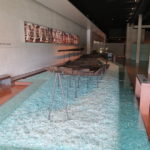
Pile Dwellings in Switzerland

Around one thousand pile dwellings are known in six countries (Switzerland, Austria, France, Germany, Italy, and Slovenia). A UNESCO project comprises a selection of 111 archaeological pile dwelling sites.

The project reveals the remains of prehistoric pile-dwelling settlements dating from 5,000 to 500 BC, which are situated underwater, on lake shores, along rivers, or in wetlands.

Due to the exceptional waterlogged conditions, the organic material was preserved, providing us with a detailed image of the living conditions of these prehistoric populations and, in turn, offering unique insights into their social, economic, and ecological interactions.

The results of over 150 years of research on the pile dwelling sites had a considerable influence on our understanding of the development of the early agricultural societies of the Neolithic and the Bronze Ages, and the interactions between the regions around the Alps in particular.

Museums and archaeological sites in Switzerland present this history. The following is not an exhaustive list of museums featuring pile dwellings:

Museum Burghalde in Lenzburg, the historical museums of Bern, Biel and La Neuveville, the Pile-Dwellings Museum in Lüscherz, the Historical Museum in Murten, the  Geneva Museum of Art and History, the Wiggetaler Museum in Lucerne, the Laténium Parc in Hauterive, the Musée de l`Areuse in Boudry, the Museum Nidwalden in Stansstadt, the Museum Allerheiligen in Schaffhausen, the archaeological museum in Olten, the historical museum in Arbon, the archaeological museum in Frauenfeld, the museum im Kornhaus in Rorschach, the archaeological museum in Lausanne, the Yverdon museum in Yverdon-les-Bains, the Museum of Prehistory in Zug and the museums in Pfäffikon, Meilen, Horgen and Wetzikon.

(Source and further information: www.palafittes.org).

Laufen Castle and Schlössli Wörth at the Rhine waterfall

The Rhine waterfall (Rheinfall) in Neuhausen (Canton of Schaffhausen) was once called “Grosses Lauffen.” The castle (Schloss Laufen) still bears this name and was first mentioned in 858.

The castle was the ancestral seat of the Lords of Laufen, but it had many owners over the centuries, including the Bishop of Constance, the All Saints’ Convent in Schaffhausen and the Count of Kyburg.

One of the (many) famous visitors was Johann Wolfgang von Goethe (1749-1832). He visited Switzerland three times, and each time, he stopped in Neuhausen to marvel at this natural wonder.

Another owner, Hans Wilhelm von Fulach, sold the castle to the town of Zurich in 1544. The castle belongs to the canton of Zurich and is a modern tourist destination.

For centuries, the small castle ‘Schlössli Wörth’ has served as a customs building and a point of protection for the transit of merchandise.

At the same time, travellers could spend the night here. Schlössli Wörth was built on a rock in the 14th century. Its predecessor was a castle built in the 11th century. The castle was converted into a restaurant and hotel between 1836 and 1837.

(Source and further information: www.schlosslaufen.ch)

Schlössli Wörth

The House of Nature in Canton Neuchâtel

The House (Maison de la Nature Neuchâteloise, AMNN) aims to promote respect for nature and to develop structures for visiting the park, in particular the Gorges de l’Areuse and the Creux du Van.

The three buildings (Noctule, Morille and Rousseau House) are managed by the AMNN. They organise exhibitions and provide documentation and information.

The Cotencher Caves and La Noctule in Champ-du-Moulin offer a multidisciplinary approach to the heritage, nature and climate change.

(Source et plus d’informations: http://maisonnaturene.ch).

Alpine route of Romanesque culture

The Alpine route of Romanesque culture features buildings and paintings from the period. It stretches between the Swiss Engadine and the Italian South Tyrol and Trentino.

It features dozens of Romanesque cultural sights. The Vinschgau and the Val Müstair are home to some of Europe’s oldest Carolingian/Romanesque churches and frescoes.

The route travels through Müstair, Burgusio, Laas, Naturns, Hocheppa, Lana, Dorf, Tisens, Burgusio/Mals, Veit, and Kortsch.

(Source and further information: www.stiegenzumhimmel.it)

The Giacometti Dynasty and Centro Giacometti

The Giacometti Centre (Centro Giacometti)  in the village of Stampa in the valley of Bergell (Val Bregaglia), canton of Grisons, tells the story of the Giacometti family.

One of the crucial factors that shaped these artists’ artistic development was the region’s cosmopolitan, open and bilingual (Italian-German) culture.

Many inhabitants worked in other countries as immigrants before returning to their region after a while. The artistic branch of the dynasty started with Zacarria Giacometti (1856-1897) and Giovanni Stampa (1834-1913). They taught Giovanni Giacometti (1868-1933) and Augusto Giacometti (1877-1947) drawing and decorative arts.

Augusto became famous as a painter and glass artist. Giovanni changed Swiss painting at the beginning of the twentieth century.  He also inspired and educated his son, Alberto Giacometti (1901-1966), and his two other sons, Diego (1902-1985) and Bruno (1907-2012).

Alberto became the world star of the family: the Centro Giacometti puts Alberto’s artistic accomplishments into perspective with his roots and the cosmopolitan Alpine region, a crossroads of cultures, languages, trade, and mountain passes.

The Centre introduced the Giacometti Art Walk—a digital art history of Alberto, his family, and the region.

(Further information: www.centrogiacometti.ch).

The Celtic Sanctuary of the Mormont

The Swiss cement manufacturer Holcim has been doing what it has been doing for decades: making cement from lime by extracting it from mountains and hills.

In 2006, excavations were in full swing on the Mormont hill, between the villages of Éclépens and La Sarraz (canton of Vaud). On this occasion, one of the most significant archaeological sites of the Celtic tribes came to light.

After discovering Celtic settlements (5th-1st century B.C.) in La Tène near Neuchâtel in the mid-nineteenth century, Mormont is the second prominent Celtic presence in Switzerland. In addition, Celtic existence has been proven in many other places by smaller finds.

At Mormont, it concerns a sanctuary where human skeletons, animal bones, and numerous artefacts have been discovered.

The Helvetic tribe inhabited this area (and the Swiss Plateau). Other tribes on the present-day Swiss territory include the Rhaetians in the east (Graubünden), the Lepontii, Uberi, Nantuates, Seduni, and Veragri in the Alpine region and southern Switzerland, and the Rauraci in parts of northern Jura, Basel, and Basel-Landschaft.

The Mormont was used as a cemetery and sanctuary during the Iron Age, from 450 to 100 B.C.  Since 2006, around 200 graves and sacrificial sites have been discovered. They include hundreds of men, women and children, the remains of some 460 animals (cows, horses, poultry, pigs, sheep, one wolf, one red deer, one bear, one donkey) and many other (utilitarian and religious) objects and weapons, including axes, swords, rings, chisels, knives, coins (Roman at the time of the Republic (up to 44 B.C.) and Celtic coins).

The research is still going on. Attention is being paid, among other things, to the causes of death of people (some skeletons were beheaded, a Celtic custom in case of conquered enemies, others burned, some intact), diseases and nutrition. The researchers also hope to gain a better understanding of the world of the gods.

What is the share of the (domestic) animals, and what does it say about, for instance, nutrition? So far, 211 cattle, 51 horses, 87 pigs, 31 sheep, 8 dogs and 17 goats have been identified. Where did the horses come from, for instance? What were they used for? What is the meat’s share in the diet?

What do the objects tell us about daily life, religious life and warfare? Where did they come from? What does it reveal about trade with other tribes, the Mediterranean and other parts of Europe?

The bronze and silver coins also have a story to tell. The Celtic coins were in use in the area of the Three Lakes Region (the lakes of Neuchâtel, Morat and Bienne) and the French Jura; the Roman coins came mainly from the period from the second century BCE, which coincides with the Roman conquest of the south of France up to Geneva (122-120 BCE) and the formation of the Provincia Gallia Narbonensis.

Conclusion

Mormont is an industrial limestone mine and an archaeological gold mine. The research is still relatively young, but the initial findings confirm earlier investigations from the Hallstatt period (800-450 B.C., see the Hallstatt Museum in Austria) and La Tène (450-100 B.C., see also the Musée Laténium in Hauterive, canton Neuchâtel).

This Celtic site is unique due to its religious significance. With about 200 graves, it is one of the largest Celtic sites.

(Source: C. Brunetti, G. Kaenel, P. Méniel, (ed.), ‘Les Helvètes au Mormont’ in Archéothéma. Histoire et archéologie, hors série 7, Avril 2014; W. Dusan (ed.), Le Mormont. Un sanctuaire des Helvètes en terre vaudoise vers 100 avant J.-C., Lausanne 2009).

Bibracte and Swiss History

One of the crucial events in Switzerland’s history occurred in 58 BC, at the Celtic or Gallic oppidum of Bibracte on the Beuvray mountain in Burgundy, near Autun.

Cesar stopped the migration or advance of the Helvetians (Helvetii) and some other Celtic tribes from northern Switzerland. This battle between the Roman and Celtic tribes is mentioned in De  Gallo Bellico (written by Cesar). Caesar sent the survivors back to their territory in Switzerland to prevent the arrival of the Germanic tribes.

Caesar did not occupy this Swiss region but made allies (Foederati) of the Helvetians and other tribes. He also founded two Roman colonies (Colonia Iulia Equestris (Nyon), on the territory of the Helvetians, and Colonia Augusta Raurica  (Augst), on the territory of the Rauraces.

These cities became centres of romanisation after 15-13 BC. Nyon remained a small town throughout the Middle Ages, while Augst developed into a small fishing village.

Bibracte’s fate was even more uncertain. Scholars first thought that Autun was Bibracte. Bibracte was abandoned after 20 BC, when Autun was founded anew in the early years of Emperor August’s reign, around 20 BC.

The name of the city was Augustodunum. It was the capital of the civitas of the Aedui people. The Celts are known for their fortified oppida on hills, such as Bibracte, but the Romans had other ideas and founded cities at the intersections of the main roads or waterways in the plains.

The first excavations of the Bibracte site began in 1864, following the discovery by Jacques-Gabriel Bulliot (1817-1902) that Autun and Bibracte were distinct cities.

Today, Mont Beuvray is home to an essential European archaeological centre and a museum (www.bibracte.fr).

(Source: D. Tabary, Bibracte – Mont Beuvray, Langres, 2016).

Mexit or Moutier Exit

Although it did not receive attention outside Switzerland, an exit drama is unfolding in the canton of Bern.

Referendum

A majority of voters of Moutier voted in favour of leaving the canton of Bern and joining the canton of Jura instead, by 2,067 votes in favour versus 1,930 votes against, a difference of 137 votes.

The canton of Jura (République et Canton du Jura) has already been separated from the canton of Bern as a result of the referendum on 24 September 1978.

However, Moutier, Belprahon, Perrefitte, and Sorvilier chose to remain in the canton of Bern.

On 5 November 2018, the result of the 18 June 2017 referendum was declared invalid due to irregularities. The highest court, the Bundesgericht in Lausanne, decided that a new referendum will take place in 2021.

The history

The history of these referendums goes back more than 200 years. The area of the canton of Jura and Moutier, Belprahon, Perrefitte, and Sorvilier was assigned to the canton of Bern by agreement of the Congress of Vienna in 1815.

The canton of Basel was given the Birseck, which merged into the new canton of Basel-Landschaft in 1832.

The Congress of Vienna

The Congress of Vienna (1814-1815) wanted to restore the balance and the old regimes after the Napoleonic wars and the (French) revolutionary movements.

The four great powers, Prussia, Austria, Russia, and England, surrounded France with powerful countries.

In the north the Kingdom of the Netherlands (the Netherlands and Belgium, which separated in 1831), in the south the Kingdom of Spain, in the east the Swiss Confederation of 22 cantons and the Kingdom of Piedmont-Sardinia (part of France from 1860 after a referendum) and on the right bank of the Rhine the areas allocated to Prussia.

The diocese of Basel continued to exist after 1815, but the bishop lost worldly power over his territory. The episcopal seat was in Porrentruy after 1529 and is now in Solothurn.

The Jura was French-speaking, but with Catholic and Protestant regions and cities. Moutier, Belprahon, Perrefitte and Sorvilier are Protestant; the northern part of the Jura is mainly Catholic.

The (legal) emotions and tensions have risen high because of Mexit.

(Source: J.-C. Rebetez, D. Bregnard, Le Jura et Berne. Bicentenaire du Congrès de Vienne 1815, Porrentruy 2015).