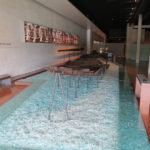
The Barbier-Mueller Museum in Geneva

Josef Mueller was born in 1887 in Solothurn. He moved to Paris in 1903. He met the famous art dealer, Ambroise Vollard (1866-1939).

He acquired paintings of Cézanne, Matisse, Renoir, Picasso, Braque and many other prestigious painters. He was also interested in ancient Roman and Greek art.

His son-in-law, Jean-Paul Barbier, was an enthusiastic collector of primitive art. The two collections were merged into one. The Barbier-Mueller Museum opened its doors in 1977.

(Source and further information: www.barbier-mueller.ch).

The Celts in Switzerland

Greek and Roman authors used the Celts (Galatoi, Keltoi, Galli, Celtae) to refer to the tribes that inhabited much of Europe, including Ireland and the British Isles. However, the Celts never had political unity. Their economic activities included agriculture, handicrafts, trade, and cattle breeding.

The period of the pre-Roman Iron Age, the La Tène period (400-100 B.C.), takes its name from the area La Tène on the shores of Lake Neuchâtel (see also the Celtic Hallstatt period (800-400 BC) and the Laténium Museum in Hauterive.

They were traders and maintained trade relations with Greek colonies, including Massalia (Marseille), Etruscans, Rome and other Italian cities.

Bremgarten, Oppidum (Reconstruction)

Significant changes occurred in political, economic, and social structures in the 2nd and 1st centuries B.C., particularly after the Roman military advance in 122 B.C. and the conquest of the southeastern region of France and Geneva.

Helvetic tribes inhabited the Vaud area and the Swiss Plateau. Other tribes in present-day Swiss territory include the Rhaetians in the east (Graubünden), the Lepontii, Uberi, Nantuates, Seduni, and Veragri in the Alpine region and southern Switzerland, and the Rauraci in parts of northern Jura, Basel, Basel-Landschaft, and the northern part of Switzerland.

After the Roman conquest of Gallia and the territory that is now Switzerland (15-13 B.C.), the Celtic tribes preserved some of their culture despite Romanisation. This assimilation is nowadays called Gallo-Roman. The Celtic language disappeared, though. (vulgar) Latin replaced it.

This language gradually developed into French, except in the regions where the German-speaking Alemanni settled, the Romansh people in eastern Switzerland and the Italian-speaking Tessin.

(Source: B. Maier, Die Kelten. Ihre Geschichte von den Anfängen bis zur Gegenwart (München 2016).

The Kleine Mythen and the Grosse Mythen

Myth, legend, historical fact, or a combination, William Tell (Wilhelm Tell) and the year 1291 are closely linked to the origins of present-day Switzerland, much like Rome cherishes Romulus and Remus and Greece worships the goddess Athena as the founders of their cities.

The mountains, the Grosse and the Kleine Mythen, however, are hard granite facts. The Grosse Mythen (1899 m.) is also called the Matterhorn for mountain hikers.

These two peaks in the vicinity of Schwyz are also depicted on the famous panorama of Charles Giron in the Bundeshaus, as a symbol of the beginning of the Eidgenossenschaft.

The Kleine Mythen (1811 m.) is flanked by the Haggenspitz (1761 m.). The Mythen are witnesses of the battle in the thirteenth and fourteenth centuries between Schwyz and the monastery Einsiedeln, which the Habsburgs supported.

This conflict was not about sovereignty or nation-building, but rather about local interests, including the use of water, pastures, cattle, and forests. It led to the legendary battle of Morgarten in 1315.

The Grosse and Kleine Mythen saw these developments and facts..

Makerspace Médiathèque Valais

The first Makerspace of the Médiathèque Valais opened its doors on Monday 2 March in Sion. A Makerspace is a place where people come together to share digital resources and knowledge, collaborate on projects and above all to create, invent, craft, explore and discover using a variety of digital tools and materials. Makerspace in Sion pursues several goals such as the discovery of digital technologies, creation and co-creation around personal or shared projects, raising awareness about digital resources and sharing knowledge. (Source and further information: www.mediatheque.ch).

The Animaloculomat

The camera Animaloculomat by the artist Klara Hobza (1975) captures extraordinary photographs on paper. The focus is not on the person portrayed, but on perception by animals.

The camera has six different animals as observers. During the development of her animal observation machine, the artist exchanged ideas with scientists and consulted professional literature.

She studied in detail the effects and movements of the animals she chose and thus arrived at her artistic interpretation of the photographs.

The Animaloculomat was created within the framework of the project ” Kunst/Natur. Künstlerische Interventionen” by the Museum of Natural Sciences in Berlin (www.museumfuernaturkunde.berlin) and can be seen in the Natural History Museum in Basel until 19 April 2020 (Source and further information: www.nmbs.ch).

Lake Dwellings Museum

The Society for Lake Dwelling Archaeology and Regional Ethnology was founded in 1922 and manages the  Lake Dwelling Museum in Unteruhldingen (Germany).

The Society studies the prehistory in the Lake Constance area and the archaeology of lake dwellings. Lake dwellings are a phenomenon that continues to surprise scholars and the public. Most lake dwellings exist in Switzerland and Germany.

Italy has a high concentration of lake dwellings in the Adige (Süd-Tirol), and France has several lake dwelling settlements in Savoie.

This heritage was submerged under water until the late nineteenth century, when archaeologists made their first astonishing discoveries of a lost civilisation. The decorative arts, housing and utilities are impressive.

Switzerland proudly presented the first replicas of lake dwellings at the World Exhibition in Paris in 1867/68. The Laténium in Neuchâtel and the Lake Dwelling Museum in Unteruhldingen are the most interesting sites.

Lake dwelling was a regional phenomenon, spanning present-day national borders and illustrating the ancient interdependence of cultures from the prehistoric period onwards, even before the so-called Romanisation, which began with the start of the Roman occupation.

(Further information: www.pfahlbauten.com and www.latenium.ch).

Van Gogh Alive

The paintings and drawings by Vincent Willem van Gogh (1853-1890) are presented in this multimedia show. The project tours around the world and can now be seen in Zurich. In 1880, at the age of 27, Vincent turned to art after a short career as an art dealer and a study in theology.

He was mainly inspired by the Impressionism and Post-Impressionism movements of the 19th Century. In just ten years, he produced more than 2,000 works of art, comprising approximately 930 paintings and 1,100 drawings and sketches. The show is an experience for the senses by the combination of light, colour and music.

In large-scale projections, his most famous works are brought to life. (Source and further information: www.vangogh-alive.ch). 

A multicultural Community

Grisons/ Graubünden is a the canton of 150 valleys and of different cultures and languages.

The spring fair Higa (21 to 29 March in Chur), is a multicultural residential community (Wohngemeinschaft) of these languages and cultures.

It is the first joint public presentation of four organisations: the Romansh Association (la Lia Rumantscha, founded in 1919), the Association for Italian Graubünden (l’associazone Pro Grigioni Italiano, founded in 1918), the Walserverein (l’associazione Walser Grigioni, founded in 1960) and the Association Pro Raetia (founded in 1949).

These organisations have a Romansh, Italian, Walser and German-speaking background.

(Further information: www. higa.ch/sonderschauen/sonderschau-sprachen).


The Ferries of Basel

The four small wooden ferries between the Rhine bridges of Basel have a history of more than 150 years. Until 1879, the Mittlere Brücke (until 1905 a thirteenth-century construction) was the only bridge. That was the reason to maintain the connection between Kleinbasel and Grossbasel with wooden ships of about 9 meters in length.

These ferries (Fähre) were initially called Fliegende Brücke (Flying Bridges); the operation was in the hands of a Society of Artists (Künstlergesellschaft). The Society spent the profits on the construction of an Art Hall on the Steinenberg in the city centre.

Due to the arrival of other bridges (including the Wettstein Bridge (Wettsteinbrücke) in 1879, the Johanniter Bridge (Johanniterbrücke) in 1882, the Dreirosen Bridge (Dreirosenbrücke) in 1934, and the bridge at Kraftwerke Birsfelden in 1954), as well as motorisation, the use of ferries declined. The last boatsman (Fährimann) retired in 1976.

A foundation was established to keep four boats in operation: the Ueli, Wilde Maa, Leu and Vogel Gryff, legendary figures from the history of Kleinbasel. This foundation merged into the Fähri-Verein Basel.

The four ferries still cross the Rhine between Klein- and Grossbasel, emitting no CO2. The current of the Rhine ensures the transfer to the other side by a cable construction.

(source and further information: www.faehri.ch).

Palace in the Air in St. Moritz

This year marks the 100th anniversary of the first flight between St. Moritz (Canton Grisons) and London. One of the initiators in 1920 was Hans Badrutt (1876-1953), owner of the Badrutt’s Palace Hotel in St. Moritz.

The St. Moritz Lake (St. Moritzersee), right in front of the hotel, was also the location of the first aeroplane flights in Switzerland in 1910.

The first Swiss airlines were founded shortly after the First World War; one of them, Ad Astra, was owned by Alfred Comte (1895-1965).

Comte flew more than 230 flights in the skies of Grisons in the winters of 1919 and 1920. Winter tourism was booming again, and British aristocrats, captains of industry and artists formed the most significant group of tourists.

The direct flight from St. Moritz to London and back, with an estimated travel time of nine hours, was the next logical step.

It was made possible by the new international aviation agreement between France, Great Britain and Switzerland, signed shortly after the war.

The first flight with Comte as pilot took place on March 4th, 1920, with a Condor CH-2. The Badrutt’s Palace Hotel celebrates this centennial anniversary and organises the ‘Palace in the Air’ line between St. Moritz and London.

The first flight from London landed after less than two hours on Friday, February 14, 2020, not on the St. Moritz lake anymore, but at the nearby Samedan Airport, and departed St. Moritz again the same day.

On 22 and 23 February, there will be two more flights from London to St. Moritz and back.