The Basel Tattoo 2022

The Basel Tattoo takes place from 15 to 23 July on the site of the Klybeck Kaserne in Kleinbasel.

The Red Hot Chili Pipers and the Flings and Things Highland Dancers, famous Scottish bagpipe bands, the Top Secret Drum Corps from Basel, the Swiss Military Music Company, the Indian Kumudi Homes School Pipes and Drums Band, Bulgarian and South African national bands, Royal Bands of Great Britain and Norway, and the US Air Force will give their best.

The Swiss musical and vocal group Les Armaillis and their 21 cows will also perform in the temporary arena (12,000 seats). Armailli is patois French of the cantons of Fribourg and Vaud and means cow. The troupe will present the beautiful play Le Ranz des Vaches.

It is a show with high-level choreography, dance, singing and, of course, music with wind and percussion instruments in spectacular formations.

The Basel Tattoo is the largest event of its kind after the Royal Edinburgh Military Tattoo. Basel would not be Basel without a large parade of more than a thousand musicians, dancers, and (cultural) groups from society and the army.

Swiss citizens have great respect for their army. Men serve in the army for much of their lives, a milice system similar to that of Israel. The oldest recruits take part in the parade as a mark of honour. The farmers, too, receive a grateful welcome

As a tri-country region, the canton of Basel-Stadt, Alsace, and the Markgräflerland will participate in the parade through the city centre from Grossbasel to Kleinbasel with a joint delegation on Saturday, 16 July. Groups from the Netherlands, Austria, France, Germany, and the USA will also participate.

(Source and further information: www.baseltattoo.ch).

Below is an impression of the parade of 16 July 2022.

Media, Federalism and Democracy

The media are indispensable to the functioning of a democracy. This is particularly true of multicultural, federal, decentralised Switzerland, with its direct democracy and other forms of direct citizen and civil society participation.

What characterises the media in federalism in general and in Switzerland in particular? What is the current state of the Swiss media landscape? And how do the cantons address current challenges, such as the COVID-19 pandemic, neutrality in times of war, or the financing of the media? The blog addresses these and other questions in a public debate to develop ideas and concepts for the future of Swiss media.

The ch stiftung, based in the House of the Cantons in Bern, regularly blogs on this topic (CH Blog). In addition to politicians and foundation employees, third parties from the academic world also have their say. All contributions share the common goal of starting a debate. This discussion could also be of interest to other countries.

Source and further information: www.chstiftung.ch

Erlebar-App Experience of Roman Towns

The Roman theatre of Aventicum (Avenches, canton of Vaud) has been undergoing restoration for several years. The building is the largest of the four Roman theatres in Switzerland (Avenches, Augst, Lenzburg and Lausanne).

Roman Theatre. Photo: TES

Roman Theatre. Photo: TES

The building could seat around 12 000 spectators. The monument was built in the second century AD with limestone from Neuchâtel and large blocks of grey sandstone.

After the departure of the Romans around 410 AD, the building was used as a quarry. In the 19th century, the demand for stone led to the almost complete destruction of the thus far relatively well-preserved monument.

In 1892, the Pro Aventico association put an end to the dismantling. In 1959, the theatre was classified as a historical monument.

The theatre, the amphitheatre, the temple and the shrine of the Cigognier can be discovered in 3D with the Erleb-AR application, developed by the Bernese Fachhochschule.

Amphitheatre. Photo: TES.

Le Cigonier and temple. Photo: TES

The Erleb-AR app shows the Roman towns and monuments of Aventicum and Augusta Raurica (Augst) and the Roman monuments of Bern as they would have looked at the time.

The name Erleb-AR is derived from erlebbar in German and Augmented Reality in English (Erleb-AR bfh.science).

The Engelhalbinsel in Bern,  Roman museum of Avenches and the Museum Augusta Raurica provide further information.

Gregorian Chants in Graubünden

The Fundaziun Origen is devoting the coming week to Gregorian chant. These ancient chants are part of the identity of monastic life. They structure the day and night.

The Origen Ensemble performs the Lauden, the prayer that welcomes the day, and the Complet, which bids farewell to the day and accompanies people to sleep.

They do this in monumental churches: the Carolingian monastery church of Mistail, the church of Son Martegn in Savognin and the church of Sta. Maria in Pontresina.

The Lauden takes place at sunrise at 5.30 am, and the Complet at sunset at 21.00 pm

Dates:

Church of St. Mistail in Alvaschein: 20 and 27 July 2022, 5.30 am

Church of Son Martegn in Savognin: 18 July, 21:00 pm

St. Mary’s Church in Pontresina: 22 July, 9 pm, 23 July, 5.30 am

(Source and further information: www.origen.ch)

Helvetia, the Rhine and Basel

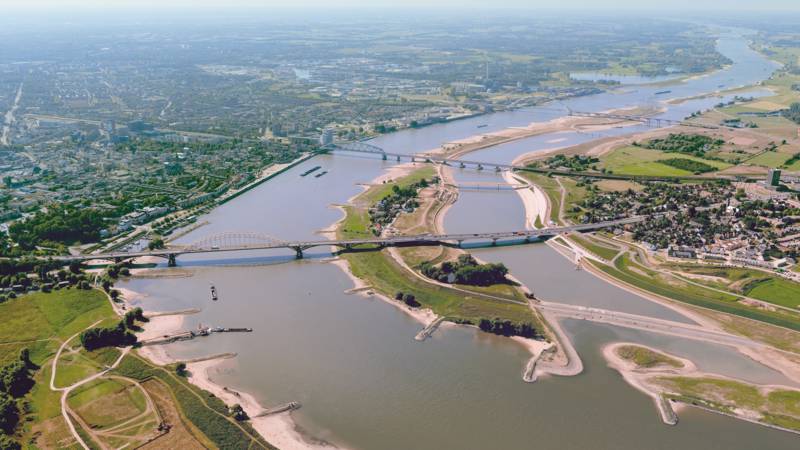
The Rhine flows out of Switzerland at Basel. It continues its journey to the North Sea as a (border) river through Germany, France and the Netherlands. At Spijk and Millingen, it enters the Netherlands and is called the Waal. The Waal splits into several rivers, forming the famous Dutch river landscape.

File:Spiegelwaal.jpg

De Waal and Spiegelwaal at Nijmegen, Photo: Wikipedia/Damatrix

The Waal is the mainstream. Nijmegen is the first large (ancient Roman) city on its way. However, the Waal then splits into various other rivers. One part becomes the Upper Merwede and the New Maas near Rotterdam.

Nijmegen

The Oude Maas joins the Nieuwe Maas at Rotterdam to form the Nieuwe Waterweg, which flows into the North Sea. This complex of waterways is the basis of the port of Rotterdam and its economic activities.

Another part of the Waal, after joining the Bergsche Maas, flows into the Hollands Diep, the Haringvliet.

In addition to these two main streams, the Waal has other branches. After Millingen, the Waal splits into the IJssel and the Nederrijn. The IJssel bends to the north and ends in the IJsselmeer. 

On its way, it meanders through the forelands of Gelderland and Overijssel, passing beautiful medieval Hanseatic towns (among others, Zutphen, Deventer, Zwolle and Kampen). The Nederrijn is called the Lek halfway. It flows into the Nieuwe Maas and the North Sea.

The IJssel River. Photo: www.Hanzesteden.nl

The Nederrijn (known from a Bridge too Far, Arnhem, September 1944, Operation Market Garden) has a branch called the Kromme Rijn, Leidse Rijn and the Oude Rijn, which flows into the North Sea via Utrecht and Katwijk. The Amsterdam-Rhine Canal (dug in the mid-19th century) connects Amsterdam and the North Sea (via the North Sea Canal) with the Rhine.

The Scheldt-Rhine Canal connects cities like Dordrecht with the Westerschelde via the Hollands Diep, Volkerak, and Oosterschelde.

Helvetia has long been the image of Swiss coins. She got tired of it and went on a journey to get to know Switzerland. After a long journey through valleys, mountains, villages and cities, she reached Basel.

The Rhine near Augst (Canton Basel-Landschaft). Photo: TES

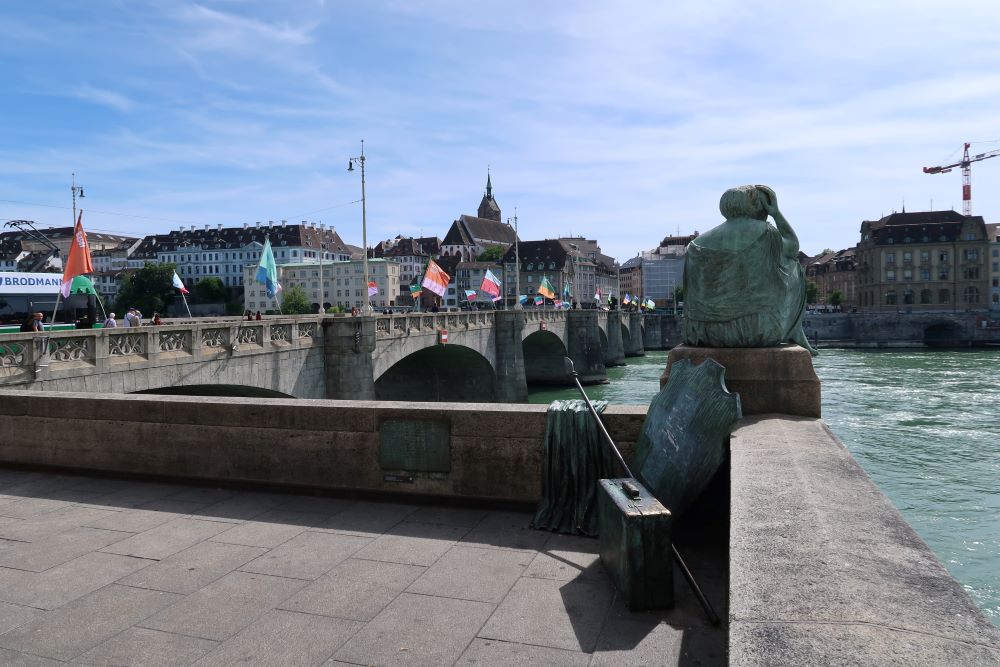
She decided to stay in Basel, thinking and musing about the Rhine and what lies in store for her on her journey. Helvetia has been sitting on the Mittlere brücke in Basel for over forty years. She may be musing on Hendrik Marsman’s (1899-1940) famous poem Thinking of Holland.

Bettina Eichin (1942) sculpted Helvetia in 1980. She called it Seated Helvetia (Sitzende Helvetia), a self-assured woman who thinks beyond borders and looks out into the world.

The artist wrote the following explanation:

“…eines Tages verlässt Helvetia ein Zweifrankenstück, mischt sich unters Volk und unternimmt eine längere Reise. Along the way, she also comes to Basel. Nach einem anstrengenden Gang durch die Stadt legt sie Mantel, Schild, Speer und Koffer ab und ruht sich auf einem Brückenpfeiler der Mittleren Rheinbrücke aus und blickt nachdenklich rheinabwärts”.

The Partnerships 360 Symposium

The Partnerships 360 Symposium, held at the Maison de la Paix in Geneva, will take place from July 11 to 13. It brings together allied and partner nations for a free exchange of ideas on the future evolution of NATO’s partnerships policy.

Switzerland is the first partner nation to be tasked with organising the Partnerships 360 Symposium. The annual symposium was first held in 2018, and Greece hosted it in 2019. Switzerland is now hosting the third event.

The symposium brings together civilian and military representatives from NATO members and partner nations. The purpose is to facilitate dialogue on the future evolution of NATO’s partnerships policy.

Switzerland has also been involved in NATO’s Partnership for Peace (PfP) since 1996. The PfP provides an institutionalised framework for security policy dialogue with NATO, member countries, and partner nations, including several Mediterranean and Middle Eastern countries.

(Source and further information: www.eda.admin.ch).

Joux Castle

The word “Joux” comes from the Latin “Iuria”, meaning “mountain forest”, and the Celtic word “Jor” for “wooded hill”. Jura or Joux, therefore, originally means a large forested area.

The Château de Joux is an emblematic monument of Franche-Comté (France). The castle is located 5 km from Pontarlier and 15 km from the Swiss border.

The castle is strategically located on La Cluse de Pontarlier, a narrow gorge that crosses the Jura massif. This military and commercial route connects the roads of Champagne, Flanders, and Haute-Saône with Italy and Switzerland.

From 1000, the Joux dynasty ruled the area and fortified the rocky hill with a first castle. Over the centuries, it was further rebuilt and extended.

In the 15th century, the mighty Duke of Burgundy, Philippe the Good (1396-1467), bought the castle from the descendants of the Joux dynasty. The Duke thus extended his rule over the border areas of the Duchy of Burgundy. It gave him access to the Cluse and a vital traffic artery to his wealthy regions in the Low Countries.

In the 16th century, the stronghold of Joux passed by inheritance and succession to the Spanish crown, which ruled over a vast territory, including the Franche-Comté, Spain, the Low Countries, and the Kingdom of Naples.

The castle of Joux became an essential defensive post at the edge of and against the French Kingdom, the Swiss Confederation and the Holy Roman Empire of the German Nation.

The French king Louis XIV (1638-1715) conquered Franche-Comté in 1678, simultaneously with his (unsuccessful) invasion of the Republic of the United Netherlands in 1672. Sébastien Le Prestre, Lord of Vauban (1633-1707), a military engineer and master builder, reorganised and modified the defensive castles captured from the Spanish enemy.

The defence of the eastern border was based on the citadels of Belfort, Besançon, the fortresses of Salins and the castle of Joux. This eastern border was further reinforced at the end of the 19th century, after the French defeat in 1871 and the loss of Alsace-Lorraine.

In the 18th and 19th centuries, the castle was a prison. Famous political prisoners included Mirabeau (1749-1791) and Toussaint L’ouverture (1743-1803). Unlike the Bastille in Paris, the castle of Joux was not destroyed in the French Revolution of 1789. The castle was in a remote corner and too far away. The castle has been a museum since 1954.

(Source and further information:  Accueil – Chateau de Joux)

Choreographies on the Julier Pass

The dance season of the Nova Fundaziun Origen (Riom, Canton Graubünden) on the Julier Pass begins on 14 July. Luca-Andrea Tessarini will kick off this year’s series of new choreographies with his work “Venom”. One week later, French choreographer Sébastien Bertaud will show his “Laniakea”.

The Red Tower on the Julier Pass unites two great traditions of the dance world: the dancers of the Paris Opera stand for classical perfection and the Nederlands Dans Theater for contemporary avant-garde.

Tessarini explores the metaphorical meaning of poison, which clouds minds, deceives the senses, sows malice, destroys friendships, ignites wars – and sometimes, in the proper doses, can heal.

Performances from 14 to 17 July 2022, starting at 21:30.

French choreographer Sébastien Bertaud and the soloists of the Paris Opera devote themselves to the infinity of the universe, the complexity of being, the intoxication of the unfathomable and the cosmos as the source of life on earth.

Performances from 21 to 24 July 2022, starting at 21.30.

Source and further information: www.origen.ch