The Monastery of Mollens and Cluny

The small monastery in Mollens (canton of Vaud) was added to Romainmôtier, a monastery of Cluny, in 1137. The monks of Romainmôtier administered the monastery’s domain for almost two centuries.

The lords of Aubonne then owned the village until the 16th century. From 1536 and the conquest of Le Pays de Vaud, Bern ruled the village.  In 1791, Nicolas-Alexandre de Watteville, guardian of Aigle (canton of Vaud), built the castle of Mollens.

The castle is still privately owned today, albeit by a different family. In April 1798, a fire destroyed 48 houses and the monastery. The church was rebuilt several decades later.

Source: www.mollensvd.ch

Simplon-Village, Gondo and the Simplon Pass

The village of Simplon (Simplon-Dorf), the namesake of the famous pass in the canton of Valais, has about 300 inhabitants today. The architecture of the place has Italian features, but German-speaking Walser emigrants mark the language. They settled in this region and the villages of Simplon and Gondo, today’s border town with Italy, from Oberwallis at the end of the 12th century.

Two great personalities influenced the development of the village: Kaspar von Stockalper (1609-1691) and Napoleon Bonaparte (1769-1821). The Ecomuseum Simplon provides extensive information about them.

The Simplon Pass was already used as a trade route and for passenger transport in Roman times. The pass and the village had their first heyday in the 12th and 13th centuries. The annual fairs in the French Champagne region, including in the towns of Troyes, Bar-sur-Aube, Lagny, and Provins, attracted many Italian merchants from Lombardy.

The shortest route was over the Simplon Pass. From the 14th century, however, the importance of these markets began to decline. The economic centre shifted to the Hanseatic cities, Lyon and Flanders.

The Great St Bernard then becomes the most important pass. The St Gotthard, Lukmanier, Splügen, and Septimer passes also became increasingly important, especially after the Confederation and its cantons (Eidgenossenschaft) conquered Italian territories in the late fifteenth and early sixteenth centuries.

The Stockalperturm

Kaspar von Stockalper ( le roi du Simplon, der Fugger der Alpen) initiated a new trading (and political) empire in the seventeenth century with a trade monopoly between Geneva and Milan.

He uses the Simplon Pass as a transit route. He also initiates the first regular postal service across the Simplon Pass. The Stockalper tower in Gondo is a reminder. In the following century, north-south trade again shifted mainly to other passes.

Napoleon decided in 1800 to build a new road over the Simplon to transport cannons and his army to Lombardy (owned by Habsburg) after the conquest of the Confederation in 1798 and the establishment of the Helvetic Republic (1798-1803).

This road was completed in 1805 and was an engineering feat. Napoleon also perfected the postal service over the Simplon Pass. The post office in Simplon village, built by Napoleon, was built during this period. The ‘Alten Kaserne’ museum in the Gondoschlucht gorge recounts this history.

After the fall of Napoleon, the Simplon Pass and the village became tourist attractions. The beautiful nature, mountain scenery, proximity to glaciers and the Grand Tour of poets, writers, scientists and (English) aristocrats and their travel reports made the village and the pass increasingly famous. Diligences drove to and from the two hospices on the Simplon pass.

Stockalper Hospiz, Simplon Pass.

At the end of the road over the Simplon and Gondo canyons, a gold rush arose in the village of Gondo around 1870, as it was then in the (wild) west of America. Kaspar of Stockalper had initiated the first gold mine (the Stockalpermine) two centuries earlier.

After 1870, international companies with headquarters in Paris were established. The first telegraph connection in Switzerland reported messages to the management in Paris. This gold hype did not last long, but the gold mines are still accessible today (guided tours).

Today, Gondo is the end of Canton Valais and Switzerland and the start of hiking routes in the Gondo Gorge, the Via Stockalper (from Gondo to Brig) and Domodossola in Italy.

The Simplon Tunnel was constructed and opened in 1906. Collection Ecomuseum Simplon

Simplon-Dorf successfully withstood the construction of the Gotthard railway tunnel (1882) and the Simplon tunnel (1906). The pass was no longer crucial for goods and passenger traffic. Still, the modernisation of the road, the Post auto from 1919 onwards, the Swiss road network, the recognition of the Stockalperweg as a road of national historical importance, the natural environment, the Ecomuseum Simplon, and several tourist opportunities offer the village numerous opportunities.

Source and further information: Brig Simplon Tourismus – Gemeinde Simplon Dorf (gemeinde-simplon.ch)

European Heritage Days in Switzerland

The 29th edition of European Heritage Days in Switzerland on 10 and 11 September 2022 will focus on places of art, recreation and sport under the motto “Leisure – Temps libre – Tempo libero”.

From the Roman amphitheatre to the National Museum, from the opera house to the mountain hotel to the seaside resort. Some buildings impress with their size and design, while others are modest or functional. However, leisure venues are always crucial for the functioning of society. The Corona epidemic makes that clear.

These Heritage Days take the public on a journey through time. To places of art, recreation and sport: from medieval and pre-industrial places of recreation and entertainment such as baths and theatres to the spa hotel of the Belle Epoque to the first sports hall to the Volkshaus or museum of the 19th and early 20th centuries. On foot along cultural trails, by cable car or by steamboat.

Hundreds of guided tours, workshops and round tables on this theme will be held in Switzerland. The cantonal and municipal departments for preserving historical monuments and archaeology carry out the programme with associations and private individuals.

The event is organised by NIKE and is an initiative of the Council of Europe.

(Source: www.nike-kulturerbe.ch)

Kandersteg, Oeschinensee and Blausee

The eagle in the municipal coat of arms of Kandersteg (Canton of Bern) in the Kander Valley serves as a reminder of the freedom rights once granted by the Holy Roman Emperor.

The footbridge (steg) over the Kander (Kandersteg) points to the importance of the connection to the Valais. It is also a symbol of the function the village fulfils for people from all over the world.

The small community, with barely 1,150 inhabitants, can accommodate up to 4,000 guests in valley and mountain hotels, apartments, group accommodations, camping, and the international scout centre.

Situated on the Lötschberg Pass and Gemmi Pass routes, Kandersteg has been a popular stopover for travellers for centuries, offering a place to rest and change horses. The site is renowned for its magnificent nature today.

The Hotel Ritter dates back to 1789 and was expanded in 1895 with the addition of the Victoria hotel, which catered to increasing tourist traffic. After the opening of the Lötschberg railway, an increasing number of guests came to Kandersteg, and Hotel Victoria became the Grand Hotel Victoria.

The International Scout Centre was founded in 1923. One of the initiators was Lord (Robert) Baden Powell (1857-1941), founder of the Scout movement. The complex is used yearly by an average of 9,000 Scouts worldwide.

Albrecht von Haller (1708-1777), doctor and naturalist in Bern, crossed the Gemmi Pass from Leukerbad on 29 August 1728. In the Kander Valley, he discovered the beauty of the mountains, Lake Oeschinen (Oeschinensee) and the Blausee, which he then praised in his famous poem “Die Alpen” (The Alps).

The Blausee

Lake Oeschinen is Kandersteg’s water reservoir and is part of the UNESCO World Heritage Site of the Jungfrau-Aletsch region. The lake is fed by meltwater from the Blüemlisalp, Fründen, and Doldenhorn massifs. The water from the lake seeps into the earth and emerges as springs in the valley in numerous places.

The Oeschinensee.

The small community is home to many monumental buildings, including the Samishus, Haus Spychermatte, the Hüttenmatte, the Ruedihaus, Haus Becki, the Röstihaus, the Protestant Church, built 18 years before the Reformation in 1510, the Grand Hotel Victoria and the Gasthof Ritter.

Kandersteg is also the site of the Kandersteg-Goppenstein (canton Valais) railway connection.

Source and further information: Kandersteg | Kandersteg

Swiss National Park

The Swiss National Park encompasses an impressive Alpine landscape with many flora and fauna. Extending over 170 km2, the Swiss National Park is the largest protected area in Switzerland and the country’s only National Park. Founded in 1914, it is the oldest national park in the Alps and central Europe.

The park is well known for its various Alpine plants and animals, such as chamois, deer and marmots. There is a wide choice of paths with differing degrees of difficulty.

The visitor Centre in Zernez provides information and an overview of the flora, fauna, park’s history and landscape.

Home Page – Parc National Suisse (nationalpark.ch)

Democracy in perspective

The 98th conference of the Organisation for Swiss Abroad (Auslandschweizer Organisation (ASO)/Organisation de la Suisse au l’Etrangé, OSE) was held in Lugano (canton of Tessin/Ticino) from 19 to 21 August. The central theme was democracy from the perspective of European and global developments, as well as the place and role of Switzerland and the Swiss abroad.


The conference


Experts from national, cantonal and communal politics, science and administration presented their opinions and knowledge. The four main topics were the functioning and adaptation of the Swiss democratic system, the impact of fake news on democracy, the right to vote and stand for election for 16-year-olds, and E-voting. After the introductions by the experts, there was an opportunity for discussion. Four workshops concluded the conference.


Filippo Lombardi, president of the ASO/OSE

 Opening speeches


Filippo Lombardi, President of the ASO/OSE, and representatives from the canton and civil society organisations opened the conference on August 20 to 400 participants.


In his speech on 21 August, the President of the Confederation, Ignazio Cassis, emphasised the unique character of Swiss direct democracy and its challenges. After a brief introduction to European and global democracy as a form of government from 1800 to the present, he concluded that democracy as a form of government is under pressure today. However, despite the many uncertainties and crises, he believes there is no reason for pessimism in the longer term.


He regards it as a process with ups and downs. Today, it is a period with more people living under dictatorial regimes. Liberal democracies, however, have a decisive advantage: they have the capacity for self-correction and can adapt to new circumstances.


In the global world and its cross-border problems, multilateral and European cooperation are necessary. At the same time, however, many international organisations established in a different era are struggling to reform their organisations and give substance to this cooperation.


What does it mean for democracy in Switzerland and thus for the ‘fifth Switzerland’, the Swiss abroad? Swiss democracy is not a divine creation but must be maintained and adapted daily. It is not only a democracy for the people but also a democracy by the people. It is not only a right but also a duty of the citizens, and thus, Swiss abroad, to care for it.


Impression of the panel discussions.

 Swiss abroad


According to ASO/OSE data, around 780,000 Swiss live abroad, around 450,000 in European Union countries. Therefore, it is no surprise that the issue of EU-Swiss relations arose. Above all, the free movement of Swiss citizens in the EU must be guaranteed, according to the ASO/OSE.


For Swiss people abroad, voting by post is not always transparent because of the dependence on local and national postal services. Moreover, emigration has changed. Until 1960, people often emigrated forever. Nowadays, it is usually for a shorter or longer period. For example, around 40,000 citizens leave every year, while 30,000 return. E-voting and information via the Internet can increase the involvement of Swiss abroad.


Foreigners in Switzerland


An interesting aspect is the relationship between Swiss citizens abroad and foreigners in Switzerland, as highlighted by one of the experts. Foreigners in Switzerland often do not obtain a Swiss pass after two years and therefore have no right to vote or be elected. Granting citizenship has always been a communal and cantonal affair in Switzerland. Citizenship for newcomers has never been a right but must be earned. 


In contrast, all foreigners are entitled to fundamental rights. All Swiss citizens have communal citizenship, cantonal citizenship and Swiss citizenship. They are an inseparable unity (Art. 37 para. 1 Federal Constitution). Therefore, the acquisition of Swiss citizenship is linked to the acquisition of cantonal and communal citizenship.  Ultimately, it is the cantons and the people who vote on changes to the acquisition of citizenship (see also the referenda in 1994, 2004, and 2008).


The parallel with women’s suffrage was mentioned in this perspective. In this case, however, a reference to the context is appropriate.


In any case, it is an essential and topical point of attention, just like e-voting, which also entails (yet unforeseeable) risks and the issue of fake news and democracy. The voting rights of 16-year-olds should be carefully considered and is far less evident than the other issues.


Ariane Rustichelli, the ASO/OSE director, concluded the conference with a summary of the above discussions. The cantons are traditionally the experimental gardens for (direct) democracy.  Regarding passive and active voting rights for foreigners at municipal and, in some cases, cantonal levels, mainly French-speaking cantons have taken the lead. E-voting will also be first applied in cantons and, if approved by the ASO/OSE, at the national level in 2027.


Ariane Rustichelli, director of the ASO/OSE

 Conclusion


An inspiring and well-organised conference. The city also hosted the Ukraine conference a few weeks ago. In 1830, Lugano presented as the canton’s capital the most democratic constitution of Switzerland. 


In Locarno, in the same canton, a new peace conference between Germany, France, Belgium, the United Kingdom, Italy, Poland, and Czechoslovakia took place in 1925. It was a conference of new hope and cooperation. And with success until October 1929.


The closing words of the President of the ASO/OSE were addressed to the four hundred participants and the 780,000 Swiss abroad. They are ambassadors and active participants, including voting, in Switzerland’s democratic functioning. Their experience abroad can contribute to maintaining and, where necessary, adapting and improving the democratic system in Switzerland and perhaps inspire systems in their countries of residence.


What applies in Switzerland also applies to Swiss people abroad: democracy for the people, but also by the people. 


The Romansh language and culture


A small note: Switzerland has four official languages, and Romansh could be mentioned in one way or another for a good reason. The Grisons/Bündner emigrants and returnees have earned their place in Swiss, European, and world history, if only because of the culinary innovations and the foundation of (world-famous) hotels, restaurants and cafés. 

Furthermore, as one of the cantons with (former) Landsgemeinden, Graubünden is a cradle of direct democracy. Romansh consists of five main idioms, but Rumantsch grischun is applicable and could be a solution. 

(Further information: https://www.swisscommunity.org)


Impressions of Lugano

Bridge in Switzerland

The Netherlands and Switzerland were republics of seven sovereign provinces of the Netherlands and thirteen sovereign cantons of the Confederation (Eidgenossenschaft) until 1795 and 1798, respectively.

Both were recognised as independent states by the Peace of Münster/Westphalia in 1648. Close diplomatic, military, and commercial contacts existed between countries and their cantons/provinces.

Swiss (Protestant) mercenaries in the service of the state army of the Republic came into contact with a Dutch game of cards known as Klaverjassen.

The Suisse Garde in the Dutch Republic, 1752. Source: Cent suisses retousched – Schweizer Truppen in niederländischen Diensten – Wikipedia

They introduced this game under Jass in Switzerland, including the Trump Nine and the Trump Jack. It is the most popular card game in Switzerland today. However, a new card game emerged between the World Wars and the Interbellum.

English or American tourists introduced a bridge to Switzerland between 1925 and 1930. Did the first bids occur in the Waldhaus in Flims, the Schweizerhof in Vulpera or perhaps in the Grand-Hotels Kulm or Badrutt’s Palace in St. Moritz, in Baur au Lac in Zurich, the Montreux Palace, the Kurhotel Val Sinestra near Sent or in the residences in Bern? In any case, the Belle Époque Hotel Museum Waldhaus exhibits architectural elements from this era.

Or was it in the Suvretta House in St. Moritz, which has a long bridge history, bridge rooms, and the first international bridge tournament in Switzerland in 1941?

The bridge rooms with a view, Suvretta House. Source: Suvretta House. Photo: TES

The American Harold Stirling Vanderbilt (1884-1970) developed the so-called contract bridge in 1925 during a cruise across the Atlantic.

In 1930, an English team led by Colonel Walter Buller (1886-1938) faced off against a team led by the American Ely Culbertson (1891-1955) at Almack’s Club in London. The game was covered on the front pages of European (including Swiss) and American newspapers.

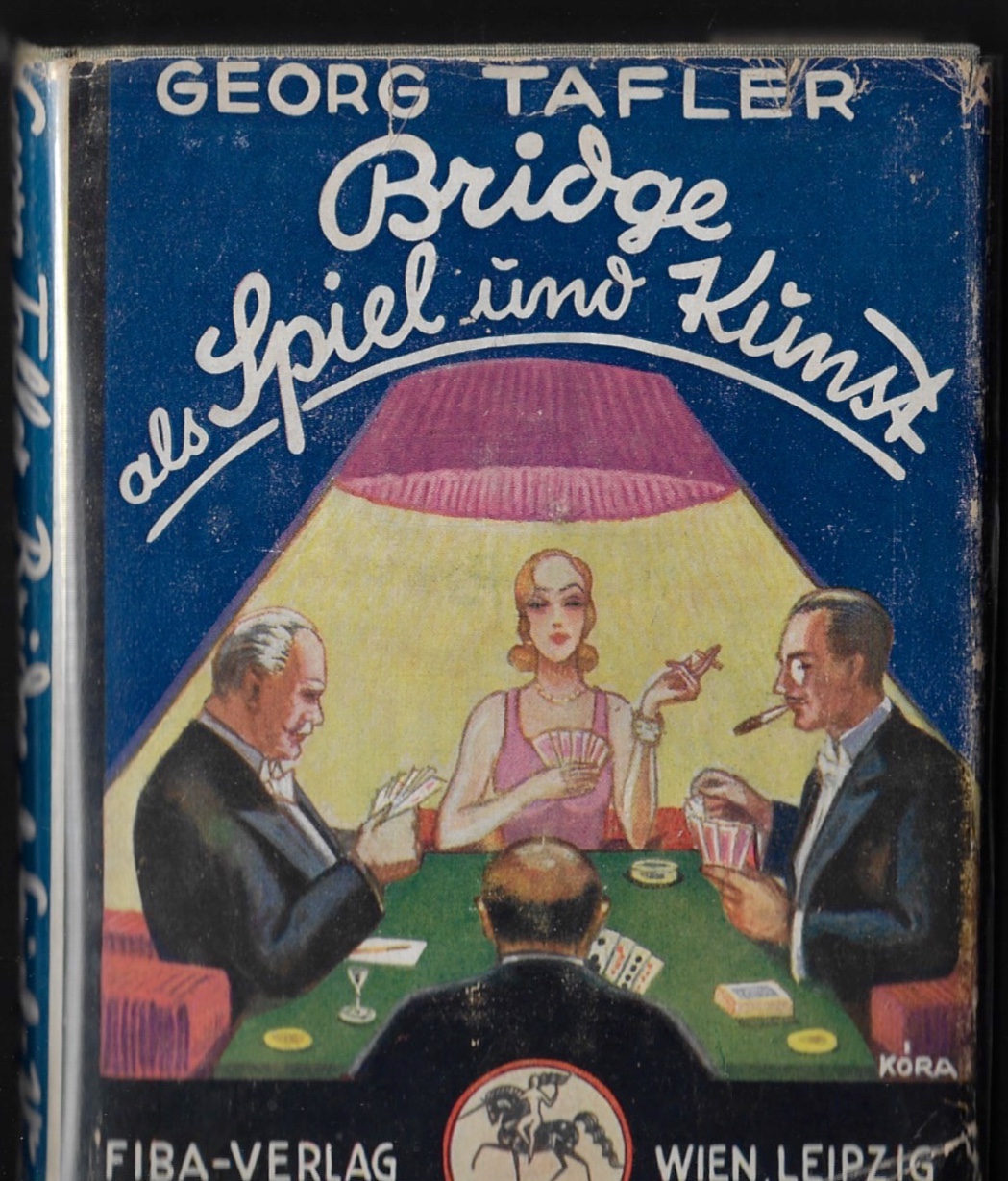
Georg Tafler, Bridge als Spiel und Kunst, Vienna, 1930.

Vanderbilt’s contract bridge was accepted as the international bridge system in 1932 by the world’s leading bridge organisations: the Portland Club of London, the Whist Club of New York and the French Bridge Commission. Culbertson introduced the first bridge conventions and shaped the game as we know it today. It soon became the card game for the well-to-do in America and England.

The famous (Belgian) detective Hercule Poirot also played bridge in 1936.

Agatha Christie, Cards on the Table, London, 1936.

On the one hand, this fascinating game with an almost infinite number of combinations is considerably more complicated than, for example, ‘klaverjassen’ or ‘Jass’. On the other hand, it is more social than, for example, chess.

The triumph of bridge in Europe and Switzerland began in 1947 after the founding of the European Bridge League, based in Lausanne. The FSB (Fédération Suisse de Bridge) was established on 18 March 1950, followed by the World Bridge Federation in 1958, also based in Lausanne and recognised by the International Olympic Committee (IOC).

IOC President Juan Antonio Samaranch (1920-2010) stated at the opening of the first Bridge Grand Prix in the Lausanne Olympic Museum in September 1998 that bridge was also a competitive sport. Bridge was a demonstration sport at the 2002 Winter Olympics in Utah (USA).


European Bridge League, Lausanne. Photo: Headquarters | European Bridge League (eurobridge.org) and the logo of the World Bridge Federation.

The FSB has around 3000 members and 52 clubs. The minor club has five members in Sainte-Croix (canton of Vaud), and the largest has 271 members in Zurich. In addition, many bridge players are not club members.

Swiss teams participate in the World and European championships, the Sports Games (a type of Olympic Games for bridge players), national, regional, and local championships, as well as tournaments in clubs, cities, and communes.

Gerry Link and Max Saesseli were champions for Switzerland in the 1993 European Senior Pairs Championship. The Swiss team became world champions in April 2022, followed by the U31 in August 2022.


Basler Bridge Gesellschaft

The FSB competition at the national level consists of Leagues A and B, each with eight teams. They play in a two-weekend Round Robin in November (all teams play against each other). At the third weekend, the finals and barrage matches take place.

The lower leagues I-IV are divided geographically. These leagues are split into eight teams that play at two weekends in November.

The country’s multilingualism also plays a role. Bidding and communication are often conducted in three national languages: Italian, German, and French, sometimes in Romansh, and frequently in English. For example: spades: Pik, pique, picche, palas, hearts: Cœur, cœur, cuori, cours, diamonds: Karo, carreau, quadri, pizs and clubs: Treff, trèffle, fiori and cruschs.

The bridge association FSB’s name is only in French, but its seat is in the German-speaking city of Zurich. St. Moritz, Crans-Montana, Geneva, and Zurich host the most prestigious international tournaments. The larger towns and communes also organise annual bridge events. 

Sources: Fédération Suisse de Bridge, Zurich; Suvretta House and Hotel Kulm Archives in St. Moritz; Belle-Époque Hotel Museum Waldhaus, Flims.


The Zuckerbäcker from Graubünden

The canton of Graubünden is the only trilingual canton in Switzerland. German is the spoken language of most inhabitants. Romansh has been increasingly replaced by German over the centuries. Italian is mainly spoken in four valleys of the canton: Val Poschavio (das Puschlav), Bergaglia (das Bergell), Val Mesolcina (das Misox), and Val Calanca (das Calancatal).

Bergaglia also stands out in architecture from the other side of the Maloja Pass, the Engadine. This pass may not be particularly high (1 800 meters), but its steep mountain slopes make it a formidable natural border.

Bergaglia was already, in Roman times, an important storage place for the north-south trade and remained so until 1798. (Austrian) Lombardy and its cities, including Bergamo, Brescia, Cremona, Verona, Treviso, and Padua, as well as the Duchy of Milan, Venice, the Duchy of Savoy, the Kingdom of Sardinia, and the Swiss Confederation, comprising thirteen cantons, were immediate neighbours.

Graubünden joined the Confederation as a canton in 1803, but with the loss of its Italian territories. Between 1512 and 1797, the border of Graubünden extended much further south; Chiavenna, Valtellina, and Bormio were under the control of the canton and the Confederation. Napoleon, however, created the Republic of Cisalpina in 1797, and later established the Italian Republic, which included these areas.

Italian architecture and its status as a transit route accompany the hiker in Bergaglia on a twenty-kilometre tour from the Maloja Pass to the Italian border at Chiavenna.

The mountain scenery and the view of the villages give hikers wings, which are not superfluous because of the steepest and rocky slopes. It is not surprising that this European route has produced great European personalities. The artist Alberto Giacometti (1901-1966), born in Stampa, is perhaps one of the most famous, but along the way, the villages bear witness to other cultural and economic success stories.

Not only merchants and mercenaries in the service of European kings and princes, but also bakers of pastries, such as Zuckerbäcker, and founders of hotels and cafés in European capitals, tell the story of emigration in the eighteenth and nineteenth centuries.

One of the most impressive witnesses of this typical ‘Bündner’ specialisation is the Palazzo Castelmur near Stampa. The builders were Giovanni Redolfi (1658-1742) and Giovanni de Castelmur (1800-1871). Today, the Redolfi Patrician House, which the Castelmur converted into a castle, is now a museum.

The museum features a permanent exhibition on the successful “Zuckerbäcker” from Graubünden, showcasing authentic furnishings and interiors from the 18th and 19th centuries. Stampa is halfway along the trail from the Maloja Pass to Chiavenna.

The Piz Amalia in Concert

On the occasion of the baptism of Princess Amalia, Crown Princess of the Netherlands, in 2004, the Municipality of Scuol and the Regional Tourism Organisation in the Lower Engadine (Canton of Graubünden) named a hitherto unnamed mountain after the princess.

The naming of Piz Amalia confirmed the friendship between Switzerland and the Netherlands. In the spirit of this bond, an annual festival for young musicians has been organised around locations of the Piz Amalia in Winterthur (canton Zurich) and The Hague since the autumn of 2015.

Young musicians from the Royal Conservatory in The Hague, under the direction of Thomas Herrmann, and the Winterthur Conservatory, directed by Valentin Gloor, will give several concerts at particular locations around Piz Amalia, in Winterthur and the Paleiskerk in The Hague.

The artistic director of the festival is Anthony Zielhorst. Two pieces of music have been composed for this year’s festival. They will be performed as world premieres.
Concert programme 2022:

Wednesday, 14 September, 7.00 pm, Conservatory Winterthur;
Friday, 6 September, 5.30 pm, Bergkirche, Scuol;
Saturday, September 17, 8.15 pm, Musikschule, Scuol;
Sunday, 18 September, 11 am, Fundaziun Nairs, Scuol;
Friday, November 11, 8.15 pm, Paleiskerk, The Hague.

On Friday, 16 September, at 6 am, there will be a guided mountain hike to Piz Amalia.

For more information about the programme, tickets and the organisation:

Piz Amalia, 14.–18.9.2022