Mario Botta in Saint-Blaise

The fountain celebrating the millennium of Saint-Blaise was designed by Mario Botta (1943).

The Ruau stream is the source and origin of the village. The Ruau provided the village with 12 water sources. For six centuries, the water also powered the millstones of several mills. These mills traversed the village and followed the Ruau to Lake Neuchâtel.

In the upper mill, three wheels drove the millstones. This fountain symbolises the history and origins of Saint-Blaise. The monument serves as a reminder to future generations of the village’s and this area’s identity.

Mario Botta realised one of his first projects at the Bigorio monastery in his canton of Tessin in the 1960s!

(Source: Fondation de la fontaine du Millénaire de Saint-Blaise)

The Jura Mountain Range

The Jura mountain range extends over several cantons in western Switzerland. It borders the Swiss Plateau region and covers 10% of the country’s area.

In French-speaking Switzerland, the Jura mainly encompasses the cantons of Geneva, Vaud, Neuchâtel, Bern, and Jura. In German-speaking Switzerland, the Jura is primarily found in the cantons of Solothurn, Basel-Land, and Aargau. The Jura massif also forms a natural border between France and Switzerland.

The Jura mountain range captivates the cantons of Jura, Vaud, Bern, and Neuchâtel with its diverse landscape. It is always a pleasure to discover or revisit, among others, the Creux-du-Van (NE), gorges de l’Areuse (NE), Lac de Neuchâtel (NE), Lac de Bienne (BE), and Chasseral (BE).

The Jura massif can also reveal some surprises: magnificent places, such as the Dent de Vaulion (VD), the Covatannaz gorges (VD), the Taubenloch gorges (BE), the Douanne gorges (BE), the Etang de la Gruère (JU), the caves and the Préhisto-Parc de Réclère (JU), the Franches-Montagnes (birthplace of the eponymous horse, the only breed of Swiss origin), the Chemin des Vignes (vineyard trail) following the footsteps of Bacchus from Biel to La Neuveville (BE), the sentier des Monts (mountain trail) linking Mont-Soleil to Mont-Crozin (BE) and the Chemin des Crêtes du Jura (Jura ridge trail) which forms an arc from Zurich to Geneva: This long-distance route crosses two language regions and offers a magnificent view, a varied and imposing landscape.

The panorama of the Jura mountain range is charming in all seasons, as can be seen, for example, in Saint-Brais, a small village in the Franches-Montagnes (JU).

(Source and further information: Office du Tourisme, Jura et Trois Lacs, Randonnées du Rêve, www.j3l.ch).


The Basel Tattoo 2023

Today, an arena for almost 8,000 spectators stands in the former barracks area (der Kasernenhof) in Basel. The premiere of the 16th Basel Tattoo will take place here from 14 to 22 July. Top formations from five continents with around 1 000 artists will enchant the audience and the city (tickets are available at www.baseltattoo.ch).

The Basel Tattoo shows a unique combination of dance, horses, parades, pipes, drums, Mariachi music and Aztec dancers, bands of the Sultanate of Oman, the Tattoo Choir and the world’s only Tattoo Guard.

The first rehearsals were a colourful, musical and choreographic spectacle! And Basel Tattoo is also the result of the Swiss militia system, the cooperation with the army, the city, the canton of Basel-Stadt, the population and businesses.

The population and others involved have also decided on the colours of the ties, direct democracy à la Suisse. And the organisation is proud of this choice.

Members of the Basel Tattoo organisation (Erik Julliard and René Häfliger) with the ties during the press conference. Mr Julliard was a member of the Basel Top Secret Drum Corps. The world-famous Top Secret Drum Corps of Basel arranged, in collaboration with the Scottish film composer Lorne Balfe the theme tune for the latest film in the series Mission Impossible- Dead Reckoning part one by Tom Cruise. This premiere is on 12 July, so there are two Basel-orientated world premieres within two days!

The Patrouille Suisse will fly over the Arena on Friday 14 July (without aerobatic show). The participation of the Patois suisse (and their cows and le Ranz des vaches) has not yet been confirmed.

Doe den tap toe

By the way, the Old Dutch “doe den tap toe” (turn off the tap) is at the origin of the Dutch word “taptoe”, tattoo in German and English. “Doe den tap toe” has a military context and means to turn off the beer tap. On the other hand, Heimweh (homesickness in English) is a Swiss word.

The beer taps were closed on the command ‘doe den tap toe’, often supported by a drum or trumpet signal. Over time, “tattoo” has also become a term for military music festivals.

The Barracks Yard

The barracks yard is, therefore, the right setting for a tattoo. The Klingental Convent (today the Kleines Klingental Museum) for Dominican nuns was closed after the Reformation (1527). The buildings were used for storage, commercial space and as a location for the city garrison. The new barracks were completed in 1863 and housed troops until 1965. So there have been many taps and ‘doe den tap toe’ commands (Zapfstreich in German).

The rehearsals of the Lucerne Marching Band, the Combined Bands of the Royal Cavalry and the Royal Guard of the Sultanate of Oman and the Banda Monumental de Mexiko.

Basel Tattoo 2023

Quests of honour, so to speak, are the musicians of the Brass Band of the 194th Pontoon Bridge Brigade of the brave Ukrainian army. Exceptional performers are also the Combined Bands of the Royal Cavalry, the Royal Guard of the Sultan of Oman, and the Mariachis and dancers from Mexico. The formation from Oman consists of 50 wind musicians, bagpipe players, and 46 horses. Aztec dancers and Mariachi music accompany the dancers from Mexico.

The New Zealand Army Band represents the fourth participating continent. The Canadiana Celtic Highland Dancers are the 50 best highland dancers in Canada. Together with the Mounties of the Royal Canadian Mounted Police and the Canadian members of the Massed Pipes and Dr, they represent the fifth continent.

The European continent is, besides the Ukrainian Brass Band, represented by the Lucerne Marching Band, music and dance of the Scottish Act, the Band of the Royal Regiment of Scotland, the Swiss Military Band, the Basel Tattoo Guard, the Basel Tattoo Choir and the British pipers and drummers of The Massed Pipes and Drums.

The famous Street Parade takes place on Saturday, 15 June, and the Basel Tattoo Children’s Day on 22 July.

(Source and further information: www.baseltattoo.ch)

Switzerland, A European Microcosmos ?

Switzerland is the outcome of centuries of cooperation, alliances, exchanges and contacts between the cantons. After the Congress of Vienna (1814-1815), it seemed impossible to unite these sovereign republics and their different languages, religions, cultures and (economic) interests in a federation with a national currency, government, parliament, army or even a flag or a national anthem.

The Constitution of 1848

In 1848, following the brief civil war of 1847 (Sonderbundskrieg), the Constitution of 1848 established the Confoederatio Helvetica (CH), the Swiss Confederation comprising twenty-five (semi)cantons.

Monetary, political, cultural, and economic integration continues to this day. For some, it is a (democratic) inspiration of European integration, a European microcosm.

Others believe that Switzerland indicates the maximum achievable European cooperation between different countries. Or should the EU join the Swiss Confederation as the twenty-seventh canton (after the consent of the Swiss citizens and cantons, which goes without saying)?

M. Valéry Giscard d’Estaing (2008) and President François Hollande (2016). Pregny Chambésy, Musée des Suisses dans le monde. Foto: TES

“The next membership of the European Union ….. of Switzerland’, ‘It is in Switzerland that the European dream has become a reality.”

Continuity and the Political System

Switzerland’s story is, above all, one of centuries of continuity and deliberate choices in its political system. That distinguishes Switzerland from other European regions that have also long cooperated in loose relationships, such as the Hanseatic League or the Swabian League.

Fate, coincidence and the course of history are not considered in this article. Things could have gone differently for Switzerland as well, ‘if’. The fact that Switzerland exists, however, is no coincidence. The first political foundations date back to the late Middle Ages, from the thirteenth to the fifteenth century. At that time, however, nothing could indicate that the Switzerland of 1848 would come into being.
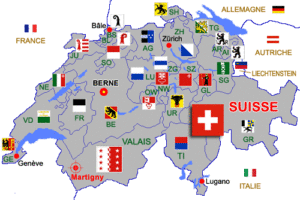
The 26 cantons. Source: Les 26 cantons suisses. Foto: www.jeretiens.net

 The cantons

The Eidgenossenschaft or Confederation of 1513 and its thirteen cantons (this term dates back to the sixteenth century) withstood the European (religious) wars and revolutions.

The mainly German-speaking cantons (only Fribourg/Freiburg was bilingual) emerged from the thirteenth century onwards as sovereign political regions with their jurisdictions, cultures, armies, currencies, flag, languages/dialects, legislation, parliaments, governments, foreign policies (including peace, war and treaties) and ambassadors without interference from a national authority or a (foreign) sovereign.

In 1648 (Treaty of Westphalia), the Confederation was (de facto) recognised as a sovereign nation, although the cantons did not regard the Confederation as a nation with a national identity.

However, in the perception of the great powers of the time (notably the Spanish and Austrian Habsburgs, Sweden, the United Provinces, France, and England), this Confederation was regarded as a sovereign entity. The cantons achieved this status due to their success on the battlefield and their effective political, economic, and foreign policies from 1315 onwards.

Vevey, Musée de la Confrérie des Vignerons, Les Cent Suisses. Photo: TES

Tagsatzung

No confederal institution existed apart from the Tagsatzung, i.e., the States-General. The cantons established a General Assembly (Tagsatzung) of representatives in 1417, following the conquest of Aargau in 1415.

Its main activity was the joint administration of the conquered territories (Untertanengebiete, Aargau, Thurgau (1460), Italian territories (around 1500-1512), and Waadt (1536). It was a complex mosaic of governance that would be left aside.

The thirteen cantons mostly disagreed on other policy areas. Cooperation and foreign policy became even more complicated after the Reformation and the emergence of Protestant cantons.

Apart from six minor military conflicts (the two Kappelerkriege of 1529 and 1531, the Bündner Wirren of 1618-1639, the Peasants’ War of 1653, and the two Villmergerkriege of 1656 and 1712), the cantons resolved their religious and economic conflicts through consultation, always seeking the feasible and acceptable.

The Confederation was not Catholic or Protestant but was an alliance of Catholic and Protestant cantons, including all (political) problems.
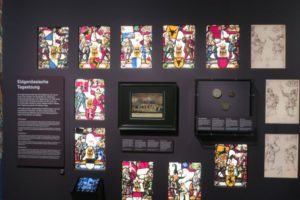
The Tagsatzung, a. 1500. National Museum Zurich. Photo: TES.

 The French Era 1798-1813

The French occupation and its constitutional concepts (the Helvetic Republic (1798-1803) and the Confederation (1803-1813) brought about significant and lasting changes in the confederal system.

After Napoleon’s defeat, the new Confederation of 1815 consisted, as before, of sovereign cantons (twenty-five cantons, including the six semi-cantons) without effective confederal bodies. But the clock could not be turned back.

The French invasion. Photo: Nidwalder Museum.

The Constitution of 1848 

The Constitution of 1848 paved the way for modern Switzerland. It combined federalism, universal suffrage for (male) citizens, a balanced system of power-sharing between the government and parliament (the Nationalrat/Conseil national and the Ständerat/Conseil d’Etats), and a prominent role for cantons and citizens. The (male) citizens and cantons had the last word by adopting the Constitution in 1848.

After the new Confederation of 1848, the cantons served as a laboratory for introducing direct democracy at the national level, with the introduction of the referendum (1874) and the popular initiative (1891). The introduction was a political decision made by citizens and cantons. They based it on the ancient model of the ‘Landsgemeinde‘, the American Constitution of 1776, the achievements of the French era (1798-1813) and the experiences in the cantons.

Direct democracy served as the lubricant for the federation of such diverse republics and interests. The cantons and the citizens trusted the national government, and the federal government trusted the cantons and the citizens.

Bern, House of the Cantons (Haus der Kantone). Photo: TES.

 Willensnation

Therefore, Switzerland is a ‘Willensnation’ with a political system that has evolved bottom-up, for and by the citizens and their cantons. Until 1798, Switzerland had no dominant national personality or dynasty and no dominant canton (it did have (very) large and (very) small cantons). Until 1848, there was no national identity, only a sense of solidarity. However, this union was mainly pragmatic and served the interests of the cantons.

Bern, Federal Palace. Photo: TES.

 Democracy 

The Swiss model is not a form of God-given predestination. It is a human process of trial and error. An essential aspect of the Swiss model is its ability to adapt to changing social, international and economic developments.

The compromise model and the national government’s so-called ‘Konkordanzsystem’ have arisen from the need to consult with all ‘stakeholders’ of society. The constitutional fundamentals of the political system are the federal structure, the cantons in the Ständerat, and direct democracy for citizens.

The national government, parliament, cantons, and all relevant organisations are involved in the legislative process in the pre-parliamentary phase. After all, the citizens and the cantons always have the last word.
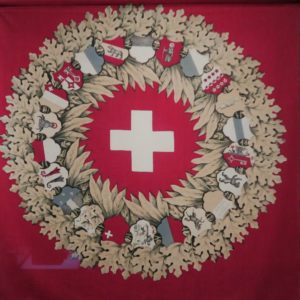
Unity in Diversity, 1935. National Museum Zurich. Photo: TES

Conclusion

Switzerland’s integration is not perfect. There is a Röstigraben and a Stadt-Landgraben, there was a late (national) introduction of women’s suffrage (which does not necessarily say anything about the Swiss man) and obtaining citizenship for foreigners, including the right to vote, is not self-evident. Granting citizenship is an ancient competence of the cantons and municipalities.

The COVID-19 pandemic and its impact on the European Union are reasons to examine the relationship between the government and the cantons. However, the system is reformable only after (lengthy) discussion and consultation with cantons and citizens.

The Swiss model is unique and a political choice for the citizens and their cantons. Switzerland is not only the undisputed world champion of referendums. Direct democracy is not an end in itself. The system is embedded in a centuries-old, bottom-up model at the municipal, cantonal, and national levels.

It has served the country well, even in times of great crisis, such as the Civil War of 1847, the Polarisation of 1914-1918, and the decades leading up to the creation of the new canton of Jura in 1979.

Direct democracy does not always simplify the political life of the federal (and cantonal and municipal) executive and legislature, and it is also the subject of reform discussions in Switzerland.

However, the citizens and the cantons are proof of its success. Legislation or a popular initiative to abolish direct democracy has never been realised.

Source: W. Lindner/Sean Mueller, Schweizerische Demokratie. Institutionen, Prozesse, Perspektiven, fourth edition, Bern 2017; A. Vatter, Das politische System der Schweiz, Baden-Baden, 2020; O. Meuwly, Une histoire de la démocratie direct en Suisse, Neuchâtel, 2020)

The Tell Chapel in Lausanne

The chapel of William Tell in Lausanne is not a chapel. It does not have relics of the national hero Wilhelm Tell, who (when he existed anyway) never visited Lausanne. Moreover, the chapel was not founded by a Swiss but by the Frenchman Osiris.

Although it is not a chapel, and there are three chapels in Switzerland – in the religious sense – dedicated to Wilhelm Tell in the canton of Uri (in Sisikon and Bürglen) and Schwyz (in Küssnacht), the one in Lausanne is unique.

The chapel was the idea and project of Daniel Iffla (1825-1907), a wealthy Parisian banker who obtained the right to add “Osiris” to his name by imperial decree in 1861.

Daniel Iffla-Osiris. Photo: Wikipedia

The French author Pierre Assouline describes him in his book Le dernier des Camondo (Paris, 1999) as

“the prototype of the modern patron and a man of projects (…). His philanthropic obsession stemmed from the Jewish tradition of tzedaka (charity), republican values and the desire to draw attention to his fortune“. ((le prototype du mécène moderne doublé d’un homme d’œuvres (…). Son obsession philanthropique procédait à la fois de la tradition juive de la tsedaka (charité), des valeurs républicaines et de l’irrépressible désir d’étaler sa fortune).

In 1902, Osiris had already financed the statue of Wilhelm Tell, in front of the steps of the Palais de Justice in Montbenon in Lausanne, in gratitude for the hospitable reception of Bourbaki’s army in 1871.

On his death, he left the city a large sum to construct a synagogue and a chapel in memory of the national hero. The architect Georges Epiteaux (1873-1957), also responsible for the Galeries Saint-François in Lausanne, and the painter Ernest Biéler (1863-1948) realised the project.

William Tell. Photo: Ville de Lausanne

Palais de Justice. Photo: Notrehistoire.ch

The chapel was inaugurated in 1917 while the First World War (1914-1918) raged in Europe. As a precaution, the frescoes in the chapel were moved to the hall of the Palace of Justice, the seat of the Swiss Supreme Court (Tribunal fédéral/Bundesgericht).

Therefore, a Wilhelm Tell statue and a chapel, which is not a chapel, stand in Lausanne, and frescoes of the legendary hero embellish the Palace of Justice, commissioned by a French citizen.

Lars Kophal, editor and journalist 

The Tell Chapel in Bürglen

The Tell Chapel near Sisikon 

The Tell Chapel and the Hohle Gasse near Küssnacht

Friedrich Schiller, Wilhelm Tell (1804), “zum Neujahrsgeschenk auf 1805”. Informationstelle Küssnacht

The  Gessler Castle (die Gesslerburcht)

The Rigi-Region

The Rigi, located along Lake Lucerne, is one of the most famous Swiss mountains. Unlike, say, the Gotthard massif, Zermatt or the Jungfrau, it is not its altitude (1 798 m above sea level) but its location and history that have earned Rigi the name “Queen of the Mountains” (Königin der Berge).

Albrecht von Bonstetten (1443-1504), the first depiction of the Eidgenossenschaft, 1479. The Eidgenossenschaft is the centre of the earth, and the Rigi as the queen of the mountains, regina montium. Collection: Bibliothèque nationale de France. Latin 5656, p. 8r. Image: Museum Vitznau-Rigi

Until the 18th century, central Switzerland was primarily a transit area for the “Beau Monde” and the English nobility’s “Grand Tour” to or from Italy. Few were interested in the inhospitable countryside. Diplomats, prelates, pilgrims, merchants, and other travellers did not go further than the larger cities or monasteries. Tourism, mountaineering, nature lovers, or hikers did not yet exist.

Detail of the “Wäggemann-Karte, 1630. In the middle are the three villages of Weggis, Vitznau, and Greppen. Image: Museum Vitznau-Rigi

The three main villages in the Rigi region are Weggis, Vitznau, and Greppen. Weggis is first mentioned in documents in 1116 as “Guategisso”. Greppen is referred to as “Crepon” in 1259 and Vitznau as “Vitzenouwa” in 1342. Weggis and Vitznau were originally owned by the Pfäfers monastery. Lucerne acquired Vitznau and Weggis in 1380. Greppen was owned by the Habsburgs until 1406. In that year, Lucerne acquired the village.

Greppen today

750 years Greppen

St. Wendelin

Weggis today

Weggis briefly had the status of a sovereign “village republic”, from 1359 to 1380 (until its takeover by Lucerne), and even joined the Confederation as an ally. Nearby Gersau retained this status even until 1798!

Until 1798, when the Helvetic Republic (1798-1803) was established, little changed in the Rigi region, apart from a few uprisings by dissatisfied inhabitants due to the Lucerne administration. However, the end of the 18th century heralded the changes of the 19th century. The rise of journalism and newspapers, along with the attention of writers and intellectuals, created a boom in Switzerland.

Examples include Jean-Jacques Rousseau, Lord Byron, Madame de Stäel, Johann Wolfgang von Goethe, and Edward Gibbon. The founders of America, Thomas Jefferson, James Madison, and John Adams, also invoked this republican confederation in Central Europe amid monarchies in their Declaration of Independence on July 4, 1776.

Vitznau today

The country’s rapid industrialisation also drew the attention of other countries, particularly Great Britain. However, the Napoleonic Wars caused stagnation until 1815. After 1815, however, significant economic, social, and political changes took place in Switzerland. The Rigi region was one of the first to benefit from this initiative. From 1820, a newly constructed road enabled a direct stagecoach to go straight from the ports to Rigi-Scheidegg, Rigi-Kulm, and Rigi-Kaltbad. It is no coincidence that the country’s first Grand Hotels were built at these places. At that time, transportation was mainly via Lake Lucerne, rather than by land.

The  Luzern near Weggis

The first steamships on Lake Lucerne appeared in 1837. Escher Wyss even became the European leader in building these vessels for inland navigation! With the construction of railways, transport to Lake Lucerne became increasingly comfortable.

Weggis, Vitznau, and Greppen benefited from the tourism boom. Breathtaking views of the Alps, excellent hiking opportunities, easy access, clean air, hotels and spas, and boat trips on the lake were all attractive features.

21 May 1871 was a memorable day. The Vitznau-Rigi railway, the first rack railway system, was put into operation. One of the first Swiss Tourism organisations (Kurverein) was founded in Vitznau in 1888, followed by Weggis in 1893.

The Rigi-Bahn. Image: Museum Vitznau-Rigi

The infrastructure, including roads, public toilets, public entertainment venues (theatre, concerts), benches for sitting and resting, boulevards lined with trees, electric street lighting, a water supply, harbours, and a daily cleaning service, was (and remains) well-organised.

Foreign tourists also brought the Protestant religion to the Catholic canton. In 1904, the reformed St Markus Church in Vitznau was the first non-Catholic church in a village in the canton.

The St. Markus Church in Vitznau

The Rigi was also the scene of the first skiing attempts in central Switzerland. Josef Dahinden-Pfyl (1863-1931), owner of Hotel Bellevue in Kaltbad, and the Pilatus branch of the Swiss Alpine Club (SAC), founded in 1863, undertook the first ski tours on the Rigi in 1906. From 1907, the Rigi railway also transported guests to Scheidegg, Kulm, and Kaltbad in winter. In 1908, the Rigi Ski Club was founded. The Rigi had become a year-round destination for winter and summer sports and tourism.

Poster a. 1930 Image: Museum Vitznau-Rigi

Weggis, the Lido, today

There were more innovations in the Rigi region. In Hertenstein, one of the country’s first open-air theatres was built, and in Weggis, the first mixed open-air swimming pool (for men and women) in the lake was opened in 1919. It was a great success and remains in existence today.

Besides attractions, something else deserves attention in these ecological times. Greppen is, again, a chestnut paradise, culminating in the annual Chestene-Chilbi in October. For centuries, chestnuts were the most essential food in the region, but by 2000, they had become almost forgotten.

Greppen, the chestnut road (kastanienweg, Rigi-Chestene-Weg)

(Source and further information: Gemeinde Greppen; Ferienregion Weggis-Vitznau; Museum Vitznau-Rigi)

Information centre Hohle Gasse

Küssnacht, the Tell Chapel (Tellskapelle)

The Gessler Castle 

The Hohle Gasse

Immensee, Missionsgesellschaft Bethlehem

Lake Lucerne, Nature, Culture, History

Switzerland has hundreds of larger and smaller lakes, mountain lakes and reservoirs. One of the most remarkable in terms of shape, history, nature and location is Lake Lucerne (Vierwaldstättersee).

This lake was created from the meltwater of the Reuss Glacier. In the last ice age, this glacier had a height of 1 400 metres and a width of several kilometres. This gigantic ice mass began to melt 20 000-15 000 BC. Several other lakes in central Switzerland are also the children of this glacier.

Lucerne

The landscape was also shaped by this glacier. The Glacier Garden (Gletsjergarten) in Lucerne offers a well-documented overview of this process.

Lake Lucerne has an irregular shape and crosses four cantons: Nidwalden, Lucerne, Schwyz and Uri, hence its apparent French name: Lac des Quatre Cantons. With some goodwill, Canton Obwalden and the Alpachersee can also be included.
The English name is Lake Lucerne, which is also correct, as it is the most prominent neighbouring canton and city.

The lake is of great historical importance to Switzerland. The three cantons of Uri, Schwyz and Unterwalden (later divided into Obwalden and Nidwalden) created the Eidgenossenschaft on the shores of the lake (also called Lake Urnersee) on the Seelisberg near Brunnen.

In the Morgartenbrief of 1315, these three Orte first used Eidgenossen. The subsequent course is well known. That things could have gone differently is irrelevant. Along the shores of the lake lies the village of Gersau, which has been a sovereign republic for centuries.

The lake to Stansstad (Canton of Nidwalden)

The Pilatus (on the right)

The Bürgenstock

The Rigi

Lake Lucerne 

The biggest Swiss flag near Vitznau

Vitznau

Lake Lucerne is also a centre of European art history.  The shores near the city of Lucerne, including the Rigi, Pilatus, and Bürgenstock (an enclave of Lucerne in the canton of Nidwalden), were regular focal points or even residences of political, literary, and musical personalities, as well as other VIPs. Richard Wagner, Sergei Rachmaninoff, Wolfgang von Goethe, Audrey Hepburn, Jimmy Carter, Sophia Loren and Konrad Adenauer are just a few names from a long list.

The royal tragedy of the lake is the fatal accident of Queen Astrid (1905-1935) of Belgium in 1935. A chapel near Küssnacht commemorates this event.

The Astrid Chapel

Knokke (Belgium)

Meggenhorn Castle

Küssnacht

Villa Senar

Picture from 1930. (picture: Museum Vitznau-Rigi). The peninsula Hertenstein, in the background Küssnacht. On the left, the Villa Senar of Sergej Rachmaninoff, the Stella Matutina, and the castle-hotel Hertenstein.

Hertenstein today

The Luzern near Weggis

The Uri on the Urnersee near Brunnen

Anyone cruising around the lake, by rowboat or on one of the many (monumental) ships will see this (art) history and nature with the Alps in the background:

Lucerne’s skyline and its hermitage with the Richard Wagner Museum on the other side of the lake, the Meggenhorn Castle, the Astrid Chapel, Küssnacht and the Wilhelm Tell story, Hohle Gasse, Gessler Castle and Tell Chapel, Greppen and its chestnut culture, Hertenstein and ‘European’ history, Weggis and the visionary Lido in the lake, Vitznau and the first non-Catholic village church in this Catholic area, the former Republic of Gersau, the Tell Chapel near Sisikon, Brunnen and its grandeur, the Axenstein and the Morschach (viewpoints), Flüelen and the nearby Reussdelta and nature park, the village of Bauen, along gorges and cliffs, the legendary Rütli and the Seelisberg, the village of Beckenried, Buochs, Ennetbürgen, Stansstad (the capital of Nidwalden), along the foot of the Pilatus near Hergiswil and via the Richard Wagner Museum back to Lucerne.

Brunnen, Urnsersee and the Kleine and Grosse Mythen. SBB Bahnhof Basel

The Seelisberg, Rütli and the Schiller-rots (Dem Saenger Tells. F. Schiller. Die Urkantone 1859)

The village of Bauen

Tell Chapel near Sisikon

A striking contrast: the urban environment of the city of Lucerne and the beautiful nature and Reuss Delta on the other side of the lake in another canton (Uri), with the villages and nature of the cantons of Schwyz and Nidwalden in between. This area is worthwhile on water, and on foot with the many well-marked and maintained hiking trails, and in the air for lovers of kite-surfing and paragliding.

(Source and further information: Museum Vitznau-Rigi; www.myswitzerland.com; B. Schumacher, Kleine Geschichte der Stadt Luzern, Baden, 2015).

The Reussdelta 

Küssnacht, Tell Chapel 

Friedrich Schiller, Wilhelm Tell (1804).

Immensee, Mission Bethlehem

Brunnen, the Cradle of Switzerland and Swiss Abroad

The Bundesbriefmuseum in Schwyz (Museum of Swiss Charters of the Confederation)  stores the ‘Morgartenbrief’ from 1315. This document is indisputably authentic and is indirect proof of the first agreements of the Eidgenossenschaft at the end of the 13th century.

It is irrelevant whether the oath (Eid) on the Rütli, the meadow on the Seelisberg on the shores of Lake Urnersee, took place in 1291 or whether Wilhelm Tell existed, any more than Rome question Romulus and Remus or Athens the existence of her namesake goddess Athena.

The Seelisberg, the Rütli and the Weg der Schweiz

The story of the legendary Wilhelm Tell and the oath of Rütli (Rütlischwur) fit into the context of resistance by Orte (the name for cantons until the sixteenth century) in Unterwalden (cantons of Nidwalden and Obwalden), Uri and Schwyz against the Habsburg. The battle of Morgarten is a fact, as are other Habsburg defeats in 1386-1388, 1415, 1460, and finally 1499.

Brunnen on Lake Urnersee (a tributary of the Vierwaldstättersee) with the Kleine and Grosse Mythen. SBB Bahnhof Basel

Image: Hotel Weisses Rössli, the Kleine Mythen and the Grosse Mythen

Brunnen, The Kleine and the Grosse Mythen

These three Orte consisted of villages. The (military) prestige and economic interests of surrounding towns were so great that the cities of Lucerne, Zurich, Bern, Freiburg, and Zug joined these ‘ peasants’.

It was unique: cities allying with villages! There were many alliances of cities at the time, for example, the Hanseatic League in northern Europe, the Dekapolis in Alsace, or the Swabian League in southern Germany. None were long-lived.

The Urnersee 

However, the Swiss Confederation (Eidgenossenschaft) was a military superpower in the 15th century, as the supreme Duchy of Burgundy experienced in 1476 and 1477, and the French King until 1515. However, it was not a political entity but a loose association of sovereign cantons.

The Eidgenossenschaft of 8 cantons became the Confederation of 13 cantons in 1513, the Confederation of 19 cantons in 1803, the Confederation of 22 cantons in 1815, the Confoederatio Helvetica of 25 cantons (including six half-cantons, this term expired on 1 January 2000) in 1848 and finally the current Confederation of 26 cantons and republics with the new canton of Jura in 1979.

The Bundeskapelle (1635)

The village of Brunnen, with the grandeur of a small town and many other villages in Switzerland, symbolises this history. The Bundeskapelle symbolises the (slow) process from the union of states to the federal state of Switzerland. Other (religious) monuments in Brunnen-Ingenbohl include the Wendelinskapelle (1633), the 14-Nothelfer-Kapelle (1576), the parish church of St Leonard (1387), the Sust (1631), Monastery Ingenbohl (1856), the chapel of St Laurentius and Theodul (1595) in Wylen, the wooden bridge (1555) over the Muota and the Alte Hafenanlagen.

Moreover, Brunnen not only means “source” in German, but also refers to the source of several streams and the Confederation. Brunnen is also the location for the Swiss Abroad (Auslandschweizer). The Auslandschweizerplatz, on the banks of Lake Urnersee near the Rütli, was inaugurated in 1991. This place represents the band of more than 800,000 Swiss Abroad with their fatherland (Heimat). The word and concept ‘Heimweh’ (homesick) originate from Switzerland!

(Source and further information: Gemeinde Ingenbohl)


Impressions of Brunnen

Brunnen lives up to its name. Several water sources crisscross the village. Here is the Dorfbach.

Seehotel Waldstätterhof (1870) welcomed, among others, Queen Wilhelmina of the Netherlands, Winston Churchill, King Alfons XII of Spain, German emperors, and Thurn und Taxis family members. Richard Wagner (1813-1883) even called Brunnen his ‘Lieblingsort’. 

Hotel Weisses Rössli. King Ludwig II (1845-1886) of Bavaria in 1865 was the most famous guest. The immediate cause was Friedrich Schiller (1759-1805) and his work Wilhelm Tell (1804). The king wanted to visit the Urschweiz and the Rütli, so great was the prestige of the young Confederation (1848)

Seeklinik Brunnen (1857) built on the foundations of Löwenstein Castle (12th century).

The Boulevard, the former Grand Palais, on the right

The Föhnhafen, from 1872, accommodates ships during a Föhn from the Gotthard massif. In medieval times, a harbour (Alte Hafen) was already at the mouth of the river Muota (Ruosaplerbach in Canton Uri). Many piles can still be seen, most dating from the 14th and 15th centuries.

Rowing on the Lake Lucerne (BRC from Basel, 24 and 25 June)

The Reuss Delta and nature park on the shores of Lake Urnersee near Flüelen

The Schiller Rock: Dem Saenger Tells F. Schiller. Die Urkantone 1859

The Tellkapelle

Bridge-builder Regio Basiliensis

In the second century AD, the Romans and Celtic inhabitants of Augusta Raurica (today’s Augst, canton Basel-Landschaft) built the first bridge across the Rhine. Augusta Raurica was a city (Colonia) founded by the Romans in 44 BC.

Augusta Raurica and the first bridge over the Rhine, a. 240 n. Chr. Image:  Augusta Raurica Museum

A thousand years later, the inhabitants of Basel built their first (wooden) bridge over the Rhine in 1226. The Mittlere Brücke bridge was replaced by the current bridge in 1905.

Basel, The Mittlere Brücke

Rheinfelden (canton of Aargau) was a Habsburg town until 1802. From 1803, the Swiss part of the town, located on the left bank of the Rhine, belonged to the canton of Aargau. The bridge over the Rhine has connected the German part of Rheinfelden, located on the right bank of the Rhine (Baden-Württemberg), with the Swiss part of Rheinfelden for centuries.

Rheinfelden

The Dreiländerbrücke/ la Passerelle des Trois Pays has been connecting France (Huninque) with Germany (Weil am Rhein) since 2007, but bears the symbolic name Three Countries Bridge to confirm the bond with Switzerland.

Dreiländerbrücke/ la Passerelle des Trois Pays

Switzerland has built other (international and European) bridges for centuries. Various monuments and events testify to these accomplishments, for example, in Verrieres,  Neuchâtel, Geneva, Basel, Brunnen (canton of Schwyz), Hertenstein (canton of Lucerne) or the University of Zurich.

Basel, SBB Bahnhof, Strasbourg monument, a gift from the citizens of Strasbourg to express their gratitude for support during the 1870-1871 siege and war against Prussia.

Bern, Commemoration of the foundation of the Universal Postal Union in Bern (1874)

Neuchâtel, (Hôtel des Postes), former headquarters of the Universal Postal Union

Brunnen, Seehotel Waldstätterhof

Geneva, United Nations Headquarters. Picture: Auslandschweizerplatz Brunnen

Lake Lucern, the “Europa”, referring to the Declaration of Hertenstein (1946)

Regio Basiliensis

Another bridge-builder is the Swiss Association (Verein) Regio Basiliensis. This organisation is a pioneer and visionary in European regional cooperation.

Regio Basiliensis has almost 400 members (245 individual members, including a youth section (Jugendforum) and 141 organisations from education, business and government). The association was founded in 1963 by representatives of business, education, political and civil organisations from the cantons Basel-Stadt and Basel-Landschaft. The first working group was established on 25 February 1963.

The first project was the creation of a structure for regional cooperation in the Upper Rhine region (Today, the five cantons Aargau, Solothurn, Jura, Basel-Stadt and Basel-Landschaft, the Südpfalz (Rhineland Palatinate) and Baden (Baden-Württemberg) in Germany and Alsace in France).

The next step was the establishment of the Internationale Koordinationsstelle der Regio (IKS) in 1970, the forerunner of today’s Interkantonale Koordinationsstelle bei der Regio Basiliensis (IKRB).

Due to the competence, commitment, and vision of Regio Basiliensis, the trinational political structure, the Oberrheinkonferenz soon followed. Political recognition at the highest national level was the document of 15 December 1989. Chancellor Helmuth Kohl, President François Mitterand and Swiss Federal President Jean-Pascal Delamuraz confirmed this interregional cooperation on this date. The European Union’s Interreg Oberrhein programme has been financing projects since 1990.

Eric Jakob / Regio Basiliensis (Ed.), Martin Weber, Die Regio-Idee.
Grenzüberschreitende Zusammenarbeit in der Region Basel, (Basel, Merian Verlag 2013).
15 December 1989, Helmuth Kohl, Jean-Pascal Delamuraz and François Mitterand.

Hundreds of small and large regional projects have been realised in the fields of mobility, industry, trade, spatial planning, tourism, the world’s largest museum, energy, traffic, health, climate, environment and nature, labour, science, research and education, cultural and linguistic projects, information centres, communication, in short, too many to list one by one.

On 20 October 2023, Regio Basiliensis is organising the Conference of Border Regions in Switzerland (Konferenz der Schweizer Grenzregionen). 

Aims and projects

What these projects have in common is creating a living, working and housing environment for the approximately six million inhabitants of the Upper Rhine region.

The trinational cooperation is also becoming increasingly institutionalised. Some examples are the Trinational Metropolitan Region Upper Rhine (Trinationale Metropolregio Oberrhein (TMO)/ la Région Métropolitaine Trinationale (RMT) and the information centres INFOBEST.

Projects can be submitted to the appropriate authorities in this region. Funding often combines national, cantonal, regional, local or EU funds. Interreg, in particular, is worth mentioning. Further details are listed on Regio Basilienis’s (IKRB) website, the INFOBEST information centres (see below) or the Interreg Oberrhein’s information centre in Strasbourg.

Transnational Cooperation in Education and Science

Trinational cooperation in education and science is of special importance and even a warning and wake-up call in the current situation. To be mentioned are, among others, the Oberrhein-cooperation of dozens of institutes in the field of higher and specialised education, the European Campus EUCOR (three countries and five universities in Basel, Freiburg, Mühlhouse, Strasbourg and the Institute of Technology in Karlsruhe (KIT) and concrete projects, e.g. QUSTEC (Quantum Science and Technologies).

Dr Kathrin Amacker, President of Regio Basiliensis, during her opening address on 19 June 2023.

Muttenz, 19 June 2023, 60 years Association Region Basiliensis