

Available in French, German and Dutch
Author: Maarten Koning
The beau monde and the Square

Gstaad is part of the municipality of Saanen (Canton of Bern). The Counts of Gruyère (Greyerz in German) ruled over an area from the source of the Saane (Sarine in French) to Lake Gruyère (today the canton of Freiburg). Gstaad and Saanen lie on the language border. Rougemont (canton of Vaud) is a French-speaking area.

The Counts of Gruyère lived beyond their means. It caused the first bankruptcy in 1246. In 1554, things went wrong again, and the Count was again bankrupt
The area was divided between Bern and Freiburg. Bern (Protestant) got Saanen (the Saanenland), and the Pays-d’en Haut, Freiburg (Catholic) acquired the remaining part of the county. The difference between this region’s current Protestant and Catholic parts can be traced back to this division.
The beauty of nature had already been noticed by English Grand Tour travellers and German poets and writers in the 18th century. After 1860, tourism experienced rapid growth and became the primary economic activity.


Gstaad Palace

Le Grand Bellevue


The construction of the Montreux-Gstaad railway led to an increasing number of tourists, as well as the Grand Hotels, including the Gstaad Palace, Gstaad Bellevue, and several spas. Construction of lifts, cable cars, and gondolas began after 1935. The main destinations are still the Wispile, the Wasserngrat and the Eggli.

Despite its reputation as a place to be seen, the village has managed to retain its authenticity. The village square and the chapel (St.-Niklaus Kapelle) from 1402 still present the town’s centuries-old atmosphere.
(Source and further information: www.gstaad.ch)


SBB Railway Station Basel
The Aletsch Glacier on the Move

The Aletsch Glacier and the three peaks Eiger, Mönch and Jungfrau, les Bernoises, are the focal point of the UNESCO World Heritage Site ‘Swiss Alps Jungfrau-Aletsch‘. The English physicist, mathematician and glaciologist John Tyndall (1820-1893) wrote as early as 1860:
“The Aletsch glacier is the most impressive glacier of the Alps. We stood above it while the surrounding mountains generously fed the gigantic ice stream“.
The Aletsch Glacier
The Konkordiaplatz on this glacier owes its name to another Englishman, J. F. Hardy. He compared the intersection of several glaciers to the Place de la Concorde in Paris. The ice thickness here was still approximately 900 metres around 1937, but has decreased to around 800 metres today.
These, along with hundreds of other glaciers, have shaped the landscape in large parts of Switzerland for hundreds of thousands of years. Even the mighty Aletsch Glacier, however, has its beginnings and periods of decrease and increase in thickness and length. It still amounts to about 22 kilometres, with a current reduction of approximately 50-70 metres per year.
Millions of years ago, Switzerland was still largely underwater in a subtropical climate. Then, in a long process, it got colder and colder. The peak was around 24,000 years ago during the last Ice Age.


The end: July 2022
Research
The Aletsch-, Fiescher- and Rhone glaciers reached as far as Lyon in the south and Solothurn in the north with a thickness of up to 1,700 to 500 metres! The average temperature was 14 degrees lower than today.
Modern research has been able to map the historical course of glaciers up to 24,000 years ago with reasonable accuracy. The first scientific investigations date back to 1841. That year, Alfred Escher von der Linth (1807-1872) published a report on melting the Aletsch Glacier.
This process is accelerating, reaching more than 50-70 metres annually. Since 1860, the glacier has shrunk by about 4 kilometres. The melting of glaciers is, therefore, not a new phenomenon. Numerous lakes are the result of this process, from the Blausee (canton of Bern) and Märjelensee (canton of Valais) to the lakes of Neuchâtel, Morat (Murten) or Bienne (Biel).

The Blausee, Kandertal
The significant melting began around 12,000 years ago. In fifty years, the temperature rose by no less than 7 degrees! However, it was a process with cold and warm periods. Between 1300 and 1850, for example, a minor ice age occurred, during which the Aletsch Glacier reached its maximum size. The paintings, prints, documents, and literature of this period bear witness to the cold.

Abraham Beerstraten (1643-1666), Little Ice Age, 1660. Musée d d’art et d’histoire, Ville de Genève.
Between 800 and 1300, it was considerably warmer, and the Aletsch Glacier had approximately reached its present size.
The Fieschen Glacier
The Fieschen Glacier is the little brother of the Aletsch Glacier. The Finsteraarhorn is the 4000+ metre centre of this giant of almost 15 kilometres. In the seventeenth century, this glacier threatened the hamlets of Brucheren and Unnerbärg. The people asked for help from above and the Pope. An annual procession, many vows (among others, no dancing and no red shoes for women) and daily prayers. Since 1860, the glacier has been answering these prayers and retreats.
John Tyndall
John Tyndall deserves special attention. He was not only a renowned glaciologist and climber of the Jungfrau, Weisshorn, Dufourspitze, Finsteraarhorn and Aletschhorn. He also loved Switzerland, particularly Valais and Belalp.
From 1861 until his death, he spent the summer months at Hotel Belalp, built in 1857. The Anglican chapel dates from 1884. Tyndall constructed an English country house, Alp Lüsgen, next to the hotel in 1877. The town of Naters granted him honorary citizenship in 1887. A monument at his country house commemorates this builder of the highest villa in Europe.
The English Heritage
It is not the only English heritage. At the foot of the Eggishorn, Alexander Wellig from the village of Fiesch established a simple inn with financial support from England. By 1902, it was a complex with the Grand Hotel Jungfrau-Eggishorn (102 beds), two (Anglican) chapels, a post office, a tennis club and other facilities.

Das schreckliche Trümmergebilde, View from the Eggishorn.
“Das schreckliche Trümmergebilde“, at that time the most famous viewpoint in the Alps, was a great attraction and destination for many alpinists, with the Grand Hotel serving as their starting point. The hotel flourished until 1968. The construction of a cable connection from the valley meant the end of the Grand Hotel. It burned down in 1972.
Sir Ernest Cassel (1852-1921) built a 25-room mansion on the Riederfurka in 1902. The villa, located next to the 1882 Grand Hotel Riederfurka, is now the Naturschutzzentrum Aletschwald. From the 1920s until World War I, it was a ‘precursor’ of the World Economic Forum in Davos. Sir Winston Churchill (1874-1965) was one of the many visitors from politics, economics, culture and finance.
Conclusion
The Aletsch Glacier is the centrepiece of a UNESCO World Heritage region. The glacier has a venerable age and a history of fluctuations, marked by periods of growth and decline. It is also one of the first scientifically researched glaciers and a cradle of and for British tourism from 1850 until the First World War.
It also shows that today’s glaciers, mountains, lakes, rivers, flora, and fauna are not self-evident but the result of natural processes that have occurred over many millions of years. Today, man or humanity is influencing nature faster and more than ever. Climate change, however, is not unique. Planet Earth will continue to turn for some time, as it has for four billion years.
It does not alter the fact that people (caring for nature starts with each individual) and humankind should respect the greatest of world heritage sites without a UNESCO label: the earth.
Source and further information Home – UNESCO World Heritage Swiss Alps Jungfrau-Aletsch (jungfraualetsch.ch)

The Matterhorn, view from the Aletsch glacier

The Romansh Diaspora

The Lia Rumantscha took the initiative to establish local organisations in Switzerland for Romansh-speaking people living outside the Romansh-speaking regions in Graubünden. The “Rumantsch en la diaspora” project aims to ensure a sustainable network of organisations to preserve this language and culture in Switzerland.
About a third of the Romansh-speaking people (the Romansh diaspora) live outside their regions in Graubünden. The Ministry of Culture (Bundesamt für Kultur) has prioritised promoting and preserving the Romansh language and culture outside Graubünden.
Based on this intention and policy, Lia Rumantscha launched the “Rumantsch en la diaspora” project at the end of 2021. In the first phase, Lia Rumantscha took the initiative to set up organisations in German-speaking Switzerland. This step took place between January 2022 and June 2022. The result is the establishment of five local organisations in Basel, Bern, Lucerne, St Gallen/Appenzell and Winterthur.
These organisations will organise events in cooperation with Lia Rumantscha. The first kick-off meeting will take place on 24 September in Lucerne.
Source and further information: www.liarumantscha.ch
The Pontifical Swiss Guard

The Vatican’s Swiss Guard (Pontificia Cohors Helvetica) expands from 110 to 135 men. Therefore the small army is looking for new recruits: these must be Catholic, male, unmarried and of Swiss nationality.


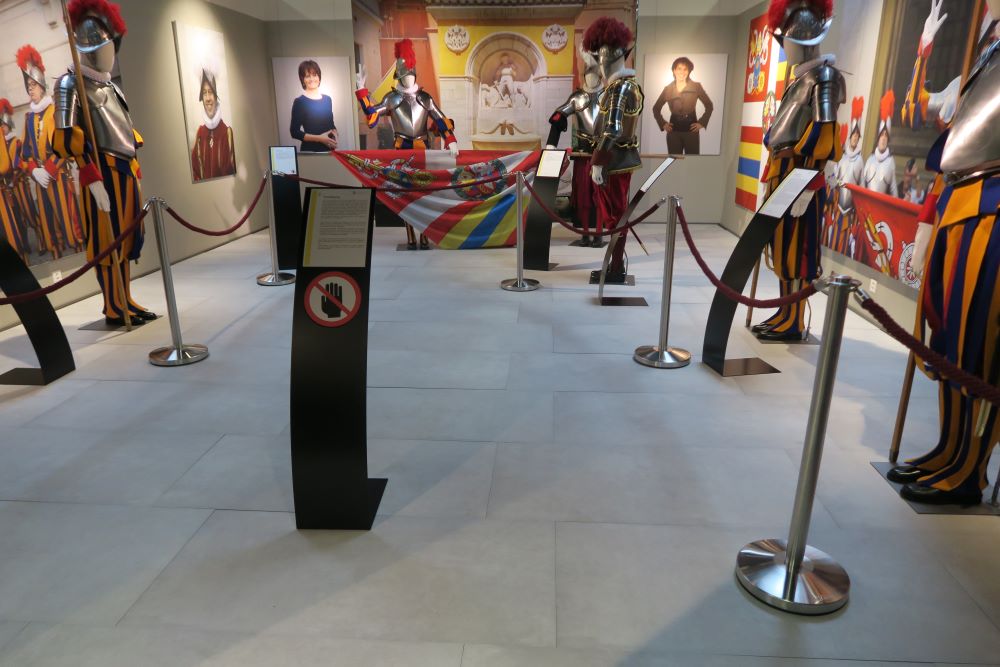
Pratteln, Galerie Beyeler, exhibition ´Schweizer Garde´, 2019. Photo: TES.
The Guard was founded in 1506. It is the only foreign military organization Swiss citizens can join today.
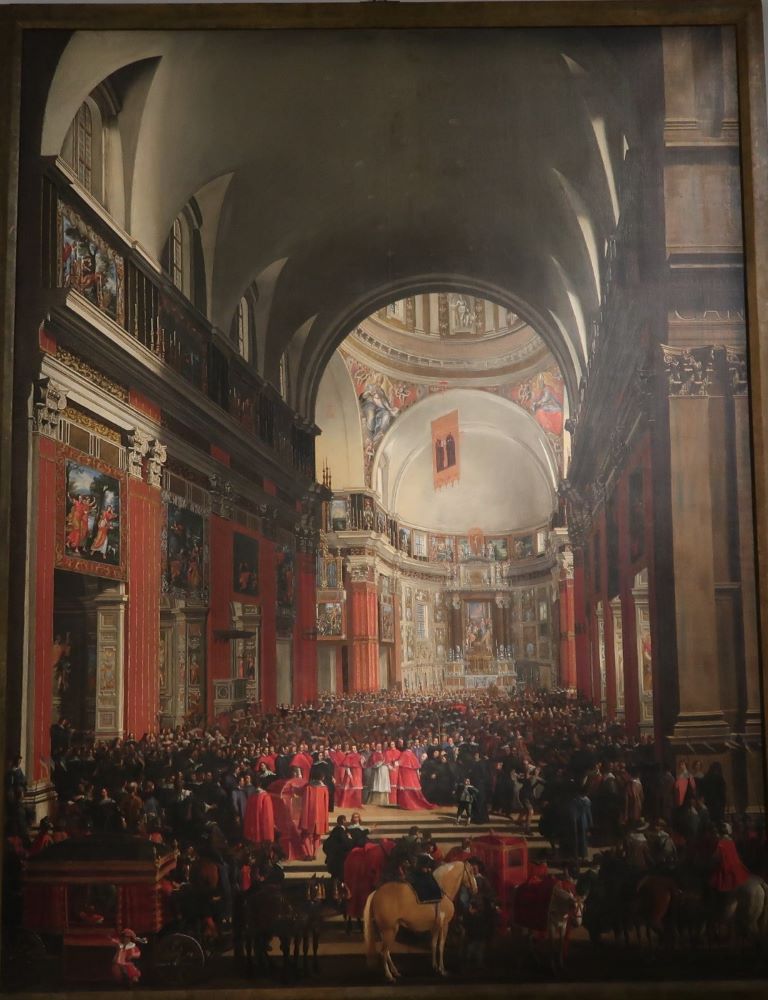
Andrea Aacchi, Jan Miel, Filippo Gagliardi, The Church Il Gesù Rome, 1640. Collection Nazionali d’Arte Antica di Roma. Exhibition ‘Baroque. Age of Contrasts’ National Museum Zurich

Detail: The Swiss Guard

Bern, Apostolische Nuntiatur. Photo: Nonciature – Conférence des évêques Suisses (eveques.ch)
Foundation for the Renovation of the Barracks of the Swiss Guard
The Foundation for the Renovation of the barracks of the Swiss Guards was founded in 2016. The foundation (La Fondation pour la Rénovation de la Caserne de la Garde Suisse Pontificale au Vatican/ Die Stiftung für die Renovation der Kaserne der Päpstlichen Schweizergarde im Vatikan) undertakes fundraising activities to finance the project.
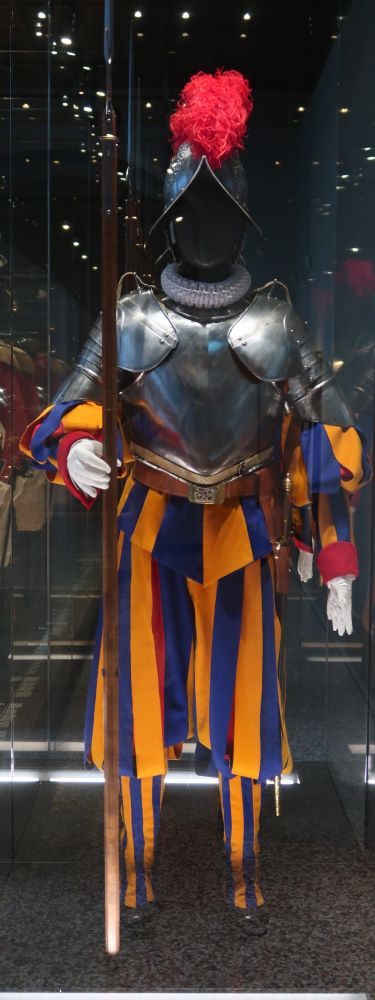
The Swiss Guard. National Museum Zurich

Galauniform Zwitserse Garde, c. 1820. Collectie: Rätisches Museum, Chur.

La Garde Suisse, gala uniform, 20 August 2022 in Lugano. Photo: TES.
Castelmur and the Pastrymakers

Available in German, Dutch and French
The Albula Pass and its History

The Albula Pass (Canton of Grisons) has been an important trade route and strategic pass since the Confederation conquered the Italian territories in the Veltlin region around 1500.
, transported wine from Italy and salt, grains and rice from Tyrol with donkeys, horses and mules. To the south, they sold cattle, dairy products, ores and metals from Bergün (Bravuogn in Romanic) and Filisur.


A postal service was established in 1548. It also transported people in diligence, large carriages pulled by six or eight horses, over the pass. The French king, who had been an ally of the Confederation of thirteen cantons and their allies, including the Freistaat der Drei Bünde, today’s Graubünden, initiated the postal service to the Republic of Venice in that year.
Although the Splügen and Septimer passes also grew in importance, the Albula pass remained a vital traffic route for people, mail and goods. In 1866, the four-metre-wide road between Bergün and Le Punt in Upper Engadine was completed. The journey from Chur to St. Moritz took from then on ‘only’ fourteen hours. The Albula railway, in 1903, shortened the trip to a few hours.


Landwasserviaduct, Filisur. Photo: TES
Due to the ban on cars in the canton, it was not until 1925 that cars were allowed to use the pass. The Albulabahn, the famous Landwasserviaduct at Filisur and the almost six-kilometre-long Albulatunnel have been registered as UNESCO World Heritage Sites since 2008. Today, the Albula Pass is primarily a tourist route and a pass for local travel.


The Albula Pass was part of the defensive line, known as the Reduit, in the Alps during the Second World War (1939-1945), under the name Sperre Albula. Every pass in the canton was a fortress of rocks, bunkers and stone obstacles during this period.


A Last Farewell by Otto Frank

The section’ Latest News’ contains the last sign of life and the last news of the Frank family to the outside world. Otto Frank (1889-1980) wrote on 4 July 1942 to his mother Alice Frank-Stern (1865-1953) and his sister Helene Frank (1893-1986) in Basel: “Seid doch in keinem Fall beunruhigt, wenn Ihr wenig von uns hört”. On July 6, 1942, the family went into hiding. The message is eighty years old but still topical.
The Frank Family
The married couple Otto and Edith Frank-Elias (1903-1945) and their two children, Margot Betti (1926-1945) and Anne(lies) Marie Frank (1929-1945),had lived in Amsterdam since 1933. Two of Otto’s brothers, Robert (1886-1953) and Herbert (1891-1987,) and his sister Helene (Leni, 1893-1986), had lived in Basel since 1929. They had founded the Opektapectine company in Switzerland.
Otto grew up in Frankfurt am Main (Germany). In 1914, there was no indication that 19 years later, he would have to leave his homeland. He and his brothers Robert and Herbert had bravely defended their Heimat in the First World War (1914-1918).
After a relatively prosperous economic period in the Weimar Republic from 1925 to 1929, the Wall Street Crash ended the bank of Michael Frank (1851-1909), Otto’s father. The crash also began the Nazi party’s rise to power. After January 31 1933, Otto foresaw what was to come. Otto chose Amsterdam to open a branch of the Opekta (Obstpektin aus dem Apfel) company. It was a fatal choice, but nobody could have predicted that in 1933.
The Netherlands and Switzerland
Margot and Anne quickly integrated and spoke Dutch without an accent. They spent the winter and summer holidays in Sils-Maria (Upper Engadine, Canton Graubünden) or Adelsboden, Canton Bern).
From 1938, Otto tried unsuccessfully to get a visa to Cuba or America. His many requests were not granted. On May 15 1940, the Netherlands capitulated, and the persecution of the Jews began.
Margot received the call for transport in early July 1942. Otto realised that it was time to go into hiding. Everyone knew about their intensive contact with Switzerland. Otto pretended to the outside world that he was fleeing to Switzerland. The other people in hiding were Hermann van Pels (1898-1944), his wife Auguste van Pels (1900-1945), their son Peter van Pels (1926-1945) and Fritz Pfeffer (1889-1944).
The Annex (Het Achterhuis)
Only a small group of helpers, employees of his company and their relatives, knew the real destination: the secret room in his company’s building at Prinsengracht 263 in Amsterdam. These heroes were Miep Gies (1909-2010) and Jan Gies (1905-1993), Victor Kugler (1900-1981), Johannes Kleiman (1896-1953), Johan Voskuijl (1892-1945) and his daughter Bep Voskuijl (1919-1983).
Anne was given a diary in 1942 and started writing. A radio broadcast by Radio Orange on the BBC in 1944 inspired her to change her editorial style. She re-edited her story as a literary testimony. Since then, two versions of the diary have existed. The second version was intended for the outside world. Anne wrote her last contribution on August 1 1944, after many hopeful days following D-Day.
The Diary
Only Otto survived the war. Miep Gies gave him the diary on his return to Amsterdam. It was not until months after the war that he received the news that his two daughters and wife had not survived. He emigrated to Basel soon afterwards.
After much deliberation, reading and rereading, he published the diary in the Netherlands in 1950. At the time, few people in the Netherlands were interested in the sad fate of Anne and the Jews in general. People wanted to forget and look forward.
The German edition appeared in 1952. However, the breakthrough came with the American editio, which was adapted intor a play in 1955 and a film in 1959. Although the diary appeared infreely adapted scriptst in the theatre and cinema, Anne and her diary became world-famous.
In 1963, Otto founded the Anne Frank Fonds (www.anne-frank.ch) in Basel. Others have continued this NGO from 1980 to the present day. Anne often visited Switzerland in the 1930s, visiting her uncles and aunts in Basel for winter and summer holidays. Would Anne have been happy with the seat of the Anne Frank Fonds in Basel? We will never know, but the treatment of Jewish refugees is not a glorious chapter in the country’s history.
Neutrality
The Swiss authorities did not recognise Jews as political refugees, and around 25,000 men, women and children were sent back to the border to certain death. That approximately the same number were allowed to stay does not alter this fact. It is a black page in the history of the country of the Red Cross and humanitarian aid. 1871, the country received around 80,000 French soldiers and welcomed almost 70,000 Ukrainian refugees in 2022.
There were extenuating circumstances, however. The aggressive and ruthless dictators could invade at any moment, and there was a lot of poverty and unemployment in Switzerland. All democracies had closed their borders to Jews on the eve of the Second World War. The European anti-Semitic mentality was omnipresent, and less information and foreign experience were available.
Moreover, there were many brave (police) officials, citizens, men, women and children who did allow Jewish refugees to pass through and shelter them. Public opinion did not agree with the restrictive policy, but there was press censorship because of the state of emergency and little came out into the open. Fear of dictators was and is a bad advisor—a topical lesson concerning the present-day neutrality discussion.
Conclusion
Switzerland also has a war past. Since 199,0, this has been the subject of much debate and publication. With today’s knowledge, it is easy to make judgments.
However, the politicians did not want to, and could not annoy the surrounding ruthless dictatorships too much. After France’s rapid capitulation in 1940, Germany did not have a military necessity to invade the country, but Swiss politicians and generals could never be certain.
The stakes were high. The policy of making compromises and giving in on the one hand but building up a strong defence (the reduite in the Alps), on the other hand, seemed reasonable enough in these dangerous days for Switzerland as a nation. The outcome of a German invasion was sure, but the costs had to be as high as possible so that the aggressor preferred the benefits of a neutral country.
The discussion is still ongoing. However, Switzerland, its politicians and citizens did not distinguish themselves from other neutral countries, such as Sweden, or governments, citizens and industries in the occupied countries.
The current exhibition in the National Museum (Landesmuseum) in Zurich has the theme ‘Anne Frank und die Schweiz‘, Anne Frank and Switzerland (June 9 to November 6 2022).
The Saffron Village of Mund

There is always something to discover in Switzerland. For example, every hamlet, village and town has its particularity, the village of Mund (canton of Valais). In Gondo (Kanton Valais), there was a real gold rush in the nineteenth century, but in Mund, the (culinary) precious Saffron, the ‘Queen of Plants’, has been cultivated for centuries. Iran is the home country and the undisputed market leader in this field, but Mund also has a reputation.
Mund is located at an altitude of 1,200 metres in the middle of the UNESCO World Heritage Site Jungfrau-Aletsch, on the right side of the Rhone Valley, not far from Naters and Brig.
Saffron has been cultivated in Switzerland since the 14th century, but nowadays, only in Mund. In an area of two hectares, the harvest in September and November yields approximately two kilograms of pure Saffron per year. Per kilo, no less than 130,000 petals are needed!
Due to climatic conditions (lots of sun, sufficient rain and morning dew) and the soil conditions, the aroma is exceptional. It is not only the Queen of Plants but, per gram, more precious than gold!
The Saffron Museum (Safranmuseum) in Mund and the Safranlehrpfad tell the history of this unique plant in Valais and its properties in scents and colours.
Source and Further information: www.belalp.ch en de Safranzunft Mund.
Two Thousand Years Geneva, Vienne, Allobroges and Gallia Narbonensis

Geneva is more than a city of diplomacy, international organisations, markets, banks, the watch industry, and the lake’s fountain.
It was the first territory conquered and governed by the Romans (120 B.C.) in present-day Switzerland, one of the country’s first bishoprics, the capital of Calvinism, an independent republic until it was annexed by Napoleon in 1798 and incorporated into the Swiss Confederation in 1815. In short, a city with a millennia-old past and an interesting and varied (cultural) present.

Le Sentier culturel Vielle-Ville (The cultural path of the old town) traces two thousand years of history by an architectural, cultural and historical trail:
The Roman period and Christianity (the archaeological site of St Peter’s Cathedral);
The kings of Burgundy, the Merovingians and Carolingians, the county, the bishopric, the city, and the canton of Geneva (since 1815), the dukes of Savoy, and the famous Escalade, the Reformation, and the Musée de la Réforme.


The Roman period

The Burgundian King
The City Hall, the seat of the cantonal and municipal political for more than half a millennium, the Place du Bourg-de-Four, the birthplace of Jean-Jacques Rousseau, Maison Tavel, the Museum of the Zoubov Foundation, the Barbier-Mueller Museum, Jean Calvin’s house (the house he lived in was demolished in 1706 and replaced by the current building).

The Saint-Antoine Bastion, the Lutheran Church, the Baudet Tower, the Old Arsenal, the Reformers’ Wall, the Temple of Fustery, the Temple of Madeleine, the Abbey Foundation, the Museum of Art and History, the Graphic Arts Cabinet, and many ancient streets and squares. Et encore le Bastion Saint-Antoine, l’Église luthérienne and la tour Baudet.


The residence of Calvin

The auditorium of Calvin


Collège Calvin

The four Calvinist reformers Calvin, Farel, Beze et Knox, le mur des Réformateurs
(Source and more information: www.geneve.ch).


The Rhone, the Arve and Neptune

La Madeleine

Le Temple de la Fusterie

Hans Rudolph Manuel Deutsch, the oldest realistic map of Geneva, around 1550. AEG Archives privées 247/1/91
