The Ajoie, Dinosaurs and the Bishop

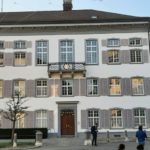
Porrentruy (Pruntrut in German, canton of Jura) was for a long time the seat of the bishop of Basel after he left his episcopal palace at the Münster in Basel during the Reformation in 1528.

The Bishop of Basel acquired this area in 999 by a gift of the (last) king of Burgundy, Rudolph III (977-1032). The king transferred the powerful abbey of Moutier-Grandval to the bishop. This abbey possessed the Ajoie and other territories in the Jura. The monastery was abandoned after the Reformation around 1530 and torn down to the last stone (Moutier and the Moutier-Grandval Abbey).

Porrentruy and Ajoie

Porrentruy is located in the Ajoie region, north of the River Doubs, on the edge of a plain in the Jura Mountains and a few kilometres from the French border. The large episcopal palace and castle on the hill, the Hôtel-Dieu, the 18th-century glacière, the chapter houses, and other grandeur bear witness to the centuries-long presence of this prince of the Holy Roman Empire of the German Nation.

The Prince Bishop and Bern

The bishop, also a prince of the Holy Roman Empire of the German Nation, hence the title prince-bishop and prince-bishopric, remained in possession of Ajoie until the invasion of revolutionary France in 1792. Only the Count of Monbéliard was lord of this region for a few periods, in 1283 and 1386-1461.

The prince-bishop definitively lost the territory in 1792. Ajoie, together with other regions of the present-day canton of Jura, fell under the short-lived Rauracian Republic (November 1792-March 1793), the department of Mont-Terrible (1793-1800) and the department of Haut-Rhin (1800-1813) before being annexed to the canton of Berne by the decision of the Congress of Vienna in 1815.

Many old boundary stones in the forests mark the ancient border of the canton of Bern (with the Bear) or the Swiss Confederation (CS: Confédération Suisse) with France, marked with the French Fleur-de-lis or RF (République Française). Since 1979, the French-speaking canton of Jura has formed the border with France.

Dinosaurs, Glaciers, Sea and Prehistoric Park

Not only the bishop but also the dinosaurs, glaciers and sea are still visible. Some 20 million years ago, this region was situated on and under a subtropical sea. Further back in time, around 175 million years ago, the Jurassic was a favourite habitat of the dinosaurs. It was cold, approximately 20,000 years ago, with a polar climate characterised by glaciers hundreds of metres thick and wide.

The Prehistoric Park near the village of Réclère (Préhisto-Parc de Réclère) reconstructs the world of dinosaurs along a two-kilometre-long trail and features a documentation centre. There are 45 lifelike replicas of the first fish, reptiles, and dinosaurs on land, in the water, and in the air along the trail. The 1,500-metre-long caves and their stunning stalagmites and stalactites in this park were formed over a process lasting millions of years.

The church of Réclère is also home to a more recent work of art: the famous stained-glass windows by Wilfrid Moser (1914-1997).

Ajoie

The name Ajoie is derived from the little Allaine, which flows through Porrentruy and into the Doubs. Other names for this region are Le Pays de Porrentruy and, in German, Pruntruter Zipfel (formerly also called Elsgau).

Mountains up to almost 1,000 metres surround the plain of the Ajoie. The agricultural use of the area is characterised by fruit trees, cattle breeding and arable farming, including rape and grain.

The hiker passes several ancient villages, including Grandfontaine, above Réclère, Roche-d’Or, Rocourt, and Chevenez.

The Swiss Alpine Club

The Swiss Alpine Club, section Basel (www.sac-basel.ch) regularly organises hiking trips in this region (and elsewhere).

The SAC (www.sac-cas.ch) organises ski tours, mountaineering, and other sports in the high mountains and the Alps, as well as activities in different regions.

Roman Theaters and amphitheatres in Switzerland

Ancient theatres

A theatre tradition was absent in the western provinces of the Roman Empire until August (emperor from 27 BC—14 AD). Stone theatres existed only in Greek settlements in Spain (Hispania) and southern France (Gallia Narbonensis).

Stone theatres were not built in Rome and the conquered western territories until the last phase of the Roman Republic (the period after 55 BC).

The theatre was a vital means of communication in Greece and played a significant political role in society.

Rome

The Senate banned stone theatres in the Roman Republic because they could be abused for political purposes. Wooden theatres were allowed because they were not permanent.

After all, the theatre was not just a place to perform a comedy or tragedy but primarily a meeting place for the elite and citizens.

Additionally, religion played an important role in the theatre. Processions, sacrifices, and other religious rituals were central to theatre performances, which lasted for days.

Aosta, the only roof-covered Roman theatre, is next to the amphitheatre.

The Republic

In the last decades of the Republic, theatrical performances and the size of wooden theatres, which could accommodate many thousands of spectators, surpassed each other in originality and cost. Generals and other high-ranking and wealthy citizens financed the spectacles.

Ideology, religion and propaganda went hand in hand. Against this background, the general Gnaeus Pompeius Magnus, Pompey the Great (106 – 48 BCE), built the first stone theatre in Rome in 55 BCE, presented as a temple, as it was still formally forbidden.

And there was indeed a temple present, though dwarfed by its construction for tens of thousands of spectators.

His opponent, Julius Caesar (100-44 BC), did not leave it at that and began building a gigantic stone theatre in Rome, which, however, was not completed until 11 BC, under Emperor August, as the Marcellus theatre. In Spain, Lucius Cornelius Balbus (100-32 BC), an ally of Caesar, built a vast stone theatre at Gades (Cadiz) in 44. Chr.

Theatre Aventicum (Avenches)

Emperor Augustus

Under Augustus (63 BC – 14 AD), the stone theatre became an important ideological and political medium. He struggled to present his monarchy in Republican Rome without being referred to as a king.

After all, that had proved fatal to his adoptive father, Caesar, in 44 BC, August called himself princeps inter pares, hence the name Principate, but he could not hide the fact that there was, in fact, a monarchy, which was only called an empire after Augustus.

Theatre Augusta Raurica

Propaganda

Propaganda, the feeling of peace, security, and economic prosperity after decades of civil war, was also crucial for legitimising his power.

Not the letter of the (republican) law, which formally remained in place, but imperial ideology and the imperial cult were the de facto constitution.

The theatre became one of the empire’s mouthpieces and propaganda institutions. It was an essential means of communication, organised strictly hierarchically according to an established building concept.

The theatres, ideology, and communication

Rome’s theatres became the architectural benchmark for provincial towns and local elites, urbs pro maiestatae imperii ornata.

The local elites financed the theatres and performances, mirroring the building and cultural policies of the emperor, Rome, and its immediate surroundings. In this ideology, theatres were an essential means of communication between the emperor and his citizens in Rome, Italy, and distant provinces.

The political significance of the theatre stemmed from the omnipresent emperor’s cult, statues, and other images, as well as the fact that the performances took place in his name. The theatre was a political building. It was a medium for mass communication, with religion and self-representation of the elite and financiers playing a central role.

For this reason, Augustus introduced numerous new religious festivals and ceremonies, which were often expressed in the theatre through performances.

By closely linking religion and political ideology, Augustus created a new structure for loyalty to his person and regime in the profoundly religious ancient world.

This feature was the core of the imperial cult, expressed by priests. Augustus had appreciated the importance of theatre.

Amphitheatres

Amphitheatres did not arise until much later, at the end of the 1st century. The Colosseum in Rome (70 AD) is the best-known example. Due to its success in Rome, amphitheatres were constructed in the provinces during the 1st and 2nd centuries. Spectacles, wild animals and gladiators were the main events. However, like the theatre, it was a political institution that served as a platform for propaganda and communication with citizens.

Avenches (Aventicum), amphitheatre. Musée romain.

Political

Local elites had to copy Rome’s model and started financing and building stone theatres in their cities. They also organised festivals and ceremonies more than fifty days a year.

Stone theatres and performances were not only a favour of the emperor and the local elite but also a right of the people. The people expected public sponsorship from the elites. In the theatre, citizens’ political involvement led to participation in the performances by publicly expressing approval or disapproval of policies.

After all, Augustus had effectively established an absolute monarchy under the guise of a republican form of government, and the theatre was one of the lubricants that maintained this system.

Theatres in Switzerland

During the first and second centuries AD, several large stone theatres were constructed on Swiss territory, including those in Augst, Lausanne, Nyon, Lenzburg, and Avenches. Amphitheatres have also been discovered in Windisch, Avenches, Nyon, Augst, Kaiseraugst, and Martigny. The local elites paid for them and their maintenance, sometimes perhaps with the (financial) support of the emperor, his closest relations, and the manpower of the local legions.

Nothing is known about the performances, but propaganda and the imperial cult will also have been prominent in these theatres.

(Source: U. Pappalardo, Antique Theatre, Petersberg, 2007)

The Engadine in the Spotlights

Deep blue lakes and sunny snow-capped peaks – with its landscape and unique light, the Engadine is one of the most spectacular (holiday) destinations and natural environments in the Alps.

The book presents the most important places and beautiful landscapes, from Sent to Sils, Corvatsch to Münstertal.

The Alpine passes, viaducts, valleys, mountains, lakes, villages and towns, rivers and streams, Engadine specialities, the Rhaeto-Romanic language, graffiti and architecture are only some topics discussed.

From the mundane Upper Engadine to the still rural Lower Engadine, the book offers fascinating insights into one of Switzerland’s most beautiful high-altitude valleys, if not Europe.

Angelika Overath, Gebrauchsanweisung für das Engadin, Munich, 2016

Basel-Stadt and Basel-Landschaft

Nothing is forever, not even in Switzerland. The creation of the new canton of Jura in 1979, the choice of Moutier (canton of Bern) by referendum in 2021 to join the canton of Jura in 2026 or, for example, the mergers of municipalities.

Switzerland is also the outcome of centuries-long processes, as the new publication by François Walter (Text) and Marco Zanoli (Maps), Historischer Atlas der Schweiz (Zurich, 2021), shows. The canton of Basel also has a similar history.

Canton of Basel

The Canton of Basel became a member of the Eidgenossenschaft or Confederation in 1501. The city of Basel was the canton’s most important political and economic municipality. An oligarchy of guilds and merchants governed the town and the Landschaft.

After the Reformation of 1527-1528, the last aristocratic families left the town or were absorbed into the bourgeoisie. The bishop and his chapter left for Porrentruy (Pruntrut in today’s canton of Jura). The bishop was also a prince in the Holy Roman Empire of the German Nation, hence the titles “prince-bishop” and “prince-bishopric.”

However, he retained his property and estates, which extended into Alsace, southern Germany, and the current cantons of Jura, Bern, Basel, and Basel-Landschaft. This situation ended during the French invasion in 1792-1798 and the Congress of Vienna in 1815. The end of French rule marked the beginning of restoring the ancien régime of the Basel oligarchy.

Town Hall (Rathaus)

Canton of Basel-Landschaft

However, the old days did not return to the canton of Basel. The towns, municipalities, and farming communities of the Landschaft no longer accept the political dominance of the urban oligarchy.

Economic and demographic changes created new realities. Firstly, almost twice as many people lived in the Landschaft as in Basel. Secondly, the Landschaft had become much more prosperous and self-confident since the sixteenth and seventeenth centuries, partly due to the flourishing textile industry.

The Landschaft’s population demanded more participation in political decision-making, which led to disagreement with the canton’s government, which, after 1815, was effectively back in the hands of the old ruling class that had been in power before 1798.

From 1830 onwards, the citizens of the Landschaft organised themselves, partly inspired by the uprising in Paris that year. A referendum showed a majority in favour of a split. However, the government did not accept this outcome.

It led to the period known as the “Basler Wirren” and armed interventions by the city of Basel’s militia. The inhabitants of the Landschaft adopted, following a referendum on 17 March 1732, a constitution for the new canton Basel-Landschaft (Baselbiet or Baselland)

Not all communes agreed, however. It was a complex situation. In fact, there was a kind of civil war within the Landschaft, as evidenced by a proclamation of 20 August 1831 from supporters of secession: “Jeder der zu Gunsten von Basel agiert oder Proklamationen verteilt, wird volgelfrei erklärt“.

The situation threatened to escalate with a new military expedition by Basel, which ended in defeat on August 3, 333. The Tagzatzung, the meeting of the cantons, then intervened. On 26 August 2633, a large majority decided to split the canton into the cantons Basel-Stadt and Basel-Landschaft. Liestal became the capital of the new canton and the seat of government and parliament (Landrat).

The new canton Basel-Stadt accepted the decision of the other cantons and adopted a new constitution on October 3833.

The unification of the two cantons and referendums 

In 1863, the canton Basel-Landschaft (informally Baselbiet or Baselland) was one of the first cantons (except the cantons with a Landsgemeinde) to introduce direct democracy: the election of the government (Regierung) and the parliament (Landrat) by the citizens, the right to vote out a member of parliament at any time, the right of initiative (Initiative), and the obligatory referendum (obligatorisches Gesetzesreferendum) on new legislation.

One of the first referendums, held on 4 March 464, abolished the “Niemals Beschluss” of reunifying the two cantons. From 1900, there was indeed a strong movement in the two cantons to achieve reunification.

A 1936 referendum led to preparations for reunification. Then came the Second World War, and the momentum was lost. However, a new referendum in Basel-Landschaft in 1958 confirmed the majority’s wish to unify both cantons.

Two events thwarted this project: Basel-Landschaft experienced economic success in the 1960s. It was the most robustly growing canton, and this development reduced the inclination to merge with the relatively poorer canton of Basel-Stadt.

The second factor was the introduction of women’s suffrage in the canton in 1968. On 7 December 1969, women overwhelmingly voted against unification in the referendum for a unified canton of Basel.

A new era? Eric Nussbaumer (SP), canton Basel-Landschaft, President of the Federal Council in 2024 (third from left) Eva Herzog (SP), canton Basel-Stadt, President of the Council of States in 2024 (fourth from left), on 6 December 6ter their appointments. Beat Jans (SP), president of the canton’s government, fifth from left.

Cooperation and cantonal treaties

Although the cantons have been cooperating in many fields since this referendum, the citizens of Basel-Stadt rejected reunification in a new referendum in September 2014.

For example, the two cantons concluded agreements as sovereign republics regarding health care and education. Citizens in both cantons have the final say, however. The citizens of Basel-Stadt, for instance, rejected the merger of hospitals in a referendum, while the citizens of Basel-Landschaft voted in favour.

Even though the dates of Fasnacht differ, there has never been a referendum on this issue.

(Source: R. Teuteberg, Basler Geschichte, Basel 1988).

Notre-Dame du Vorbourg

The oldest Maria sanctuary (12th century) in the canton of Jura is located in the valley of Delsberg (Delémont), situated on a rock at the foot of the river Birs, which flows into the Rhine near Basel.

The chapel was originally part of Telsberg Castle. The earthquake of 1356 destroyed the castle. The chapel was largely spared.

After the Thirty Years’ War (1618-1648), the chapel was extended to the rock on which the tower of St. Anne stands. At the same time, the statue of Notre Dame du Vorbourg was erected.

On 7 April 1658, Mary became the chapel’s patron saint.  The votive images from 1671 are among the most remarkable in Switzerland.

During the Second World War, the pastor of Delsberg vowed to establish a permanent priesthood in the chapel if the Nazis did not occupy Switzerland. Until 2018, this service was carried out by the Benedictines. The current observer is a priest of the diocese.

(Source and further information: www.delemont.ch)

Natural History Museum 200 Years

In 1821, Basel opened its first state museum, the Natural History Museum Basel (Naturhistorisches Museum Basel), in the Falkensteinerhof building on the Münsterplatz.

Specialist libraries, collections, and research equipment were no longer scattered throughout the city but were under one roof. Some collections date back to the Middle Ages and the Basler bourgeoisie’s passion for collecting in the early modern age.

Citizens laid the foundation for the collections in the 17th century. Numerous objects originated from the cabinet of the Basel physician Felix Platter (1536–1614). Other pieces date back to the Amerbach cabinet filled by the professor of law, Basilius Amerbach (1533 – 1591).

At the start of the 19th century, the space needed for the collections increased after Peter Merian (1795–1883) donated his objects to the newly founded museum.

The museum’s collections comprise natural history objects from zoology, entomology, mineralogy, anthropology, osteology and palaeontology.

When Basel-Stadt and Basel-Landschaft became two separate cantons in 1833, there were calls to split the collections. A court ruling, however, concluded that they were assets of the canton Basel-Stadt.

Since 1849, the museum has been housed in the late-classical monumental building on the Münsterhügel in the city’s heart. However, the museum will move to another building in 2028, the monumental Baugrube from the eighteenth century.

A museum is a place of national education. The museum combined Aula, event spaces and library rooms with natural and art history collections.

(Source and further information: www.nmbs.ch).

Waldegg Castle

Waldegg Castle is situated on a hill at the foot of the Jura, in the middle of the baroque town of Solothurn.  Johann Viktor von Besenval (1638-1713) from Solothurn had the baroque house erected as his summer residence between 1682 and 1686.

Today, Waldegg Castle is owned by the Canton of Solothurn. Since 1991, the monument of national importance has been open to the public as a museum and meeting centre.

Museum Waldegg Castle dedicates its permanent exhibition to a core theme of Solothurn’s history: From the 16th to the end of the 18th century, the envoys of the French kings resided in Solothurn, bringing courtly splendour, savoir-vivre, and a great deal of money. The exhibition highlights the social and economic importance of the French ambassadors for the local patrician families and the city of Solothurn.

With its richly decorated salons, the extensive collection of magnificent paintings and the original furniture, the museum illustrates the French lifestyle of the Solothurn patricians. Further highlights on the tour include the two castle chapels and a historic bathtub in the gardener’s house.

The various gardens are what make Waldegg Castle so special. On the representative south side of the house lies the Baroque garden. To the west lies the orangery parterre. On the north-western side of the house, there is a traditional kitchen garden with flowers and vegetables.

(Source and further information: www.dieschweizerschloesser.ch)

The Report of John Bowring on Switzerland

The Report on the Commerce and Manufactures of Switzerland by John Bowring was presented to both Houses of Parliament in 1835 and published in 1836.

Bowring (1792-1872) visited Switzerland and most of its cantons in 1835. He wrote this Report based on his impressizons and visits and meetings with politicians, industrialists, manufacturers, traders, citizens, farmers, and labourers.  The summary is made by the editor and is still topical.

Introduction

“When I was directed to inquire into the commercial relations of Switzerland, it could not, indeed, but excite the attention of any reflecting person, that the manufacturers of Switzerland, almost unobserved, and altogether unprotected, had been gradually, but triumphantly, forcing their way into all the markets of the world, however remote, or seemingly inaccessible.

That such a remarkable result was not the consequence of geographical position is evident, for Switzerland neither produces the raw material which she manufactures nor when manufactured, has a shiny outlet port, except on the conditions her maritime neighbours impose upon her. None of her fabrics owes its prosperity to protecting or interposing legislation.

Her progress has been almost unparalleled in manufacturing prosperity. In most of the manufacturing cantons of Switzerland, the power of legislation is not only indirectly but directly in the hands of the whole body of the people. Were their commercial economy opposed to the common interest, it could not exist for a day. It has the sanction of universal experience and universal approbation.

Activity is visible everywhere, like in the trading and agricultural districts. There is no national debt in many of the cantons, and some of them nearly discharge their government’s expenses out of the interest of that capital which has been accumulated from the surplus revenues of many years.

However, Switzerland is far removed from the great centres of trade. The cotton she manufactures must be conveyed hundreds of miles from the Mediterranean and a greater distance from the Atlantic Ocean.

The silks she imports from Italy and France, and her wool from Germany. It must find its way over the Jura or the Alpine mountains; be conveyed down the irriguous rivers or on the inland lakes; yet, despite all impediments, the manufactured products of Switzerland are found in all the great markets of the universe; and the reason is simple, but unmistakable: Industry has been left to itself.

The system

Wealth has not been diverted from its natural tendencies by legislative interference. There has been no foolish struggle encouraged by the government between the protected monopoly of the few and the unprotected interests of the many.

It might be expected that the prohibitory system with which surrounding States have fenced their frontiers would alarm the manufacturers of Switzerland, and induce them to seek commercial alliances among neighbouring countries by adopting similar legislation, falsely called protective.

But such has not been the tendency of Swiss opinion nor the recommendation of Swiss experience. Many of the most enlightened manufacturers assured me that they were convinced that the free trade and the free transit policy are the wisest, the most prosperous, and the best.

Notwithstanding the natural disadvantages of the geographical position of the Swiss cantons, I am persuaded there does not exist in the world a manufacturing industry more sound, healthy, and elastic than that of Switzerland.

While, on the one hand, it is an object of alarm to those who represent the interests of the protected portion of the manufacturers of France, while the markets of Germany and Italy are becoming less and less accessible to the produce of Swiss industry, that industry, on the other, is constantly making its way to new regions of demand.

That of the transatlantic states far exceeds the consumption it formerly found in Europe, and Switzerland has already, through courageous perseverance and an intelligent and successful commercial policy, In travelling through the different districts, I constantly found merchants and manufacturers who had established connexions with the remotest countries of the globe.

The cantons

The cantonal independence has been singularly preserved. Revolutions that have entirely changed the constitution and laws of one district have had little or no influence on another. The boundary of a canton has often been the scene of the most marked and violent political commotions. The civil war has not spread beyond the narrow sphere of local interests. No other example exists in the long continuance of separate adjacent communities so small yet wholly independent. Switzerland is a federation of large, self-governing cantons.

In some cantons, a public assembly is required to obtain the direct approval of a majority of the entire population, thereby giving any act of the legislature the form and sanction of law. In almost all instances, electoral suffrage is widely diffused and, in most instances, universal.

The independence of the different cantons has prevented the settlement of any general law of transit, the want of which is very sensibly felt. A significant proportion of the cantons receives a large part of its revenues from a Droit de péage, and the collection of tolls at the different frontiers necessarily impedes the transport of merchandise.

Merchants have made numerous attempts to equalise the transit duty and eliminate the charges and burdens of numerous local administrations through a comprehensive plan. Still, the local influences have been hitherto invincible.

I had the satisfaction of frequently hearing discussions on trading and manufacturing interests. I was invariably struck with the calm and quiet good sense, the sobriety, order, and intelligence with which all such matters were debated.

It very frequently happens that, without local or personal influence, individuals are nominated by the electors solely on the grounds of their virtues or their talents. I am well aware this is not the place for those general details as to the improved condition of the labouring population of Switzerland.

Prosperity

I doubt whether any country has made the same comparative progress in prosperity. In the mountains of the Jura and Appenzell, along the borders of the lakes of Zurich and Constance, everywhere where the operatives are settled, I found in their habitations a mass of enjoyments, such as are possessed by few of similar stations in other countries.

If there be any ground for anxiety, it is in the gradual intrusion of machinery upon manual labour, an intrusion everywhere felt, and which menaces Switzerland more immediately and more alarmingly since so significant a portion of her manufactures is produced by domestic labour.

International relations

In December 1833, the Swiss Confederation appointed a committee to report on Switzerland’s foreign commercial relations. The reports boast of the fact that the various industries of Switzerland has developed itself without protection or privilege for articles produced at home, as without prohibitions or duties on those imported from abroad, and it strongly recommends, in the fiscal and custom house struggle which is going on in Europe, that Switzerland should preserve a strict neutrality.

They declare that their political and commercial well-being demands perseverance in liberal legislation, which is the groundwork of their social policy.

The political character of the Prussian League—the interests of other countries, France, England, and Russia, which Switzerland is bound not to disregard — requires that Switzerland should not be a party to a question likely to divide Europe into two opposing sections.

They state that however strong the motives for adhesion may be among the German cantons, opposed motives are far more vital in the Southern and Eastern districts, and, as the establishment of a different system between the North and South would destroy the unity of Switzerland, the Committee recommend that participation in the good or evil of the Prussian Commercial League should be declined.

Conclusion and recommendations

The Committee concludes the Report with the following resolutions: I. The Swiss Confederation shall adhere to its established system of free trade and manufacturing. II. Under no circumstances and conditions shall it form a part of the French custom-house system of the Prussian Commercial League or the custom-house line of any foreign nation. III. It shall use every effort to establish and extend the principles of free trade. IV. As far as possible, it shall discuss and establish conventions with neighbouring states for maintaining daily, reciprocal, economic, neighbourly, and border traffic and market transactions. V. Wherever a free trade is not obtainable, it shall endeavour to remove all prohibitions, lower duties, and secure transit power on the most favourable terms.”

Grandval and the Abbey

The village is located in the Grand Val (approximately 900 Meters Above Sea Level). The village of Grandval emerged after the establishment of the abbey of Moutier-Grandval, which was founded around 640.

The famous medieval Bible of Moutier-Grandval (now in the British Museum in London) and the cross of St. Germain (in the Musée jurassien d’art et d’histoire in Delémont) have given the village worldwide fame.

Grandval belonged to the abbey until 1797. After the French invasion of 1792, the village passed into the French departments of Mont-Terrible (1793-1800) and Haut-Rhin (1800-1813) before being annexed to Bern in 1815.

First mentioned in 962 and dedicated to St. Martin, the chapel became the parish church in the 14th century. After 1663, the church was rebuilt several times. It has been a reformed parish since 1531.

(Source and further information: Historisches Lexicon der Schweiz, François Riwart, translation Anja Lindner, 10.01.2006).

The Juraweg Thal near Gänsbrunnen

Gänsbrunnen is the highest municipality in the canton of Solothurn. The farms in the valley and the Sennhöfe on the heights of the Jura form this idyllic hamlet. Mining, limestone quarries and the iron industry have shaped the landscape for centuries.

The Juraweg Thal is a marked network of hiking trails along and on the second Jura mountain range. Information boards along the path provide information on geography, geology, history, nature, hunting, agriculture and forestry.

The trail leads through the Thal Nature Park. The Brunner mountain range begins at the Gänsbrunnen train station. A seven-hour hiking trail leads across it through the nature park to Balsthal.

Another hiking trail leads from Welschenrohr to the Probstenberg with a view of the Delsberg valley and the Vosges mountains.

Along the cantonal border with Basel-Landschaft, the route goes to the Malsenberg and through the forest back through the valley to Gänsbrunnen.

The Wolfsschluchtroute starts with a climb through the gorge and continues over the heights of the second Jura chain. Through the meadows of the Jura, it goes via Tannmatt to Mieschegg and over the Hinter Brandberg back to Welschenrohr.

(Source and further information: www.naturparkthal.ch).