The bishop’s court in Chur and the Dance of Death

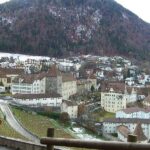
The bishop’s court in Chur (Canton Graubünden) comprises the Palace, the Cathedral of St. Mary’s Assumption (St. Maria Himmelfahrt), and the residences for the chapter. A Part of the bishop’s Palace is used by the Domschatz Museum today. The other part is being renovated and will be opened to the public.

The Obere Spaniöl, 17th century 

1,600 years of church history

Chur is one of the oldest episcopal cities north of the Alps. Moreover, its liturgical art treasure has survived almost intact, despite the reformation of Chur in 1527, the permanent tension between the Protestant city council and citizens, and the Catholic enclave of the episcopal court.

The bishop’s Palace. Photo: Alice das Neves Photography

This situation can be compared to that of St. Gall. This city, too, changed faith in 1524 and 1525. However, the centuries-old abbey of St. Gall did not fare as well as the cathedral in Chur. Many liturgical objects were sold, destroyed or looted. St Gallen even had one of the first political walls in Europe: a wall separated the territory of the abbey in the middle of town from the rest of the Protestant city.

Back to Chur. The first predecessor of Chur Cathedral was built in the 5th century, possibly during the time of Bishop Asinio. Archaeological research has revealed another predecessor from the eighth century, the so-called Tellokirche from the period 750-760. Bishop Tello was the last descendant of the Rhaetian ruler dynasty of the Zaccones or Viktorids. The late Romanesque church was consecrated on 19 June 1272 after a 120-year construction period.

Its intact Romanesque sculpture, decorations, and capitals, supplemented in later centuries by Gothic and Baroque elements, are among the best-preserved in Europe. The Gothic frescoes are probably the work of the Rhäzuns Master in the style of the Waltensburg Master.

The Premonstratensian St. Luzius Monastery was founded in 1149. St Luzius and St Florinus are the patron saints of the diocese. However, the first construction of the complex dates back to the eighth century, as a Carolingian church.

The Carolingian crypt in St Luzius has been preserved. Tomb plaques of members of the Viktoriden dynasty from the eighth century are still in place. The dynasty died out in 765, after which Charlemagne (748-814) appointed Frankish abbots and, from 806, earls as secular rulers.

The Domschatzmuseum, located in the former Baroque bishop’s Palace, is a museum and repository for liturgical objects still in use. For example, the display of the 13th-century triumphal cross in the cathedral is a regular part of the liturgy at Easter.

Photo: Ralph Feiner

The Triumphal Cross, 13th century

Moreover, since 2020, the world-famous 25 intact images of the Totentanz (death of dance) from 1543 have been displayed in the palace’s wine cellar. These images were created from woodcuts by Hans Holbein the Younger (1498-1543). This unique series hung in the palace until 1882. After a stay at the Rätische Museum, they are back on display.

This series consists of grisailles (the unknown painter used only grey, black, and white colours) in a latticework of three rows, measuring 15 metres in length and 3.40 metres in height.

Photo: Ralph Feiner

The nearby parish church of St Martin has been Evangelical-Reformed since 1525 and is mentioned as early as around 800 for the first time. It indicates the isolated position of the episcopal court after the reformation in 1527.

St. Martin’s Church and the Saint Martinus 

(Source and further information: Domschatzmuseum Chur)

The Saints Luzius and Florinus

Geneva and the Wall of Reformers

The Wall (Le Mur des Réformateurs, Monument international de la Réformation) of a hundred metres was built in 1909 to commemorate the 500th anniversary of the birth of Jean Cauvin (1509-1564), better known as Jean Calvin. Calvin fled from France in 1535 to the relatively tolerant city of Basel, the hometown of Desiderius Erasmus (1469-1536). Basel converted to the Protestant faith between 1527 and 1529.

The reformer Johannes Oekolampad (1482-1531) was the main protagonist. Erasmus fled Basel in 1529 because of the Reformation and went to Catholic Freiburg (Baden). Just before his death, he returned to his beloved Basel to find his final resting place near the reformer Oekolampad in the Protestant Münster in 1536.

Jean Calvin, Guillaume Farel (1489-1565), Théodore de Bèze (1513-1605), John Knox (1513-1572).

Calvin published his ‘Institution de la religion chrétienne‘ in Basel in 1536. Shortly afterwards, Calvin left for Geneva, which had also become Protestant in 1536. He worked in this city with the reformer Guillaume Farel. Farel was the driving force behind Protestantism in the French principality of Neuchâtel.

However, Calvin was too dogmatic for the Geneva government and left for Protestant Strasbourg (at the time, still an independent Imperial city in the Holy Roman Empire). Calvin was a pastor to Protestant French refugees.

In 1541, he returned to Geneva to spread Calvinist doctrine from there. Within a few years, he made Geneva a Protestant ‘Jerusalem’, a holy city of the Reformation. He published numerous books and writings in Latin and French. He founded the academy for preachers, the precursor to today’s university, and the Calvin Auditorium. The city grew from 10,000 inhabitants in 1535 to over 23,000 in 1562.

He was in permanent conflict with other Protestant theologians and reformers, including Martin Luther (1483-1546) and Sebastian Castellio (1515-1563), s a current exhibition in the University Library of Basel shows.

Calvinism became the dominant religion in the Netherlands on the eve of the Eighty Years’ War (1568-1648) against Catholic Spain, led by Emperor Charles V. The Protestant Prince William the Silent (1531-1584) was the leader of the revolt.

“Le 26 juillet 1581 les Etats-Generaux reunis a la Haye adpotent la déclaration d’indépendance des Provinces-Unies”:

“D’ondersaten zyn niet van Godt gheschapen tot behoef van den Prince om hem in alles wat hy beveelt weder het goddelick oft ongoddelick recht oft onrecht als slaven te dienen, maer den Prince om d’ondersaten wille sonder dewelcke geen Prince is om deselve met recht ende redene te regeeren”. 

The Netherlands was then called the Seven United Provinces of the Netherlands (1581-1795). For this reason, William the Silent has a place of honour on the ‘Mur des Réformateurs’ among other protestant leaders: Gaspard de Coligny (1519-1572),  Friedrich Wilhelm Graf von Brandenburg, 1620-1688), Roger Williams (1603-1684), Olivier  Cromwell (1599-1658) and István Bocskai (1557-1606).

Among the Protestant characters is King William III, Prince of Orange (1650-1702), who was also King of England from 1688 to 1702. He is pictured with his wife, Mary Stuart (1662-1694), Queen of England.

“Le 13 février 1689 Guillaume Prince d’Orange et Marie son épouse fille aînée de Jacques II appelés au trône d’Angleterre acceptèrent la couronne et la déclaration de droits fondamentaux de la monarchie constitutionnelle. Les Lords et les communes présentent à Guillaume et à Marie la déclaration des droits d’Anglais“.

William was the primary political and military opponent of the catholic Sun King (Louis XIV, 1638-1715).

The Wall begins in the left corner on 21 May 1536 and ends in the right corner on 12 December 1612.

On this night, Charles-Emmanuel (1562-1630), the Catholic Duke of Savoy, with the support of the expelled bishop of Geneva, tried vainly to capture the city. This event is named ‘L’Escalade’ because of the ladders the attackers used. This day is annually commemorated in Geneva.

The Wakker Price 2023

The Organisation of Swiss Cultural Heritage (der Schweizer Heimatschutz) awards the Wakkerpreis annually. This organisation awards this prize to municipalities with outstanding achievements in urban and village development.

The town of Lichtensteig (canton of St. Gall)  has been awarded the Wakkerpreis 2023. For centuries, the city was a prosperous urban centre in Toggenburg. However, the local economy began to falter in the 1970s: hundreds of industry, trade and services jobs disappeared, and the population continued to shrink until recently. Politicians, the population and entrepreneurs developed innovative projects to revitalise the town.

Toggenburger Museum

Since then, Lichtensteig has positioned itself as a “Mini.City” (Mini.Stadt), a small countryside town offering relatively cheap office space and residential neighbourhoods. The “Mini.City” strategy is not a short-term project but a long-term process.

The city recently adopted a vision and strategy for the Mini .City development until 2050. The formulated objectives offer opportunities for utilising the old town and areas on the outskirts, as well as along the main roads.

(Source and further information: Der Schweizer Heimatschutz)

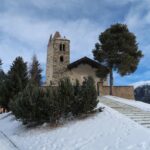
San Gian (St. John) in Celerina

The first mention of the church of San Gian (St. John) in Celerina (Schlarigna in Romansh, Canton Graubünden) dates back to 1320. In 1478, the extension of the nave to the west and the vaulting of the choir took place.

Although these churches are small, their location on a hill gives them a monumental appearance. They can be seen all over Graubünden. The church not only has a prominent place but also features two towers and a remarkable interior.

The smallest Romanesque tower was built around 1300. At that time, the church was still facing east. In 1478, the church was enlarged and turned more to the west. The Romanesque tower was integrated into this new ensemble.

The construction of the new late Gothic tower was only completed in 1520. However, the Romanesque tower could no longer be removed without affecting the new church. For this practical reason, it remained standing. Perhaps it was providence because, in 1682, lightning destroyed the roof and bell of the new tower. It was not repaired since the village had built a tower with a clock in the centre in 1665.

The wooden ceiling inside the church is one of the finest and best-preserved in the canton, alongside those in Pontresina and Bergün/Bravuogn.

The bishop of Chur, Ortlieb von Brandis (1458-1491), had his family crest and the coat of arms of the Gottesnhausbund (the ibex), and his coat of arms (ibex and burning wood) as bishop Ortlieb von Brandis inserted into the ceiling. The Brandis castle contains a fresco by the Waltensburg Meister.

The coat of arms of the burning wood of the lords of Brandis

The church features several 15th-century frescoes. During the reformation, they were limed over and are in good condition today.

Source: R. Muggli, O. Emmenegger, Kirche San Gian bei Celerina/Schlarigna, Bern 1993

Celerina’s most famous resident, Federal President Anton Ganzoni

Pontresina

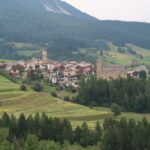
The area around Pontresina (Canton of Graubünden) was already inhabited before the arrival of the Romans. Excavations in Val Languard reveal 8,000-year-old settlements.

After the conquest by the Romans (15th B.C.), vulgar Latin mixed with the Raetic languages. It led to various Romansh idioms in the Canton of Graubünden. Puter is spoken in Pontresina.

The first mention of Pontresina is in a document from 22 January 1139, when the bishop of Chur ruled the village. The Oberengadin participated in the founding of the Gotteshausbund in Zernez in 1367.

Pontresina lies at the foot of the Bernina Pass and the highest mountain in Graubünden, Piz Bernina (4,049 m). In the Middle Ages, there was lively traffic over the Bernina Pass. The village was the first community in the Upper Engadine to adopt the Reformed faith.

St. Maria church and the Spaniolaturm

Museum Alpin

Grand-Hotel Kronenhof

The Rhätische Bahn

Thanks to its good accessibility, healthy climate and the growth of alpinism, Pontresina rapidly developed into a holiday- and spa resort from 1850 onwards.
The opening of the Bernina road in 1864 and the connection to the Rhaetian Railway in 1908 contributed to his development.

(Source: www.gemeinde-pontresina.ch).

The natural grandeur of Pontresina

Pontresina (canton of Graubünden) may not have the (tourist and Olympic) status of nearby St Moritz, but the village lies at the foot of the canton’s largest glacier and highest mountain (4049 m.).

The beginning of the  Gletscherpfad near the famous hotel-restaurant Morteratsch 

The Alp-Schaukäserei Morteratsch

The grandeur is not limited to these natural phenomena. Pontresina also had its Grand Hotels and an illustrious Belle Époque period.

Grand-Hotel Walther

Moreover, the fairy-like landscape (in all seasons) is home to the largest population of ibex in the canton, around 1,800.

The waterfall trail (Der Wasserfallweg) Cascada da Bernina

The Morteratsch glacier on the  Piz Bernina, the highest mountain of the canton (4049 m.)


Pontresina has the largest ibex population in the canton. 

The Referendum

There is another player besides Switzerland’s parliament and government: the citizens. Referendums can always present decision-makers (federal, cantonal, and municipal) with alternative perspectives.

The Constitution covers three types of federal referendums. The cantons and municipalities also have referendums.

Mandatory referendum

A mandatory referendum (das obligatorische Referendum) must take place if the Constitution stipulates it, for example, in cases of changes to the Constitution or membership in international organizations or the European Union (rejected in 1992 by 50.3%, and once more in 2001 by 77% of the voters. Today, probably by around  80-85% of voters).

Optional referendum

The second referendum is the optional referendum (das facultative Referendum). Citizens must collect at least 50,000 signatures within 100 days to request a referendum on federal law or other decisions. Citizens can express their views on various subjects every three months. The issues vary from cowbells to taxes.

People’s Initiative

The People’s Initiative (die Volksinitiatieve) is another referendum about constitutional changes. At least 100,000 citizens must support the Initiative. At least eight cantons can also request a referendum (Kantonsreferendum). This has not been the case for long, but the idea is gaining momentum.

The constitution will adopt the text of this initiative when a majority of voters are in favour. The government can also initiate a counter-initiative to provide citizens with an alternative. The Swiss Constitution is the only one that contains citizens’ daily concerns. It is worth the effort to read this Constitution in detail.

Functioning

An absolute majority is decisive, and federal decision-makers must respect the outcome of such referendums.

It is a double ‘yes’ in the people’s initiative and mandatory referendum, an absolute majority in the country, and a majority of votes per canton in the senate. In other words, a majority can exist nationally, but if ballots are counted per canton, a majority of the cantons may be against it. This happens regularly. The rural cantons with few inhabitants have the same voting weight as the urban, densely populated cantons.

The absolute majority in the optional referendum is decisive.

Conclusion

Not all referendums are equally interesting or mobilise a significant number of voters. That is not the point, however. A referendum is crucial because politicians can never forsake their duties or act in bad faith.

Someone is always watching them. Like every system, it has disadvantages. It slows down procedures and decision-making and sometimes hampers changes. On the other hand, it protects the country from (opportunistic) delusions of the establishment. It is also an obstacle to the emergence of oligarchies and their networks.

The establishment must always consider all the arguments of organisations and citizens. The presence of citizens at all levels (municipal, cantonal, and federal) for all political decisions is one of the pillars of Swiss democracy: the rule of law, (social) cohesion, and prosperity. It also confirms a modern, open, self-confident democracy and society. The government is there for the citizens, not the other way around!

Direct democracy can only function effectively with independent media and a robust civil society. This is (still) the case in Switzerland.

(Source: A. Vatter, Das Parlament in der Schweiz, Basel, 2018).

Writing, Able to Write

The Jan Michalski Foundation opens the year with the exhibition ‘Colette | Écrire, pouvoir écrire’, which traces the journey of an author who made writing the place and the instrument of her emancipation, a way of exploring the possible.

The exhibition curator will offer two guided tours on Saturday, 14 January, followed by a poetic performance of Baudelaire Jazz by writer Patrick Chamoiseau and saxophonist Raphaël Imbert.

(Source and further information: Fondation Jan Michalski (fondation-janmichalski.com)

The National Council

Definition

The National Council, also known as the Nationalrat (Volkskammer, Erste Kammer, Grosse Kammer), represents the people in the parliamentary system.

It has powers identical to those of the Council of States (discussed in the previous contribution). The 200 seats are distributed in proportion to the votes obtained in elections held every four years.

Seats

The twenty-six cantons are the constituencies. The number of their inhabitants is decisive for the number of their seats. The smallest cantons have one seat (Appenzell Innerrhoden, Appenzell Ausserrhoden, Uri, Glarus, Obwalden, and Nidwalden), while the largest cantons have thirty-five (Zürich), twenty-four (Bern), and nineteen (Vaud). The remaining cantons have between two (Jura) and sixteen (Aargau) seats.

Citizens vote for political parties, which then form alliances in parliament. A previous article discussed the relationship with the government or Federal Council (Bundesrat, Conseil fédéral).

Powers

This contribution focuses, in particular, on the political powers of the National Council (and thus the Council of States).

The National Council has several possibilities within the legislative and supervisory processes:

the parliamentary initiative, parlamentarische Initiatieve (initiating a law),

the motion, Motion (forcing the government to draft a law),

the postulate, Postulat (asking the government to examine whether a new law should be drafted or measures taken),

Interpellation and questions, einfache Anfrage (requesting information about documents or (international and European) developments and issues.

These instruments are often applied (e.g., parliamentary initiative, motion) or less frequently (e.g., question, postulate). However, they always play a role in the communication, information, and prioritisation between the National Council and the government.

Depending on current affairs (and approaching elections), one political party tends to use the question more, while the other uses the motion or parliamentary initiative.

In addition, the Parliament (and the Council of States) exercises financial control in two commissions and exceptional (severe) cases by the Enquete Commission of the Parliament, i.e. PUK (Parliamentarische Untersuchungs Kommission).

Functioning

The National Council (and the Council of States) must always remain in close and direct contact with the cantons, (social and economic) interest groups, and the citizens.

The National Council occupies a very independent and strong position vis-à-vis the government, as the government cannot dissolve the Council.

The annual election of a prime minister/primus (a) inter pares by both chambers in a joint session also prevents political opportunism and concentration of power.

The representation of the people and democracy live up to their names.