Two Empires in Brugg and Windisch

Two empires left their mark on the Brugg-Windisch region (Canton Aargau). The Roman Legionary Park Vindonissa (Windisch) and the city of Brugg in the Habsburg Empire were important military and administrative sites.

Roman Empire

The army camp for a Roman legion (about 5,000 troops and officers) was built around 15 AD to guard the border (Limes) with the Germanic tribes. Many remains of buildings recall the centuries-long stay of the Romans. Moreover, several complexes have been partially or fully rebuilt or renovated as replicas.

The Contuberna (soldiers’ quarters) and the villas of senior officers and the commander have been rebuilt in the Legionary Park. The walls, towers, and entrance gates (the porta principalis (west gate), the porta praetoria (south gate), and the porta decumana (north gate)), the balneum (bathhouse), the valetudinarium (hospital), and the aqueduct, among others, can be seen.

Switzerland’s oldest amphitheatre (11,000 spectators) is outside the camp. Moreover, the Romans introduced viticulture. Roman viticulture is still being cultivated in four places (römische Rebberge).

The Vindonissa Museum recounts the Roman presence through numerous archaeological finds and extensive documentation.

Habsburg

The Habsburgs built their castle, Habsburg, a few kilometres from Brugg. After this, the castle lost its strategic significance in the 13th century, and Brugg’s importance increased.

On the site of the former legionary camp, Queen Elisabeth (1285-1353), the widow of King Albert I (1255-1308), who was murdered in 1308, founded two monasteries and built the monastery church Königsfelden in memory of her husband. Albert I was buried in Speyer Cathedral, but until 1528, Habsburg descendants were buried and commemorated in the monastery church by Franciscan monks and nuns of the order of Clarisses.

The beautiful Gothic glass windows date from the years 1330-1350. In addition, the church was a memorial to the knights killed at the Battle of Sempach in 1386.

The bear of Bern and the coat of arms of Austria-Habsburg, 1669. The upper class of Bern was also buried in the monastery church of Königsfelden, a testament to the great prestige of the Habsburgs.

The monastery was dissolved in 1528, and the Franciscan convent was subsequently demolished. Today, the remaining buildings are used as (psychiatric) hospitals and archives.

Brugg

Habsburg Castle and the new Worldpower

One of the most informative sources on the early Habsburgs is the Acta Murensia on the foundation of the monastery of Muri in 1027. The Habsburgs descended from a family from Alsace. (See also the last Habsburger in Basel)

The Habsburg castle was built around 1030. The Acta Murensia mention the Habsburg Radbot and the Bishop Werner of Strasbourg as builders. Around 1100, Otto II was the first Habsburg to refer to himself as Count of Habsburg. This title referred to the count’s status in Alsace.

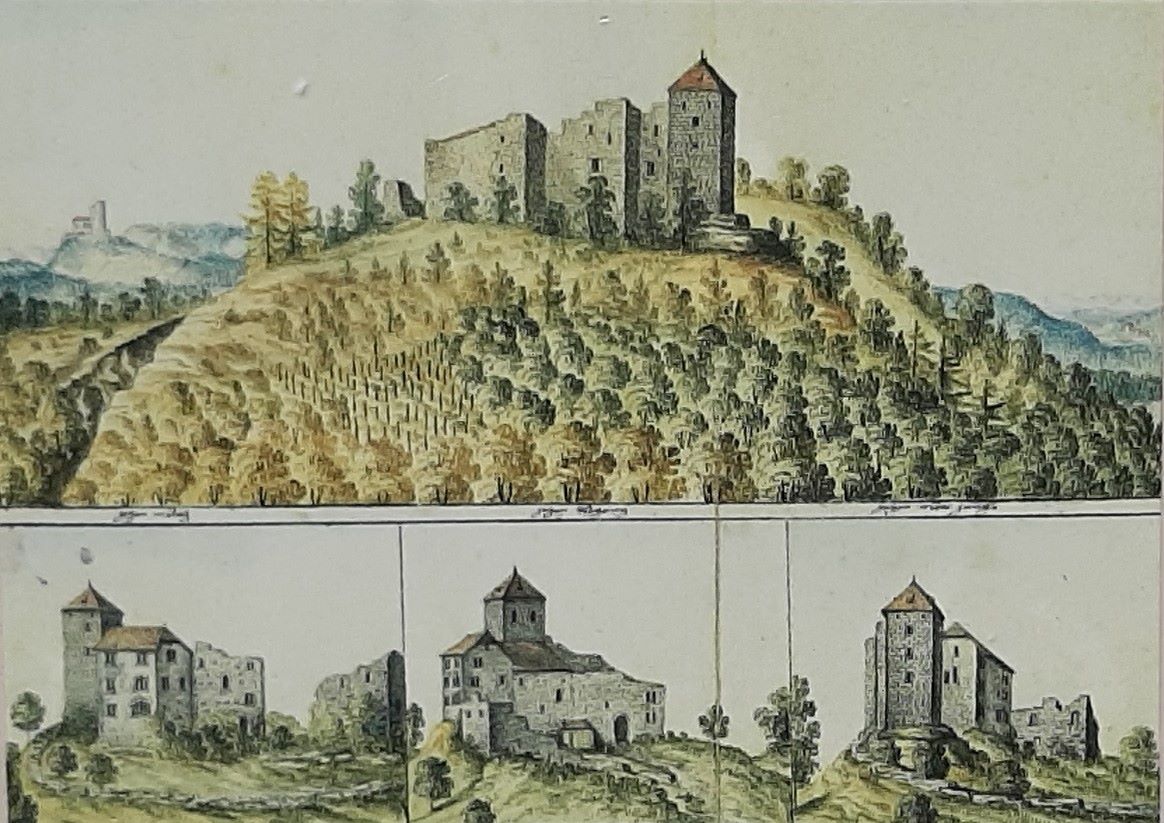
The vordere Burg with the Steinhaus and the Ostturm, The Burghof with the Sodbrunnen and the hintere Burg. After P. Frey, M. Hartmann, E. Mauer, die Habsburg. 

Albrecht Kauw (1616-1681), rond 1670. The Habsburg Castle from four perspectives. Collection: Bernisches Historisches Museum

The Habsburgs benefited from the extinction of other dynasties in the region (including the counts of Lenzburg and later Kyburg). They acquired earldoms in the southern Zurichgau, in the Frickgau, and around 1200 also in Aargau.

In 1273, the electors of the Holy Roman Empire elected Count Rudolf IV (1218-1291) as German king Rudolf I. Habsburg Castle was then no longer suitable as a residence, and the Habsburgs moved to Brugg, Bremgarten or Laufenburg.

The seal of King Rudolf I. Staatsarchiv des Kantons Bern

Habsburg territories around 1265. After P. Frey, M. Hartmann, E. Mauer, die Habsburg.

Nobles in the service of Habsburg then occupied the castle until the conquest of Aargau by the Swiss Confederation in 1415. In 1469, the castle came into the hands of the Königsfelden monastery in Brugg.

The Eidgenossen knock on the door, 1415. Diebold Schilling, Spiezer Chronik. Burgerbibliothek Bern, Mss.h.h.I.16, p. 629.

When the monastery was dissolved in 1528, the castle fell to Bern. In 1804, the new canton of Aargau became the owner. Today the castle a national monument. A small exhibition showcases the castle’s building history and the rise of the Habsburgs to a global power.

(Source and further information: Via Habsburg; P. Frey, M. Hartmann, E. Mauer, die Habsburg, Bern 1999; Museum Aargau)

The vordere Burg

The hintere Burg

The Burghof

The landscape 

The namegiver

The Swiss Textile Industry

For a long time, Eastern Switzerland was one of the world’s most significant and largest exporters of textile products. Around 1910, more than half of the world’s embroidery production came from Eastern Switzerland.

Embroidery was also the largest export sector of the Swiss economy, accounting for around one-fifth of the total. The First World War (1914-1918) marked the end of the heyday of embroidery in eastern Switzerland.

Already in 825, the St. Gallen Monastery produced clothing and other textiles. International trade began in the fifteenth century, following the establishment of the first guild of weavers in St. Gallen.

The linen industry and international trade flourished until the early 18th century, when the production of cotton textiles began to replace it. Following the invention of the hand embroidery machine, the cotton industry was replaced mainly by embroidery around 1850.

The village and region of Herisau (Canton of Appenzell Ausserrhoden) were not only among the most densely populated areas of Europe in the 17th century, but were also leaders in linen production. Trogen (Canton Appenzell Ausserrhoden) took over this role in the 18th century. Another vital textile village was Teufen.

With the invention of the hand embroidery machine in 1828 by Josua Heilmann (1796-1848), embroidery increasingly replaced cotton production. Isaak Groebli (1822-1917) invented the Schiffli embroidery machine in 1863, and the textile industry reached its peak.

The Swiss textile industry was a serious competitor to the British industry. The British government sent a parliamentary delegation to Switzerland in 1835 to investigate this ‘economic miracle’. The parliamentarian John Bowring (1792-1872) wrote a report that, in certain aspects, remains topical today.

Today, numerous companies in Eastern Switzerland are still among the world’s leading and most innovative suppliers of (high-tech) textiles and related industries – from haute couture, plastics, and filters to conductor technology, and the St. Gallen embroidery is still regarded as a world leader.

Trade and the manufacture of textiles had a decisive influence on Eastern Switzerland—and vice versa, perhaps comparable to the watch industry in Western Switzerland.

Villages with the appearance of cities and the architecture, palaces and (former) textile factories in the town of St Gallen are the silent witnesses of international entrepreneurship, innovation and commitment to the ‘Heimat’.

St. Gall, Textilmuseum

The Rhine Valley is called the high-tech and textile valley. A centuries-old economy, nowadays linked to high-tech innovations in this sector.

(Source and further information: Textilland Ostschweiz; Textilmuseum St. Gallen; Museum Herisau; Jahrhundert der Zellweger; Textildorf Rehetobel; Sauer Museum)

Johannes Hädener, drawing, Herisau 1789. 

Herisau, its palaces and the rosegarten, founded by the Landammann Laurenz Wetter (1654-1734) in 1695

The Huguenot community in Bern

This year marks 400 years since services in French were first held in Bern’s former Dominican church since then known as the French Church (l’église française de Berne).

The anniversary looks back at the great waves of Huguenot emigration in the 17th century and the role of this French-speaking Protestant community in the city of Bern. This history is also a current challenge: bringing languages and cultures together and connecting them.

The festivities will take place from Sunday, 27 August to 1 October 2023.

(Source and further information: die französische Kirche Bern)

See also: Stiftung VIA-Auf den Spuren der Hugenotten und Waldenser

The French Church of Bern

The church is the oldest preserved church in Bern. It was built around 1300 for the Dominican monastery, founded in 1269. Since 1623, it has been the church of the French-speaking Protestants.

The Dominicans were expelled from Bern during the Reformation, and the monastery became a hospital. Reformed worship in French was introduced at that time at the request of the French maréchal Louis de Champagne, Comte de la Suze (1573-1637). He donated a fund to maintain the French service on his departure from Bern.

The nave received a new west façade and round-arched windows in 1753. The choir dates from the 13th century. The north side is windowless in the middle because the monastery adjoined here. The monastery was demolished in 1899. The stage between the nave and choir shows paintings from around 1495.

Altenrhein, Alter Rhein and Hundertwasser

Altenrhein is a border village located in the municipality of Thal, in the canton of St. Gallen, adjacent to Austria. Altenrhein lies at the end of a headland between arms of the (Alter Rhein) old Rhine delta.

In 983, the village was mentioned as Rinisgemünde, in 1402 as zum vornchtigen Rhin. Since the 17th century, the village has been referred to as Altenrhein.
In 983, the Bishop of Constance donated Altenrhein to the Petershausen Monastery in Constance. In the late Middle Ages, a settlement of the Abbey of St. Gall gradually developed.

Der Alte Rhein (the Old Rhine)

In addition to cultivating fields and pastures, the population primarily lived off the produce from the Rhine and Lake Constance. Since 1900, the course of the Rhine near Altenrhein has been fed only by the Rhine Valley inland canal, and as a result, it has become deserted. The riparian and reed landscape was placed under protection in 1973.

In 1803 (foundation of the Canton of St. Gallen), Altenrhein became part of the political municipality of Thal. Between 1926 and 1927, the airfield and the Dornier Aircraft Works Altenrhein were built and later transformed into the Flug- und Fahrzeugwerke Altenrhein (FFA) in 1949.

Today, the village is known for the St. Gallen-Altenrhein airfield, the (former) Flug- und Fahrzeugwerke Altenrhein, the Altenrhein Aviation Museum, and the Hundertwasser architectural project (Die Markthalle-Altenrhein) on Lake Constance. Altenrhein is also a popular destination for water sports, tourism, and local recreation.

(Source and further information: Bodensee Kultur.info)

The Hundertwasser Projekt (Die Markthalle Altenrhein)

Like other more than 30 buildings in Europe and Japan, the project is an example of the architectural concepts of the artist Friedensreich Hundertwasser (1928-2000).

European Heritage Days

(Re)Discovering cultural heritage is the theme of the 30th European Heritage Days. A new online platform presents all events taking place in Switzerland on 9 and 10 September 2023. At the same time, the current theme shows how it is possible to preserve cultural heritage while making careful use of resources.

Die Nationale Informationsstelle zum Kulturerbe (The National Information Centre on Cultural Heritage), NIKE, presents the events of the European Heritage Days in all the cantons on the website www.kulturerbe-entdecken.ch: Guided tours, lectures, workshops, or exhibitions.

This digital agenda replaces the previous national program brochure. However, regional program brochures are still available from the cantonal offices for monument conservation and archaeology.

(Source and further information: Die Nationale Informationsstelle zum Kulturerbe )

Wonnenstein and St. Gall

Wonnenstein Monastery holds particular cultural and historical significance for the two Appenzell cantons, St. Gall Abbey, and the former Diocese of Constance.

Located near the village of Niederteufen (Appenzell Ausserrhoden), the monastery has linked the two Appenzell cantons since 1597. The monastery buildings belong to Appenzell Innerrhoden, the farmland to Appenzell Ausserrhoden.

Wonnenstein was initially a Beguine community at the beginning of the 13th century. Around 1379, on the eve of the Appenzeller Wars, abbot Kuno von Stoffeln of St Gallen Abbey founded the monastery.

In 1524, however, the city of St Gallen introduced the Reformation. The Reformation was closely intertwined with the history of the canton of Appenzell in the second half of the 16th century (member of the Eidgenossenschaft since 1513).

On 8 September 1597, the split into the Protestant canton of Appenzell Ausserrhoden and the Catholic canton of Appenzell Innerrhoden followed after a vote. The monastery was at its peak (economically, culturally and financially) in the 17th century.

In 1938, the convent still had 47 nuns. After 1964, however, no new sisters registered. In 2010, five sisters were still living in the convent, and today, only one sister remains. The farmland has been leased since 1980.

Since 2014, the association Kloster Maria Rosengarten Wonnenstein has been the successor to the convent.

(Source and further Information: Verein Kloster Maria Rosengarten Wonnenstein)

Teufen and the Textile Industrie

Teufen was first mentioned in 1272 as “Tiuffen”. The hamlet was a district of the abbey of St Gallen. In 1377, several villages of Appenzell (Urnäsch, Teufen and Gais) joined the Schwäbischen Städtebund (‘Swabian League of Cities’)  or the Bund der Bodenseestädte with the permission of the abbot of the abbey. From 1429, Teufen was a Rhode in the independent land of Appenzell, an ally or Zugewandter Ort of the Swiss Confederation.

During the Reformation, Teufen adopted the new religion along with the other äusseren Rhoden. Following the Landsgemeinde decree in 1525, each municipality could decide whether to adhere to the old faith or adopt the new one. The religious differences eventually led to the country’s division in 1597. Since then, Teufen has belonged to the canton of Appenzell Ausserhoden.

Teufen’s economic boom was due to linen weaving and, later, cotton textiles. The municipality, still a poor Rhode in 1597, was one of the wealthiest municipalities in the canton in the 19th century.

The basis for its growth and prosperity was the textile industry (weaving and embroidery) that emerged from the 17th century onwards. Teufen developed into a textile manufacturing village with many villas and merchant houses.

In the 1890s, however, the textile industry experienced a severe crisis, from which it briefly recovered before ultimately collapsing for good after the First World War. However, the stately merchant houses and numerous embroidery houses along the streets serve as reminders of this era.

(Source and further information: Gemeinde Teufen; Kulturpfad Teufen)


The Arcadian Appenzeller Landscape

The Doctor and scholar Lauzenz Zellweger (1692-1764) discovered the healing effects of hiking on the Gäbris mountain near Trogen (Appenzeller Ausserrhoden) at a time when hiking was not appropriate for gentlemen (and ladies).

He founded a society in Trogen after he studied medicine in Leiden. He combined the healthy effects of hiking and medicine and “climbed to the Gaberius Höhe every morning to drink milk for their health”.

In the 19th century, other writers also referred to these motifs. They are an established canon nowadays and define the image of the landscape, the villages and the people of Appenzell.

Hiking became a national Swiss sport, surpassing skiing in popularity. Even in the 21st century, a walk in the Arcadian landscape of Appenzell promises a healing effect.

(Source: www.jahrhundertderzellweger.ch)

The Region Appenzell-St. Gallen

Roman Festival Augusta Raurica

On the weekend of 26 and 27 August 2023, Augusta Raurica (Augst, Canton Basel-Landschaft) will host Switzerland’s most significant Roman festival for the 26th time.

Visitors can buy Roman products at the Roman Market and learn more about Roman crafts. At that time, the market was an important location to see and to be seen, and visitors established social contacts there.

Visitors can also become active, for example, modelling clay, weaving, felting or working bones. Archaeologists also present their work and methods, and the construction crane shows how (very) heavy objects, e.g. in buildings, were lifted into place in Roman times.

The show Panem et Circensus (Bread and Games) in the Roman theatre, with a replica of a lodge for the emperor and his family, shows Roman performances with dance, music and gladiator fights. On Sunday, alongside a tour of the festival grounds, this show will be simultaneously translated into sign language for people with hearing impairments.

Empress Sabina and her entourage will also report on the life of women in the imperial court; about a hundred legionnaires build a legionary camp; senators meet in the Curia, and legionnaires and gladiators practise in the legionnaires’ or gladiators’ school.

Another highlight is the culinary variety of Roman cuisine. There are 15 stands on the premises. Visitors can also mingle with the Romans by dressing in the appropriate Roman way by wearing available clothes.

(Source and further information: www.roemerfest.ch)