

The princely City and the canton of Neuchâtel
11 May 2025
Not much is known about the habitation of the area of the city of Neuchâtel until the year thousand. The first counts of Neuchâtel date back to the ‘second’ Kingdom of Burgundy (888-1032). The last King, Rudolf III (970-1032), built a castle on the rock—the beginning of today’s Neuchâtel. In the years 1185-1190, the abbey, la Collégiale, followed.

Neuchâtel railway station, the first inhabitants in the Stone Age

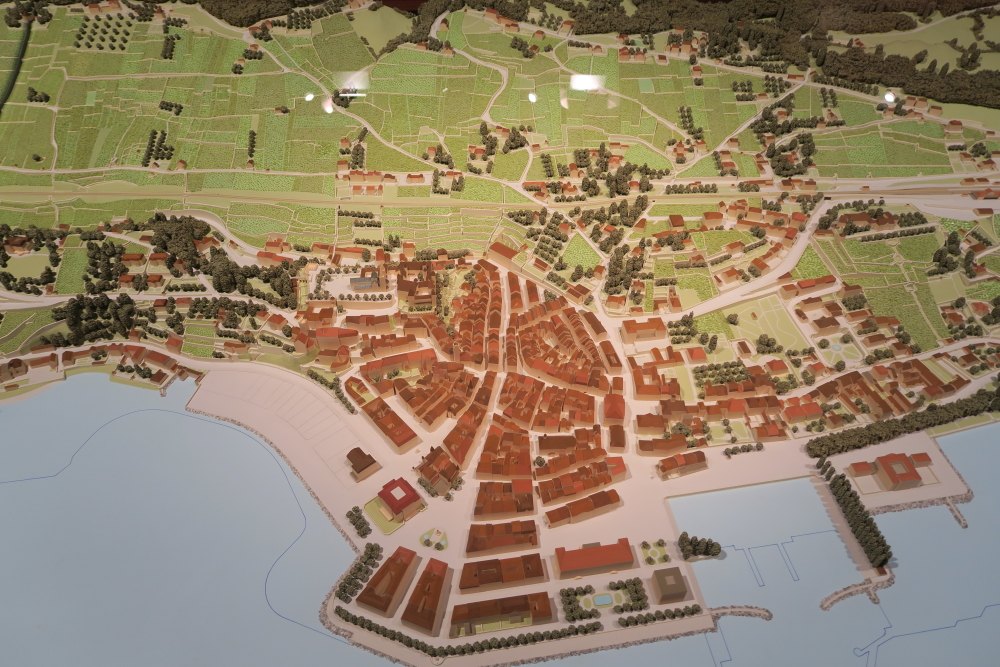

Galerie de l’histoire de Neuchâtel. The city around 1400
The dynasty of the Counts of Neuchâtel came to an end in 1395. Until 1504, the German families Freiburg and Hochberg successively ruled the county. The French (royal and Catholic) d’Orléans-Longueville family acquired the county in 1504 after the extinction of these German dynasties. The county became a principality.
However, its citizens sought rapprochement with the 13 cantons of the Confederation, as evident on the castle wall. This rapprochement progressed to the point where cantons ruled the principality for several years (1512-1529), an occupation with the consent of the citizens.


In 1530, Neuchâtel became Protestant. It had consequences for the principality’s future. The dynasty d’Orléans-Longueville died out in 1706. The States-General (les Trois états) of Neuchâtel wanted a Protestant prince who resided far away.
There were several pretenders, including the French king. Both religious and geopolitical considerations influenced the choice. Berlin was much further away than Paris. Moreover, the (Protestant) cantons kept an eye on it. Neuchâtel had been closely allied with the Confederation since the ‘years of occupation,’ 1512-1529.
The (Protestant) Prussian King of the Hohenzollern dynasty, Frederick William 1 (1688-1740), acquired the principality of Neuchâtel in 1707. He remained (formally) Prince of Neuchâtel until 1857.


City Hall
A brief French interlude followed the French era (1798-1813) in 1806. French Marshal Alexandre Berthier (1753-1815) was the Prince of Neuchâtel from 1806 to 1813. After Napoleon’s defeat and the French departure, the Prussian king regained power (formally) in 1814.
In 1815, Neuchâtel became a canton of the Swiss Confederation but remained a principality under Prussian rule. This situation ended in 1857, when King Frederick William IV (1795-1861) formally relinquished his rights after the Confoederatio Helvetica of 22 cantons, including Neuchâtel, was established in 1848. The industrial towns of Le Locle and La Chaux-de-Fonds led a successful revolt against the city of Neuchâtel’s royalist aristocracy.

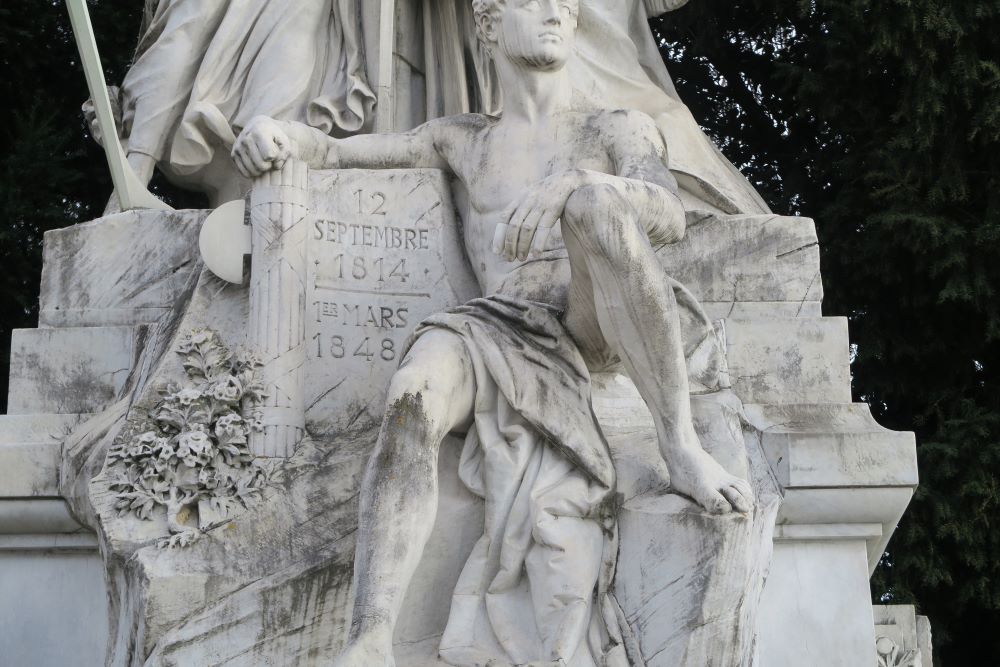
Monument 1814-1848
Unlike the changes in other cantons, the first revolt in the European revolution of 1830 failed (e.g., the split of Basel-Stadt and Basel-Landschaft, and the Regeneration with a modern Constitution in 11 cantons).
The last monarch to rule Switzerland disappeared in 1857; however, many city palaces still recall the centuries-old French, German and Prussian periods.

The city subsequently developed into an industrial and commercial centre, with a focus on watchmaking, microtechnology, electronics, tourism, trade, and, for example, cocoa processing. Suchard was the first chocolate multinational.
Its rapid population growth and urban development are well-documented and mapped in Les Galeries du Histoire.


Swiss Centre for Electronics and Microtechnology
Today, the city, with its university and medieval centre, is, after its recent merger with some municipalities, the third-largest city in Romandie, or French-speaking Switzerland. It is beautifully situated at the foot of the Jura on Lake Neuchâtel.
However, this did not eliminate the rivalry between the industrial La Chaux-de-Fonds and the aristocratic Neuchâtel, “le Bas du canton et le Haut du Canton,” the low-lying and high-lying areas of the canton (La Chaux-de-Fonds is Switzerland’s highest-lying town, at almost 1,000 m.).


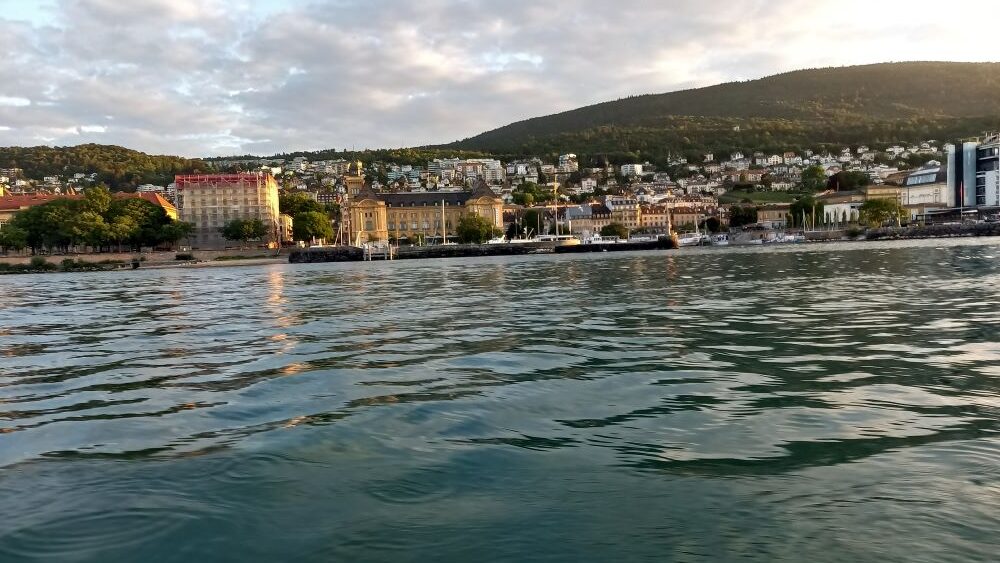


Rowing on Lake Neuchâtel Photos: Gaetano Mileti



L’Hôtel DuPeyrou




Le Jardin anglais and the Casino of Neuchâtel

Neuchâtel, Bulgari

