The Joint Administration of Aargau

Between 18 April and 18 May 1415, the Orte (cantons) of Bern, Zurich, Lucerne and other Eidgenosses conquered the Aargau. Only the Fricktal remained in Habsburg’s possession.

After 1415, four regions emerged on the conquered territory: the Freiamt, the County of Baden, the Bernese Aargau and Fricktal (Habsburg). Of great importance for the development of the Confederation of Cantons was the joint administration (Gemeine Herrschaft) of the County of Baden and the Freiamt.

Because of this Gemeine Herrschaft, the necessity and need to meet frequently arose. For this reason, the meeting of the Orte took place in Baden (canton Aargau) under the name of Tagsatzung.

The Tagsatzung remained the only joint institution of the Confederacy until 1798. The Tagsatzung survived the Reformation, the division into Catholic and Protestant cantons, the civil wars of 1529 and 1531 (the Kappelerkriege), and 1656 and 1712 (the Villmergerkriege).

The Tagsatzung not only united against the common enemy (Habsburg) but also united despite the (religious) differences and diverse (economic) interests (e.g. the conquest of Italian territories by cantons in central Switzerland in 1512 and Vaud by Bern and Freiburg in 1536).

The crushing defeat at Maregnano in 1515 against the French king for possession of the Duchy of Milan was partly the result of these divisions.

The conquest of the Aargau was thus an essential prerequisite for developing conflict resolution between the various cantons of the Confederacy.

The canton of Aargau, established in 1803, comprised four distinct regions.

The events of 1415 thus had far-reaching consequences for the development of the Swiss Confederation and the new canton of Aargau.

(Source: www.aargau.ch).

The Centenary of Henry Brandt

The events celebrating the centenary of Henry Brandt (1921-2018) aim at introducing a wider audience to the work of this significant figure of the Swiss Cinema and photographer.

An exhibition at the Art and History Museum and in the park of the Ethnographic Museum of Neuchâtel, the presentation of his documentaries in the Passion Cinéma in La Chaux-de-Fonds, Delémont en Neuchâtel and various activities and events will take place.

The first monograph on Henry Brandt (Scheidegger & Spiess, Zurich 2021) spans the entire oeuvre of this versatile cinematographer, which includes numerous documentaries, photo reportages, and TV productions.

(More information and programme: www.henrybrandt.ch).

Kleinbasel and Grossbasel

The city of Basel lies on both banks of the Rhine. Until 1392, there were even two Basels: Kleinbasel on the right bank and Grossbasel on the left bank.

Grossbasel was even a free imperial city (Reichsunmittelbarkeit). This status gave the city a high degree of autonomy, as only the Emperor was above it.

The two Basels were closely connected economically. The bridge over the Rhine in 1225 led to ever-greater economic interdependence. In 1392, the two Basels were united.

Grossbasel was part of the Prince-Bishopric of Basel (Archbishopric of Besançon), while the Diocese of Kleinbasel belonged to the Diocese of Constance (Archbishopric of Mainz).

This situation did not change due to the amalgamation in 1392, but rather because of the formal abolition of the Prince-Bishopric of Basel in the French era (1798-1813).

From this time onwards, Kleinbasel belonged to the bishopric of Basel (which has its seat in Solothurn today).

Around Switzerland in Eighty Maps

Switzerland has always been a country of and with maps. For centuries, maps of all kinds have been made and distributed. In the visual and digital information society, new maps are increasing exponentially.

Switzerland has also always been a country of map readers. Maps have accompanied the Swiss intensively from childhood, at home, at school, in the many hiking clubs or in the army.

Swisstopo, Schweizmobil or Peakfinder are the modern digital creations. The quality and precision of the watchmaking industry is reflected in ancient and modern digital cartography.

This 500-year-old tradition is bundled into the cartographic journey through time “Mit 80 Karten durch die Schweiz”.

These maps travel through space and time and almost all regions of Switzerland. The accompanying text places them in the historical perspective of half a millennium. The reader gets a clear picture of the identity of Switzerland.

Based on these 80 maps, the book describes this development from the first Swiss Confederation in 1480 to the birth of modern cartography.

The themes are spaces and borders, town and country, war and peace, transport and tourism, people and markets, and visions and fiction.

(Diccon Bewes, Mit 80 Karten durch die Schweiz. Eine Zeitreise (Baden, 2015).

The Collégiale of Valangin

Valangin was a seigneurie in the Middle Ages. The town was surrounded by a city

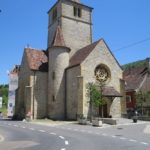
A wooden drawbridge led to roads from the seigneurie, Neuchâtel and the Swiss Plateau. Valangin was chosen by Claude d’Arberg, lord of Valangin, to build the Collégiale St. Pierre. It was consecrated in 1505.

The presence of a church with canons increased the town’s status. The aim was to build one of the largest Gothic buildings in the region. Seven terraced houses were built north and east of the church to accommodate the seven canons and the provost. They still form the heart of the present castle. In 1531, the citizens ransacked the church, which subsequently became a Protestant church.

(Source and further information: www.neuchatelville.ch).

The Alps. Space, Culture and History

The period spans from the first settlement in the Alpine region to the present day. It overviews historical developments, culture, society, economy, politics, life, and work.

The first two chapters deal with the origin of the Alps, their historical place and research. The following chapters deal with different thematic emphases on the prehistory to the Middle Ages, the late Middle Ages, and the early modern and modern periods.

The German text is illustrated with many (historical) photographs, maps, a chronological table and a selection of other sources.

(Jon Mathieu, Die Alpen, Raum, Kultur, Geschichte, Stuttgart, 2015).

The Vienna Congress

In 1814 and 1815, the great 19th-century powers (Prussia, Russia, France, Austria and the United Kingdom) sought to restore the European balance and the old regimes.

After the end of the Holy Roman Empire in 1806 (dissolved by Napoleon) and the fall of Napoleon (1813), the Continent was not to be dominated by one power again.

They created nations around France. The Treaty of Langres (29 January 1814) restored France’s borders to their 1792 status.  The independence of Switzerland was guaranteed. The Swiss cantons were deeply divided.  However, so were the great powers.

Russia and Prussia wanted a Swiss Confederation with strong federal powers. Austria was committed to maintaining the independence of the cantons. The dividing lines in the Swiss cantons defined the old Untertanengebiete, the Catholic and Protestant cantons, supporters of the ancien régime and some other (economic) divisions.

On 8 September 1814, the English envoy reached a compromise: the independence of the cantons, the abolition of internal customs barriers and aristocratic privileges, and the establishment of some federal institutions. Prussia regained Neuchâtel, but Neuchâtel also joined the Confederation.

Geneva and Wallis also joined the Confederation, and on 7 August 1815, an agreement was signed by twenty-two cantons. This constitution remained in force until 1848. Switzerland’s neutrality was guaranteed as early as 20 March 1815.

(Source: Thierry Lentz, 1815. The Congress of Vienna and the New Foundation of Europe, Munich 2014).

The Swiss Esperanto Rumantsch Grischun

Seventeen of the twenty-six Swiss cantons are German-speaking, four are French-speaking (Vaud, Geneva, Neuchâtel, and Jura), one is Italian-speaking (Ticino), and three are bilingual French and German (Fribourg, Berne, and Valais) and one is trilingual Romansh, Italian and German (Les Grisons or Graubünden).

A multilingual country

Although Switzerland or its territory has always been multilingual, many if not most, citizens are not bilingual, let alone trilingual. There is even a growing (and worrying) tendency for German-, French-, or Italian-speaking citizens to communicate in English.

The Romansh language

The only genuinely bilingual community is also the smallest, the Romansh people in Grisons. According to the latest figures, all Romansh-speaking citizens, around 60 000 speak German, and many have at least some understanding of Italian or French.

Bilingual school system.

The world’s oldest and most successful bilingual school system is one neglected accomplishment of this multilingual situation. The use of two languages in schools in Romansh areas came about in the nineteenth century when German became more relevant due to the improved accessibility of the valleys and the immigration of German-speaking citizens (and tourists).

Since 1880, the canton’s constitution recognised three languages, Italian, German and Romansh. The communes determine the use of languages in schools.

The federal constitution (Art. 4, 8, 18, 31, 70 and 188) contains detailed language provisions and the use of languages (including the Federal Supreme Court (Bundesgericht) in Lausanne. The Swiss Supreme Court handed down its first judgment in Romansh in 1996. Romansh was recognised as the fourth national language in 1938.

Romansh

Romansh is a language in its own right. The roots go back to Raetian tribes, the  Roman Province of Raetia (Prima) and Chur (Curia) as its capital (and later Episcopal) city. (Vulgar) Latin fused with the native language to become gradually Romansh.

The (slow) process of Germanisation gradually isolated the Romansh-speaking communities in their valleys. The Alemanni immigrated from the north in the second half of the fifth century. German-speaking Upper Valais immigrants, now known as Walser, settled in the 13th and 14th centuries.

German became the official language of the Three Leagues (Gotteshausbund, Zehngerichtebund, and Graue or Obere Bund) when they formally merged into the canton of Grisons (Graubünden) in 1803 (after a long history of alliances from the fourteenth century onwards and the unity of the Three Leagues (1524).

Every delegate in the canton parliament was entitled to use the Romansh, German or Italian language. Documents were recorded and printed in these three languages. However, the reality was less rosy, and German became the dominant language.

The use of Romansh

The use of Romansh was also complicated by the lack of a Romansh identity and the evolution of five Romansh idioms over the centuries due to the isolation of the valleys.

The idioms also differ from each other; for example, Surselva/Sutselva/Surmeiran Romansh (Rhein region) differs from Vallader Romansh (Lower Engadine) and Putèr Romansh (Upper Engadine). A recent initiative, Rumantsch Grischun, aims at standardising the Romansh language.

Romansh Renaissance

The so-called Romansh Renaissance in the last decades of the nineteenth century, along with the creation of private and governmental bodies to promote, educate, and utilise the Romansh language and culture, are efforts to halt the decline of this unique language, which is probably the most direct link to (vulgar) Latin.

Newspapers, radio, television, schools, a chair at Universities, language courses outside Grisons (Basel, Berne, Zurich), the legal (constitutional) framework, literature and the use in cultural-historical publications, theatre, music, and other cultural events give hope for the future, although demographic, economic and technological developments and globalisation are challenging developments.

The discussions about one foreign language (English instead of German/French or Italian) in (primary) schools in the canton (and other cantons) is another indication of the ongoing globalisation and (growing) linguistic division in the country.

Could Romansh become the Esperanto for Switzerland? The Rumantsch Grischun is ready for the sake of Swiss linguistic unity.

(Source, M. Gross, Rätoromanisch, Facts & Figures, Lia Rumantscha, Chur, 2005).

The Constitution of 1848

The Constitution of 1848 marked the beginning of a rapid development of the new Swiss Confederation in almost all areas.

1815-1848

The Confederation of sovereign cantons evolved into a federal state comprising three distinct levels: the federal level, the cantons, and the municipalities.

The principle of sovereign cantons remained unchanged, with one important difference: unless the cantons (and the People) transferred powers to the federal level (see Swiss Spectator, A Brief History of the Constitution and The Cantons).

Until 1848, Switzerland was a predominantly agricultural society with industrial and commercial centres of excellence in publishing, trade, science, chocolate, textiles, watches, machinery, and turbines for ships, as well as an incipient tourism and financial services industry.

However, there was no industrial revolution or railway construction yet. In many (mountainous) regions, there was great poverty. Switzerland was an emigration country, like most European countries.

The country had no unified system of weights, measures, or even the measurement of time. Tolls were levied between the cantons, and the infrastructure was underdeveloped.

Nor did Switzerland have any raw materials (coal, iron ore) with one crucial exception: water and granite, which played an important role after 1848.

There was no political stability, as evidenced by the division of Basel into the cantons Basel-Stadt and Basel-Landschaft (1833), the undeclared civil war in the canton of Valais (between Haut-Valais and Bas-Valais), and the Sonderbundskrieg in 1847.

Monarchies and aristocratic systems surrounded the country. Thousands of political opponents of the Habsburg, the Russian tsar, the French and German kings and dukes acted against them from Swiss soil.

The modernisation and political stability after 1848 were made possible by this Constitution and the existing entrepreneurial and export networks.

Great statesmanship

This Constitution was a masterpiece of statesmanship at the right time and in the right place in a country that, in 1847, had experienced the Sonderbundskrieg, a brief civil war.

The state immediately entered into trade agreements, and entrepreneurs traded with the world. The United Kingdom became one of the most important partners. The Swiss franc was introduced, and tolls between the cantons were abolished, resulting in the country becoming a single internal market.

Railways, chemicals, food, engineering, tourism, financial services, (electrical) engineering and other infrastructural projects changed the country in one generation.

The country was one of the most modern nations in 1875 and was often referred to as a laboratory of progress. The Confederation of 1848 was based on centuries-old political, economic, personal, cultural, and linguistic relationships, exchanges, experiences, and systems. The conditions for modernisation and the Industrial Revolution à la Suisse were already present in 1848; the Constitution was the final touch.

This Constitution was a well-balanced political system and a ‘bottom-up’ creation.

The primary consideration was: what is possible, sustainable, and feasible in this multicultural, multireligious, and multilingual country.

The roles and functions of municipalities, cantons, and the federal level, as well as the two chambers of parliament, democracy, the relationship between business and government, international politics, the organisation and financing of education, hospitals, social systems, and defence, were taken into account.

Direct democracy, federalism, subsidiarity

The strongest assets of the Constitution are direct democracy, federalism, subsidiarity, and the ability to adapt to new societal circumstances, done step by step, but always in consultation and communication with citizens, entrepreneurs, and the cantons, and never as a measure imposed from above, top-down.

Conclusion

The Constitution of 1848 created the foundations for present-day prosperity, political stability, and the will and capacity to reform and change.

Source: J. Jung, Das Laboratorium des Fortschritts. Die Schweiz im 19. Jahrhundert (Basel, 2019).