The Eternal Alliance between Rottweil and the Swiss Confederation

The ancient Roman town of Arae Flaviae, present-day Rottweil, has had an alliance with the Eidgenossenschaft of thirteen Orte (or cantons) since 1519. The town already had the status of Angewandter Ort since 1467.

Twelve of the thirteen Orte ratified the eternal alliance (ewiger Bund) with Rottweil in 1519: Zurich, Bern, Lucerne, Uri, Schwyz, Unterwalden, Zug, Glarus, Freiburg, Solothurn, Schaffhausen and Appenzell.

Basel did not sign, although the city was mentioned in the treaty. The reason is still topical: because of the emperor’s court in Rottweil.

The commercial city of Basel was cautious because of the jurisdiction of foreign judges (fremde Richter). This issue also played a role in the Schwabenkrieg or Schweizerkrieg in 1499. The Peace Treaty of Westphalia in 1648 mentioned this issue again.

The allies swore eternal trüw, liebe und fründtschafft. Indeed, the eternal treaty was never denounced, and Rottweil assisted the Eidgenossen in 1476 (he was successful in the battle of Murten against the Duke of Burgundy and less successful in the battle of Marignano against the French King and his allies in 1515).

The Eidgenossenschaft assisted Rottweil after the two world wars of the last century. The relationship was not entirely wrinkle-free either. Here, too, the Reformation and the sphere of influence of the Catholic Habsburg monarchy were the leading causes.

When Rottweil was (involuntarily) annexed to the Duchy of Württemberg in 1802, she lost her status as an ally. Legally, however, the eternal alliance was never terminated.

The ‘Swabian Eidgenossen’ (Schwäbische Eidgenossen) still commemorate and cherish the ties with the old Orte, just as the Orte maintain good relations with Rottweil.

The Brugg (canton of Aargau) even closed one of the first international city treaties with Rottweil in 1913.

Swiss International Commitment

The Red Cross (1863) and, shortly after that, the arbitration procedure known as the “Alabama Claims” (1872) marked the beginning of international diplomacy and the role of Switzerland and Geneva in particular. The Red Cross’s neutrality is also based on Switzerland’s neutrality.

The two emblems, the red and the white cross, illustrate this connection. The Red Cross and the International Committee of the Red Cross (ICRC) express the country’s message.

The League of Nations, based in Geneva, was dissolved at the end of the Second World War. The European headquarters of the United Nations is still located in Geneva.

The American President Woodrow Wilson already declared on 10 April 1919:

“Moreover, the Swiss are a people who have committed themselves in their constitution to absolute neutrality, but this is also based on the nature of the country, which is made up of different elements, races and languages. Thus, Switzerland is predestined to serve as a meeting place for other peoples who wish to work for peace and cooperation”.

(Source: F.Ch. Pictet, ´Charles Pictet de Rochemont and the accession of Geneva to Eidgenossenschaft´ in T. Kaestli (ed.), Nach Napoleon. Die Restauration, der Wiener Kongress und die Zukunft der Schweiz 1813-1815, Baden 2016).

The Jura and the Three Lakes Region

The Lakes of Neuchâtel, Morat and Bienne were very popular in the nineteenth century. Many (English) tourists appreciated the view of the Alps and, after the construction of the railway, the excellent accessibility.

The Grand Hotels are a reminder of the ‘Belle Époque’. The industry (including watchmaking, asphalt, absinthe, tourism, and services) and their favourable location created wealth and prosperity.

The Jura Mountains, the Alps, and the Three Lakes region (Drei-Seen-Land/Pays des Trois-Lacs) made Neuchâtel, Biel/Bienne and Morat/Murten an attractive location for both people and industry.

The Eiger, Mönch, Jungfrau, Mont Blanc and Les Dents du Midi were and are the (far away) witnesses.

The Via Francigena in Switzerland

The origin of the Via Francigena, which links Canterbury to Rome, crossing England, France, Switzerland, and Italy, dates back to the ancient Roman road system when soldiers and merchants travelled from the South to the North of Europe and vice versa.

The Via Francigena goes through the cantons of Vaud and the Valais and crosses the Grand-Saint-Bernard pass. The Romans used this road when they were en route to conquer Britain in 43 AD.

The name of this ancient Roman road dates back to a much later period, however.

In 772, the Lombards (a kingdom in Italy, Ravenna was the capital)  threatened the papal states. Charlemagne, King of the Franks, saved the Pope. The road got the name Via Francigena, which means the ‘road which comes from France’.

The road became a Christian pilgrimage after the archbishop of Canterbury had travelled to Rome to receive the pallium from the Pope in 985. His itinerary was written down. The document is currently housed in the British Museum. It is a guide for pilgrims ever since.

The cantons of Vaud and Valais belonged to the Burgundian Kingdom in those days (888-1032).

The Swiss cities are written down in their (vulgar) Latin names: Bourg-Saint-Pierre (Petrecastel), Orsières (Ursiores), Saint-Maurice (Sce Maurici), Aigle (Burbulei), Vevey (Vivaec), Lausanne (Losanna), Orbe (Urbe) and Yverdon (Antifern).

In 1994, the Council of Europe recognised the Via Francigena as a European Cultural Itinerary, and in 2001, the European Association of the Via Francigena was founded.

(Source: A. M. Barelli, Le Chablais (Viterbo, 2014).

The Beginning of European Tourism

Switzerland’s Tourism and healthcare industry began in the early 19th century. Before that time, most visitors were traders, politicians, pilgrims and above all, British upper-class men and a few women who travelled across Europe on their Grand Tour, passing through Switzerland.

The Alps, lakes and mountainous landscapes also attracted the attention of poets and writers, increasing the awareness of  (British) citizens.

The political history and cantonal organisation without a monarchy or aristocracy also inspired thinkers such as Jean-Jacques Rousseau (1712-1778) and Edward Gibbon (1737-1794).

Alpinism started around 1800-1820 when the first Britons climbed mountains higher than 3,000 meters. In 1857, they founded the Alpine Club in London and the Swiss Alpine Club.

Around 1850, Swiss alpine villages began to market themselves as health resorts. Tourism was booming, and British visitors mainly travelled to Switzerland.

Mountain passes, coach services and the railway made the mountainous regions accessible to a broader public, and Graubünden became a popular destination.

The Belle Époque Hotel Museum in Flims presents the heyday of tourism around 1900. The museum displays many objects from this period, including hotel rooms and the tourist way of life of Lords, Ladies, and other visitors.

(Source: www.waldhaus-flims.ch).

The Exodus of the Huguenots

The organisation is an international project focused on the exodus of French Huguenots after 1685.

It is a long-distance hiking trail that follows the path of Huguenots to Germany and French-speaking Switzerland after the revocation of the Edict of Nantes (1685).

The route begins in Geneva, passing Coppet, Nyon, Morges, Romainmôtier, Yverdon-les-Bains and ends in Vaumarcus on the shores of Lake Neuchâtel.

Another path, Le Sentier du Lac, leads to Neuchâtel and to Neuveville, l’itinéraire bernois.

(Source and further information: www.via-huguenots-vd.ch).

The Verena Church in Bad Zurzach

There are twelve-panel paintings depicting the legend of the holy Verena (about 250 AD – 4th century) in the Verena church (Verenamünster) in Bad Zurzach. The paintings by Kaspar Letter (1608-1663) date from the 17th century. Verena is the patron saint of the poor, millers, fishermen and sailors.

She was born in the Egyptian city of Thebes. She joined the Theban legion and moved north with the soldiers. Mauritius was the commander of this legion and her fiancée.

The Legion became the victim of the persecution of Christians in Wallis. The abbey of St. Mauritius, founded in 516, is dedicated to this event.

Verena buried the martyrs and lived in a cave near the town of Solothurn (Salodurum in Latin). She moved to Bad Zurzach  (Tenedo in Latin) soon afterwards.

She took care of the poor and the sick. She was later canonised. Her attributes are comb and jug.

(Source and further information: St. Verena Stiftung Bad Zurzach, www.st-verena.ch).

Pile Dwellings in Switzerland

Around one thousand pile dwellings are known in six countries (Switzerland, Austria, France, Germany, Italy, and Slovenia). A UNESCO project comprises a selection of 111 archaeological pile dwelling sites.

The project reveals the remains of prehistoric pile-dwelling settlements dating from 5,000 to 500 BC, which are situated underwater, on lake shores, along rivers, or in wetlands.

Due to the exceptional waterlogged conditions, the organic material was preserved, providing us with a detailed image of the living conditions of these prehistoric populations and, in turn, offering unique insights into their social, economic, and ecological interactions.

The results of over 150 years of research on the pile dwelling sites had a considerable influence on our understanding of the development of the early agricultural societies of the Neolithic and the Bronze Ages, and the interactions between the regions around the Alps in particular.

Museums and archaeological sites in Switzerland present this history. The following is not an exhaustive list of museums featuring pile dwellings:

Museum Burghalde in Lenzburg, the historical museums of Bern, Biel and La Neuveville, the Pile-Dwellings Museum in Lüscherz, the Historical Museum in Murten, the  Geneva Museum of Art and History, the Wiggetaler Museum in Lucerne, the Laténium Parc in Hauterive, the Musée de l`Areuse in Boudry, the Museum Nidwalden in Stansstadt, the Museum Allerheiligen in Schaffhausen, the archaeological museum in Olten, the historical museum in Arbon, the archaeological museum in Frauenfeld, the museum im Kornhaus in Rorschach, the archaeological museum in Lausanne, the Yverdon museum in Yverdon-les-Bains, the Museum of Prehistory in Zug and the museums in Pfäffikon, Meilen, Horgen and Wetzikon.

(Source and further information: www.palafittes.org).

Laufen Castle and Schlössli Wörth at the Rhine waterfall

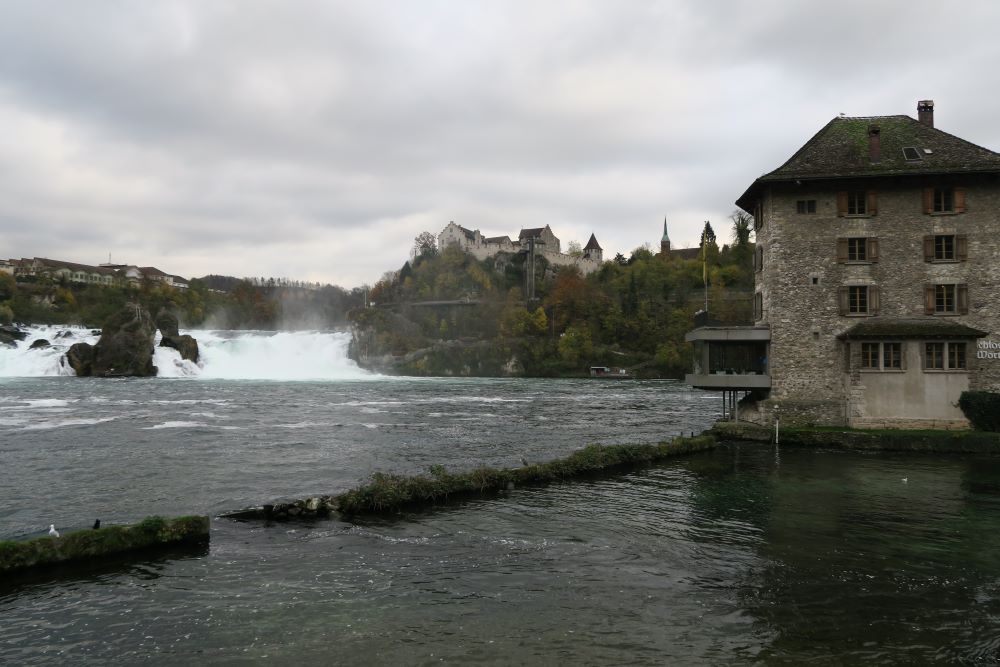
The Rhine waterfall (Rheinfall) in Neuhausen (Canton of Schaffhausen) was once called “Grosses Lauffen.” The castle (Schloss Laufen) still bears this name and was first mentioned in 858.

The castle was the ancestral seat of the Lords of Laufen, but it had many owners over the centuries, including the Bishop of Constance, the All Saints’ Convent in Schaffhausen and the Count of Kyburg.

One of the (many) famous visitors was Johann Wolfgang von Goethe (1749-1832). He visited Switzerland three times, and each time, he stopped in Neuhausen to marvel at this natural wonder.

Another owner, Hans Wilhelm von Fulach, sold the castle to the town of Zurich in 1544. The castle belongs to the canton of Zurich and is a modern tourist destination.

For centuries, the small castle ‘Schlössli Wörth’ has served as a customs building and a point of protection for the transit of merchandise.

At the same time, travellers could spend the night here. Schlössli Wörth was built on a rock in the 14th century. Its predecessor was a castle built in the 11th century. The castle was converted into a restaurant and hotel between 1836 and 1837.

(Source and further information: www.schlosslaufen.ch)

Schlössli Wörth