
Available in German, French and Dutch
Author: Maarten Koning
Canton of Zug

The German-speaking canton of Zug has been a full member of the Confederation since 1415. The counts of Nellenburg, Kyburg, and, from the thirteenth century onwards, the house of Habsburg were the most important political powers. By the end of the 14th century, the nobility had lost its significant role.
The canton signed a treaty with the Eidgenossenschaft in 1532, but still belonged to the House of Habsburg. Zug was granted Reichsunmittelbarkeit and became a free imperial town in the Holy Roman Empire in 1415.
The canton reached its current size in 1500. Zug remained Catholic during the Reformation. Zug was one of the nineteen cantons of the new Confederation in 1803 (Act of Mediation) and joined its successor in 1815.
The canton was a member of the Sarnerbund (1832) and the Sonderbund (1845) and was one of the losers of the Sonderbundskrieg of 1847. The Landsgemeinde was the political organisation of the canton until the new constitution of 1848.
Zug is one of the smallest and most prosperous cantons in the country nowadays.
Flag
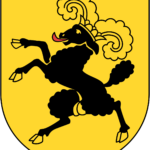
The heraldry of Zug was identical to that of Habsburg until 1352. Afterwards, the current white-blue-white was introduced.
Source: (www.schweizerkantone.ch, Kanton Zug)
General Alexander Suworow in Pigniu
After Napoleon had occupied the Confederation in 1798 and proclaimed the Helvetic Republic (1798-1803), Austrian and Russian troops (the so-called Second Coalition) invaded this area.
After these troops had been defeated near Zurich (25-26 September 1799), the Russian General Alexander Suvorov (1730-1800) led his troops over seven mountain passes back to Austria and from there to Russia (ruled by Tsar Pavel Petrovich 1754-1801).
His crossing of the high Panixer Pass (2,407 m) is legendary. This pass is the connecting route between the cantons of Glarus (and the village of Elm in the Sernftal) and Graubünden, the Surselva (Pass di Veptga is the Romansh name for the pass).
The General and his army spent the night from 6 to 7 October 1799 in Pigniu, a village of seventy inhabitants in the Vorderrhein Valley. Many soldiers did not survive, but the General was not defeated. However, he died soon afterwards in his Russian homeland.
Several monuments commemorate this event. The fresco on the Panixer dam by Martin Valär. is the most impressive memorial.
(Source and further information: Suworow Museum, www.1799.ch).
(Deutsch) Der Genfersee und seine Artisten

Lake Geneva is one of the thousands of large and small lakes worldwide. In the middle, the lake also forms the border with France and is not Switzerland’s largest lake. That is Lake Neuchâtel.
However, Lake Geneva is the most famous lake in Europe. It is reflected, among other things, in the many globally renowned characters who have lived, worked and lived by the lake, for example, Charlie Chaplin, Madame de Staël, Calvin or Le Corbusier.
The Lake Geneva Museum (Musée du Léman) in Nyon has visualised this by depicting 16 other personalities on and in the building with their accessories, instruments, works or other characteristic objects.
These sixteen are Anna de Noailles (1876-1933), poet; Charles Ferdinand Ramuz (1878-1947), writer; Mary Shelley (1797-1851), writer; Jean-Jacques Rousseau (1712-1778), writer and philosopher; Rodolphe Töpffer (1799-1846), writer and creator of cartoons; Hergé́ (1907-1983), cartoonist; Gustave Courbet (1819-1877), painter; Ferdinand Hodler (1853-1918), painter; Elizabeth de Wittelsbach, or Empress Sisi, (1837-1898); Ritchie Blackmore (1945), guitarist of Deep Purple; Jean-Luc Godard (1930) filmmaker; Ella Maillart (1903-1997), writer; Auguste Piccard (1884-1962), scientist and explorer; Jacques Piccard (1922-2008), scientist and explorer; Jean-Daniel Colladon (1802-1893), scientist and François-Alphonse Forel (1841-1912), scientist.
The museum relates this to its scientific work and an extensive collection of art and objects that have as their subject the life, history and nature of and around the lake.
Exem, the artist Emmanuel Excoffier (b. 1951), created the frescoes.
(Source and further information: museeduleman.ch).
Chasté crap da sass

The neo-romantic castle in Sils Maria on Lake Silvaplana was built in 1906 by Wilhelm, Prince zu Schaumburg-Lippe (1834-1906), a German general.
It is one of the most important examples of late historical architecture in Graubünden. The castle is privately owned and is not open to the public. The name means “stone castle” (Romansh: Putèr idiom).
(Source: www.engadin.ch)
Mount Rigi Railways 150 Years

Number double 007, not just number 7, but just as legendary. To commemorate the 150th Anniversary of Mount Rigi Railways (Rigi Bahnen AG), the steam locomotive Number 7 will be restored and brought back into operation in 2021.
On May 21st, 2021, 150 years after its maiden voyage, the locomotive will journey up the Rigi, the Queen of the Mountains, from Vitznau to Rigi Kulm.
This day in May was the first step towards establishing the modern-day Mount Rigi Railways (Rigi Bahnen AG). From June to October, the company will operate exclusive departures with Steam Locomotive number 7 for the general public.
The engineer Niklaus Riggenbach (1817-1899) built Europe’s first mountain railway in 1871, connecting Vitznau with Rigi Kulm after patenting his innovative cog-railway concept in 1863 in France.
The railways celebrate this momentous occasion in Switzerland’s history and the foundation of Alpine tourism by organising various programs and events throughout the year.
(Source and further information: www.rigi.ch).
The Royal Rigi
The Royal Rigi (Canton Lucerne) is a holiday and excursion paradise nowadays. It is known, among other things, for the world’s first cogwheel railway (21 May 1871) and today’s mountain railways and aerial cable cars.
The Rigi (1,800 metres) owes its title to Albrecht von Bonstetten (1443-1504). He described the mountain in 1479 as “Regina Montium”, the Queen of the Mountains. Von Bonstetten was a geographer, humanist and dean of Einsiedeln Monastery.
The name Rigi is derived from the Latin word Riga, which means line. Riginen is the geographical name for the upper edge of the mountain. This designation already indicates that the mountain is not steep. It is easily accessible, unlike Mount Pilatus (2,137 metres) on the other side.
Since the thirteenth century and the opening of the St. Gotthard Pass (around 1230), Lucerne was an important trading centre. The mountain lies between and on the edge of the Midlands and the Alps, and the North-South trade route.
The mountain had a chapel with a hospice dating from 1689. Due to a recognised miracle, the chapel also became a pilgrimage site—thousands of travellers and pilgrims passed by every year.
The mountain offers a magnificent view of the Alps and the Swiss Plateau on Lake Lucerne. Therefore, it is unsurprising that the Rigi became one of Switzerland’s first tourist attractions in the nineteenth century.
Hotel Kulm opened in 1816, followed by the spa hotel on Rigi Scheidegg in 1840 and the Grand Hotel Schreiber in 1875. In 2021, the Queen of the Mountains lost none of its appeal.
(Source and further information: www.rigi.ch).
Schwyz, Forum Swiss History and Bundesbriefmuseum

The name “Switzerland”, in German “die Schweiz”, in French “la Suisse”, in Italian “Svizzera”, and in Romansh “Svizra”, is derived from the canton Schwyz.
This name comes from the Germanic word Sueit, sengen, or to scorch or to burn off the grass. Schwyz is not a city in the traditional medieval sense, but the canton plays a significant role in Switzerland’s history.
Schwyz, Uri, and Unterwalden were the first Eidgenossen and the adversaries of the Habsburgs, as well as the Einsiedeln monastery (1314: looting of the monastery, 1315: Battle of Sempach).

In 1513, the Swiss Confederation or Eidgenossenschaft consisted of 13 independent German-speaking cantons. Only Freiburg (Fribourg) was bilingual.
The Confederation was (de facto) recognised as a sovereign German-speaking state in 1648 (Peace of Westphalia).
The Napoleonic era (1798-1813), the Congress of Vienna (1814-1815), and the Constitution of 1848 were crucial to the birth of modern Switzerland.

The remarkable Swiss flag has its origins in the Middle Ages and the canton of Schwyz. These Eidgenossen distinguished themselves in battle by wearing a white cross on a red background.
This history is shown in two institutes in Schwyz: the Forum Schwyz History (Forum Schweizer Geschichte, www.forumschwyz.ch, one of the three national museums (the other two are in Zurich and Prangins) and the Bundesbriefmuseum.

The Sahel, Land of Light

The theme of this year’s Printemps Culturel Neuchâtel festival is The Sahel, Land of Light (Le Sahel, terre de lumière).
The festival aims to highlight the civilisations in this region. The emphasis is on the history, culture and current affairs of Senegal, Mauritania, Gambia, Guinea-Bissau, Mali, Niger, Chad, Sudan and the northern region of Cameroon.
These countries are facing ecological, demographic, security and institutional crises. These may seem far away, but they also have major consequences for and in Europe.
The festival organises debates, film screenings, performing arts and other activities.
For more information: www.printempsculturel.ch
The Via d’Acqua transalpina

Available in German and Dutch.