A small question about a small country in the Alps with no direct access to the sea, no colonies, no natural resources or raw materials (apart from water, granite, wood and stone), largely uninhabitable, inaccessible and infertile territory and, until 1848, with a medieval, chaotic state system of almost entirely sovereign cantons surrounded by powerful expansionist monarchies. How can a country become one of the most prosperous globally under such conditions?
The Report by John Bowring (1792-1872)
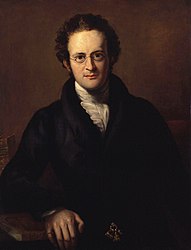
John King ( 1788-1847), Sir John Bowring, 1826. National Portrait Gallery London.
Prosperity
The tremendous increase in prosperity in the second half of the 20th century is often associated with banking secrecy and accounts of less bona fide clients, (Jewish) assets, gold reserves from plundered countries, or trade with Germany in the Second World War. The role of Swiss traders and entrepreneurs during slavery and colonialism has recently been at the centre of attention (including the danger of anachronistic points of view and ignoring the brutal rule of local tyrants and slave traders).
These factors played a role pecunia non olet. However, they only partly explain today’s prosperity, if at all. The social welfare state did not appear out of thin air, nor is it a direct result of the above factors, however morally reprehensible they may be in certain circumstances, with today’s knowledge, laws and morals.

Fleurier, canton of Neuchâtel, Watchmaker Parmigiani
The age-old economic success
The foundation of Switzerland’s economic success dates back several centuries. The decentralised state system with small political units by and for citizens and no aristocratic dynasties arose in the late thirteenth to early sixteenth centuries in the thirteen (German-speaking, only Fribourg is also Freiburg) cantons and their allied territories (Zugewandte Orte), including today’s Graubünden, Geneva, (Upper) Valais, St. Gallen and Neuchâtel.
The unique Landsgemeinde arose in eight cantons in the thirteenth and fourteenth centuries. They are the forerunners of what today is called direct democracy. In the other cantons, the guilds and the regent-merchants were in power.

Trogen, village centre (Canton of Appenzell Ausserrhoden). Photo: TES
The Orte, also known as cantons from the sixteenth century onwards, focused on trade and industry, and after 1515 (Marignano), Swiss neutrality prevented costly foreign conflicts and expeditions.
The Swiss soldier, however, was not absent from the European battlefields. He was a sought-after export product from which the local canton elites made a good living. Moreover, it was a means to rid oneself of poor men and potential troublemakers.
These decentralised structures encouraged entrepreneurship, trade, innovation, legal security, conflict management, and dispute resolution. The cantons were, in fact, sovereign republics after 1499 (Treaty of Basel) and, under international public law, after 1648 (Peace of Westphalia), with no foreign, imperial, royal, or judicial authority above them.
These (relatively) democratic structures without foreign interference were an advantage during the religious wars in the 16th and 17th centuries. Apart from some relatively minor wars (the Kappelerkriege of 1529 and 1531 and the Villmergerkriege of 1656 and 1712), there were no significant (religious) conflicts, apart from the peasant revolt of 1653.
The cantons voted on the choice of religion. The Appenzeller split peacefully in 1597, and Glarus recognised the two faiths, as well as the sharing of churches (Simultaneum). Some cantons were reformed, and others remained loyal to the old faith. Freiburg (Catholic) and Bern (Protestant) were allies in their foreign policy and shared in the booty from the Duke of Savoy in 1536 (conquest of Waadt).
The religious question provoked conflicts in the private sphere and alliances with countries of the right faith. However, Switzerland’s human and material damage was limited, and this stability was good for trade, business, and industry.

Glarus, textile industry
Specialisation, trade and niches
Furthermore, the towns and cantons specialised at an early stage. Cattle and dairy products are in one canton, while watchmaking and textiles are in another. Global and European trade in silk, cotton, wool, linen, coffee, tea, and spices is concentrated in large urban centres.
Trade, industry, and export centres flourished from the sixteenth to the eighteenth centuries, two centuries before the Industrial Revolution. For example, St. Gallen, Glarus, Zurich, the Appenzeller, Basel, and other areas dominated the textile industry.
The basis was the Verlagsystem. The entrepreneur provided the raw materials and simple production facilities for home labour. Wages and investments were low; production was mainly manual labour by (house) women and children.

Suchard, Neuchâtel, the first chocolate multinational
The Protestant contribution
Like other Protestant regions, Switzerland benefited greatly from the arrival of tens of thousands of Huguenots and other Protestant refugees in the 16th and 17th centuries. They took their knowledge, experience and commercial mentality with them. The textile, financial, and watch industries benefited from it in particular.
1800-1900
The pioneers of the watchmaking industry quickly established a foothold in Europe through their global networks. The banking industry has increased. England and Switzerland were the leading textile producers in the eighteenth century.
This situation changed from 1780 onwards due to (English) inventions during the Industrial Revolution and the Napoleonic Wars. Afterwards, the cantons in the new Confederation of 1815 were too divided to build cross-canton railways. The new Constitution and Confederation of 1848 altered this division and granted new powers to the central government (der Bund, la Fédération).

Solothurn, Attisholz complex, paper industry
In 1875, the country had a well-developed railway network and numerous stations, and tourism was thriving. Engineers produced masterpieces in tunnelling, viaducts, bridges, railways, waterways, the first hydroelectric power stations, water management (the “Delta Works” of the Juragewässerkorrektion, 1868-1891, for example), mountain passes, and later motorways, as well as mechanical engineering, electronics, and even shipbuilding.

For a long time, the shipbuilder Escher Wyss from Zurich was the most significant European producer of steamships. The ships were assembled elsewhere, or the shipbuilder established shipyards abroad.
Around 1900, Switzerland was a leading nation in tourism, finance, industry, and trade. Multinationals such as Hoffmann-La Roche, Nestlé, ABB, as well as giants in the chemical, insurance, and banking sectors, were established. Universities and centres of research were already worldwide renowned. The beau monde of Europe and the world met in the Swiss Grand Hotels and Spas.

Basel, Roche Towers. Photo: TES
The disadvantage became an advantage.
The Alps, once a disadvantage, were now an advantage. Good infrastructure, confirmed once again in 2016 by the new Gotthard tunnel, abundant building materials (granite and many types of stone), creative and innovative use of water (and wood), and tourism characterise the (transit) country. The farms are kept relatively small (by subsidies), guaranteeing high-quality meat and milk products and exemplary nature conservation.
The lack of raw materials inspires innovations. Raw materials such as wool, cotton, linen, or ores were imported and re-exported to high-quality products (machines, watches, stationery, and electronics, for example). The lack of raw materials became an advantage. Entrepreneurs and traders had to rely mainly on their creativity, innovation, and high-quality ‘niche’ products to become market leaders.
Switzerland experienced no wars, revolutions, or costly colonial or foreign expeditions in the 19th and 20th centuries. The political system was stable, economically liberal, and socially inclusive.
The last armed conflicts were the Basler Wirren (1831-1833) and the Sonderundskrieg of 1847, a brief civil war. Religious and economic motives, particularly the state’s constitution (a decentralised confederation or increased power for the federation), were at the root of this conflict, which lasted 26 days, primarily through marches, and resulted in a few casualties.
Between 1880 and 1890, water became an essential natural resource for generating electricity and supporting the chemical and pharmaceutical industries.

Powerplant (Kraftwerk), Whylen-Augst

For example, Primeo Energie has created the Primeo Energie Kosmos, an experience and science centre for climate and energy.
Conclusion
Stable social and economic development, a robust political system, excellent education, high labour morale, and innovation are the foundations of financial success.
This situation is particularly evident in the vital small and medium-sized enterprises, as well as in the excellent education for trades and crafts, and the world’s best engineering schools and research institutes. The strength of small and medium-sized enterprises is, in turn, linked to legal structures, legal certainty, a mercantile spirit, and the involvement and respect of citizens for one another, their environment, the municipality, the canton, and the federal system.
Decentralisation is the magic word for a bottom-up society, economy and politics. The so-called Militia system (Milizsystem, système de milice) in the army, politics and civil society also reflects this principle. In which country do ‘captains of industry have a seat in the parliament? It is only possible if there is trust in the system and in each other.
Switzerland has no better or worse people, traders, entrepreneurs, and industrialists. It combines several factors that underpin its success and its centuries-old continuity. Banking secrecy, black or dirty money and bad trade in times of war are certainly not the basis of the success of the age-old Swiss model.
The Swiss system seems incompatible with the top-down, centralistic, ‘one size fits all’, not-so-democratic and bureaucratic European Union of 27 (totally) different economic, fiscal, legal, political, monetary and cultural histories, mentalities and systems.
(Source: Markus Somm, Warum die Schweiz reich geworden ist, Bern, 2022; Joseph Jung, Das Laboratorium des Fortschritts. Die Schweiz im 19. Jahrhundert, Zürich, 2019).