
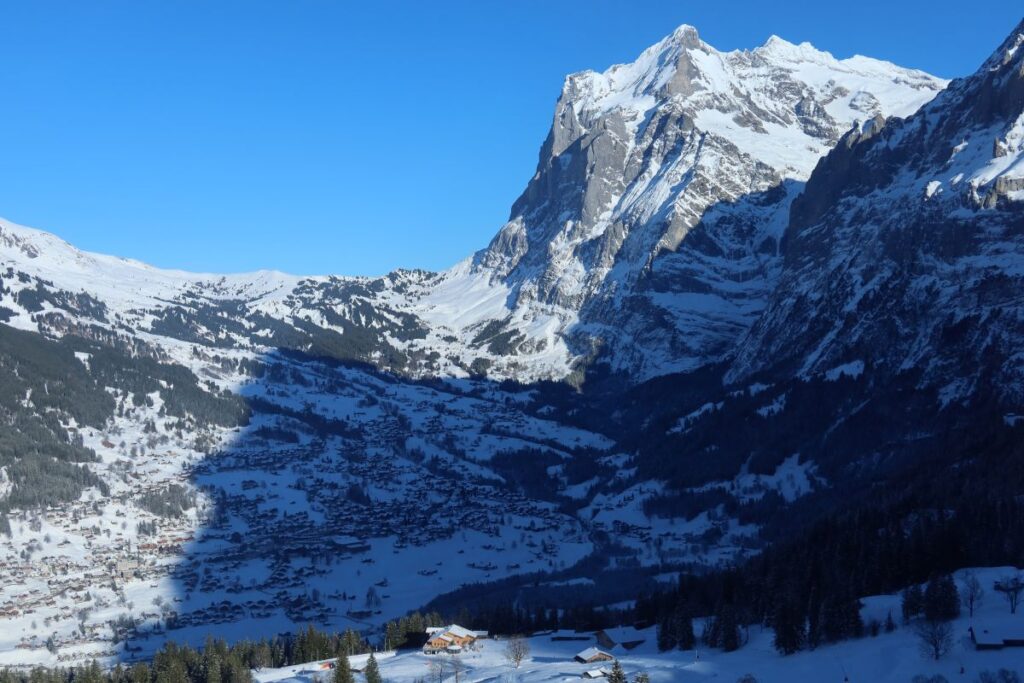
Grindelwald, its Bergschaften, Jungfraujoch and Eigergletscher
18 January 2025
Grindelwald (canton of Bern) is well known for its location at the foot of the Jungfrau and the Jungfraujoch. Today, the municipality of Grindelwald is divided into seven Bergschaften (Bussalp, Holzmatten, Bach, Grindel, Scheidegg, Wärgistal, and Itramen).
This situation was different in the 12th century. Barons (Freiherren) ruled the area in the 12th century. However, Duke Berthold V of Zähringen (1160-12180), founder of Neuenburg am Rhein (G), Rheinfelden (G and CH), Freiburg im Breisgau (G), Freiburg/Fribourg (CH), and Bern (CH), defeated them in 1191 in the Baronenkrieg (Barons’ War). This war ended the power of local rulers in the valley.

Grindelwald today
Moreover, the namesake of the Jungfrau, the monastery Inter lacus, present-day Interlaken, owned a significant amount of land in the valley. The Roman-German King Konrad III (1093-1152) gifted the monastery many possessions in 1146. By the end of the 15th century, the monastery had expanded its possessions and owned most of the Grindelwald Valley.

Bern acquired the valley in 1528, introduced the protestant faith, dissolved the monastery, and created a new political division of the valley. The Bergschaften with their municipal councils date from this period.
These Bergschaften are independent public law bodies (best compared to Consortages and Bourgeoisies in the canton of Valais) for managing the public and private alpine meadows and other administrative matters.
The valley is surrounded by famous mountains (including the Lauberhorn, Kleine Scheidegg, Finsteraarhorn, Wetterhorn, the Grosse Fiescherhorn, Mönch, Eiger, Jungfrau, Lauteraarhorn, and Schreckhorn), their glaciers, and beautiful panoramas.
Not surprisingly, English tourists and alpinists also discovered Grindelwald in the nineteenth century. The first Zahnradbahn (Wengeralpbahn) was operated in 1893 and extended to the Jungfraujoch in 1912. Additionally, the Schweizer Alpen Club (SAC) opened several SAC Cabanes.

World Snow Festival (13-18 January), work in process.

Swiss art in process (15 January)
But that’s not all. This year, the 40th World Snow Festival took place from 13 to 18 January, on the same days as the Lauberhornrennen in Wengen!

The Eiger Express


Grindelwald in Summer
Jungfraujoch
Whoever says Grindelwald also immediately thinks of the Jungfraujoch. The cabin and train to the Jungfraujoch at an altitude of 3,454 m. leave from the terminal in this village, first with the cabin of the Eiger Express to the Eiger glacier, and then with the Jungfraubahn to Europe’s highest train station on the ‘Top of Europe’.


The founder A. Guyer-Zeller (1839-1899)

Image of a poster

The Jungfraujoch and the Mönch

The Jungfrau
The Jungfrauloch is not only an experience with views of the highest Alpine peaks, including the Eiger, Mönch and Jungfrau, the Konkordiaplatz, the Lake of Ice (Eismeer, 3,160 m) and the Palace of Ice (Eispalast). Still, it is also a documentation and information centre about the Alpine world and the construction of this unique site.

The Eismeer


The Konkordiaplatz

The Aletsch Glacier (Aletschgletscher) 1850 and today (on the right)

Science on the ´Top of Europe´
Impressions of the Jungfraujoch


Switzerland’s tunnel builders and engineers

Remembrance of workers killed during the construction of the railway tunnel
(Source and further information: Gemeinde Grindelwald)