The Monuments of Serrières

The name Serrières (today a district of the city of Neuchâtel) derives from the Latin word serra, saw, which in ancient times denoted a place with many sawmills. The town lies on the shores of Lake Neuchâtel. This region was already inhabited in prehistoric times and the centuries before the Roman occupation (15-13 BC). The … Read more » “The Monuments of Serrières”

Roman Mosaics in Vallon and Orbe-Boscéaz

Available in French, German and Dutch. (Source and further information: Musée romain de Vallon (museevallon.ch); Mosaïques | pro-urba).

San Gian (St. John) in Celerina

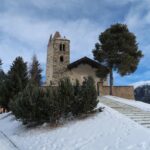
The first mention of the church of San Gian (St. John) in Celerina (Schlarigna in Romansh, Canton Graubünden) dates back to 1320. In 1478, the extension of the nave to the west and the vaulting of the choir took place. Although these churches are small, their location on a hill gives them a monumental appearance. … Read more » “San Gian (St. John) in Celerina”

The Werthenstein Monastery

In the village of Werthenstein (canton of Lucerne) near the river Emme, the bishop of Constance consecrated the first pilgrimage chapel in 1520. The church building was marked by the transition from late Gothic to Renaissance. Niklaus Ratzenhofer (1600-1649) described the origins of the pilgrimage site in his book “Kurtze Erzehlung dess Ursprungs und Wunderzeichen … Read more » “The Werthenstein Monastery”

Allerheiligen Monastery Schaffhausen

The Romanesque church of the Benedictine monastery of All Saints (Allerheiligen) in Schaffhausen was consecrated in 1103/1104, replacing the church consecrated in 1064 of the first complex of the monastery founded by Count Eberhard III of Nellenburg (1015-1078). The church is a three-nave basilica with a transept in the style of the Hirsau building school. … Read more » “Allerheiligen Monastery Schaffhausen”

The Mélisande-Fresco at the Grimsel Pass

Available in Dutch and German

Open Air Museum Ballenberg

The open-air museum (Freilichtmuseum Ballenberg) features a collection of over 110 rural houses and farm buildings relocated from all over Switzerland. To furnish the buildings, the museum collects objects from rural life and farming before the advent of agriculture. These items and related secondary information relate to earlier ways of living, social structures, and economic … Read more » “Open Air Museum Ballenberg”

Burgdorf Castle and City

The Counts of Rheinfelden owned a castle in Burgdorf, which passed into the possession of the Dukes of Zähringen in 1090. The castle was renovated and given its present form with a residential tower (palace), a defence tower (donjon) and a hall. The castle is reminiscent of royal residences. The large town church also suggests … Read more » “Burgdorf Castle and City”

Bursins and the network of Cluny

The history of the village of Bursins (canton of Vaud) is closely linked to the Kingdom of Burgundy (888-1032) and the Abbey of Cluny. The well-preserved church and village centre have their origins in this period. The church bears a strong resemblance to the church of Saint-Sulpice, a village near Lausanne. Lausanne was the diocese … Read more » “Bursins and the network of Cluny”

The Sta. Maria Church

As the name of the village already suggests, the church was dedicated to Mary, the Mother of God. The church first appears in a document in 1167, Sta. Maria in Silvaplana. Sta. Maria became the name of the village. According to legend, Charlemagne founded the church after his campaign in 774/775 against the Lombards and … Read more » “The Sta. Maria Church”