The Amphitheatre of Kaiseraugst

Augusta Raurica, Stadtrekonstruktion um 200 n. Chr. Museum Augusta Raurica. Foto/Photo: TES.

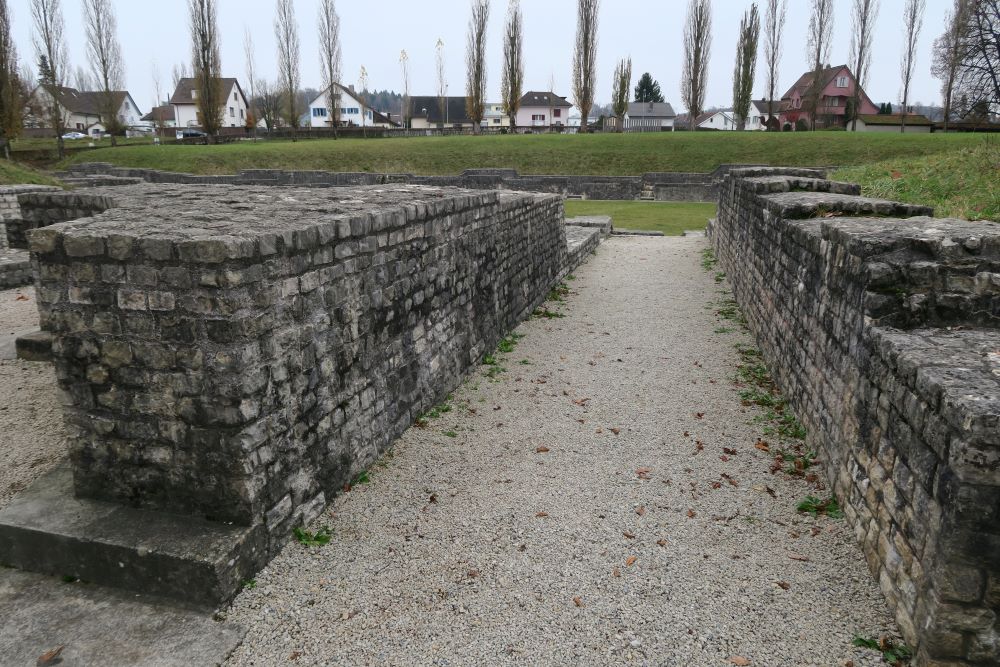
In December 2021, an amphitheatre was discovered during a building survey in Kaiseraugst (canton Aargau), near the museum Augusta Raurica (Augst, Canton of Basel-Landschaft). The amphitheatre is the second amphitheatre in the canton of Aargau, after the one in Vindonissa (Windisch). In Augusta Raurica, it is already the third monument of its kind, although its … Read more » “The Amphitheatre of Kaiseraugst”

Roman Theaters and amphitheatres in Switzerland

Das römische Theater in Augst. Foto: TES

Ancient theatres A theatre tradition was absent in the western provinces of the Roman Empire until August (emperor from 27 BC—14 AD). Stone theatres existed only in Greek settlements in Spain (Hispania) and southern France (Gallia Narbonensis). Stone theatres were not built in Rome and the conquered western territories until the last phase of the … Read more » “Roman Theaters and amphitheatres in Switzerland”

Basilia, the Roman vicus without a name

Bâle-Münsterhügel, c. 374 apr. J.C. Photo: www.archaeologie.bs.ch

After Julius Caesar’s (100-44 BC) victory over the Celtic leader Vercingetorix at Alesia in 52 BC, Rome ruled Gaul, which is roughly equivalent to present-day France. The Roman Republic also had a direct influence on the western and northwestern parts of Switzerland. The Celtic tribes in this region were allies (foederati) after the battle of … Read more » “Basilia, the Roman vicus without a name”

The amphitheatre of Vindonissa

Windisch/Vindonissa, Amphitheater, aditus. Foto/Photo: TES.

The XIII Legion built the wooden amphitheatre of Vindonissa (Windisch, Canton Aargau) during the reign of Emperor Tiberius (14-37 AD). After a fire, the XXI legion replaced it with stone construction. The ranks (cavea) are divided into three horizontal sections and can accommodate about 11,000 spectators. The spectators were strictly separated according to the hierarchical … Read more » “The amphitheatre of Vindonissa”

The Celts and Romans in Bern

Das römische Badegebäude, 1. Jh. N. Chr.Foto: www.be.ch/archaeologie

The area of the city of Bern was already inhabited in the Iron Age (after 800 BC) and during the Roman occupation (15 BC – 400 AD).  The small informative exhibition shows the remains of this history on the Enge peninsula (Engehalbinel). Since the Iron Age, several Celtic tribes have lived in the Swiss Mittelland. … Read more » “The Celts and Romans in Bern”

Romanization in Italian-speaking Switzerland

Poster of the Exhibition. Photo: Santa Giulia Museum Brexia

The tribes of the Po Valley in northern Italy had different attitudes towards Rome’s military and political ambitions in the century preceding Christ. Some were hostile to Rome (the Insubrians), while others concluded an alliance (the Venetians and Cenomanes), and still others remained hesitant (the Ligurians). After their conquests in the last decades before Christ, … Read more » “Romanization in Italian-speaking Switzerland”

From Capital Aventicum to the Provincial Town Avenches

Avenches. Foto/Photo:TES

The Helvetians The story of the migration of some Celtic tribes (Helvetii, Rauraci) from 58 BC to eastern France is known from Julius Caesar’s Book de Bello Gallico (100-44 BC). Far less well-known outside present-day Switzerland is the history of their defeat in that year near Bibracte and their return to their homelands in Switzerland. … Read more » “From Capital Aventicum to the Provincial Town Avenches”

New Centre of the Augusta Raurica museum

Sammlungszentrum Augusta Raurica. Foto/Photo: TES.

The new scientific and administrative centre of the Augusta Raurica open-air museum (Sammlungszentrum) in the canton of Basel-Landschaft was recently inaugurated. The centre is near the Ostport, the Roman viaduct on the east side of this Roman city, and the archaeological zoo. The centre concentrates all the museum’s activities in one building. Previously, the departments … Read more » “New Centre of the Augusta Raurica museum”

The Roman Road Neckar-Alb-Aare

Die Römerstrasse Neckar-Alb-Aare. Foto: www.roemerstrasse.net

Available in German (Die Römerstrasse Neckar-Alb-Aare) and Dutch.

Swiss Amber

The Greeks, Romans, Celtic and other European peoples highly valued amber, a precious stone. Archaeological amber finds are made throughout Europe. The finds date from the older Stone Age ( c .10000-4000 BC), the later Stone Age (c. 4000-1800 BC), the Bronze Age (c. 1800-500 BC) and Greek and Roman times. The Roman (provincial) elite … Read more » “Swiss Amber”